🧬 Not every mutation in plasma comes from the tumor.
CHIP can shed mutated DNA from hematopoietic clones into plasma — potentially mimicking a positive ctDNA/MRD signal.
Tumor → ctDNA = SIGNAL
CHIP → cfDNA = NOISE
A detected plasma mutation needs context, not reflex interpretation.
#MVOnco #ctDNA #MRD #CHIP #LiquidBiopsy #Oncology #Hematology
🚨 TALENTOP: Surgery after immunotherapy may reshape locally advanced HCC
In patients with HCC + macrovascular invasion, no extrahepatic metastasis, who achieved PR/SD after atezolizumab + bevacizumab and became resectable:
📌 Phase III TALENTOP
201 patients randomized:
• Liver resection → atezo/bev × 12 months
vs
• Continue atezo/bev maintenance
📊 Primary endpoint: Time to treatment failure
20.4 vs 11.8 months
HR 0.60 (95% CI 0.39–0.91)
p=0.015
Nearly 40% reduction in treatment failure with the surgery strategy.
Among those actually resected:
🔹 R0 resection: 93%
🔹 Pathological CR: 28%
⚠️ The price:
Grade 3–4 TRAEs 39% vs 21%
Serious TRAEs 23% vs 7%
Two treatment-related deaths occurred in the surgery arm.
💡 Why it matters
This is the first randomized phase III evidence supporting conversion resection after systemic therapy in carefully selected advanced HCC responders.
⚠️ Limitations
China-only population, predominantly HBV-related disease, highly selected resectable patients, and OS remains immature.
🩺 Clinical verdict: IMPORTANT / POTENTIALLY PRACTICE CHANGING
Don’t operate on every responding advanced HCC. But after atezo/bev, resectability should now become an MDT question, not an afterthought.
#HCC #LiverCancer #Oncology @ASCO@oncoalert
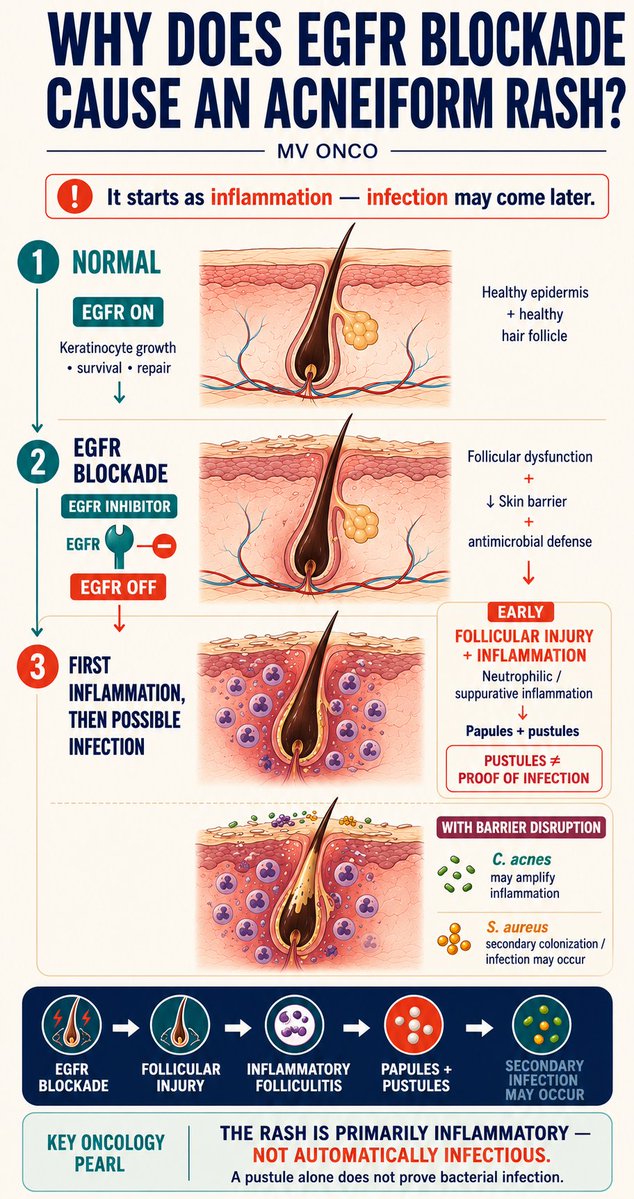
Why does EGFR blockade cause an acneiform rash?
EGFR is not just a tumor target—it is important for normal epidermal and follicular homeostasis.
EGFR blockade → follicular injury + barrier impairment → inflammatory folliculitis → papules & pustules.
💡 Key pearl: A pustule ≠ proof of infection.
The rash is primarily inflammatory. With barrier disruption, microbial contribution may increase, and secondary colonization/infection can occur later.
Inflammation first. Infection is not automatic.
📚 Refs: Lacouture ME. Nat Rev Cancer. 2006;6:803–812.
Eilers RE Jr, et al. JNCI. 2010;102:47–53.
#MVOnco #Oncology #MedicalOncology #EGFR #NSCLC #LungCancer
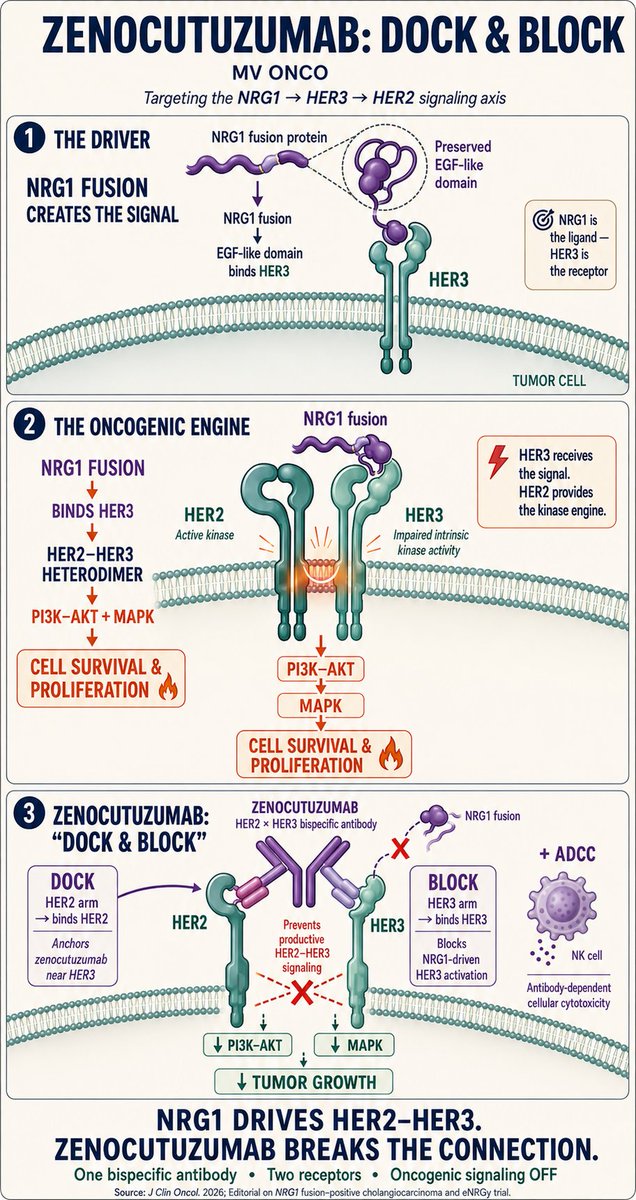
NRG1 fusion creates the signal. HER3 receives it. HER2 powers it. 🔥
Zenocutuzumab uses a clever “Dock & Block” strategy:
DOCK on HER2 → BLOCK NRG1–HER3 → switch OFF PI3K–AKT/MAPK signaling.
One bispecific antibody. Two receptors. One oncogenic connection broken.
#Zenocutuzumab #NRG1 #PrecisionOncology #BispecificAntibody #MVONCO
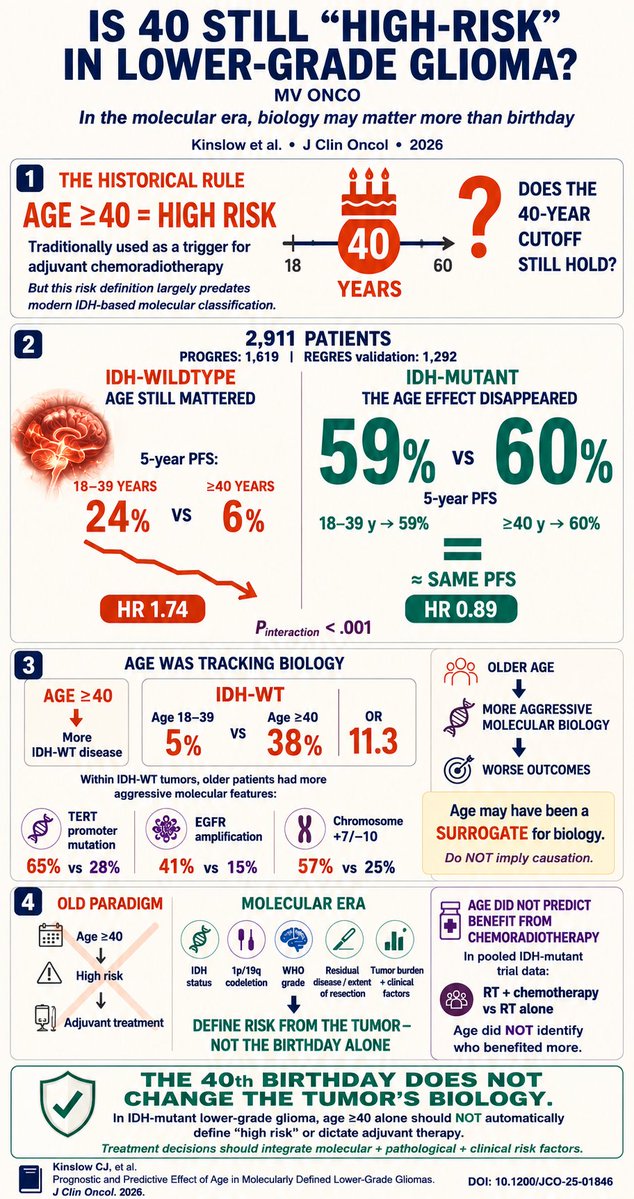
Is 40 still “high-risk” in lower-grade glioma?
Kinslow et al. challenge a decades-old rule:
🧬 IDH-mutant glioma: 5-year PFS 59% vs 60% for age <40 vs ≥40.
Age ≥40 may have been tracking adverse biology, rather than independently defining risk.
Biology > birthday.
Age alone should not dictate “high-risk” classification or adjuvant therapy.
#Glioma #NeuroOncology #BrainTumor #Oncology #MVOnco
🚨 Oral paclitaxel beats IV paclitaxel for OS in 2L advanced gastric cancer.
In a phase III trial of 536 patients with unresectable/recurrent/metastatic gastric cancer progressing after fluoropyrimidine-based therapy:
💊 Oral paclitaxel 200 mg/m² BID D1,8,15 q28d
vs
💉 IV paclitaxel 175 mg/m² q3w
📊 Key results
• OS: 9.13 vs 6.54 mo
• HR 0.77, P=0.006
• PFS: 3.02 vs 2.89 mo, HR 0.89, meeting noninferiority
• ORR: 13.6% vs 9.8%
✅ Less neuropathy, alopecia & hypersensitivity with oral therapy
⚠️ More diarrhea and treatment interruptions.
💡 Why it matters: an oral taxane delivering an OS advantage while avoiding IV administration and routine hypersensitivity premedication is intriguing.
⚠️ Caveat: the comparator was q3-weekly paclitaxel, not the contemporary ramucirumab + weekly paclitaxel standard in many regions. The study was also conducted entirely in Chinese patients.
🩺 Verdict: Promising, but not practice-changing globally yet.
@ASCO@oncoalert
#GastricCancer #GIOncology #Paclitaxel
🚨 Iza-bren delivers another Phase III win in EGFR-mutant NSCLC.
Panku-Lung01: EGFRxHER3 bispecific ADC iza-bren vs platinum chemotherapy in advanced nonsquamous EGFR-mutant NSCLC after progression on an EGFR TKI.
📊 Primary endpoint met: significant PFS improvement at interim analysis
📈 OS: positive trend reported, but mature data are awaited.
Earlier phase II data in chemo-naïve patients after 3rd-gen EGFR TKI showed median PFS 12.5 months.
💡 Why it matters:
Another strong signal for dual EGFR/HER3 targeting and an encouraging read-through for the global Izabright-Lung01 program.
⚠️ Full efficacy, OS and safety data are still needed before judging the magnitude of benefit.
🩺 Verdict: Promising. Watch this ADC closely.
@ASCO@oncoalert
#LungCancer #NSCLC #ADC #EGFR
EGFR-mutant NSCLC → SCLC transformation: when the biology changes.
The Marcoux cohort gives us a few memorable lessons:
• Median time to transformation: 17.8 months
• Founder EGFR mutation was retained in 59/59 genotyped tumors
• T790M disappeared in 15/19 previously T790M-positive cases
• Platinum–etoposide and taxanes showed activity
• 0/17 patients treated with checkpoint inhibitors responded
• CNS metastases were frequent
• Median survival after transformation: 10.9 months
Perhaps the most important clinical message:
Rapid progression on an EGFR-TKI? Rebiopsy.
Don’t just ask, “What new mutation?”
Ask, “Has the histology changed?”
Whether osimertinib should be continued after SCLC transformation remains an important clinical question—and this retrospective study does not answer it.
📖 Marcoux N, et al. J Clin Oncol. 2019;37:278–285.
doi:10.1200/JCO.18.01585
#LungCancer #NSCLC #EGFR #SCLC #PrecisionOncology #ThoracicOncology #MVOnco
MET amplification after osimertinib: first understand the numbers—then the cutoff.
Part 1 | GCN vs MET/CEP7
🔴 MET GCN = How many MET copies/signals are present per tumor cell?
🔵 MET/CEP7 ratio = Has MET increased disproportionately relative to chromosome 7?
Same GCN can mean different biology:
MET 8 + CEP7 2 → GCN 8 | ratio 4
→ disproportionate MET gain → MET amplification
MET 8 + CEP7 6 → GCN 8 | ratio ~1.3
→ MET and chromosome 7 rise together → chromosome 7 gain/polysomy
Same GCN ≠ same biology.
Part 2 | Which cutoff matters after osimertinib?
There is no single universal cutoff.
• TATTON: FISH GCN ≥5 OR MET/CEP7 ≥2
• INSIGHT-2: tissue FISH GCN ≥5 OR MET/CEP7 ≥2
• SAVANNAH: initially FISH5+; subsequently enriched for high MET using FISH10+ and/or IHC90+
The key distinction:
Eligibility cutoff ≠ universal biological cutoff.
Higher MET levels enrich for more strongly MET-driven disease and greater response to combined EGFR + MET inhibition.
Take-home:
GCN tells you HOW MANY.
MET/CEP7 tells you THE CONTEXT.
The degree of MET amplification matters.
Refs:
Oxnard GR, et al. Ann Oncol. 2020;31:507–516.
Wu Y-L, et al. Lancet Oncol. 2024;25:989–1002.
de Marinis F, et al. Ann Oncol. 2025;36:920–933.
#LungCancer #NSCLC #EGFR #Osimertinib #MET #METAmplification #PrecisionOncology #ThoracicOncology
🔥 Could tsMHC-II identify who actually benefits from perioperative immunotherapy in gastric cancer?
MOUNTAIN-02 suggests it might.
📌 Study
Randomized phase II, N=136
Operable cT3–4aN+M0 gastric/GEJ cancer
Patients stratified by tumor-specific MHC-II (tsMHC-II), then randomized:
💉 Tislelizumab + SOX/XELOX
vs
💊 SOX/XELOX alone
📊 Key result
In tsMHC-II+ tumors:
• mPR: 61.8% vs 26.5%, p=0.003
• pCR: 32.4% vs 8.8%, p=0.016
But in tsMHC-II− tumors:
• mPR: 23.5% vs 26.5%
• pCR: 5.9% vs 8.8%
🎯 Treatment × tsMHC-II interaction for mPR: p=0.031
💡 Why it matters
tsMHC-II may be a PD-L1-independent predictive biomarker that identifies patients most likely to benefit from perioperative PD-1 therapy.
⚠️ Limitations
Phase II, modest sample size
OS/EFS still immature
SOX/XELOX-based, so applicability to FLOT-based therapy remains unknown
🟡 Clinical verdict: PROMISING BIOMARKER, NOT READY FOR ROUTINE SELECTION
Needs prospective phase III validation before tsMHC-II guides perioperative immunotherapy decisions.
@ASCO@oncoalert
#GastricCancer #GIOncology #Immunotherapy
Could PTEN IHC identify patients missed by NGS who may benefit from capivasertib? 👀
Exploratory CAPItello-291 analysis suggests it might.
📌 Study
HR+/HER2− advanced breast cancer after AI therapy.
Capivasertib + fulvestrant vs placebo + fulvestrant
PTEN deficiency assessed by IHC.
📊 Key results
• PTEN deficient by IHC: 19.1%
• Overall IHC vs NGS agreement: 87%
• Among PTEN-deficient tumors:
mPFS 9.3 vs 3.7 mo
HR 0.52
Most interestingly, among PTEN-deficient tumors without PIK3CA/AKT1/PTEN alterations detected by NGS:
mPFS 16.2 vs 4.6 mo
HR 0.43 (95% CI 0.15–1.05)
💡 Why it matters
PTEN IHC may identify additional biologically relevant PTEN loss that genomic testing can miss.
⚠️ Limitations
Exploratory analysis, small subgroups, and 11 patients in the NGS-negative subgroup had unknown genomic results.
🩺 Clinical verdict
Promising biomarker strategy, but not practice-changing yet.
PTEN IHC could eventually complement NGS rather than replace it.
@ASCO@oncoalert@AACR
🚨 Has cabozantinib finally been beaten after immunotherapy in advanced RCC?
LITESPARK-011 suggests yes for PFS, but the OS story is not finished.
📌 Study
Phase III | N=747 | previously treated advanced clear-cell RCC progressing after anti-PD-1/PD-L1
🔹 Belzutifan 120 mg + lenvatinib 20 mg daily
vs
🔹 Cabozantinib 60 mg daily
Median follow-up: 29 months
📊 Key results
⏳ PFS: 14.8 vs 10.7 mo
HR 0.70 | p<0.0001 ✅
🎯 ORR: 53% vs 40%
🔥 Duration of response:
23.0 vs 12.3 mo
❤️ OS: 34.9 vs 27.6 mo
HR 0.85 | p=0.061 ❌
⚠️ Toxicity
Grade ≥3 AEs: 84% vs 83%
Belzutifan-lenvatinib:
• Anemia: 69% | G≥3 19%
• Hypoxia: 15% | G≥3 12%
💡 Why it matters
This is the first positive phase III trial to demonstrate superiority over a contemporary VEGFR-TKI control after prior PD-1/PD-L1 therapy in advanced RCC.
⚠️ Limitation
OS has not yet crossed statistical significance, subsequent therapies may confound OS, and the open-label design remains a limitation.
🏁 Clinical verdict: PROMISING / POTENTIAL NEW STANDARD
A compelling PFS + response win over cabozantinib, but I would wait for mature OS before calling this definitively practice-changing.
@ASCO@oncoalert
#RCC #KidneyCancer #GUOnc
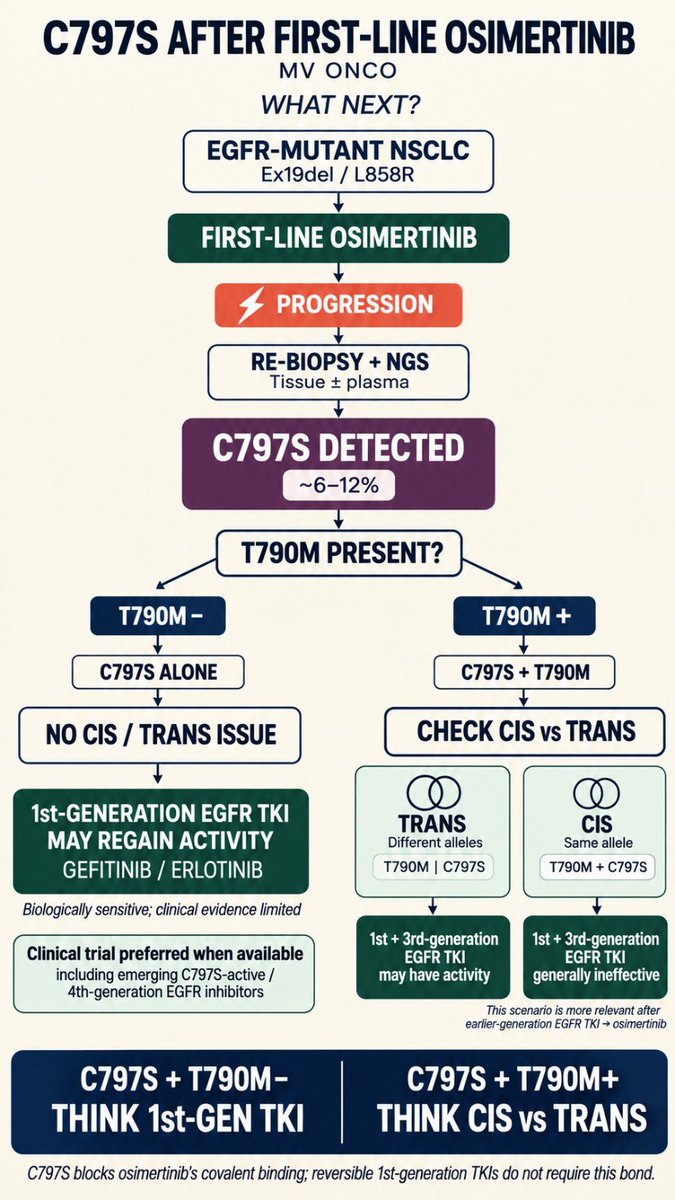
C797S after first-line osimertinib — one distinction matters.
🔹 C797S + T790M− → no cis/trans question; reversible 1st-gen EGFR TKIs may regain activity, although clinical evidence remains limited.
🔹 C797S + T790M+ → now cis vs trans matters.
A simple way to remember an increasingly complex resistance mechanism. 🧬
#LungCancer #NSCLC #EGFR #Osimertinib #Oncology
NORDIC NEC Study — The 55% Paradox
305 patients with advanced GI neuroendocrine carcinoma.
252 received chemotherapy, mainly platinum + etoposide.
Overall response: 31%; median OS: 11 months.
Ki-67 <55%: only 15% responded, but median OS was 14 months.
Ki-67 ≥55%: 42% responded, yet median OS was only 10 months.
The paradox: faster-growing tumors were more platinum-sensitive but more aggressive.
Clinical message: high-grade GI-NEC should not be viewed as one biologically uniform disease.
Remember: Higher Ki-67 → better response, worse prognosis.
Sorbye H et al. Ann Oncol. 2013;24:152–160.
NORDIC NEC Study — The 55% Paradox
305 patients with advanced GI-NEC.
Ki-67 <55%: 15% response → 14-month OS
Ki-67 ≥55%: 42% response → 10-month OS
The paradox: Higher Ki-67 → more platinum-sensitive, but more aggressive biology.
Take-home: High-grade GI-NEC does not behave as one uniform disease.
Sorbye H et al. Ann Oncol. 2013;24:152–160.
How does KRAS G12C lung cancer escape adagrasib?
A fascinating resistance mechanism:
• Adagrasib blocks KRAS G12C → initial tumor control
• Acquired EML4–ALK can bypass the blockade
• WT-RAS → MAPK/ERK signaling is restored → resistance
• With continued KRAS inhibition, the tumor can become increasingly ALK-dependent
• In experimental models, this creates a potential ALK-targetable vulnerability
💡 Clinical message: Progression on a KRAS G12C inhibitor should prompt re-biopsy + re-sequencing. Resistance may reveal a new actionable biology.
ALK-directed therapy in this setting remains a mechanistic/preclinical insight, not an established standard.
#LungCancer #KRASG12C #Adagrasib #ALK #PrecisionOncology #TargetedTherapy #DrugResistance #MVOnco
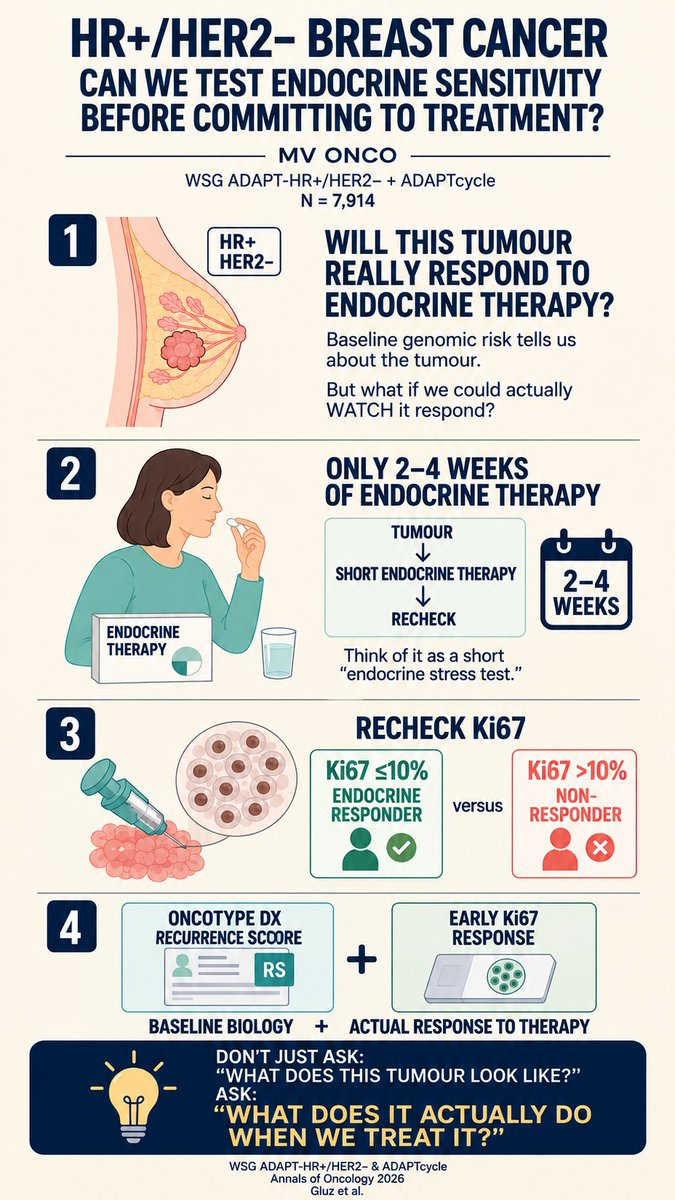
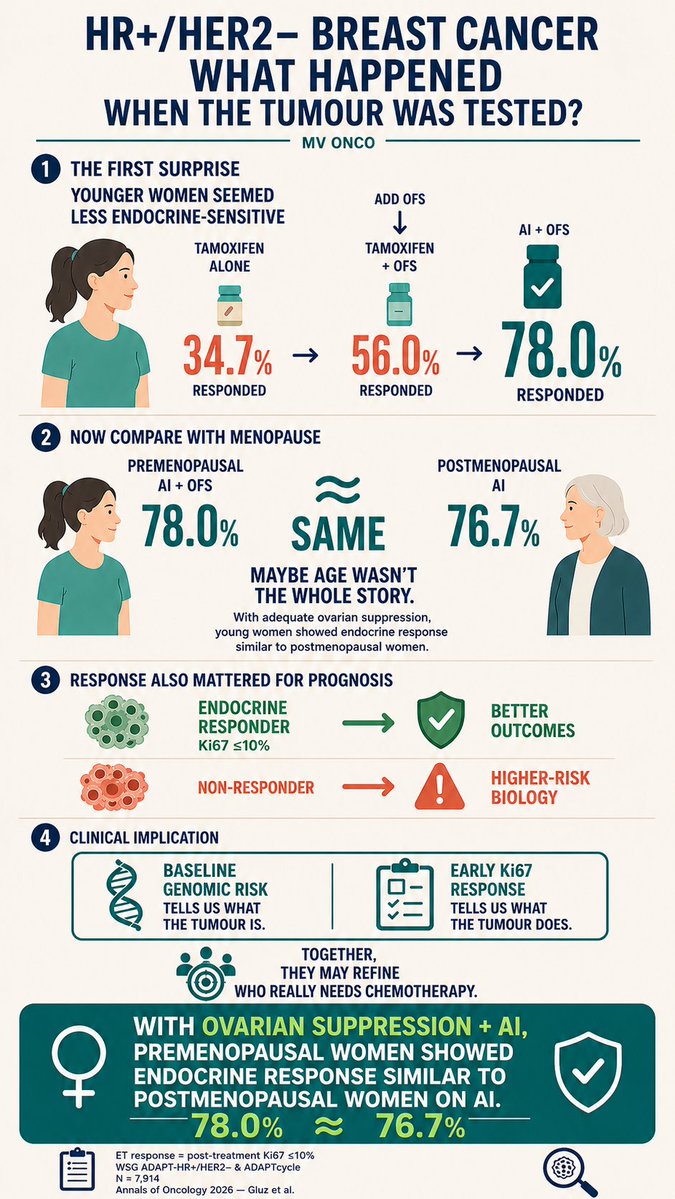
Can We “Test” Endocrine Sensitivity Before Committing to Treatment?
WSG ADAPT-HR+/HER2− & ADAPTcycle | N = 7,914
• Just 2–4 weeks of endocrine therapy, followed by Ki67 reassessment, acted as an early biological “stress test.”
• In premenopausal women, response increased: 34.7% tamoxifen → 56.0% tamoxifen + OFS → 78.0% AI + OFS.
• Remarkably, AI + OFS (78.0%) achieved a response similar to AI in postmenopausal women (76.7%).
• Clinical message: The apparent lower endocrine sensitivity in younger women may partly reflect treatment rather than age alone. Adequate ovarian suppression matters.
#MVOnco #BreastCancer #EndocrineTherapy #Ki67 #OvarianSuppression #PrecisionOncology
All TNBCs are not the same
HER2-low TNBC:
👉 Immune profile same
👉 AR expression higher
AR+ tumors behave more indolent
📌 If HER2-low looks slow… think AR
👉 Ask: Is it AR-positive?
#MVOnco#Oncology#BreastCancer