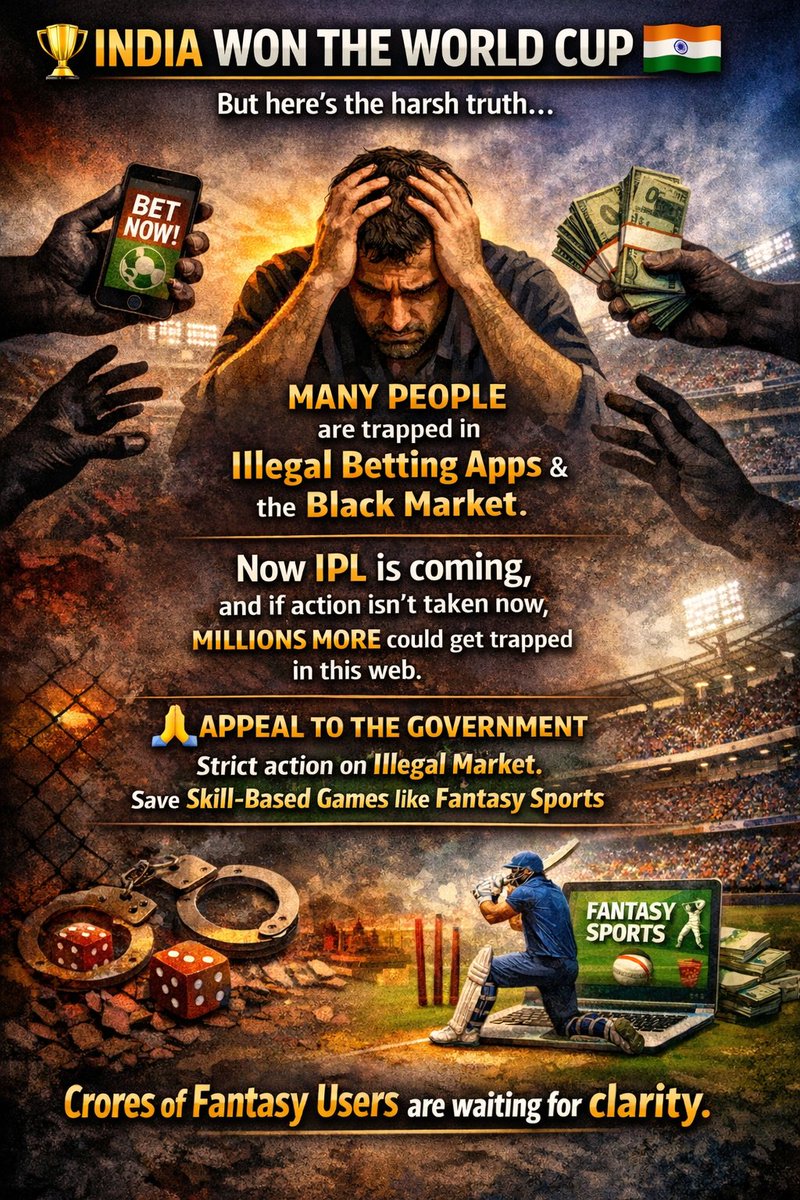
Less than 24 hours to go for #IPL to start but there is no feeling and atmosphere and hype till now like last all years. What could be the possible reason?
#dream11
ये Lays कंपनी का 10 रुपए वाला चिप्स का पैकेट है
इसकी New packaging में ऊपर लिखा है कि 50 प्रतिशत एक्स्ट्रा चिप्स
इससे पहले इसका वजन 30gm था और अब 30.5 gm
अगर 50% weight बढ़ा है तो नया weight 45 ग्राम होना चाहिये
@jagograhakjago उपभोक्ता न्यायालय इन भ्रामक विज्ञापन पर कारवाई क्यो नहीं करता है
@raghav_chadha@raghav_chadha Sir it's urgent Sir, the government implemented PROGA 2025 rules in which RMG was banned and after that they banned legal apps due to which illegal apps boomed now and it has been 8 months now and no action is being taken against illegal apps...
We expect the government to regulate skill-based games so that users can stay on safe and legal platforms, the government can receive proper tax revenue, and illegal activities can be effectively controlled.
@GoI_MeitY@AshwiniVaishnaw@narendramodi
#Onlinegamingbill2025
🚨 Big Update for Fantasy Sports Users
Supreme Court case related to the online gaming / fantasy sports ban is listed for hearing on 11 March 2026 before:
Hon’ble CJI & Justice Joymalya Bagchi and Justice Vipul M. Pancholi. ⚖️ #Dream11
#Onlinegamingbill2025 सर्वे यह संकेत देता है कि पूरी तरह बैन लगाने से समस्या खत्म नहीं होती, बल्कि लोग अनरेगुलेटेड विदेशी प्लेटफॉर्म की ओर चले जाते हैं। इसलिए कई विशेषज्ञ मानते हैं कि:
#Skillbasedgames को बैन करने की बजाय सही तरीके से regulate करना ज्यादा बेहतर हो सकता है
रियल मनी गेमिंग को नज़रअंदाज़ या बैन करने से समस्या खत्म नहीं होगी। इससे भारत में अवैध बेटिंग और ब्लैक मार्केट प्लेटफॉर्म तेजी से बढ़ रहे हैं।
समाधान साफ है — इस सेक्टर को सख्त नियमों के साथ रेगुलेट किया जाए।
@AshwiniVaishnaw@GoI_MeitY@PMOIndia#Dream11#fantasysports
Real Money Gaming पर सख्ती का नतीजा उल्टा दिख रहा है —
Illegal betting बढ़ रही है और Indian gaming industry को नुकसान।
जब लोग खेल ही रहे हैं, तो इसे रेगुलेट कर टैक्स क्यों नहीं लिया जा रहा?
सरकार इस पर कब तक चुप रहेगी? @GoI_MeitY@AshwiniVaishnaw@PMOIndia#fantasy#Dream11
🚨Six months after India halted real-money gaming and online betting, illegal offshore platforms remain easily accessible, suggesting the ban has had a limited impact on user behaviour.
For Indian users, accessing these sites is almost frictionless, industry executives said.
Skill-Based Games ≠ Gambling: Law, Policy & the PROGA Fallout
Calling skill-based games:
“gambling” is factually incorrect, legally unsustainable, and economically self-defeating.
What Skill-Based Games Actually Are(Using fantasy sports as illustration):
- Users apply skill and judgment before the event — player analysis, pitch conditions, role selection, and statistical evaluation
- Teams are selected from confirmed players only
- Once the event begins:
+ Teams are locked
+ No substitutions, stake changes, or live intervention
This is pre-event application of skill, not wagering on chance.
Platforms are also transparent and auditable:
- All teams become downloadable after contest lock
- KYC-verified users, tax-compliant transactions, audit trails
Illegal betting is the opposite — no KYC, no taxes, no safeguards.
The Law Is Settled:
Indian courts apply one consistent test:
"Where skill predominates over chance, the activity is not gambling."
For over six decades:
- Skill-based games are protected under Article 19(1)(g)
- Courts have repeatedly held rummy, poker, horse racing and fantasy sports to be games of skill
- No Supreme Court judgment has ever classified fantasy sports or legitimate skill-based games as gambling
PROGA 2025 and Constitutional Scrutiny:
PROGA 2025 is under challenge before the Supreme Court.
Serious constitutional concerns arise:
- Article 19(1)(g): Blanket bans destroy lawful trade
- Article 14: Arbitrary treatment — skill games restricted while state lotteries (pure chance) continue
- Article 21: Excessive paternalism without evidence-based harm analysis
- Federalism: Betting and gambling fall under the State List
Under settled law, regulation is preferred over prohibition.
Economic Contradiction:
The Government values India’s online gaming market at:
₹23,200 crore (2024) with
₹31,600 crore projected (2027)
Yet industry data shows:
~85% of revenue historically came from Real Money Gaming (RMG).
After choking RMG:
- Legal platforms shut down
- Payment gateways blocked
- Tax-paying, compliant operators exited
- Legitimate revenue collapsed
This raises a simple question:
- If RMG was the backbone, what exactly is being counted in future growth projections?
The Predictable Outcome
Users did not stop playing — they migrated to:
◆ Offshore platforms
◆ Illegal betting sites
◆ Unregulated operators
Consequences:
◆ No Indian taxes
◆ No consumer protection
◆ Increased fraud and financial harm
◆ Massive underground betting economy
Eliminating regulated RMG did not eliminate gambling.
It only pushed users and money into illegal markets.
Bottom Line:
✔ Skill-based games are not gambling
✔ They are pre-event, skill-driven, transparent, and auditable
✔ Courts consistently protect them
✔ Blanket bans strengthen illegal betting and weaken the State
So, Regulate skill. Punish illegality.
Do not mislabel lawful skill-based games as gambling.
@AshwiniVaishnaw@GoI_MeitY
#SkillBasedGames #RealMoneyGaming
#RMG
#PROGA
#RegulateNotBan #GamingPolicy
#DigitalEconomy #ConstitutionalLaw
#OnlineGamingAct2025 #DigitalIndia #OnlineGamingRegulation #CyberSecurity
#SafeGaming #ResponsibleGaming
भारत की ऑनलाइन गेमिंग नीति: आर्थिक स्वीकार्यता बनाम नियामक आत्म-विरोधाभास:
भारत सरकार ने पहली बार आधिकारिक रूप से ऑनलाइन गेमिंग उद्योग के आकार और महत्व को स्वीकार किया है।
सरकार के अपने मूल्यांकन के अनुसार, भारत का ऑनलाइन गेमिंग बाजार 2024 में ₹23,200 करोड़ का था, और 2027 तक इसके ₹31,600 करोड़ तक पहुँचने का अनुमान लगाया गया है।
यह एक महत्वपूर्ण स्वीकारोक्ति है।
यह ऑनलाइन गेमिंग को किसी हाशिए की गतिविधि के रूप में नहीं, बल्कि डिजिटल अर्थव्यवस्था के एक महत्वपूर्ण घटक के रूप में मान्यता देती है।
हालाँकि, यह मूल्यांकन एक मूलभूत प्रश्न खड़ा करता है।
उद्योग से जुड़े आँकड़े लगातार यह दर्शाते हैं कि भारत के ऑनलाइन गेमिंग राजस्व का लगभग 85% हिस्सा ऐतिहासिक रूप से रियल मनी गेमिंग (RMG) से आता रहा है — जिसमें फैंटेसी स्पोर्ट्स और अन्य कौशल-आधारित गेम शामिल हैं।
सरल शब्दों में कहें तो, RMG ही गेमिंग इकोसिस्टम की वित्तीय रीढ़ रहा है — जिसने राजस्व, कर संग्रह, अनुपालन लागत और रोज़गार में सबसे बड़ा योगदान दिया है।
यदि ऐसा है, तो एक गंभीर नीतिगत विरोधाभास सामने आता है:
जब RMG बाजार के कुल मूल्य का अधिकांश हिस्सा था, तब इस पूरे सेगमेंट को प्रभावी रूप से प्रतिबंधित या बाधित करके सरकार ने वास्तव में क्या हासिल किया?
नियामकीय कार्रवाइयों के बाद:
- कानूनी, भारत-आधारित प्लेटफॉर्म्स को संचालन बंद करने या फ्रीज़ करने पर मजबूर किया गया
- पेमेंट गेटवे ब्लॉक कर दिए गए
- KYC, कर और उपभोक्ता सुरक्षा का पालन करने वाले कानूनन ऑपरेटरों को बाहर कर दिया गया
- वैध उद्योग का राजस्व लगभग शून्य हो गया
यह अगला तार्किक विरोधाभास पैदा करता है:
यदि वैध RMG गतिविधि ठप हो चुकी है और राजस्व गिर चुका है, तो फिर ₹31,600 करोड़ (2027 का अनुमान) किस आर्थिक आधार पर तैयार किया गया है?
इससे भी अधिक महत्वपूर्ण बात यह है कि इस नीतिगत निर्णय के वास्तविक परिणाम अब स्पष्ट रूप से दिखाई देने लगे हैं।
नियंत्रित भारतीय प्लेटफॉर्म्स के बंद होने के बाद, लोगों ने खेलना बंद नहीं किया।
इसके बजाय, वे बड़ी संख्या में स्थानांतरित हो गए हैं:
- ऑफशोर प्लेटफॉर्म्स पर
- अवैध सट्टेबाज़ी वेबसाइट्स पर
- ऐसे पूरी तरह अनियमित ऑपरेटरों पर जो भारतीय क्षेत्राधिकार से बाहर हैं
ये प्लेटफॉर्म:
- भारत में कोई टैक्स नहीं चुकाते
- किसी भी उपभोक्ता संरक्षण मानकों का पालन नहीं करते
- कोई शिकायत निवारण व्यवस्था नहीं देते
- लगातार धोखाधड़ी, हेरफेर तथा उपभोक्ताओं के वित्तीय नुकसान से जुड़े पाए जा रहे हैं
नतीजा स्पष्ट और बेहद चिंताजनक है:
- कानूनी, टैक्स चुकाने वाले भारतीय व्यवसाय नष्ट कर दिए गए
- अवैध सट्टेबाज़ी इकोसिस्टम को मजबूती मिली
- उपभोक्ताओं को असुरक्षित और धोखाधड़ी वाले माहौल में धकेल दिया गया
- राज्य ने राजस्व, निगरानी तथा नियंत्रण — तीनों खो दिए
नियंत्रित, कौशल-आधारित RMG को समाप्त करने से जुआ समाप्त नहीं हुआ।
इससे केवल भारतीय उपयोगकर्ताओं और उनका पैसा अवैध बाज़ारों की ओर शिफ्ट हो गया।
जो नीति वैध उद्योग को कमजोर करे और अवैध ऑपरेटरों को सशक्त बनाए, उसे विनियमन नहीं कहा जा सकता।
यह, सर्वोत्तम स्थिति में, एक रणनीतिक भूल है — और सबसे खराब स्थिति में, स्वयं को नुकसान पहुँचाने वाली आर्थिक और उपभोक्ता संरक्षण की विफलता।
यदि भारत वास्तव में ऑनलाइन गेमिंग को अपनी डिजिटल अर्थव्यवस्था का विकास इंजन मानता है, तो समाधान पूर्ण प्रतिबंधों में नहीं, बल्कि कौशल-आधारित गेमिंग के लिए स्पष्ट, तर्कसंगत और लागू करने योग्य नियमन में है — भारत के भीतर, न कि उसे बाहर धकेलकर।
https://t.co/O3VvpUJ0w3
@AshwiniVaishnaw@GoI_MeitY
#OnlineGaming
#RealMoneyGaming
#SkillBasedGames
#DigitalEconomy
#PublicPolicy
#GamingPolicy
Regulations are only half the battle. The real hurdle? A 40% GST on all deposits.
From what I’m hearing, major apps aren't ready to absorb that cost. If you're waiting for a quick comeback, buckle up it’s going to be a long wait.