Founder @ Produktiv
Building the Control Plane for Enterprise AI.
Connecting data, context, policy, models, agents & audit.
Former founder at Transerve (acq.)
A useful technology integration should make the customer's existing investment more useful for their enterprise.
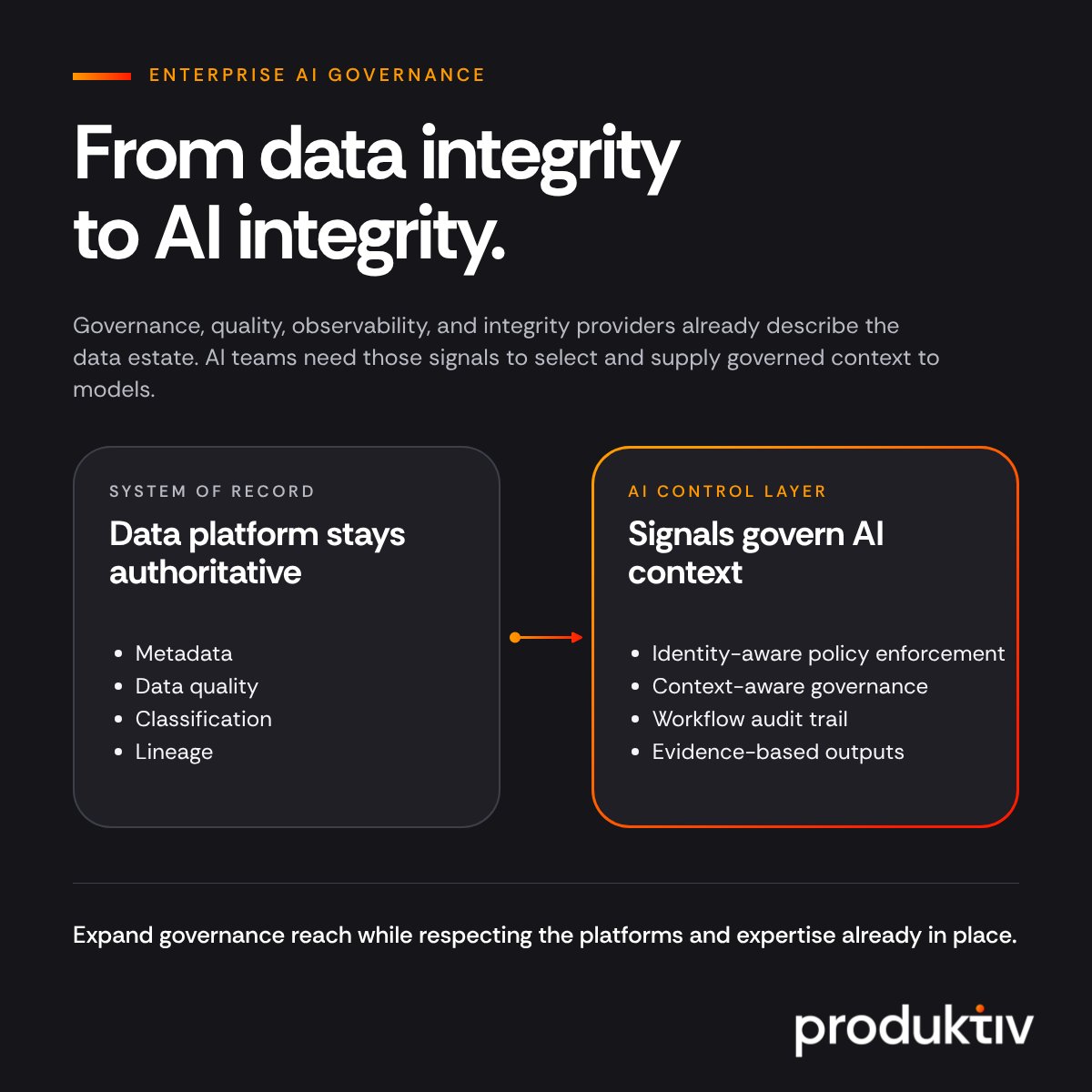
For data governance, quality, observability and integrity providers, enterprise AI creates a clear extension point. Their systems already describe the data estate and AI teams now need those descriptions to influence which context is selected and supplied to a model.
The division of responsibility can stay clear while the data platform remains the authority for metadata, quality, classification and lineage. The AI control layer uses those approved signals when governing context and records evidence from the AI workflow.
That is a credible route from data integrity to AI integrity. It expands the operational reach of governance while respecting the platform and expertise already present in the enterprise. #AIGovernance #EntepriseAI
Kynexa uses a common schema to unify metadata across SQL & unstructured data. Its current SQL capabilities include connectivity, metadata generation, semantic modelling, lineage and stewardship workflows. Governed SQL discovery & RAG retrieval come out of the box. #AIGovernance
The best AI extension preserves the value of the enterprise's data platform. Trusted metadata, quality, classification and lineage should remain authoritative as AI begins consuming that information. #AIGovernance
Governance metadata earns its place in an AI architecture when it changes a real decision: what context is selected, what a role may access or what evidence accompanies the result. #AIGovernance
Enterprise AI uses tables and documents together. A common metadata model can preserve business meaning across both while keeping SQL processing and vector-based retrieval architecturally distinct. #AIGovernance
In governed unstructured RAG, Kynexa applies runtime policy filtering so only authorised retrieved chunks are supplied to the language model. External classifications would require a defined and tested integration. #AIGovernance
How can data integrity be combined with AI integrity? Here are my 6 rules which can help in extending the integrity of data to AI execution lineage.
1. A data-platform and AI-control-plane integration needs more than two product logos. Start with the governance decision the joint architecture should support.
2. Name the authority. The existing platform may own business definitions, quality signals, classifications and lineage. Keep those responsibilities explicit.
3. Define the exchange. Specify the approved metadata fields, identifiers, update behaviour and scope. Do not assume that similar field names carry the same meaning.
4. Define runtime use. State how a field informs retrieval, role-based access, sensitivity handling or the evidence attached to a result.
4. Test the boundary. Change a source classification, process the update and verify the resulting metadata and policy behaviour before the model call.
5. Record the limits. A metadata integration does not prove answer accuracy or end-to-end action control. Clear boundaries make a joint proposition more credible.
#AIGovernance #EnterpriseAI
Clean data can still produce an AI response that should never have been generated for a particular user.
The data may be accurate but the problem can arise later, when retrieval assembles context without preserving the right access boundary or sensitivity classification.
This is why I use the phrase AI integrity carefully. It describes the integrity of the information and controls carried into an AI interaction. The model should receive context that is relevant, authorised and traceable to its source.
Data governance providers already hold much of the intelligence required to make that possible and their classifications, ownership records, lineage and quality signals should remain useful when enterprise data enters an AI workflow.
The next step is to make those governance assets operational at retrieval and reasoning time. #AIGovernance #DataGovernance
Data observability covers the health and movement of data. AI integrity adds visibility into selected context and policy outcomes. Connecting those records can give operators a more useful investigation path. #AIGovernance
A credible data-to-AI partnership names the authority boundary: who owns metadata, which signals are exchanged, which runtime decision uses them and what evidence returns to the data platform. #AIGovernance
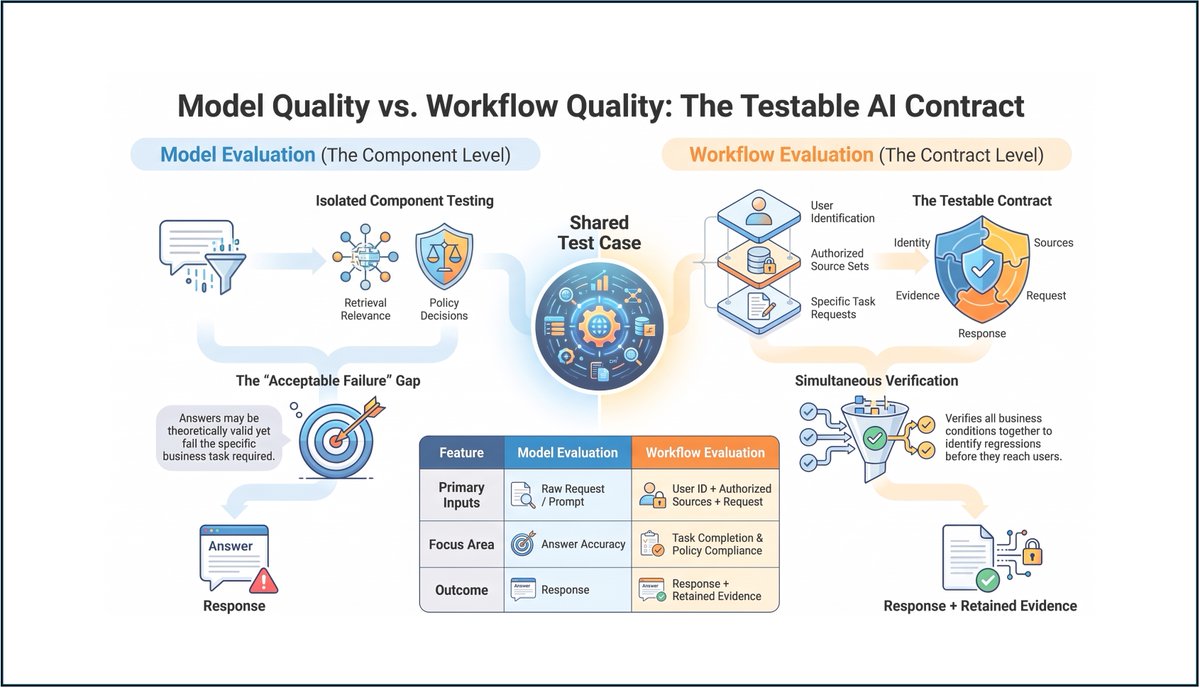
A model evaluation asks whether a model performs well on a defined set of #prompts. An #enterprise workflow evaluation asks a larger question - did the complete application behave correctly for a particular user and task? #EnterpriseAI#Quality
AI retrieval works with chunks, passages and other smaller units. Governance meaning needs to stay attached to the unit the AI uses. File-level classification alone can be too coarse.
#AIGovernance
A quality score that disappears before retrieval cannot help explain the context used by AI. Partner architectures should preserve source and quality evidence where AI teams can inspect it. #AIGovernance
@adovo_ai Agreed. Any failure, denied access or poor retrievals in the chain should move upwards and get recorded. Human feedback and overrides will help in adding exceptions and strengthening the system.
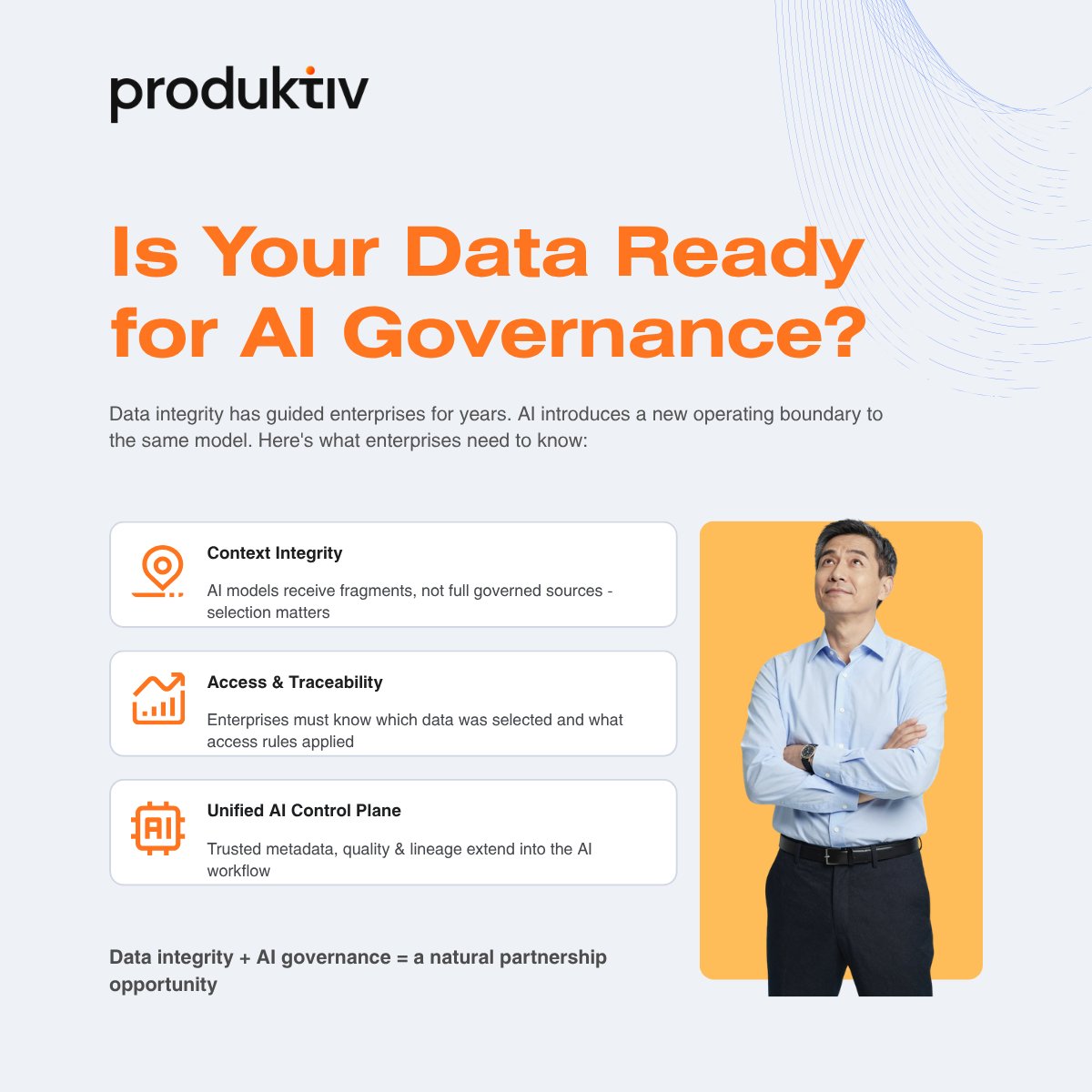
Data integrity companies have spent years helping enterprises understand whether data is accurate, consistent, classified and traceable.
AI introduces another operating boundary to the same model. Let’s consider a scenario - a model rarely receives an entire governed source. A retrieval service selects fragments, assembles context and passes a smaller information set into the reasoning process.
The integrity question therefore continues into the AI workflow. Enterprises need to know which information was selected, what access rules applied and what evidence can support the action.
I see a natural partnership opportunity emerging between solutions of different players in the data and AI space. Established data platforms bring trusted metadata, quality and lineage. An Enterprise AI Control Plane can carry those governance assets into the context used by AI.
That extends the value of the existing data investment. It also gives AI teams a stronger foundation than rebuilding governance inside every application.
Extend #DataIntegrity into #AIIntegrity.
1. Data integrity gives enterprise AI a trustworthy foundation. The integrity chain continues when the AI application selects context from that foundation.
2. A catalogue can define meaning, ownership and sensitivity. A quality platform can describe the condition of the source. Lineage can show where the information came from.
3. Retrieval creates a new control point. It chooses which passages or records are supplied to the model for a particular request.
4. The approved governance signals should stay attached to the information through that selection. Access policy should be evaluated before restricted context reaches the model.
5. The AI layer should return evidence that data, risk and platform teams can inspect: source, selected context, relevant metadata and policy outcome.
6. That is the practical extension from data integrity to AI integrity: keep trusted governance intelligence active inside the AI workflow.
#EnterpriseAI #AIGovernance
A data catalogue becomes more valuable when its definitions, ownership and classifications influence the context selected for AI. The catalogue remains authoritative. The AI control layer makes its governance intelligence operational. #AIGovernance
Data integrity continues after information enters an AI workflow. Retrieval selects fragments and assembles context. Enterprises need the approved meaning, access boundary and source evidence to survive that step. #AIGovernance
#EnterpriseAI platforms should scope the control at the stages in processing. Check how #Kynexa does it for governing #AI, data, context, agents and tools. https://t.co/dhjEDKLfET