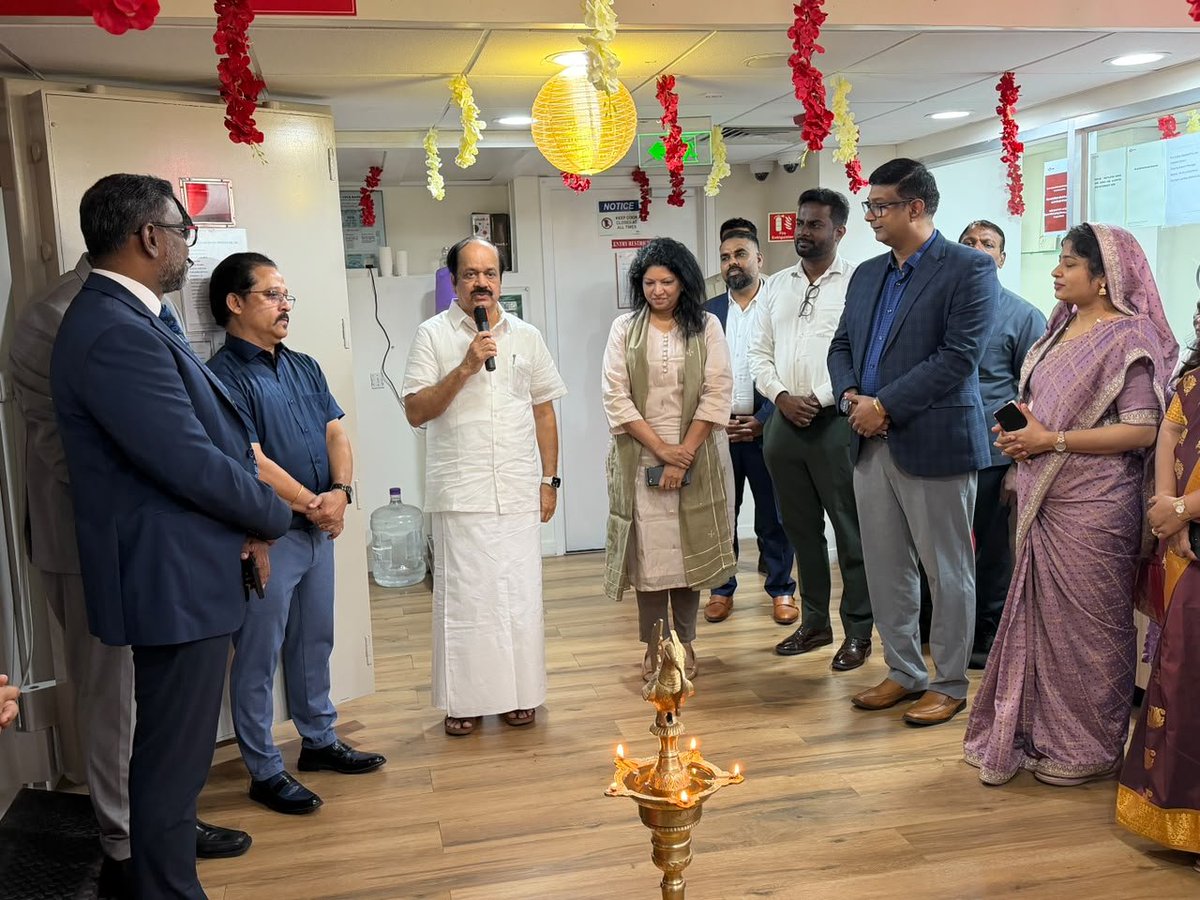
HSBC Helping Hands Mela 2026 நிகழ்வைத் தொடங்கி வைத்து, பங்கேற்பாளர்களுக்குப் பரிசுகளை வழங்கி மகிழ்ந்தேன்.
சமூக நலனுக்காகப் பாடுபடும் தன்னார்வத் தொண்டு நிறுவனங்களின் சேவைகளைப் பாராட்டுவதுடன், அவர்களின் முயற்சிகளுக்கு ஆதரவளிப்பதும் நம் அனைவரின் கடமையாகும்.
அன்பும் அர்ப்பணிப்பும் நிறைந்த இத்தகைய முயற்சிகள் மூலம் சமூகத்தில் நல்ல மாற்றங்கள் தொடர்ந்து மலரட்டும்!
#HSBCHelpingHandsMela2026 #SocialResponsibility #CommunityDevelopment
Cyclone Murasu – Severe Cyclone Likely at Landfall around Kavali in South Andhra - Who are the enemies for a Cyclone
====================
Murasu is expected to cross the South Andhra coast, close to the Kavali belt, as a Severe Cyclonic Storm. The atmospheric and oceanic conditions are currently quite favourable for further intensification.
There are two major enemies that can rapidly weaken a cyclone:
1. Strong Wind Shear - Wind shear can tilt a cyclone's vertical structure and displace its upper-level clouds from the circulation centre, disrupting the storm's organisation. Strong shear, particularly above 30 knots, can significantly hamper intensification.
For Murasu, the 850–200 mb vertical wind shear is currently less than 10 knots. This is an extremely favourable environment for cyclone intensification. (Refer to Images 1 and 2.)
2. Dry Air Intrusion - Dry air is another major enemy of tropical cyclones. When dry air enters the circulation and reaches the core, it can suppress convection and disrupt the moisture supply that sustains the cyclone.
In Murasu's case, dry air is attempting to wrap around one side of the circulation. However, the cyclone is managing to protect its core for now.
3. Ocean Conditions (SST) – Sea Surface Temperatures (SST) remain above 29°C along the system's path. These warm ocean waters provide ample heat and moisture to sustain deep convection and support further intensification.
The overall environment continues to support intensification. All these factors favour Murasu maintaining its strength and potentially intensifying further until landfall. IMD expects 110 km/hr while crossing while American counterparts JTWC 105 km/hr.
Chennai (KTCC)- Rains should start tomorrow (monday) morning. But the intense rainfall zone is likely to remain the Sea away from the city. Maybe areas close to sea in North Chennai, if lucky can get some good bands. and the extreme north areas of Tamil Nadu around Ponneri-Gummidipoondi - Pulicat areas can grab some heavy spells if lucky.
Tamil Nadu is either on top or among the top on all social and economic parameters.
Chennai is not among top 10 airports in the country by area.
Not only passenger traffic, cargo traffic is very high from Chennai, being the industrial city and that too being electronics capital.
At 5746 acres, Parandur airport in Chennai would be the second largest airport in the country on par with international standards.
The largest airport coming up in India is at Noida, with an area of 11,750 acres.
Who will and how to explain to the government that this project is extremely critical for development and growth of Chennai?
Both city and the state would simply start losing important investments if the new airport project is shelved.
Machines are already speaking through data. Smart manufacturers are the ones learning how to listen.
Here's a short clip from @ashwindesikan's session at the @lubindia event on how #AI, #IoT and real-time intelligence are reshaping #manufacturing operations.
#Industry40#MSME
Elon Musk just used a joke to perform an autopsy on the American economy.
Two economists go for a hike. They find a pile of shit. One pays the other $100 to eat it.
They keep walking. Find another pile. The second economist pays $100 back to eat that one.
They stop. Neither man gained a dollar. Both ate shit for nothing.
But on paper they just generated $200 in GDP.
Musk: “That basically would count as a job. This is to illustrate the absurdity of economics.”
That is not a punchline. That is the operating system of the federal government.
Every time a politician celebrates “record job creation” this is what they are describing. Not output. Not value. Not progress. Motion.
The entire bureaucratic machine exists to manufacture friction and then invoice for it.
Compliance layers built to justify the next compliance layer. Oversight committees that produce nothing but the need for more oversight. Consulting firms hired to audit the work of other consulting firms.
Trillions circulating through systems that have never produced a single thing you can hold in your hands. But the GDP number ticks up. So everyone applauds.
The shit gets eaten. The scoreboard moves. Nobody asks what actually got built.
This is why Washington treats AI like a five alarm fire.
AI does not play the friction game. It does not form a committee. It does not schedule a review. It does not file 400 pages of paperwork no one will ever read.
It just solves the problem.
And that is the one thing the machine cannot survive.
The government does not tax results. It taxes the process. The longer the process, the deeper the cut.
AI compresses a ten day workflow into seconds. There is nothing left to bill. Nothing left to tax. Nothing left to skim.
So they will spend the next decade warning you that AI threatens the economy.
What they will never say is what it actually threatens.
The illusion that activity equals progress.
The $200 economy where both men ate shit and called it a job.
The machines are not coming for your purpose.
They are coming to prove that half the economy never had one.
AI-native software engineering teams operate very differently than traditional teams. The obvious difference is that AI-native teams use coding agents to build products much faster, but this leads to many other changes in how we operate. For example, some great engineers now play broader roles than just writing code. They are partly product managers, designers, sometimes marketers. Further, small teams who work in the same office, where they can communicate face-to-face, can move incredibly quickly.
Because we can now build fast, a greater fraction of time must be spent deciding what to build. To deal with this project-management bottleneck, some teams are pushing engineer:product manager (PM) some teams are pushing engineer:product manager (PM) ratios downward from, say, 8:1 to as low as 1:1. But we can do even better: If we have one PM who decides what to build and one engineer who builds it, the communication between them becomes a bottleneck. This is why the fastest-moving teams I see tend to have engineers who know how to do some product work (and, optionally, some PMs who know how to do some engineering work). When an engineer understands users and can make decisions on what to build and build it directly, they can execute incredibly quickly.
I’ve seen engineers successfully expand their roles to including making product decisions, and PMs expand their roles to building software. The tech industry has more engineers than PMs, but both are promising paths. If you are an engineer, you’ll find it useful to learn some product management skills, and if you’re a PM, please learn to build!
Looking beyond the product-management bottleneck, I also see bottlenecks in design, marketing, legal compliance, and much more. When we speed up coding 10x or 100x, everything else becomes slow in comparison. For example, some of my teams have built great features so quickly that the marketing organization was left scrambling to figure out how to communicate them to users — a marketing bottleneck. Or when a team can build software in a day that the legal department needs a week to review, that’s a legal compliance bottleneck. In this way, agentic coding isn’t just changing the workflow of software engineering, it’s also changing all the teams around it.
When smaller, AI-enabled teams can get more done, generalists excel. Traditional companies need to pull together people from many specialties — engineering, product management, design, marketing, legal, etc. — to execute projects and create value. This has resulted in large teams of specialists who work together. But if a team of 2 persons is to get work done that require 5 different specialities, then some of those individuals must play roles outside a single speciality. In some small teams, individuals do have deep specializations. For example, one might be a great engineer and another a great PM. But they also understand the other key functions needed to move a project forward, and can jump into thinking through other kinds of problems as needed. Of course, proficiency with AI tools is a big help, since it helps us to think through problems that involve different roles.
Even in a two-person team, to move fast, communication bottlenecks also must be minimized. This is why I value teams that work in the same location. Remote teams can perform well too, but the highest speed is achieved by having everyone in the room, able to communicate instantaneously to solve problems.
This post focuses on AI-native teams with around 2-10 persons, but not everything can be done by a small team. I'll address the coordination of larger teams in the future.
I realize these shifts to job roles are tough to navigate for many people. At the same time, I am encouraged that individuals and small teams who are willing to learn the relevant skills are now able to get far more done than was possible before. This is the golden age of learning and building!
[Original text: https://t.co/1pUxNC5UXk ]
With LPG supply tightening, every unit of gas matters.
Yet in many factories, gas consumption is still not metered in real time, making leaks and inefficiencies hard to detect.
Bring intelligence to gas consumption with AOne.
#LPGShortage#Manufacturing#EnergyEfficiency#IoT
LPG shortages are hitting commercial kitchens.
But most kitchens still don’t measure LPG consumption; they replace cylinders.
At a time of tightening LPG supply, that approach needs a rethink.
Read more: https://t.co/ZsxTFZA4Cc
#LPGShortage#CommercialKitchens#AI#IoT
In a series of blogs I will be exploring how AI can be used to manage its own infrastructure.
the first of the series is below. feel free to join in with your thoughts and comments. We will explore solutions together
#aiautonomy#aiinfrastructure#aiforall#aisustainability
From classrooms at @SASTRADeemedUni to being Top 20 globally at #AIForAll — the journey has been powered by strong fundamentals and fearless thinking.
Thank you @SVaidhyasubrama for your mentorship and belief.
We’re just getting started. AOne is built to scale globally.
"Most investors invest based on the why. And the question you have to ask yourself constantly is why should an investor care about what I'm doing? Why is this important to them?"
We are partnering with @zacktrak of Series Z to help our companies develop, refine and communicate their stories. Here is a workshop from our CEO Summit on framing your pitch to investors.
https://t.co/8J8hl6quDY
Team AOne honours all the fathers and father figures out there who strive to be the guiding light in their children’s lives. A special shout out to our AOne dads who excel at both work and fatherhood!
A very happy Father’s Day from #TeamAOne!
#FathersDay#Dads#Fathers#Papa