THE HEAD ENGINEER AT ANTHROPIC LEAKED A SETUP WHERE ONE FILE TURNS INTO A FINISHED PRODUCT IN 24 HOURS
you hire nobody - you paste a $3.2M file into Fable 5, and the system unrolls itself from there.
root → wiring → 4 branches → tests → release → back into the root
in the first hour you write 4 things: boundaries, stack, roles, escalation - everything downstream is a consequence of that file.
the first 5 hours the system wires itself into tools and only then decides what to build - a team would spread that across two weeks.
8 straight hours run 4 parallel branches with zero meetings - the same block a team fills with standups.
by the time you finally open the diff, tests and the critic have already rejected it twice.
the changelog is written by the run, not by a human from memory - so it never falls behind the code.
your total involvement across the day is exactly 2 hours: the first one, and the one where you say ship it.
the 9 hours you were asleep weren't downtime, they were capacity - a queue you have to launch by hand becomes your monday.
and the key part: at 05:00 the report rewrites that same root - what shipped, what got rejected, what it cost.
without that last line this is just a schedule - with it, the schedule improves itself.
save this and paste it into Claude Code - and tomorrow starts from a better file than today did ↓
Google Brain founder, Andrew Ng:
"Prompting will be dead in 6 months, graphs are what's replacing it."
In 2 hours at Stanford he shows how to build agents that work and improve entirely on their own.
The first 10 minutes cover what most $500 courses never do.
Watch the lecture first, then read the guide below on how to build a system that improves itself.
You're not using Obsidian wrong. You're just missing the one folder that makes Claude actually fast against your notes.
Right now every question you ask reads your whole vault. 2,000 notes, hundreds of thousands of tokens, just to answer one thing. That's not a second brain, that's a pile you taught Claude to search blind.
A graph fixes this. One router, one index, nodes split by idea, edges that point where they need to. Claude reads 2-3 files instead of 2,000. Answers back in under a second, bill drops with it.
Wrote out the full 11-step system, from raw vault to working graph 👇
An open-source agent that never forgets you just crossed 200,000 stars, and it runs entirely on your laptop.
I mapped every part worth stealing:
00:37 - the bot that lives inside your local files
03:00 - SOUL.md, the file that gives it a personality
04:31 - the self-improving loop that writes its own skills
09:49 - the three-layer memory that remembers who you are
14:31 - sub-agents that call Claude Code to do the work
19:15 - why memory, not the model, is the real moat
20 minutes here will teach you more about building agents than a month of blog posts.
Watch it, then read the exact harness I run to get frontier results from any model, below.
Sam Altman:
"We're going to see 10-person billion-dollar companies pretty soon."
"If I were 22 right now, I'd feel like the luckiest kid in history."
Most people will read this, feel inspired for 3 minutes, and go back to what they were doing.
The ones who act will build a one-person company this weekend.
One tool. Claude Cowork. Full operation.
This is the exact playbook ↓
A 21-YEAR-OLD FROM CHINA RUNS 300 AI AGENTS AT ONCE. THE PART THAT MATTERS ISN'T THE SPEED, IT'S THAT NONE OF THEM CAN LIE TO HIM
he opens the dashboard and shows the swarm live, 300 Kimi K2.6 agents firing in parallel, then Opus 4.8 checking every single output against its source. this is not just a faster swarm. it is a loop that refuses to stop while anything is still wrong
he pointed it at 100 EV-market companies. first pass: 12 failed. wrong revenue, dead citations, empty fields. second pass: 3 failed. third pass: zero
this is not another agent demo. it is a system that catches its own mistakes before he reads a single row
17 year olds are about to start printing $100k months with 2 shifts that just happened in the ecom space.
Meta and Higgsfield both dropped official MCP connectors for Claude.
What that means in plain English and how to set it up today:
You can now connect Claude directly to your Meta Ads account and to Higgsfield's full creative studio at the same time.
The setup:
CONNECT META ADS TO CLAUDE
→ Go to claude[.]ai Settings → Connectors → Add custom connector
→ Name it Meta Ads
→ Paste this URL: https://mcp[.]facebook[.]com/ads
→ Connect and sign in with your Meta Business account
→ Grant ads_read, ads_management, business_management, read_insights permissions
Claude can now read your full campaign performance, ROAS, CTR, CPM, creative breakdowns, pixel health and more.
It can also create and edit campaigns, ad sets and ads with your approval on every action.
CONNECT HIGGSFIELD TO CLAUDE
→ Same place: Connectors → Add custom connector
→ Name it Higgsfield
→ Paste this URL: https://mcp[.]higgsfield[.]ai/mcp
→ Connect with your Higgsfield account
Claude can now generate UGC videos, static ad creatives, product mockups, carousels and storyboards directly inside the chat.
Images up to 4K, videos up to 15 seconds, and any format ready to upload.
You need Claude Pro, Max or Team to run both connectors at the same time.
THE WORKFLOW
Open a Claude chat with both connectors being active.
→ Step 1: Ask Claude to pull your last 14 days of Meta data and identify your top-performing creatives and angles
→ Step 2: Tell Claude to brief Higgsfield using those winning angles and generate 10 fresh ad variations for your product
→ Step 3: Review the assets Claude generates directly in the chat
→ Step 4: Tell Claude to build new test campaigns using the new creatives and approve the launch
You used to pay for creatives, wait for delivery, upload manually, and guess which angle would win.
Now Claude tells you what's already winning in your account and builds the next round of creatives around that data before you finish your coffee.
Comment "PROMPT" below, and I'll send you the exact prompt stack you can use to run this full loop.
(follow so I can send to your dm)
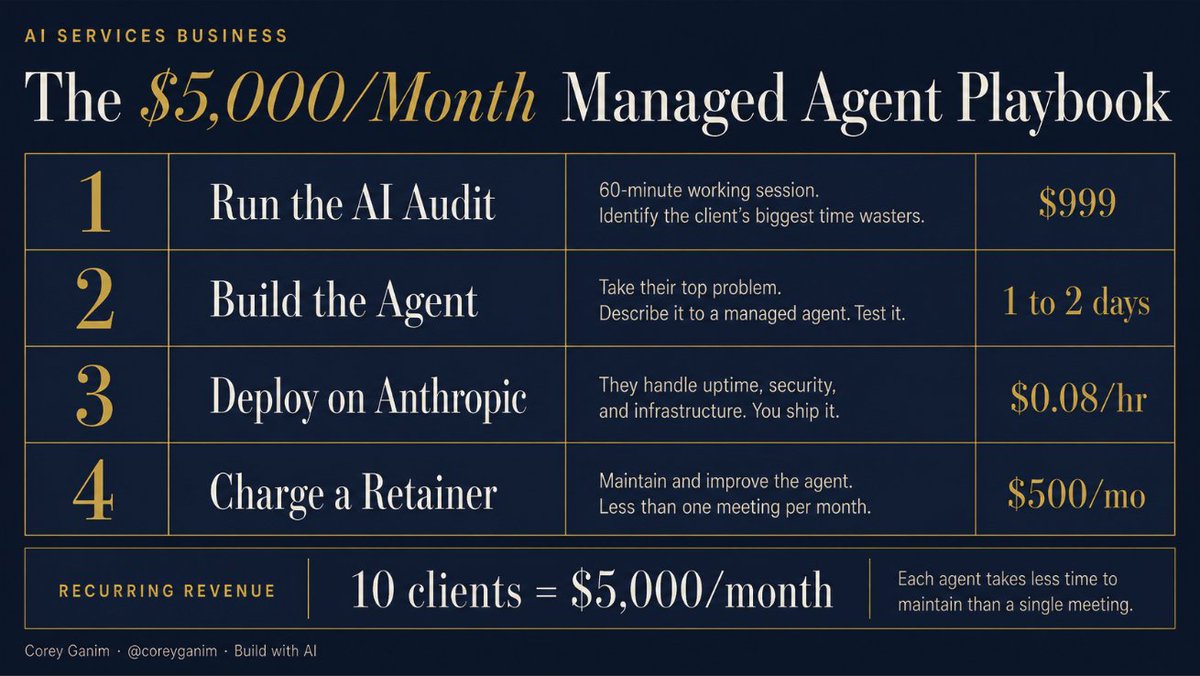
This is a $5,000/month service hiding in plain sight.
the play:
1. Run a $999 AI audit. 60-minute working session. Identify the client's biggest time waster.
2. Build a managed agent for their #1 problem. 1 to 2 days of work.
3. Deploy it on Anthropic. They handle uptime, security, infrastructure. Costs you $0.08/hr.
4. Charge $500/month to maintain and improve it.
10 clients = $5,000/month recurring.
Find a niche problem, build an agent that solves it, then sell it to everyone in that vertical.
POV: claude traveled 6 months into the future and told you exactly how your next move failed.
it's called a premortem.
daniel kahneman (nobel prize-winning psychologist behind "thinking fast and slow") called it his single most valuable decision-making technique.
google, goldman sachs, and procter & gamble all use it before major launches.
here's the problem it solves.
when you ask claude "is this a good plan?" it finds all the reasons to say yes.
that's what it was trained to do. so you walk away feeling confident.
you execute, and spend weeks / months building on top of that plan.
then it blows up.
and you realize the problem was obvious in hindsight, you just never stress-tested it because claude told you it was solid.
a premortem fixes this by flipping the frame.
instead of asking "what could go wrong?" you tell claude "it's 6 months from now and this is already dead. tell me how it died."
that shift turns off claude's optimism because there's nothing to be optimistic about. the premise already says it failed.
so claude stops looking for reasons your plan will work and starts explaining how it fell apart.
claude comes back with every way your plan could die, each one with a full failure story and the early warning signs to watch for.
then a synthesis pulls it all together:
> which failure is most likely
> which failure is most dangerous
> the single biggest hidden assumption you're making (often the most valuable part)
> a revised version of your plan with the gaps closed
you say "premortem this" and give it your plan. the skill handles the rest.
I built an AI that identifies revenue leaks in any local business website.
Built it in 15 minutes. Here's what it does:
→ Crawls the website and Google Business Profile
→ Scores the site on offer clarity, trust signals, CTAs, and service pages
→ Estimates how many leads they're losing per month
→ Calculates the dollar amount leaking based on their lead value and close rate
→ Spits out a priority matrix: quick wins vs. strategic projects
One vet clinic example: $2,400/month in estimated lost revenue because certifications were buried on the about page and service pages had zero conversion CTAs.
This was my first time touching Codex and one shotted this with a single prompt.
First impressions on Codex: easy to use, beautiful UI, easy for a non-technical person like me to navigate.
Will be doing more demos like these if you guys enjoy them.
this 16-min video course teaches you how to set up your own agent-dev team.
it’s free. zero coding. just watch, copy the prompts and deploy.
and just like that, you’ll have:
• a frontend dev
• a backend dev
• a QA agent
all working for you, ready to build anything.
Hermes Agent just got a free plugin nobody is talking about. And it finally fixes the biggest problem with AI.
Right now, your AI agents are a black box.
You give them a job.
They go quiet.
You cross your fingers and hope they do it right.
If they fail, you have no clue why.
Hermes Labyrinth changes the game.
It works like a flight recorder for your AI.
It maps out every single move your agent makes.
Every prompt it writes.
Every web search it tries.
Every time it switches to a smarter model.
You see the exact path it took from start to finish.
It is totally read-only, so it cannot break your system.
It even hides your secret passwords automatically.
Setup takes exactly two lines of code.
Drop it in your plugins folder and restart your dashboard.
Stop guessing what your AI is doing behind your back.
Introducing Mesa: the most powerful filesystem ever built, designed specifically for enterprise AI agents.
Every team building agents eventually hits the same wall: where do the files live?
Not the chat history, the actual artifacts the agent works on.
> The contracts your agent redlined
> The claim files it updated
> The 200-page audit report it edited overnight while you were asleep
Today those documents live in a sandbox that dies in 30 minutes, an S3 bucket where concurrent writes clobber each other, or a GitHub repo that was never built to absorb agent-scale traffic.
So we built Mesa.
The world's first POSIX-compatible filesystem with built-in version control, designed from the ground up for agents. You mount it into your sandbox like any other filesystem. Your agent reads and writes files normally. Behind the scenes every change is versioned, branchable, reviewable, and rollback-able — like a codebase, for any file type.
Mesa provides
– Branches so agents work in parallel without locking
– Durable storage that survives sandbox death
– Sparse materialization so massive document sets load instantly
– Fine-grained access control per agent
– Full history for human review and audit
Design partners are running Mesa in production across legal, healthcare, GTM, business ops, and coding agents.
Private beta is open: link in the comments
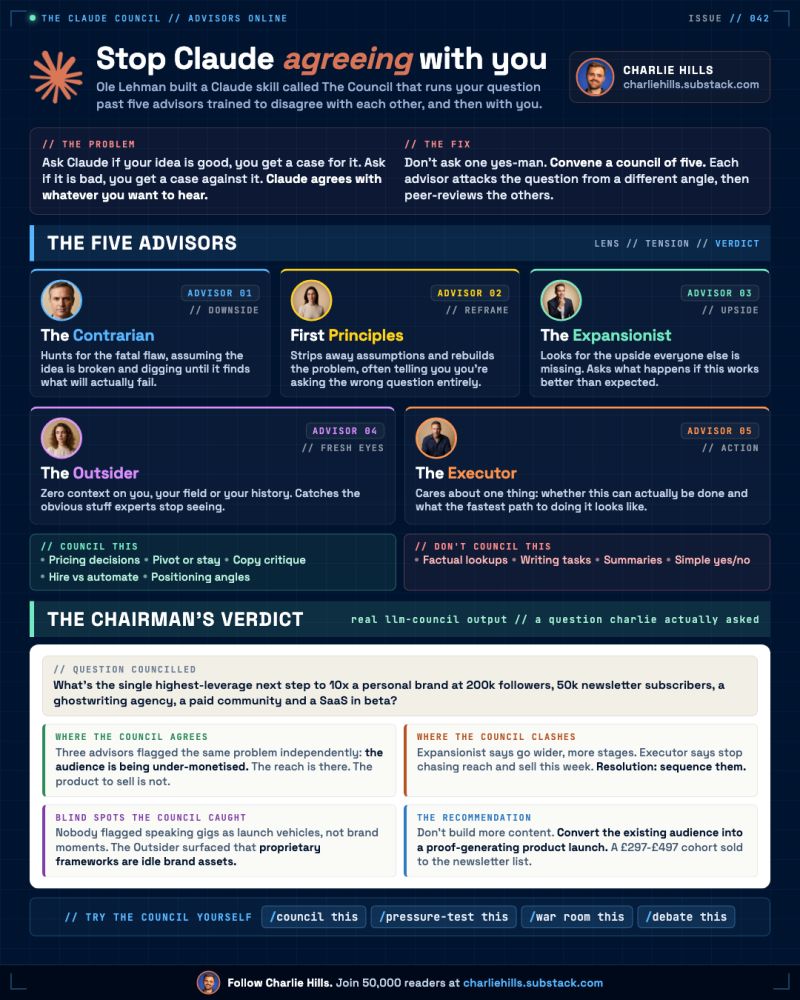
Claude will gaslight you, until you install this skill.
It's called The LLM Council.
You ask a question. 5 advisors attack it from different angles. Then they peer-review each other before giving you the verdict.
How it works:
1. You ask a real decision question.
2. 5 advisors attack it from different angles.
3. They grade each other's work anonymously.
4. Chairman synthesises one verdict and the next step.
Install in 4 steps:
1. Download the skill
https://t.co/mnpPNSnDXu
2. Open Customise skills in Claude
3. Upload the SKILL.md file
4. Type /llm-council
One Claude tells you you're right.
Five Claudes show you where you're wrong.
Get more free AI guides here https://t.co/1F12fOTjss
Repost ♻️ to help someone in your network.
P.S. Credit to Ole Lehmann for building it.
The 4-phase AI Audit that returns 6+ hours per week to small business owners:
1. Discovery call (45 min). Record it in Fathom. Pull problems, don't pitch solutions. Ask what they dread, what piles up waiting on them, what they wish ran itself.
2. AI-powered analysis. Drop the full transcript into Claude. Prompt it to find 5-7 specific tools that save weekly hours, with difficulty rating and before/after for each.
3. The report (30 min to assemble). Built in Gamma. Executive summary, priority matrix, tool recs, 4-day quick-start, financial impact in dollars.
4. Review call (30 min). Screen-share. Walk through every rec. Close with three questions: which feels urgent, want help, what's your timeline.
Average client gets 6+ hours back per week at $40/mo in tool spend. That's a 25x return on a one-time $999 fee.
You are selling CLARITY. Not AI or automation.
Key difference.