On the left is Nikhil Ravishankar. He went to school in New Zealand, worked all his life in NZ. Yet in 2025 when he was appointed CEO of Air New Zealand, the wave of online racism directed at him became such a tsunami that the country's 3 leading media outlets, the New Zealand Herald, 1News and Radio New Zealand, had to shut down their comments section. The sheer volume of racist comments made it impossible for moderators to do their job. It was like half the population of New Zealand had decided to be racist on Ravishankar.
On the right is Air India’s current CEO - New Zealander Campbell Wilson whose appointment in 2022 attracted no such backlash in India. Wilson hails from Christchurch, arguably the most racist city in New Zealand.
BBC is fighting for India's independence, Qatar for India's secularism, China for India's territorial integrity, Pakistan for India's religious freedom, Canada for India's Moolnivasi rights and America for India's rightful place in the world but Modi is blocking them all ☹️
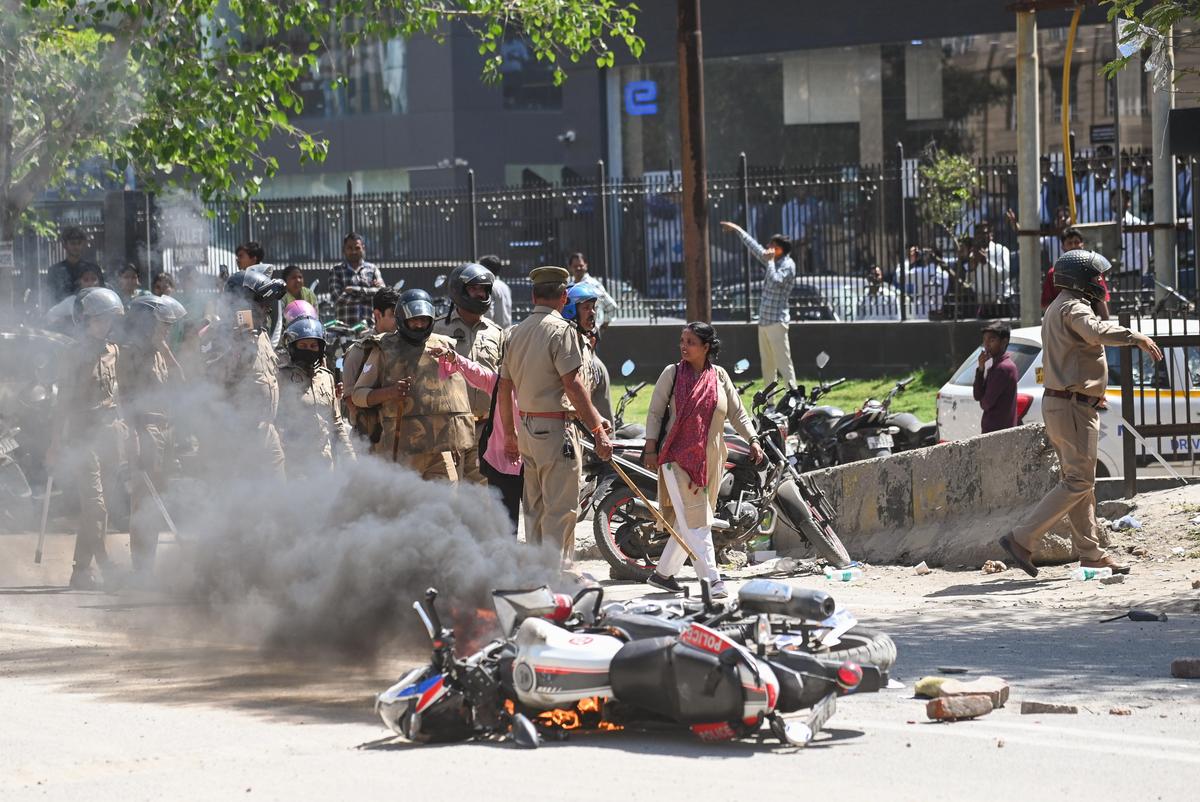
DECODING NOIDA PROTEST: A PLAN BY THE COMMUNISTS TO START CIVIL WAR IN INDIA.
This is an extremely important thread.
Exclusive details about the entire plan and characters behind it.
Thread👇
Exposing the hidden hand behind the protest against the Great Nicobar Project.
You won’t find these EXCLUSIVE details anywhere.
So let’s start the THREAD.
1. Meet Ashish Kothari. He filed a petition before the NGT against this project.
But why? And who is he?
How ironic that you spout such blatantly false propaganda to demonize Hindu culture.
It is the Christian nations of Europe that invented the custom of burning women alive. Europe spent 300 years hunting, torturing, and burning alive between half a million to possibly as many as eight million women, widows, midwives, and even children - often on nothing more than a whisper of suspicion.
In 1484 , Pope Innocent VIII, issued the papal bull Summis desiderantes affectibus which was the preface to the book Malleus Maleficarum (“The Hammer of Witches”), the ultimate Christian witch-hunting manual of Europe. In it he declared an Inquisition on anyone suspected to be a witch, and officially approved their brutal torture and execution by Holy sanction. Women and girls as young as 12 were stripped naked, every hair on their body shaved, their bodies probed in every orifice for “witchcraft objects,” branded with hot irons, stretched until their limbs tore apart, then burnt alive or drowned. Many women were killed along with their little daughters simply because the “progeny of a witch” was considered irreversibly evil.
Most of the targeted women were midwives, healers and medicine women who knew too much about the sordid sins of Christian society, as they performed abortions or assisted in childbirth. All these heinous acts were carried out not in secret but celebrated as a righteous spectacle, armed with the Church & Pope’s blessing and guided by a book that sold in at least 20 editions. Tracking, hunting, torturing and murdering the most vulnerable sections of society under mere “suspicion” of witchcraft was a hallowed sport in European culture.
Unlike the Christian religious sanction for burning women alive, the Hindu practice of Sati was always voluntary and NEVER mandated as compulsory by any scriptural sanction.
Lord Bentinck's own official directive clearly pointed out this very fact when he said that Sati "is nowhere enjoined by the religion of the Hindus as an imperative duty; on the contrary a life of purity and retirement on the part of the widow is more especially and preferably inculcated, and by a vast majority of that people throughout India the practice is not kept up, nor observed: in some extensive districts it does not exist: in those in which it has been most frequent it is notorious that in many instances acts of atrocity have been perpetrated which have been shocking to the Hindus themselves, and in their eyes unlawful and wicked." The so called statistics you quote of thousands of Satis in Bengal were never validated by neutral observers- they were simply accepted as gospel truth unchallenged by the British for their vile political agenda. The data is heavily suspect as it was reported by Christian Missionaries such as William Carey who had a demonstrably vested interest in demonizing Hindu customs to drive their fanatic conversion agenda.
Also Ram Mohun Roy was in Rungpur and never watched his sister-in-law being forced to commit Sati.
So stop making up lies to preach to Hindus about misogynist customs when your own culture is the one that burned MILLIONS of your women and even little girls, on the mere suspicion of witchcraft. Sit down & take a long hard look in the mirror before spewing hate and projecting your racist bigotry on other civilizations.
And next time you try to invent fictional propaganda, show some real historical evidence like I did - to back up your claims instead of a pathetic AI animation.
Sanitized Repost of thread disproving the myth of “Brahminical Hindus” denying education to lower castes in 19th c India.🧵
Please bookmark for future reference.🔖
In the 1820s, William Adam, a Scottish Baptist missionary came to Bengal, India to harvest heathen souls. By the mid-1830s, he was commissioned by the British Governor-General William Bentinck to conduct official surveys on the state of education in native Hindu schools of Bengal and Bihar.
Between 1835 and 1838, he submitted three official survey reports on education. The “native schools” that he documented were not operated under British administrative control. They were local institutions run exclusively by Hindus - primarily in villages managed by local teachers, funded by parents or village committees and conducted in native languages like Bengali or Hindi. A few Missionary schools also operated separately from these “native schools.”
The data that Adam recorded, definitively challenges the insidious colonial myth that Hindu upper castes, especially Brahmins held an exclusive monopoly over education. The statistics demonstrate in stark contrast, that lower castes not only had comprehensive access to education in native Hindu schools, but that they also outnumbered upper castes in the student body.
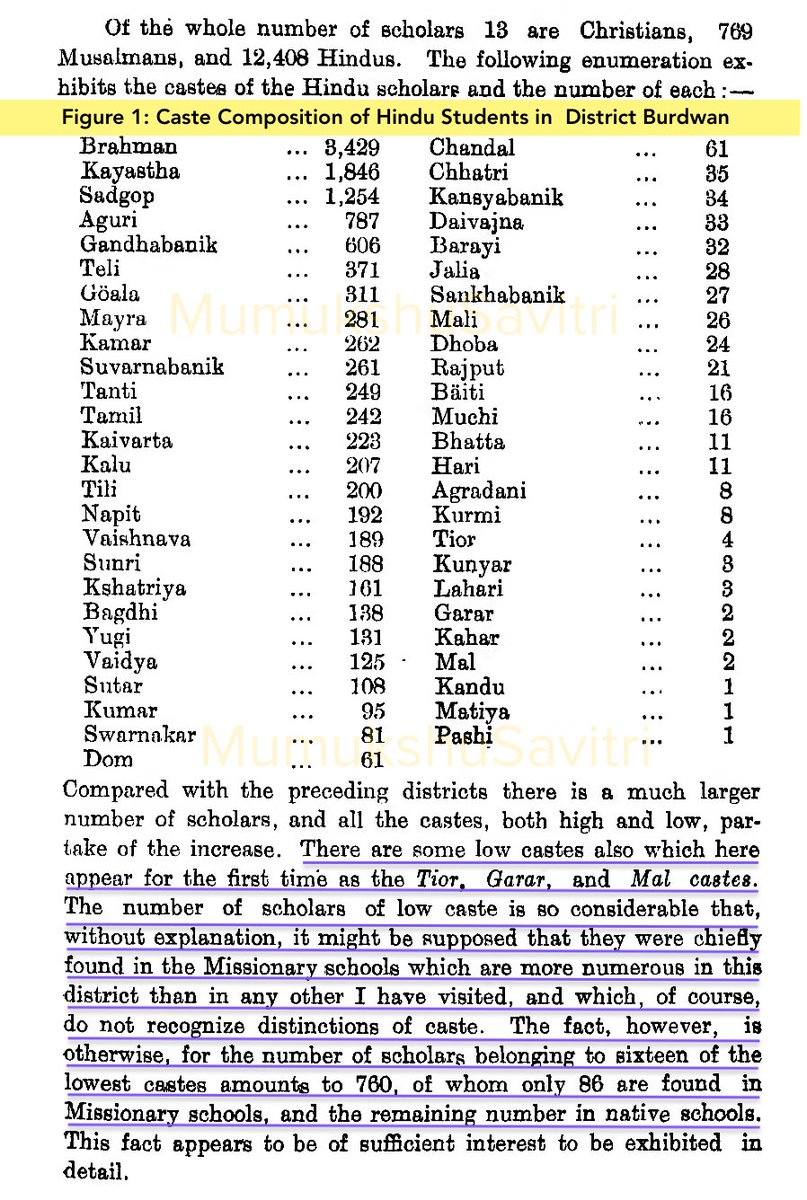
In Burdwan district (Figure 1), out of 12,408 Hindu students - Brahmins represented only 27.6% of the student body, all upper castes together made up 44.8%. While Shudra students dominated at 49%, and Avarna student participation was at 6%.
The breakdown:
Brahmins: 3,429 students - 27.6%
Other UCs: 2,132 students - 17.2%
Shudras : 6,087 students - 49.1%
Avarnas: 760 students - 6.1% (Including Chandal, Dom, Muchi, Hari, Bagdhi, Dhoba, Jalia, Tior, Garar, Mal, Pashi, & others labelled “very low castes”by Adam)
----------------------------------
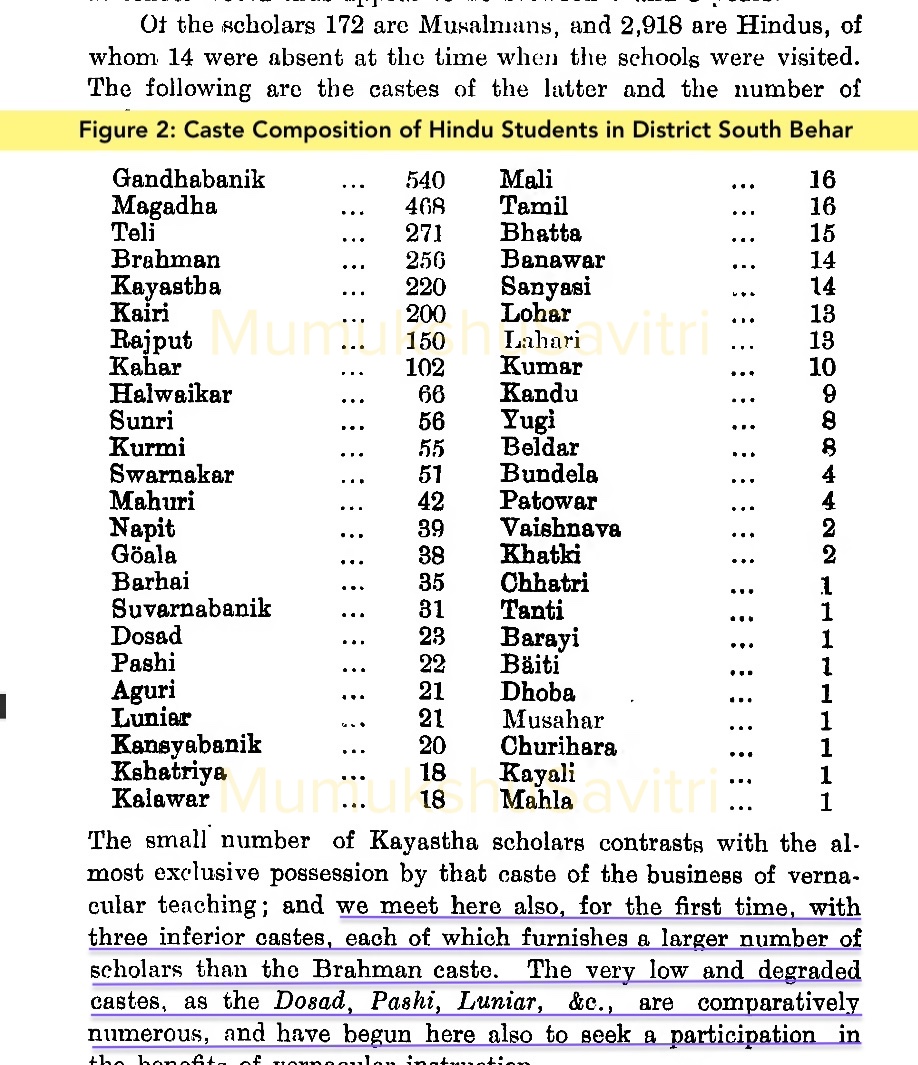
In South Behar district (Figure 2) the difference was even more striking. Brahmins & other UCs together made up LESS than 1/5 (17%) of students in native Hindu schools. Shudras constituted 81% of the entire student body and Avarnas represented 2.3%
The breakdown:
Brahmins: 250 students - 8.6%
Other UCs: 238 students - 8.1%
Shudras : 2,364 students - 81.0%
Avarnas: 66 students - 2.3% (Dosad, Pashi, Luniar - explicitly described by Adam as “very low castes”)
-----------------------
Thus, Adam's surveys of native Hindu schools in districts Burdwan and South Behar demonstrated a student composition where Brahmins represented only about a quarter of the student body, and total UCs were less than half, while Shudras were the most numerous (upto 80% in some districts), and hundreds of students from “very low castes” as defined by Adam were also enrolled in native schools.
Adam records similar trends in the composition of student bodies in other districts like Nadia, Murshidabad and Birbhum as well. Adam himself explicitly notes that “all the castes, both high and low, partake of the increase,” and that even communities such as Tior, Garar, and Mal appear in the schools”. This was not any superficial observation - it was a grudging testimonial to the diverse nature of the student body - proving that Hindus from all castes were mixing freely and equitably in native educational institutions.
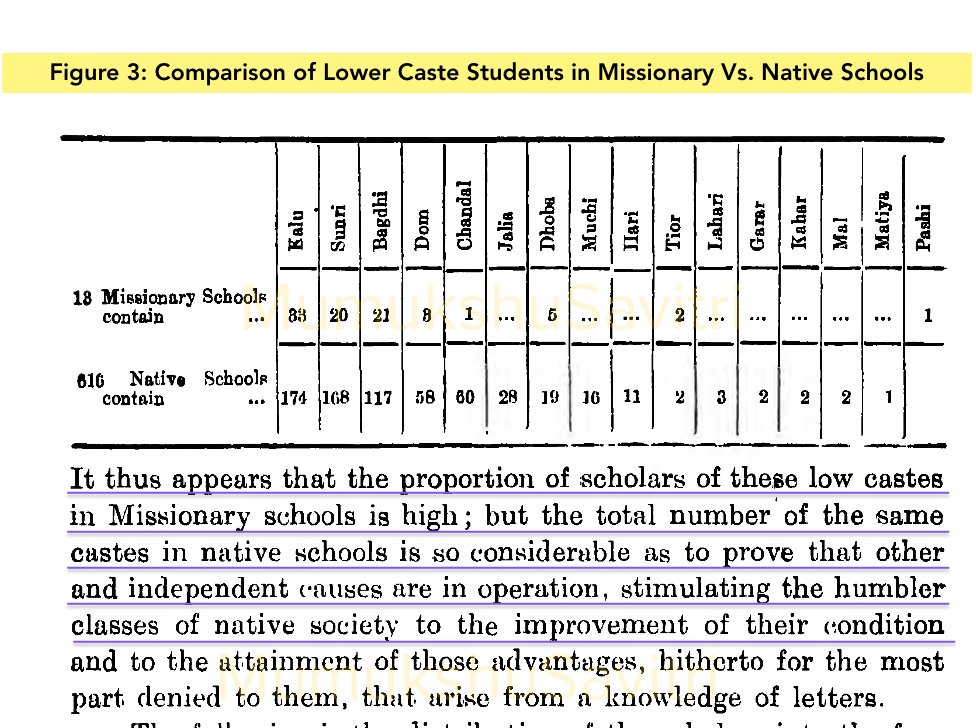
Strikingly, Adam’s comparison between missionary and native schools (Figure 3) also showed that out of 760 students of the lowest castes, only 86 went to Missionary schools, while the remaining 674 were all studying in native Hindu schools. Adam himself emphasizes that the total number in native schools was “so considerable” that it proved native schools already encouraged humbler classes to seek education. In other words, Avarna participation in education was higher in native schools and significantly higher than missionary institutions! This poses two important implications.
1. It proves that the lower castes trusted their own Hindu brethren far more than missionaries when it came to educating their children. An overwhelming 75% of lower castes chose to send their children to native Hindu schools instead of Missionary schools. This could only be the case if there was no evidence of any caste based discrimination or conflict in native Hindu schools.
2. It highlights the fact that Hindus were not just capable but actively collaborating in providing equitable community education across all castes, without any supervision from the “enlightened” Christian colonial administration. This busts the myth that Hindus were too divided to be capable of displaying any form of social unity by themselves.
So much for the myth of Christian missionaries as saviors of the lowest castes.
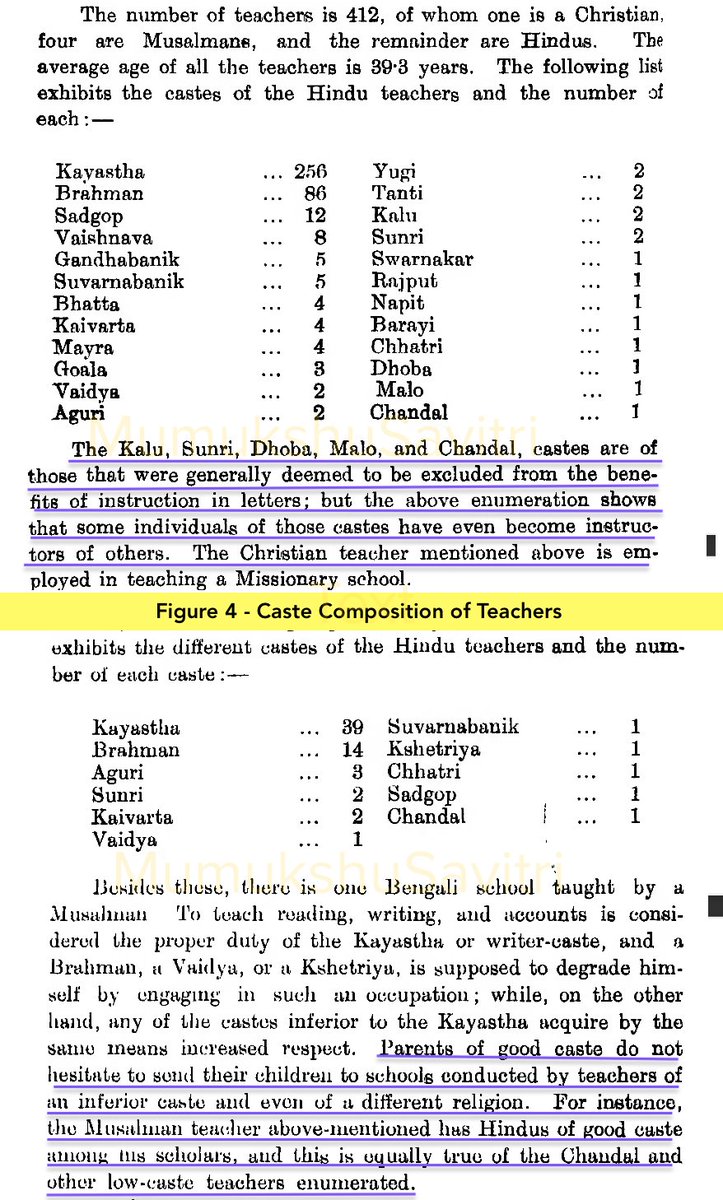
The survey of teacher data (Figure 4) revealed even more startling evidence. While Kayasthas and Brahmans served as the majority of instructors, Adam records striking evidence of several teachers from lower castes such as Sunri, Kalu, Dhoba, Bagdhi, and even Chandal - groups that the British had categorized as completely “excluded from literacy” by UC Hindus. In fact, Adam goes even further and observes that Hindu parents of “good caste” did not hesitate at all to send their children to schools where they were taught by teachers of inferior caste or even of a different religion!
In summary, Adam’s surveys of indigenous schools in Bengal in the 1830s, provide detailed statistical evidence clearly indicating that native Hindu institutions enrolled students from the entire range of caste backgrounds and that teachers likewise came from multiple social strata. The data does NOT support the claim that Brahmins maintained exclusive monopoly over education or systematically barred lower castes from access to learning. Despite this, the British colonial administration ignored these important implications and deliberately continued to propagate the false myth of Hindu Brahmins systematically denying education to lower castes. The agenda of portraying Hindus as a divided society of rigidly caste-bound groups was perpetuated to justify the British “civilizing” intervention and drive conversion to Christianity.
William Adam’s surveys unintentionally undermined a central pillar of the colonial justification for educational intervention - the charge that indigenous Hindu schools functioned primarily as instruments of caste exclusion. Adam’s own empirical record clearly puts that assertion into question. At a minimum, his data suggests a far more complex and socially permeable educational landscape than the colonial portrayal allowed.
The colonial British regime amplified false myths of caste discrimination in education to divide Hindus and entrench their rule, shaping malicious narratives that continue to influence our public discourse today. The problem arises when such insidious historical claims are treated as settled fact and used to rationalize modern policies like reservations, that collectively blame and punish Brahmins and UC Hindus for unsubstantiated crimes. Public policy in today’s India should not be built on false historical narratives and unwarranted moral indictments, especially those which were deliberately manufactured to divide Indian society and perpetuate colonial rule.
Epstein was in the same business as Mother Teresa. Mother Teresa was a child trafficker who sold babies and made between $50 million and $100 million a year for the Vatican. Teresa's connections include Baby Doc Duvalier, the Haitian dictator, Charles Keating, the criminal of Saving and Loan, and Robert Maxwell, the father of Jeffrey Epstein's partner in child trafficking, Ghislaine Maxwell. And there is more, Mother Teresa opened the DC toddler home with none other than Hillary Clinton. This orphanage was silently closed in 2012. Sorry Zelensky, we are not letting Epstein leave our feed today.
Credit: The White Rabbit telegram.
Did birds and monkeys talk during Rām Era?
Vālmīki is real genius!
He encoded Anthropology as Talking Animals and Birds!
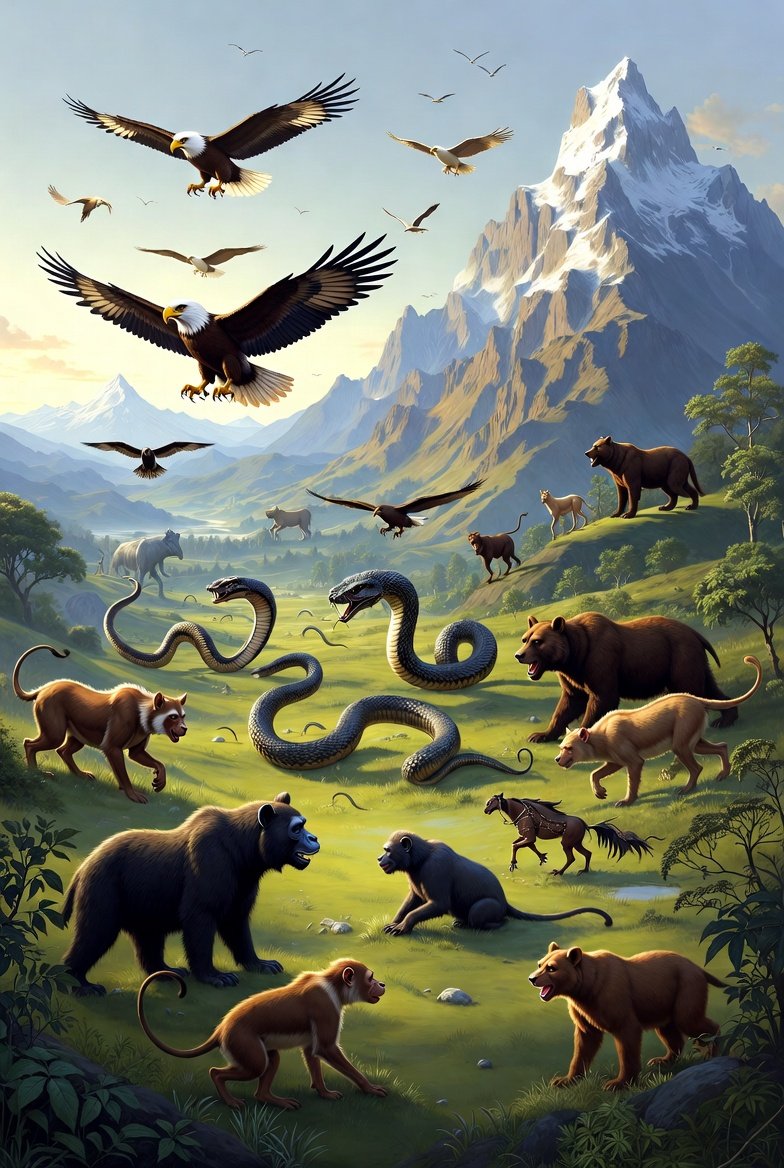
One of the most persistent misunderstandings about the Rāmāyaṇa is the belief that it describes a literal world where eagles, monkeys, snakes, and bears spoke Samskrit, ruled kingdoms, and fought wars alongside humans.
This confusion does not arise from the text.
It arises from forgetting how poetry encodes human history.
Vālmīki used Poetic Imagination to transform real tribes into powerful symbolic forms—hawks, snakes, apes, and bears.
His imagery was so effective that later generations mistook metaphor for zoology and began asking why archaeology has not discovered an age of talking animals.
The answer is simple:
They were never animals.
Across the ancient world, tribes identified themselves through animal and bird totems.
Archaeology confirms this globally:- snake hoods, hawk wings, feathers, masks.
Bhāratavarṣa followed the same pattern.
Tribes with snake totems were remembered as Nāgas.
Those with hawk or eagle totems were remembered as Suparṇas.
Garuda is described as Tārkṣya, belonging to the Ṛgvedic Tṛkṣi lineage. They are a Western brach of Ikṣvākus dominating Ṛgveda.
They were the cousins of Eastern Ikṣvākus of Ayodhya in Uttarpradesh.
Hawk imagery was their tribal emblem.
Jaṭāyu and Saṃpāti, the two Suparṇas of the Rāmāyaṇa, are sons of Aruṇa, Garuda’s brother, hence also Tṛkṣis.
That is why Jaṭāyu explicitly calls himself a relative of Daśaratha, Rāma’s father.
A bird cannot do that.
A kinsman can.
Vālmīki applies the same logic to geography.
Human tribes living near the Ṛkṣa mountains, east of the Vindhya range, were remembered as Ṛkṣas, that is, bears.
The mountains themselves were named after bears, and the people living there inherited the same regional identity.
Ideally they should be read as Ṛkṣa-kula (human clans of the Ṛkṣa region), not literal bears.
Likewise, tribes inhabiting the Vindhya–Śuktimat belt up to the Narmadā are remembered as Vānaras.
The region was famous for monkeys and apes, and Vālmīki fuses ecology with anthropology.
The word Vānara itself comes from a question:- “vā nara?”
“Are they human?”
Such doubt arises when dress, habitation, customs, and social norms differ sharply.
Vālmīki hints at this through behaviour.
Vāli takes Sugrīva’s wife after defeating him; Sugrīva later takes Vāli's wife.
This was alien to Ārya norms of the Indo-Gangetic plains but consistent with tribal warrior customs, and incidentally, with primate dominance patterns.
The same classificatory logic appears in the north.
Mountain tribes of the Himalayas were called
Kiṃnara and Kiṃpuruṣa!
“kim nara?” (Are they men?)
“kim puruṣa?” (Are they male?)
Their dress, lifestyle, and gender presentation differed so much that outsiders struggled to classify them.
These names survive today in regions like Kinnaur and South Tibet along Sutlej.
The Rākṣasas follow the same principle.
The root rakṣa means protection.
Like Kṣatriyas, they guarded territory and hunted animals.
The difference was cultural alignment, not race.
Those who accepted Vedic norms became Kṣatriyas;
those who did not were remembered as Rākṣasas.
Hence kings could be ritually declared Rākṣasas. Examples:- Kalmāṣapāda (कल्माषपाद).
Closely linked were the Yakṣas, aligned more closely with Vedic ritual (yaj).
Gandharvas lived along Kabul River in Charsadda Valley (Gandhara).
Gandharvas, Yakṣas and Rākṣasas intermarried.
Vaiśravaṇa the Yakṣa and Rāvaṇa the Rākṣasa are stepbrothers.
Elite Yakṣas and Rākṣasas were two ancient Yadu clans .
They were active in trade networks from Himalayas to Harappa seaports in Gujarat.
This is not fantasy.
This is encoded anthropology.
Read the Rāmāyaṇa literally, and you see animals.
Read it correctly, and you see Bhāratavarṣa in motion.
That is Vālmīki’s real genius.
@BSNLCorporate@bsnl_care if one has to start roaming facility ( to travel form one state of India to another) then go to BSNL office.
Great Idea.
While other players are providing free hassle free roaming.
History has several lessons for Hindus. This one is from Sialkot, now in Pakistan. Had the Hindus of Sialkot, who constituted majority of the population pre-partition, had voted in strength, to be included in India, Hindus would have lived and flourished. Today, Sialkot has barely any Hindus. Learn. Vote.
#EkHainToSafeHain