The two-person cockpit rule, protects against an incapacitated pilot, but it cannot by itself stop a threat from someone already inside.
The real safeguards must be preventive: regular psychological evaluations, confidential peer-support programmes, and early reporting of concerns about a crew member's fitness to fly.
Regulators and airlines should also review cockpit door protocols and train crew to respond when the threat comes from within.
Shared my perspectives on the same.
Delhi: On Cockpit security, Aviation expert Arvind Singhatiya says, "Under existing flight security protocols, there should always be two individuals inside the cockpit. If one pilot steps out, a crew member remains inside. However, in the kind of situation we are discussing, where a threat arises from within the cockpit itself, it presents a very difficult challenge. This is an issue that now requires serious consideration. In this case, the pilot displayed exceptional courage, risking his own life and taking decisive action by opening the cockpit door..."
Dear @dtptraffic, I seek your permission to travel to Noida tonight after 11 PM in my UP-registered BS4 petrol car with a valid PUC. I’ll briefly cross Delhi near Kalindi Kunj via Faridabad Road, solely to reach Noida via Eco Park/Agra Canal Road. Kindly allow this journey.
When Tolling Goes Digital, Evasion Goes Invisible
The real test of digital infrastructure is not how efficiently it processes compliance, but how effectively it handles non-compliance.
India’s transition to barrier-free tolling is a significant advancement in highway technology. However, the emergence of vehicles escaping identification exposes a deeper flaw that goes beyond toll evasion. It highlights the gap between technological efficiency and enforcement capability.
We are increasingly designing systems to make processes seamless, automated and frictionless. But a system that cannot reliably identify those circumventing it risks making compliance easier for honest users while leaving deliberate violators with an advantage.
This is why enforcement cannot be an afterthought in technology-led infrastructure. Identification, traceability, inter-agency coordination and credible deterrence must be integral to the system's design, not corrective measures introduced after loopholes emerge.
Frictionless mobility must not translate into frictionless evasion.
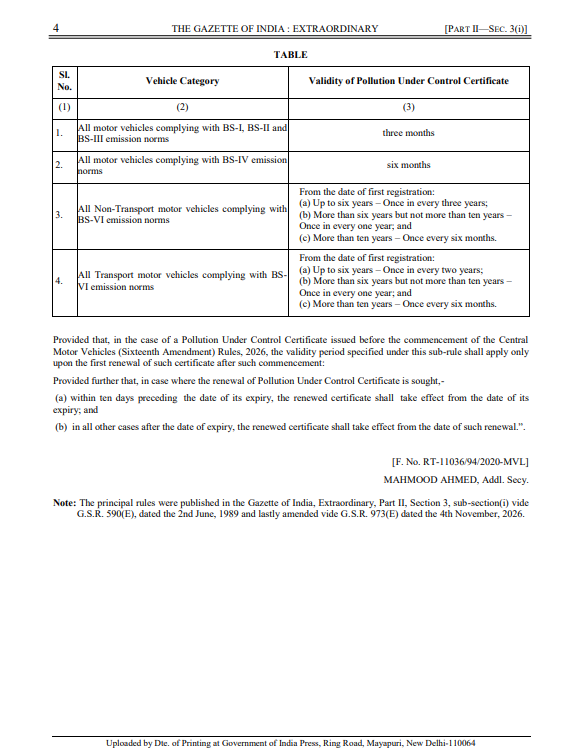
Big relief for private BS-VI vehicle owners!
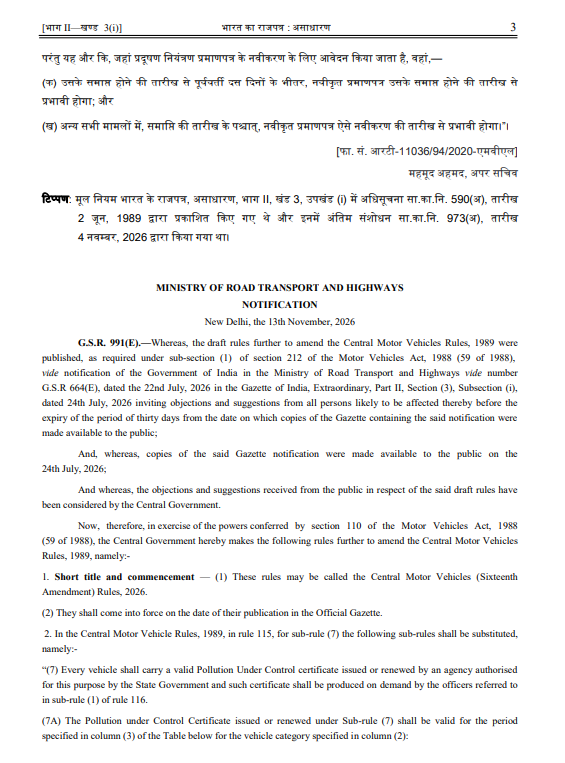
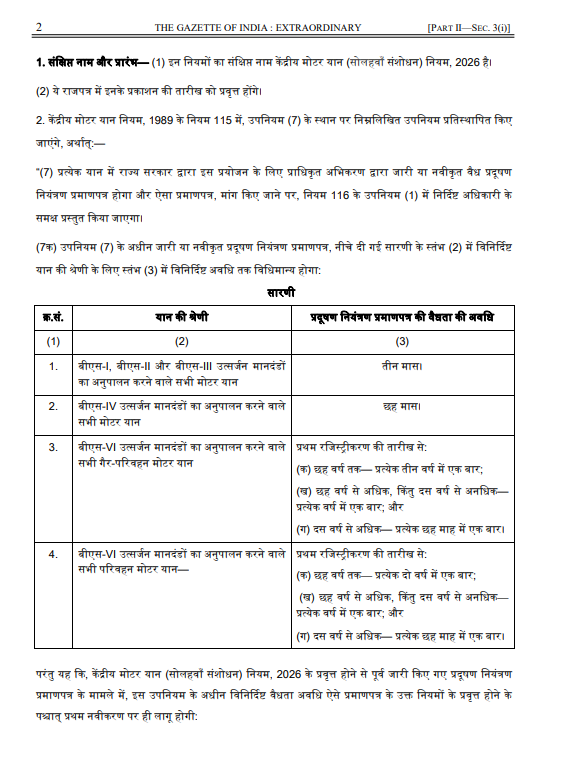
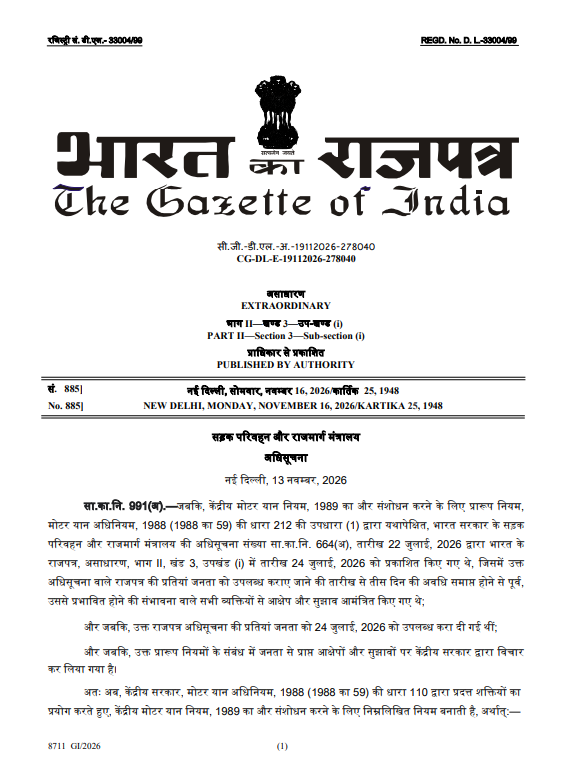
No more annual PUC renewals for newer private vehicles. Under the revised rules, BS-VI non-transport vehicles up to six years old will now require a Pollution Under Control certificate only once every three years.
That means fewer trips to testing centres, reduced renewal expenses and much less compliance hassle for vehicle owners.
A practical reform that makes everyday compliance easier while keeping pollution checks relevant to the age and category of the vehicle. Less paperwork, more convenience, without compromising on cleaner mobility.
A motor insurance policy should protect you from financial shocks, not deliver one when you make a claim.
IRDAI’s move to standardise policy structures and disclose individual covers separately is welcome. But breaking insurance into separate components also places greater responsibility on customers to understand what each cover protects and what they give up by opting out.
The distinction between legal liability towards occupants and personal accident cover, particularly for family members, is one example.
Insurers must explain these differences in plain language. Greater choice is meaningful only when customers understand the consequences of their decisions and can choose the protection they actually need.
This is insane!
That may look like some impressive driving skill, but it’s anything but cool when you’re putting the lives of your passengers and everyone else on the road at risk.
Mountain roads are narrow, winding and often have vehicles approaching from the opposite direction. No matter how experienced you are, sharp turns leave very little room to react or correct a mistake. One moment of reckless driving can turn into a fatal accident.
Drive within the limits, slow down at bends and remember that a public road is not a racing track.
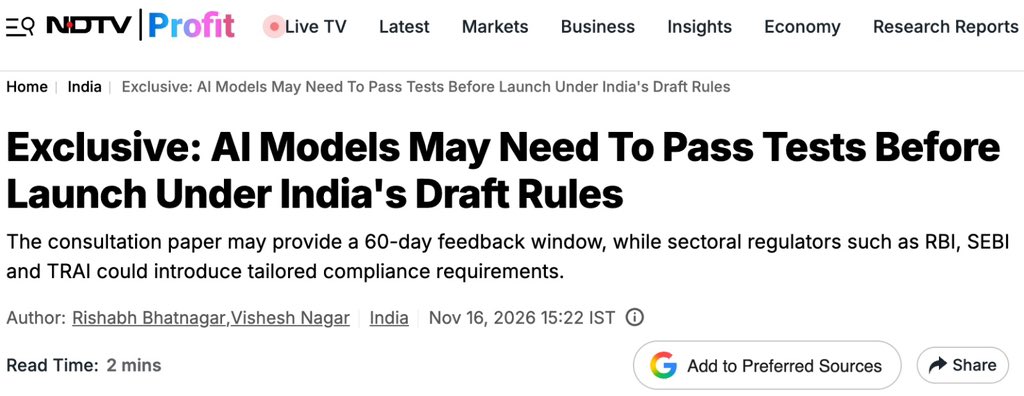
Regulating AI requires a risk-based approach, not a one-size-fits-all framework. India’s consideration of separate safety requirements for frontier AI models is a step in the right direction.
The key will be defining these models clearly, establishing credible evaluation standards and ensuring that safeguards are proportionate to their capabilities and potential risks.
India must build a framework that strengthens public trust without creating regulatory barriers to innovation. The objective should be responsible AI development, not regulatory overreach.
India wants to ride the AI boom, but not without strict guardrails.
New Delhi is considering mandatory safety testing before powerful AI models can be launched, potentially affecting companies like OpenAI, Anthropic and Google $GOOGL.
A draft AI law is nearing completion, with a possible 60-day public consultation before legislation moves forward.
While the US is racing to dominate AI development, India is increasingly focused on controlling the risks of deployment.
For AI companies, access to one of the world's largest digital markets could come with another layer of regulatory compliance.
Regulating AI requires a risk-based approach, not a one-size-fits-all framework. India’s consideration of separate safety requirements for frontier AI models is a step in the right direction.
The key will be defining these models clearly, establishing credible evaluation standards and ensuring that safeguards are proportionate to their capabilities and potential risks.
India must build a framework that strengthens public trust without creating regulatory barriers to innovation. The objective should be responsible AI development, not regulatory overreach.
We keep hearing about fines, penalties and enforcement to make citizens follow traffic rules. But what about the authorities responsible for keeping our roads safe?
A speed breaker without markings or reflectors on Greater Noida West’s 130-metre road sent a motorcyclist flying off his bike.
How is this basic negligence acceptable? If citizens are expected to follow road safety rules, shouldn’t authorities be held equally accountable for failing to provide safe roads?
Speed thrills but kills. Time and again, this has been proved.
200 kmph in a tunnel with an 80 kmph speed limit. Seriously, what makes someone think it’s okay to drive at that speed?
A 22-year-old has lost his life in this horrific crash. Whether it was for the thrill, to show off or because of some urgency, no reason is worth putting your life on the line.
I just wish people would understand that roads are not racetracks and one moment of recklessness can cost a life.
Whether it was cleaning their homes or cleaning up their driving records, people embraced the spirit of a fresh start this Diwali!
3,250 challans cleared and ₹40.48 lakh in fines paid in just 3 days on Challanwala.
When will people stop treating public roads as their private playgrounds and putting everyone's lives at risk with such reckless stunts?
Hardly a day passes without some incident of irresponsible behaviour on our roads, endangering innocent commuters.
Such people show a blatant disregard for traffic laws and the safety of others. Public roads are meant for everyone, not for seeking a few moments of social media fame at the cost of human lives.
🚨 Dost ko mithai toh sab dete hain, iss baar kuch hatke gift karte hain! 🎁😂
Dost ka challan pending hai? Toh bhai, uski tension kam karne ka time aa gaya! 😎
📲 Abhi check karo: https://t.co/5ri9lCgCf0
Absolutely not going to happen! I see it quite differently. AI is more likely to strengthen the legal profession than wipe it out. It can make research, documentation and case preparation far more efficient, but the practice of law goes well beyond these tasks.
Interpreting the law, assessing evidence, understanding human circumstances and exercising independent judgement require experience, reasoning and accountability. These cannot simply be automated.
AI will be a powerful aid to lawyers, but human judgement will remain at the heart of the profession. I believe it will significantly raise the quality and professionalism of legal practice.
🚨 “50% of all entry-level lawyers, consultants, and finance professionals will be completely wiped out within the next 5 years.”
- Anthropic founder Dario Amodei.
Policy that moves people forward.
IMPACT Bharat joins #EVOI2026 as Strategic Partner with @IndiatechO & @ConsumerVoiceIn .
4 Nov | 5–7 PM
Constitution Club of India, Delhi
#Convo
Register: https://t.co/jWsTPX6o8V
The more we discover about the universe, the more we realise how little we truly understand. Even something as familiar as Earth's motion is far more complex than it appears.
Earth revolves around the Sun, but the Sun itself is moving through the Milky Way, carrying the entire Solar System along with it.
In essence, we are not just orbiting the Sun. We are travelling through the galaxy on a journey that has been unfolding for billions of years.
Every discovery gives us a clearer picture of the cosmos, while revealing just how much remains beyond our understanding.
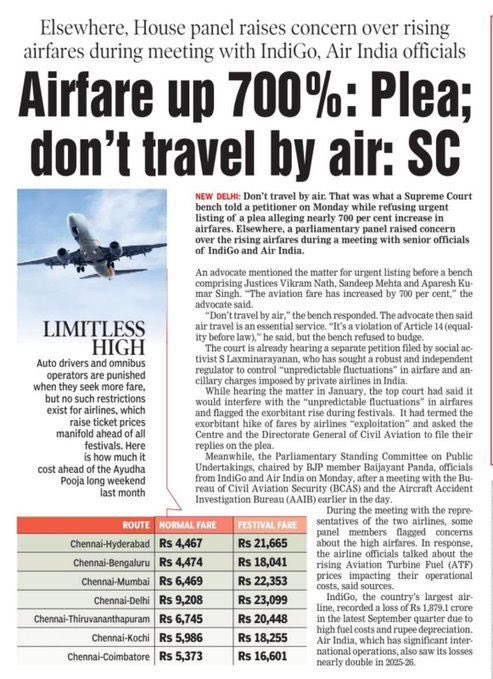
Dynamic pricing is a common commercial practice across the world, and is by no means limited to the aviation industry. It is prevalent across sectors where demand fluctuates and supply is constrained.
Anyone who has booked a bus or train ticket during Diwali, Chhath, other festive seasons or long weekends, or taken a cab during rush hour, knows how prices rise when demand increases and ease when demand falls. The same principle applies to flights, hotels and several other services.
Airlines operate with finite aircraft, crew and seat capacity and cannot expand operations overnight to meet temporary festive demand. With volatile fuel prices, geopolitical disruptions and rising operating costs adding to the pressure, higher fares do not automatically amount to exploitation.
How many more such horrific accidents before people realise that reckless driving is not just putting their own lives at risk, but everyone else’s too?
In this incident on Gurgaon’s Golf Course Road, one speeding SUV lost control and sent multiple cars crashing, leaving a trail of destruction. People who were simply going about their day had to pay the price for someone else’s recklessness.
Driving is a responsibility. It means making sure you reach home safely, the people travelling with you reach home safely, and everyone sharing the road with you gets home too.
Strict enforcement and harsher punishment are absolutely necessary. But no punishment can bring back a life lost or undo the trauma of a family shattered. The responsibility begins with each one of us behind the wheel. When will we start treating it that way?
Absolutely insane!
Revolver for a small incident on Road 🚨
Someone gets into a minor road dispute and thinks it's okay to pull out a gun and threaten another person's life? What kind of lawlessness is this? The audacity to do this in public is deeply disturbing. Such people must face strict legal action. There has to be accountability, not just outrage after the incident.
Is there no fear of the law anymore?