Mijn afscheidsverhaal vandaag in het FD over mijn bijna zes jaar in China, een vat vol tegenstrijdigheden: 'Correspondent zijn in China is leven in parallelle dimensies.'
https://t.co/69e6aqn2lz #FD#Buitenland
For English readers a translated version:
https://t.co/V7SdhptqBV
As foreign journalists in China we all knew we were being tracked. But it still is a weird sensation to come across a test system for tracking foreign nationals with mugshots, passport info and other data on me and other China (former) China correspondents.
EXCLUSIVE: How the track foreigners in China - We got rare access to demo system developed by the Ministry of Public Security in China for the prefecture of Zhangjiakou, to track and surveil foreigners visiting or being residents ( actually it applies to most nationals as well, but in this case it seems to be aimed at foreigners ). It is officially known as "Dynamic control platform for overseas personnel". 1/12
Before Air Force One left China, all members of the U.S. delegation threw away the souvenirs and gifts given to them by the Chinese side, including gifts, badges, brooches, souvenirs, and cell phones.
Before Air Force One left China, all members of the U.S. delegation threw away the souvenirs and gifts given to them by the Chinese side, including gifts, badges, brooches, souvenirs, and cell phones.
The man who built the iPhone just entered China carrying a burner phone because his own device is considered a security liability in Beijing. Tim Cook’s final diplomatic act before stepping down as Apple CEO on September 1 is negotiating in a country where American intelligence considers every piece of inbound electronics a target for state-sponsored surveillance. The executive who spent a decade arguing Apple devices are the most secure consumer electronics on earth had to leave them at the airport.
On May 13, President Trump arrived in Beijing for a summit with Xi Jinping accompanied by the most concentrated delegation of American corporate power ever assembled on a single diplomatic mission. Cook was there. Elon Musk rode Air Force One. Jensen Huang joined at the last minute during a refueling stop in Alaska because the semiconductor question was too urgent to leave him behind. Larry Fink of BlackRock, David Solomon of Goldman Sachs, Stephen Schwarzman of Blackstone, Kelly Ortberg of Boeing, Jane Fraser of Citi, Cristiano Amon of Qualcomm, Sanjay Mehrotra of Micron, and Larry Culp of GE Aerospace were all on the manifest.
Every one of them left personal phones in the United States. Every one carried a clean, stripped temporary device with no stored data and no access to corporate systems. Plugging any device into any USB port in China risks data exfiltration through what federal agencies call juice jacking. The protocol has been standard for senior US government travel to China for over a decade. What is new is the roster.
The CEOs of the companies building the $700 billion AI infrastructure, designing the chips, manufacturing the devices, managing the capital, and running the supply chains all entered the country that sits on the other side of every one of those dependencies, carrying phones that could not send an email.
Cook is negotiating Apple’s supply chain future in a country where Apple manufactures the majority of its products. He is doing so in his final months as CEO, weeks after announcing John Ternus as his successor, and days after Apple reached a preliminary deal with Intel to manufacture chips in the United States as a hedge against exactly this kind of dependency. The same month. The same executive. One hand reaching toward American factories. The other hand reaching into Beijing with a disposable phone.
Huang’s addition is the most revealing signal. Nvidia was initially absent from the list. The chip designer whose GPUs power every AI data center and the $700 billion capex buildout was not originally invited. He joined during a refueling stop in Anchorage because the semiconductor question, export controls on advanced chips China wants and America restricts, could not be discussed without the man who designs them.
Trump delayed this trip from March because of the Iran war. He arrived in Beijing while the ceasefire he negotiated is on what he called “massive life support.” He is negotiating the most important bilateral trade relationship on earth while simultaneously managing a military conflict in the Persian Gulf. The delegation carried burner phones because China is hostile to American electronics. But the real vulnerability is not the device. It is the dependency the device represents. Every executive in that room runs a company that cannot fully function without the country they are visiting. The phones were stripped. The supply chains were not.
https://t.co/xmK0gJ0TfI
The man who built the iPhone just entered China carrying a burner phone because his own device is considered a security liability in Beijing. Tim Cook’s final diplomatic act before stepping down as Apple CEO on September 1 is negotiating in a country where American intelligence considers every piece of inbound electronics a target for state-sponsored surveillance. The executive who spent a decade arguing Apple devices are the most secure consumer electronics on earth had to leave them at the airport.
On May 13, President Trump arrived in Beijing for a summit with Xi Jinping accompanied by the most concentrated delegation of American corporate power ever assembled on a single diplomatic mission. Cook was there. Elon Musk rode Air Force One. Jensen Huang joined at the last minute during a refueling stop in Alaska because the semiconductor question was too urgent to leave him behind. Larry Fink of BlackRock, David Solomon of Goldman Sachs, Stephen Schwarzman of Blackstone, Kelly Ortberg of Boeing, Jane Fraser of Citi, Cristiano Amon of Qualcomm, Sanjay Mehrotra of Micron, and Larry Culp of GE Aerospace were all on the manifest.
Every one of them left personal phones in the United States. Every one carried a clean, stripped temporary device with no stored data and no access to corporate systems. Plugging any device into any USB port in China risks data exfiltration through what federal agencies call juice jacking. The protocol has been standard for senior US government travel to China for over a decade. What is new is the roster.
The CEOs of the companies building the $700 billion AI infrastructure, designing the chips, manufacturing the devices, managing the capital, and running the supply chains all entered the country that sits on the other side of every one of those dependencies, carrying phones that could not send an email.
Cook is negotiating Apple’s supply chain future in a country where Apple manufactures the majority of its products. He is doing so in his final months as CEO, weeks after announcing John Ternus as his successor, and days after Apple reached a preliminary deal with Intel to manufacture chips in the United States as a hedge against exactly this kind of dependency. The same month. The same executive. One hand reaching toward American factories. The other hand reaching into Beijing with a disposable phone.
Huang’s addition is the most revealing signal. Nvidia was initially absent from the list. The chip designer whose GPUs power every AI data center and the $700 billion capex buildout was not originally invited. He joined during a refueling stop in Anchorage because the semiconductor question, export controls on advanced chips China wants and America restricts, could not be discussed without the man who designs them.
Trump delayed this trip from March because of the Iran war. He arrived in Beijing while the ceasefire he negotiated is on what he called “massive life support.” He is negotiating the most important bilateral trade relationship on earth while simultaneously managing a military conflict in the Persian Gulf. The delegation carried burner phones because China is hostile to American electronics. But the real vulnerability is not the device. It is the dependency the device represents. Every executive in that room runs a company that cannot fully function without the country they are visiting. The phones were stripped. The supply chains were not.
https://t.co/xmK0gJ0TfI
Covid throwback Saturday; reminds me when I left with the second European evacuation flight from Wuhan. Couple of months later it was mayhem everywhere.
Joe @TheStalwart and Tracy @tracyalloway have such a banger of an Odd Lots ep with Mariana Mazzucato. Sent me on a long exploration of how different govs are actually using AI for public good. Some excellent examples from China! https://t.co/NQLgreghXt
Belgian foreign minister Prévot, back from China, says EU must endure any retaliation from Beijing to save its industry
Politico: "Is Europe prepared to endure temporary hardship to stand behind omeasures to eventually reestablish a partnership based on level playing field?"
So China. The Foreign Corespondents Club @fccchina was told for many year we’re an ‘illegal organization’ because we were not an approved by the state ngo to reside in BJ. But if you asked where can we get accredited and would we get approval, the answer wad always ‘no’.
Fun video - the EU delegation in China has not been allowed to open an official WeChat account.
Tencent told diplomats they needed MFA approval, MFA told them it's a private company matter - so the delegation, in limbo, goes without an official account.
NIEUWS: De hoogste privacy-adviseur van Logius, onderdeel van BZK, slaat alarm: de overname van DigiD bedreigt de veiligheid van Nederland.
CPO Pieter van Oordt waarschuwt publiekelijk om overname door ‘t Amerikaanse Kyndryl tegen te houden:
https://t.co/JCfQ0BFLzu
Hoorde net @KooyJan op @NPORadio1 erover. Hoe ziet die repressie eruit in praktijk? Veel fysieke kruisen zijn laatste jaren van kerken verwijderd. Mensen mogen alleen in kleine groepjes bij elkaar komen en organisator moet voor elke dienst gastlijst inleveren bij wijkpolitie.
NEW: “A decade into Xi Jinping’s Sinicization campaign and nearly eight years since the 2018 Holy See-China agreement, Catholics in China face escalating repression that violates their religious freedoms” - Yalkun Uluyol, China researcher at HRW
“Pope Leo XIV should urgently review the agreement and press Beijing to end the persecution and intimidation of underground churches, clergy, and worshipers.”
Read the report👇https://t.co/CLsvHzTKOi
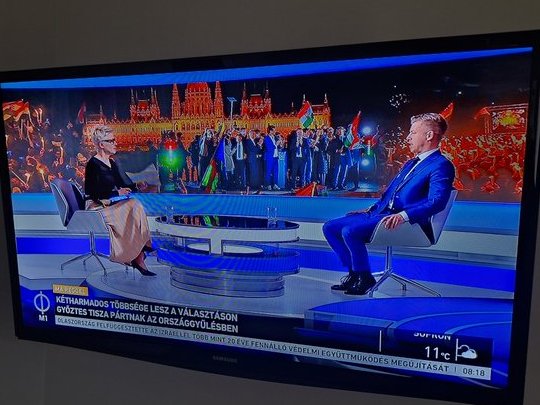
Yeni Macaristan Başbakanı Peter Magyar, devlet televizyonu M1'de ilk defa konuk alındı ve şok açıklamalarda bulundu:
-Bu kanalın haber servisini askıya alacağız. Bu benimle ilgili değil, intikam peşinde değilim. Halkımız gerçeği yansıtan bir haberciliği hak ediyor.
-Orban döneminde iş insanlarına ve vakıflara verilen varlıkları kamulaştıracağız.
-Orban'a yakın Mathias Corvinus Collegium Vakfı'na MOL (Petrol şirketi) ve Gedeon Richter'in (İlaç şirketi) %10'u bedelsiz devredildi. Bu hisseleri geri alacağız.
-16 yıllık Orban döneminin ardından bu ülkede 400 bin Macar çocuğu derin yoksulluk yaşıyor.
-Cumhurbaşkanı Sulyok, benim gözümde ve halkın gözünde artık bu ülkenin cumhurbaşkanı değil.
-(Sunucunun kontra olarak Zelenski ile görüşmesini sorması üzerine) Bu esprinizi anlıyorum, hoşuma da gidiyor. Ama artık bu göndermelerinizin bir anlamı kalmadı.
-Size göre Almanya çöktü, orada internet yok, insanlar seks bile yapmıyor. Macar halkı size gülüyordu.
-Bu kanalda küçük çocuklarımın bile benimle konuşmadığı söylendi, oysa çocuklarım benimle birlikte yaşıyor.
-(Sunucunun sözünü kesmesi üzerine) Bu stüdyoda hiçbir sunucu, Macaristan'ın en yozlaşmış ve en yalancı başbakanının sözünü kesmeye cesaret edememişti.
-(Haber servisini kapatma kararının yasal dayanağı sorulunca) Bu kanalda birinin beni yasayı ihlal etmekle suçlaması, bir hırsızın polisi suçlaması gibi görünüyor.
European companies have been for years between ‘a rock and a hard place’ as the EU Chamber calls it, with all the introduced legislation the past years on cybersecurity, privacy and data. Chinese laws are always on purpose very vague. Still, many companies keep staying there🤷🏻♀️
European businesses are seriously spooked by China's new supply chain law
EU Chamber in China statement says companies will struggle to comply with both EU rules and Chinese ones. Absolutely caught in a bind
🦔A researcher invented a fake eye condition called bixonimania, uploaded two obviously fraudulent papers about it to an academic server, and watched major AI systems present it as real medicine within weeks.
The fake papers thanked Starfleet Academy, cited funding from the Professor Sideshow Bob Foundation and the University of Fellowship of the Ring, and stated mid-paper that the entire thing was made up. Google's Gemini told users it was caused by blue light. Perplexity cited its prevalence at one in 90,000 people.
ChatGPT advised users whether their symptoms matched. The fake research was then cited in a peer-reviewed journal that only retracted it after Nature contacted the publisher.
My Take
The researcher made the papers as obviously fake as possible on purpose. The AI systems didn't catch it. Neither did the human researchers who cited it in real journals, which means people are feeding AI-generated references into their work without reading what they're actually citing.
I've covered the FDA using AI for drug review, the NYC hospital CEO ready to replace radiologists, and ChatGPT Health launching this year. All of that is happening in the same environment where a condition funded by a Simpsons character and endorsed by the crew of the Enterprise was being presented as emerging medical consensus. The people making these deployment decisions seem to believe the pipeline from research to AI to patient is more supervised than it actually is. This experiment suggests it isn't supervised much at all.
Hedgie🤗
https://t.co/8Kg8FOrgHW
Good piece (and thread) by Lizzi Lee. She notes that "In fact Xi Jinping has long been frustrated with his bureaucrats. He complained about officials who “rack up a mountain of debt, pat their butts, and walk away,” chasing short-term growth at long-term cost."
The irony, of course, is that wasted investment, rising debt, and a short-term orientation might not be caused by misaligned incentives or bureaucratic incompetence so much as by Beijing's growth model itself. The problem, in other words, is structural – because China cannot get consumption growth to outpace GDP growth, it cannot change bureaucratic behavior as long as it continues to set high GDP growth target.
Getting consumption growth to outpace GDP growth in a meaningful way would require either
-- a productivity miracle of historic proportions, one in which higher productivity shows up almost wholly as higher household income rather than as higher business profits or government revenue,
-- a substantial (and possibly disruptive) redistribution of total income (GDP) from government, businesses and the rich to ordinary households, or
-- much slower GDP growth.
The first outcome would obviously be the preferred one, but it may depend too much on wishful thinking, especially as productivity growth has actually been declining for years. The second outcome would require major (and possibly disruptive) structural reforms that so far Beijing has been unwilling to consider, probably because these would anyway lead to the third outcome, which Beijing is so far unwilling to accept.
This means that the only way local governments can meet Beijing's GDP growth target is by directing large amounts of cheap credit into rising property, infrastructure and manufacturing investment, whether or not these investments are economically justified. Perhaps not surprisingly, this is effectively what those much-criticized officials have done. Their behavior has responded more or less correctly to their incentives, which in turn were not the result of absent-mindedness but rather of the country's economic growth model.
The fault, in other words, may lie not in the inefficient implementation of economic policies so much as in the policies themselves.
DOJ issued a truly stunning indictment today, unveiling a massive AI chip smuggling operation to China--led by Wally Liaw, the Co-Founder, Board Member, and Senior Vice President of Supermicro, a Fortune 500 company and one of the largest U.S. AI server manufacturers.
The operation smuggled over $2.5 billion worth of chips to China, including Hopper and Blackwell chips. It is unsurprising that China would seek to illegally obtain U.S. chips, given how much better they are than Chinese chips. But it is appalling that leadership figures in major U.S. semiconductor companies would actively enable Chinese efforts to obtain banned AI chips.
Many U.S. companies have long denied that chip smuggling to China is happening. And now we know that it is not just happening, but it is pervasive--and individuals high up in some of the most important companies in the AI supply chain were actively supporting those smuggling operations. Policy changes are urgently needed to close loopholes in AI chip export controls and stop Chinese smuggling.
First, we need to know where these chips are going: all AI chip exports to Southeast Asia (the nexus of Chinese smuggling operations, including this operation), and potentially globally, must require a U.S. export license.
Second, Chinese companies inside the United States should not be allowed to purchase AI chips. It is absurd that the only country in which Chinese companies can buy AI chips is the United States itself, a loophole that DOJ has highlighted in past indictments that Chinese smugglers routinely exploit.
And third, much tighter compliance measures are needed by U.S. companies. U.S. companies have demonstrated that they cannot be trusted to self-police. Companies must have stricter end-use reporting requirements, and/or face stricter liability. Export control enforcement must become more like financial sanctions enforcement if it is to be effective.
https://t.co/VK6g8uoIVz
Iran just offered to reopen the Strait of Hormuz. But only if you pay in yuan.
CNN confirms, citing a senior Iranian official, that Tehran is considering allowing a limited number of oil tankers through the Strait provided the cargo is traded in Chinese yuan. Not dollars. Not euros. Yuan. The waterway that carries 20% of global oil, that seven P&I clubs closed through insurance, that a wounded Supreme Leader ordered permanently shut, that the United States just bombed the military defences of Kharg Island to force open, is being offered back to the world on one condition: the currency changes.
This is the most consequential sentence of the war that nobody in the oil market has priced.
The petrodollar system was born in 1974 when Saudi Arabia agreed to price oil exclusively in dollars in exchange for American military protection. That agreement has governed global energy trade for fifty-two years. Every barrel of crude on Earth has been denominated in dollars. Every central bank holds dollar reserves because oil requires them. Every nation that imports energy must first acquire dollars to pay for it. The system is the foundation of American financial hegemony, and Iran just proposed replacing it with yuan for the world’s most critical chokepoint.
China is already the model. Eighty to ninety percent of Iranian crude exports to China settle in yuan or barter through CIPS, the Chinese cross-border payment system that processed 175 trillion yuan, approximately $24.5 trillion, in 2025, a 43% increase year on year. Since 28 February, 11.7 to 16.5 million barrels of Iranian crude have transited the Strait to China via shadow fleet under IRGC protection while every other nation’s shipping is locked out. China pays in yuan. China’s tankers move freely. Everyone else burns or reroutes.
The war was supposed to force the Strait open. Instead it is being reopened selectively, on Iran’s terms, in China’s currency. America bombed Kharg to demonstrate it controls the island. Iran responded by demonstrating it controls the condition of passage. The military targets are rubble but the negotiating position is intact: the Strait opens when the currency changes.
The implications cascade across every domain. If yuan-denominated tankers begin transiting Hormuz while dollar-denominated tankers remain locked out by insurance, mines, and IRGC targeting, the war produces a bifurcated oil market: yuan barrels for China and BRICS partners at Iranian-discounted prices, dollar barrels for the West at war-premium prices. Two prices for the same commodity. Two currencies for the same waterway. Two systems for the same barrel of oil. The fragmentation the dollar was designed to prevent is being accelerated by the war that was supposed to preserve it.
China imports 45% of its crude through the Hormuz region. It holds 90 to 130 days of strategic reserves. Its teapot refineries process Iranian crude at $9 to $12 below Brent. Its CIPS system bypasses every Western sanction. And now the country whose Supreme Leader cannot stand is offering Beijing the one thing no amount of American airpower can bomb: a currency alternative for energy transit.
The Strait is not reopening for ships. It is reopening for yuan. And the fifty-two-year-old system that priced every barrel in dollars just met the war that may end it.
https://t.co/eMrt5qYYst