🚨 Bitnami is deprecating its free image catalog.
⚠️ Brownouts have started
⛔️ Full shutdown Sept 29
Risk: ImagePullBackOff, stale images, broken Helm charts.
👉 How to prepare: audit, update, override.
Full breakdown + mitigation tips ↓
This month's Detect covers:
- Lessons from an LLM–triggered outage
- How to get more out of OpenTelemetry with Common Reliability Enumerations (CREs)
- Tips for avoiding application migration pain
- Quick hits on recent Google & Cloudflare incidents
Link below 👇🏼
Watch/Listen to the episode on your preferred platform:
PlatformEngineeringPod: https://t.co/1uEznIFyXQ
Apple Podcasts: https://t.co/9Cbi4dJTYq
YouTube: https://t.co/EQMjCEuhav
👏 Our Co-founder and CTO, Tony Meehan, joins the #platformengineering podcast with @coryodaniel . They discuss how #CREs are transforming reliability and making it easier for teams to keep their applications up and running in the age of AI.
Link to the full episode below!
there's a lot of active debate about the future of open source. @prequel_dev believes in open source and we are excited to announce that CRE and preq are now 100% open.
here are the details...
@snowboardvstree and I founded @prequel_dev to bring our vision of community-driven reliability to life.
A world where you can seamlessly run, build, and share problem detectors for both common and obscure issues.
If you know what it feels like hunting through logs, dashboards, and metrics trying to figure out if and why something is broken - this future may be compelling to you.
Until now, only Prequel customers were able to take part in this vision.
Today, we’re excited to open two projects that enable anyone to participate.
What we shipped
cre – an open, structured standard for sharing and operationalizing knowledge of reliability problems (https://t.co/RcSAp09Tux)
preq (“preek”) – a free and open community-driven reliability problem detector that consumes CREs (https://t.co/zNG2oGQFVs)
These projects are released under the Apache 2 license and enable any engineer to more rapidly find bugs, misconfigurations and developer anti-patterns based on community knowledge
We're excited to see the early excitement for these projects.
"At a previous company, we built precise problem detectors to proactively uncover failure within our stack, but most engineering teams haven't historically had the resources, time, or technology to do this. What excites me about CREs and preq is that they make problem detection available to everyone." - Kelsey Hightower
Community-Driven Problem Detection
We’ve already experienced first hand the power that collective knowledge can bring to detection challenges. For example, in security, technologies, like Nessus for vulnerabilities, Yara for malware, and Sublime Security for email threats apply community knowledge to take the burden off of internal teams.
When it comes to reliability, it doesn’t make sense that every engineering team is tackling reliability problem detection in a manual and isolated way. This is especially true when over 81% of underlying problems (according to our most recent analysis), have already been seen by an engineer at another company.
Despite advancements in observability, the application monitoring process hasn’t changed. We store data in new places, label it in different ways, but the task of figuring out what’s happening, why it’s happening, and if it matters still rests on your shoulders.
You are the problem detector.
Enter CRE – Common Reliability Enumeration
A CRE is essentially a specification of a known problem: it includes a unique ID (e.g. “CRE-2024-0007”), a description of the issue, why it happens (cause), what could result (impact), and how to fix or mitigate it.
CREs are to reliability what Common Vulnerabilities and Exposures (CVEs) are to security.
Prequel Rules - A Powerful Syntax for Detecting Failure
Importantly, CREs also define the conditions to detect the problem described in the CRE. This is done by embedding the Prequel rule syntax directly in the CRE YAML. Each rule is designed to be readable by humans and machines.
The rule syntax is purpose-built – serving as a domain-specific language tailored to express reliability detection patterns against event data. This rule syntax is uniquely designed with distributed systems and asynchronous failure in mind, and it’s implemented in YAML to be easy to read and write.
preq – A Free, Open, CRE-Powered Problem Detector
preq (pronounced “preek”) is a lightweight engine that runs CREs against your applications.
We wanted running preq to be as simple as running grep, while supporting the powerful capabilities embedded in CRE rules.
You can install preq in a number of ways.
Download a standalone binary for Linux, macOS, or Windows. You can pipe data to it or configure data sources.
cat /var/log/syslog | preq
Install the Kubernetes kubectl plugin via krew for easy in-cluster use. If you have the Krew package manager installed, just run: kubectl krew install preq
kubectl preq pg17-postgresql-0
You can get started here: https://t.co/0lb04HwOwE
Data Privacy
preq is built to be run where your application lives whether that is on a VM, in a Kubernetes cluster, or on your laptop. In practice, this architecture aligns with Prequel’s philosophy of bringing the detector to the data, not vice versa
Hasn’t AI Solved This Problem?
In 2025, there is a lot of focus on building the agentic SRE. We are extremely bullish on an AI-assisted future and believe the results will be better than the prior AIOps era, which generally produced more noise than value.
But engineering teams have some obstacles on the AI-adoption journey:
1) LLMs excel when they’re fed the right, high‑signal inputs—not unfiltered torrents of logs, metrics, and traces.
2) Piping all of your telemetry through a foundational model is price prohibitive. Teams need a way to slash token usage and speed up responses.
3) Without guidance, models are left to make inferences from noisy data, which often leads to generic or unverified advice, at best, and hallucinations, at worst.
4) Data privacy remains a concern as AI-adoption grows.
CREs and AI are a better together story. The combination unlocks powerful possibilities.
You can read more in this detailed blog below describing how it all works.
Excited to get your feedback.
#sre #reliability #engineering #observability
there's a lot of active debate about the future of open source. @prequel_dev believes in open source and we are excited to announce that CRE and preq are now 100% open.
here are the details...
@snowboardvstree and I founded @prequel_dev to bring our vision of community-driven reliability to life.
A world where you can seamlessly run, build, and share problem detectors for both common and obscure issues.
If you know what it feels like hunting through logs, dashboards, and metrics trying to figure out if and why something is broken - this future may be compelling to you.
Until now, only Prequel customers were able to take part in this vision.
Today, we’re excited to open two projects that enable anyone to participate.
What we shipped
cre – an open, structured standard for sharing and operationalizing knowledge of reliability problems (https://t.co/RcSAp09Tux)
preq (“preek”) – a free and open community-driven reliability problem detector that consumes CREs (https://t.co/zNG2oGQFVs)
These projects are released under the Apache 2 license and enable any engineer to more rapidly find bugs, misconfigurations and developer anti-patterns based on community knowledge
We're excited to see the early excitement for these projects.
"At a previous company, we built precise problem detectors to proactively uncover failure within our stack, but most engineering teams haven't historically had the resources, time, or technology to do this. What excites me about CREs and preq is that they make problem detection available to everyone." - Kelsey Hightower
Community-Driven Problem Detection
We’ve already experienced first hand the power that collective knowledge can bring to detection challenges. For example, in security, technologies, like Nessus for vulnerabilities, Yara for malware, and Sublime Security for email threats apply community knowledge to take the burden off of internal teams.
When it comes to reliability, it doesn’t make sense that every engineering team is tackling reliability problem detection in a manual and isolated way. This is especially true when over 81% of underlying problems (according to our most recent analysis), have already been seen by an engineer at another company.
Despite advancements in observability, the application monitoring process hasn’t changed. We store data in new places, label it in different ways, but the task of figuring out what’s happening, why it’s happening, and if it matters still rests on your shoulders.
You are the problem detector.
Enter CRE – Common Reliability Enumeration
A CRE is essentially a specification of a known problem: it includes a unique ID (e.g. “CRE-2024-0007”), a description of the issue, why it happens (cause), what could result (impact), and how to fix or mitigate it.
CREs are to reliability what Common Vulnerabilities and Exposures (CVEs) are to security.
Prequel Rules - A Powerful Syntax for Detecting Failure
Importantly, CREs also define the conditions to detect the problem described in the CRE. This is done by embedding the Prequel rule syntax directly in the CRE YAML. Each rule is designed to be readable by humans and machines.
The rule syntax is purpose-built – serving as a domain-specific language tailored to express reliability detection patterns against event data. This rule syntax is uniquely designed with distributed systems and asynchronous failure in mind, and it’s implemented in YAML to be easy to read and write.
preq – A Free, Open, CRE-Powered Problem Detector
preq (pronounced “preek”) is a lightweight engine that runs CREs against your applications.
We wanted running preq to be as simple as running grep, while supporting the powerful capabilities embedded in CRE rules.
You can install preq in a number of ways.
Download a standalone binary for Linux, macOS, or Windows. You can pipe data to it or configure data sources.
cat /var/log/syslog | preq
Install the Kubernetes kubectl plugin via krew for easy in-cluster use. If you have the Krew package manager installed, just run: kubectl krew install preq
kubectl preq pg17-postgresql-0
You can get started here: https://t.co/0lb04HwOwE
Data Privacy
preq is built to be run where your application lives whether that is on a VM, in a Kubernetes cluster, or on your laptop. In practice, this architecture aligns with Prequel’s philosophy of bringing the detector to the data, not vice versa
Hasn’t AI Solved This Problem?
In 2025, there is a lot of focus on building the agentic SRE. We are extremely bullish on an AI-assisted future and believe the results will be better than the prior AIOps era, which generally produced more noise than value.
But engineering teams have some obstacles on the AI-adoption journey:
1) LLMs excel when they’re fed the right, high‑signal inputs—not unfiltered torrents of logs, metrics, and traces.
2) Piping all of your telemetry through a foundational model is price prohibitive. Teams need a way to slash token usage and speed up responses.
3) Without guidance, models are left to make inferences from noisy data, which often leads to generic or unverified advice, at best, and hallucinations, at worst.
4) Data privacy remains a concern as AI-adoption grows.
CREs and AI are a better together story. The combination unlocks powerful possibilities.
You can read more in this detailed blog below describing how it all works.
Excited to get your feedback.
#sre #reliability #engineering #observability
🚀 CRE + preq are now 100% open source.
🛠️ Community‑driven rules & problem detector to catch reliability issues fast — free for humans and AI agents.
⭐ repos https://t.co/hPaSHCTiLE https://t.co/GXOWpcletF
💻 binaries https://t.co/9hPlInb4Jg
📝 https://t.co/tkEDxNlCKJ
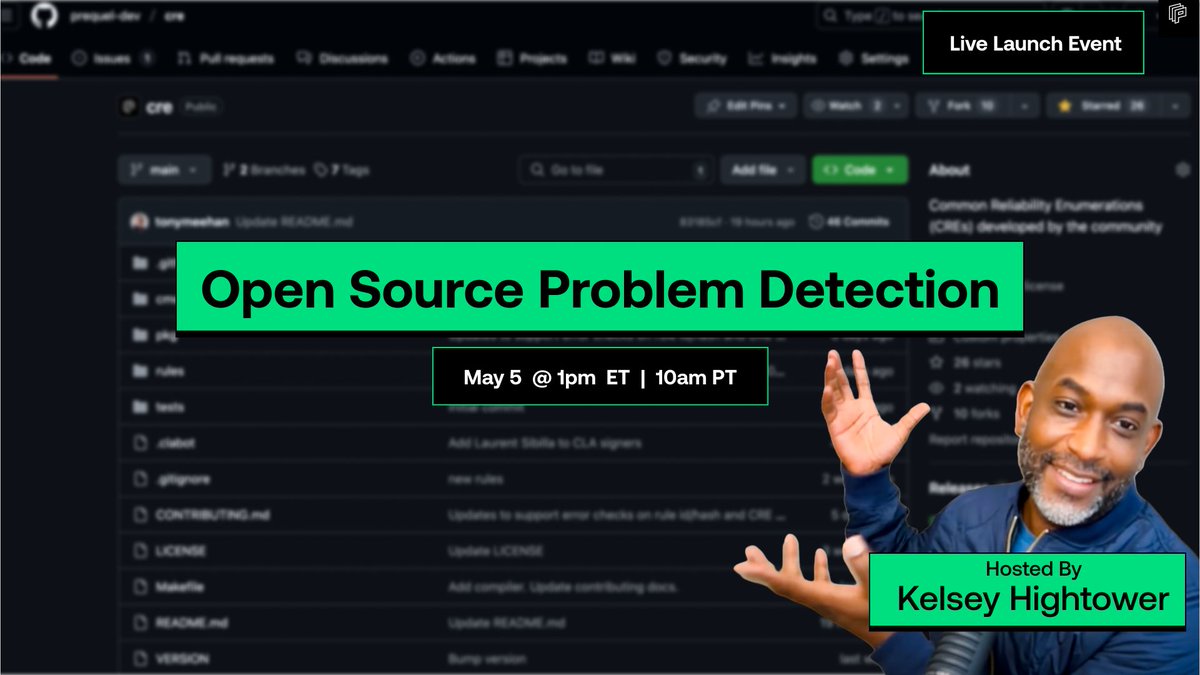
🚨 Dropping soon: Two new open source projects to spot bugs, misconfigs & other pitfalls — before they bite. Host: Kelsey Hightower + @snowboardvstree.
🧠 No pitch. No slides. Just code, Q&A, and instant repo access. ✅ Tricks you can use today. Be first in. #reliability
🚨 April issue of Detect is out — and it’s a banger.
✅ OpenAI 429s (spoiler: not just traffic)
✅ Cloudflare’s rollout gone wrong
✅ Memory lies devs still believe
✅ A smarter take on availability from Riot Games
For the engineers on the hook when things break.
Link below👇