Elon just created 4,400 millionaires in a single day.
400 of them are now worth over $100 million.
These aren't VCs. They're SpaceX employees, and the list includes welders, technicians, and cafeteria staff, because for two decades the company paid every level of the workforce in stock instead of higher salaries.
Juan Hernandez immigrated from Mexico and took a $28 an hour contractor welding job in 2015. He says he didn't even know what SpaceX was. The company gave him a $10,000 equity grant and let him buy more shares through payroll deductions. That stake is now worth $880,000.
Trevor Hise's parents wanted him to take a stable job at General Electric. He picked SpaceX instead, stayed 12 years, and accumulated over 100,000 shares. At the $135 listing price that's $13.5 million. He's 37 and semiretired. His words: "The magnitude of this has been ridiculous."
The most telling detail came before the listing. Over 100 employees quietly banded together and negotiated a group wealth management deal covering up to $5 billion, because none of them had ever needed a wealth manager before.
Software IPOs have minted millionaires for 30 years. This is the first one where the money went to the factory floor.
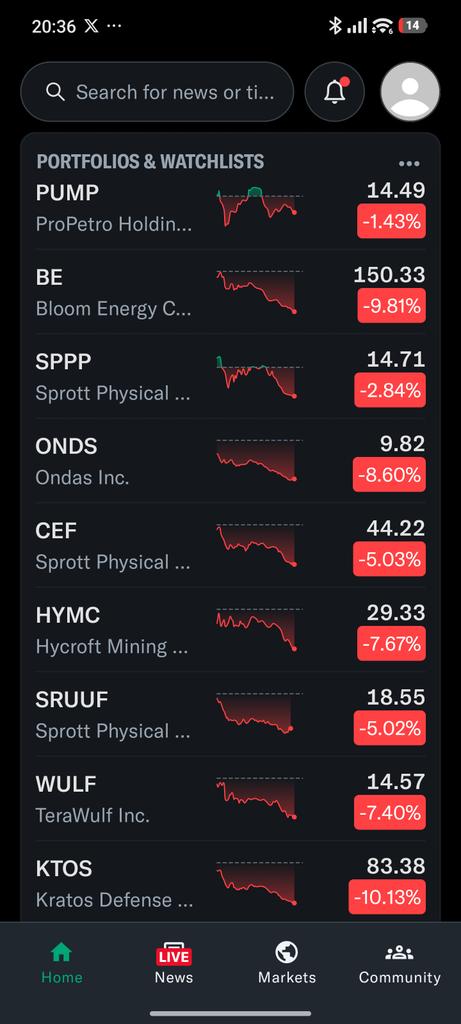
@BIG_HOMIE_1 I did not know you exited Onds!! I saw your other post on Iren.. I am considering exiting that too. Looking for underpriced long term holds. Could not time the dip like you .. but hey following.. 🫡
This is a threat of genocide and merits removal from office. The President’s mental faculties are collapsing and cannot be trusted.
To every individual in the President’s chain of command: You have a duty to refuse illegal orders. That includes carrying out this threat.
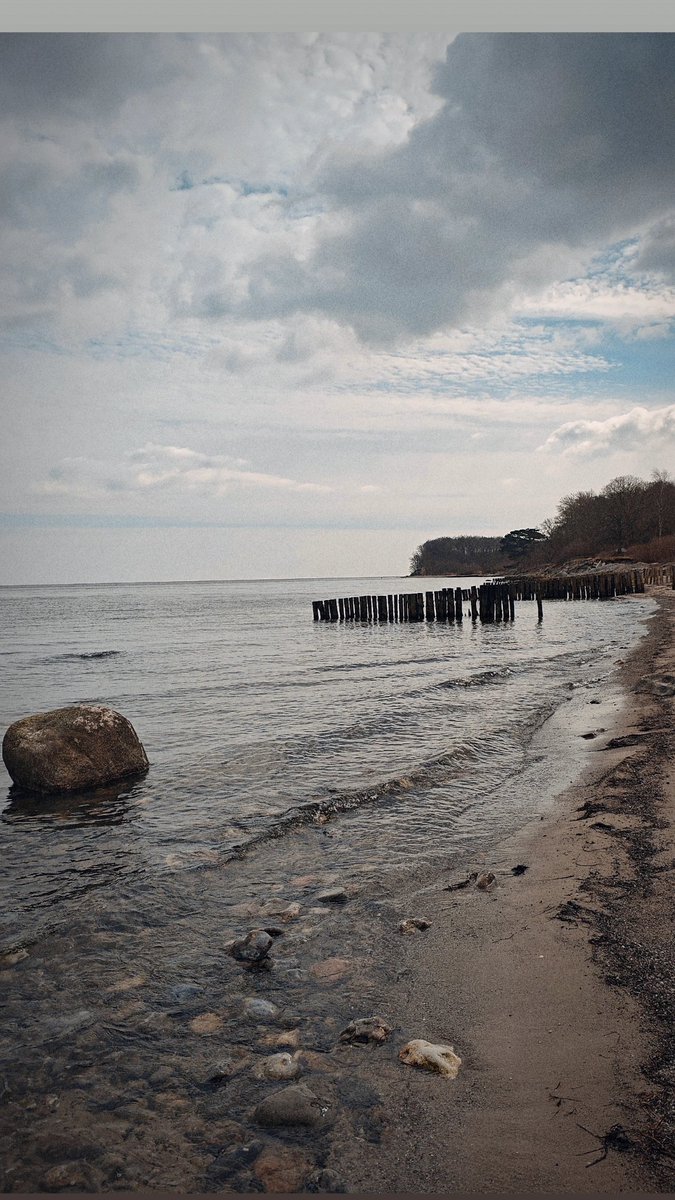
Couple years ago i'd post travel photos, go for the aesthetic look on instagram but nowadays it feels off to post anything there - post or stories, same same.. What's the alternative in 2026? #instagram#x#tiktok#aesthetic#photography#some
Didn't check the markets today.. set the pause button and walked in Magleby Skov listening to my music, doing breathwork #zen#danmark#sjælland#påskeferie
Gold and silver are not acting well in a period of rapidly rising geopolitical risks. We have an Iran War, Strait of Hormuz blockade, rising volatility. In the old framework, that setup should be close to ideal for gold. But once you understand what is now driving gold, this move makes perfect sense.
Something fundamental changed after the US and Europe froze Russian reserves in 2022. For decades, surplus countries parked their excess savings in US dollar assets, mostly Treasuries. The freezing of Russian reserves combined with the current administration's explicit push to discourage foreign countries from parking excess savings in US financial assets, forced surplus countries to rethink where they store reserves.
And those countries haven't changed their domestic policies that generate the excess savings, so those savings have to be placed somewhere. The result is that gold and silver have increasingly become the obvious “neutral” reserve assets.
That’s why gold decoupled from the three factors that used to explain it…real interest rates, volatility, and liquidity. Now reserve accumulation flows have become the primary driver.
That shift has a consequence I don’t think most investors have thought through. If gold is now primarily driven by reserve flows from surplus countries, then gold has become pro-cyclical.
Reserve growth is driven by export revenues, trade surpluses, economic growth in surplus economies. When the global economy is strong and surplus countries are generating large export revenues, their excess savings grow, their reserve accumulation accelerates, and gold catches a bid. When that surplus generation is disrupted, the bid weakens or reverses.
This is exactly what is happening with the blockade of the Strait of Hormuz.
The GCC countries are major reserve/gold buyers and now their export revenues are collapsing. They likely need to liquidate some reserves to cover fiscal obligations, and gold is one of their most liquid assets. Even if the reserve sales aren’t excessive yet, the market can see their reserve accumulation has stalled and probably reversed. That flow, which was a meaningful source of gold demand, has gone to zero at best.
There are also secondary effects on other surplus economies. China is the world's largest oil importer. An energy shock of this magnitude slows Chinese growth, and compresses Chinese surpluses, which slows Chinese reserve accumulation. That same growth shock ripples through Korea, Taiwan, Japan, and the rest of Asia.
The whole chain that has been driving gold higher, surplus countries generating excess savings that need a home outside the dollar system, is being disrupted by an event that in the old model would have been unambiguously bullish for gold.
This doesn't mean the structural case for gold is broken. The dollar standard is still ending. Surplus countries still need an alternative to Treasuries and gold is still the most obvious destination. But it does mean gold is going to be more volatile along that structural trend than most people expect, and the volatility will correlate with global growth and surplus generation rather than with the old drivers. Gold rallies when surpluses expand. Gold sells off when surpluses contract. Even if the reason for the contraction is rising geopolitical risk that, under the old model, should have sent gold to the moon.
Joseph Kent, a top counterterrorism official under Trump, just resigned.
Kent and I don't agree on much, but he is right:
"Iran posed no imminent threat to our nation, and it is clear that we started this war due to pressure from Israel and its powerful American lobby."
With so much happening in the region, what do you actually know about Turkiye?
Most Europeans, and certainly most Americans, have little if any in depth knowledge of the country that was once the Ottoman Empire, a vast and powerful forerunner of modern day Turkiye, which spanned over six centuries from the late 13th century until the early 20th century,
It was one of the most influential and enduring empires in human history, and understanding it is essential if you want to understand a resurgent modern-day Turkiye.
Founded by Osman the first(1258—1326) in a region of Anatolia, the empire quickly expanded to become a colossal state that, at its zenith controlled parts of three continents: Europe, Asia, and Africa. Key territories included much of Southeastern Europe, the Middle East, North Africa, and the Arabian Peninsula. The Ottoman Empire was known for its sophisticated military organization, cultural synthesis, and administrative prowess, which allowed it to maintain stability over diverse populations for hundreds of years.
What's most fascinating is how that empire became what is now the modern state of Türkiye
The modern Republic of Türkiye emerged from the ashes of a defeated Ottoman Empire (who had allowd itself with Germany during World War I), under the leadership of Mustafa Kemal Atatürk, Atatürk led a nationalist movement that resulted in a War of Independence, culminating in the establishment of the Turkish Republic in 1923.
Attaturks rapid transition from the Ottoman Empire to the Republic of Türkiye involved significant reforms aimed at modernization, secularization, and westernization, including the drastic and controversial adoption of the Latin alphabet, legal reforms, and the promotion of secular education. Despite these changes, it's also important to recognise that Türkiye and its people retained a deep connection to its Ottoman heritage in culture, architecture, and historical consciousness,
No objective observer could fail to accept that in the west there remains historical enmity towards the Turks and their Ottoman past, particularly from European powers and Balkan nations, this has in no small form shaped modern Türkiye's foreign and domestic policies. This enmity stems from centuries of conflict, including the Siege of Vienna, the Balkan Wars, and the complex history of minority populations within the empire particularly the Armenians, whose claims of Genocide are rejected by Turkiye.
I think its essential that modern Türkiye, with its strategic location at the crossroads of Europe and Asia, has immense potential to be a major power in the region, but so much of its potential is routinely dismissed due to these historical prejudices.
Regardless of this, the reality is that a resurgent Türkiye controls the crucial Bosporus and Dardanelles straits, which are vital for global trade and military navigation. This geographical advantage enhances its role in international politics and trade.
The Ottoman legacy also provides Türkiye with cultural connections across the Middle East, the Balkans, and parts of Africa, potentially facilitating powerful diplomatic and economic engagements in those regions. You don't have to agree with them all to recognise their importance.
Let's also not forget that modern Türkiye boasts one of the most formidable militaries in NATO and has been modernizing its forces while watching regional conflicts evolve. Of course, economically, despite challenges, Türkiye has actually shown resilience and growth, particularly in sectors like defence, tourism, and construction through initiatives like the focus on neo-Ottomanism, Türkiye promotes its culture, crucially With projects like the Trans-Anatolian Natural Gas Pipeline (TANAP), Türkiye positions itself as a vital energy corridor.
Get to know Turkiye. I've a feeling it will be a major player in the coming years.
I still can’t process the fact the White House is openly boasting of committing war crimes, crimes against humanity and against the law of the sea. 200 young men returning from a ceremonial naval exercise thousands of nautical miles away from the conflict zone, a ship with no active weapons as it was in India on an invitation to participate in a naval event/festivity which includes sporting events between sailors, last thing they would expect is to be a military target. Not only attacked and sunk but then left to drown, Nazi U-Boats would help rescue the sailors of the ships they sank, when the British and Spanish sank each other’s galleons and frigates they would pull the sailors out of the water and leave them at the nearest port… it is an age old law amongst seamen and also part of the Geneva Convention