Of giving, even when I have nothing,
Of working happily, even in the midst of difficulties, Of holding out my hand, even when utterly alone and abandoned, Of drying my tears, even while I weep, Of believing, even when no one believes in me.
Hot off the press!
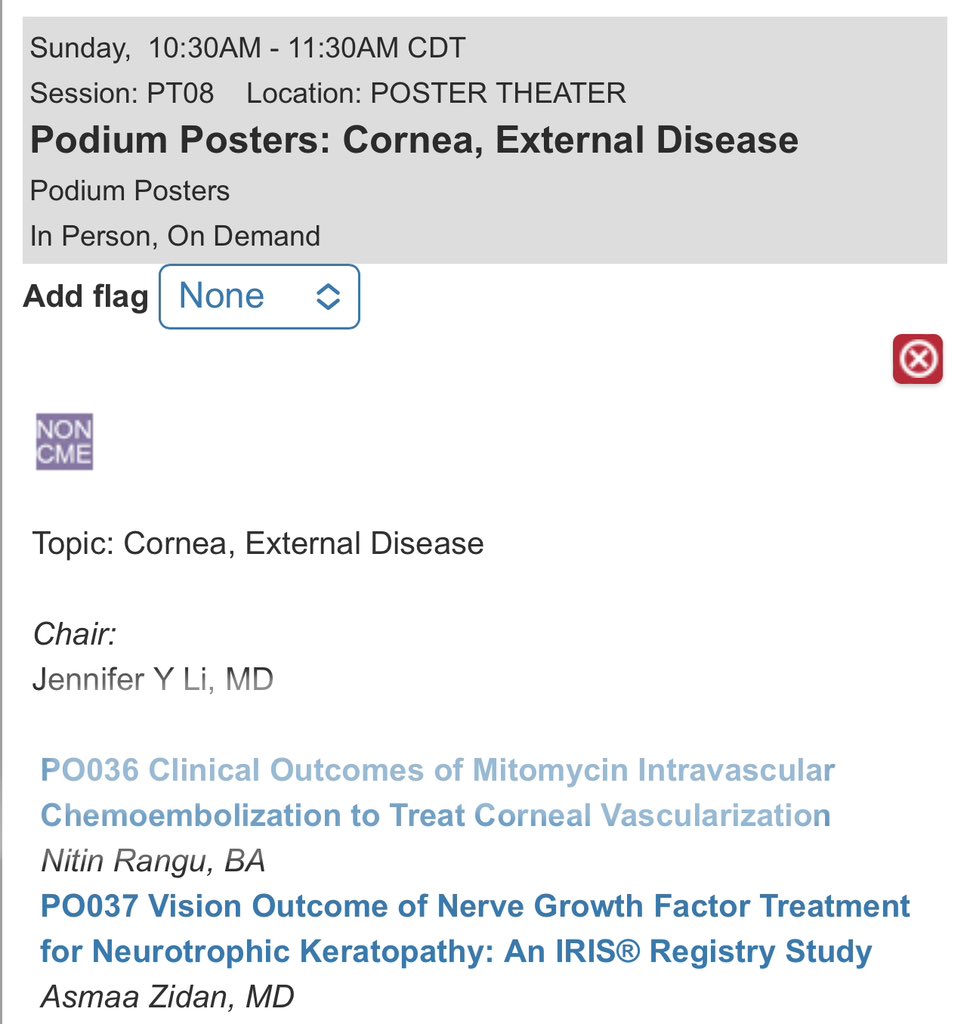
Our latest publication reports the real-world impact of nerve growth factor treatment, Cenegermin, on the vision outcomes of neurotrophic keratopathy patients, using the IRIS registry.
https://t.co/STU2IWTTMU
@HMSeye
Please join me in Chicago where I will be presenting our findings on:
1. Neuropathy in Dry Eye Disease #Cornea and Eye Banking Forum
2. Outcome of Nerve Growth Factor Treatment for Neurotrophic Keratopathy #AAO2024@HMSeye
Presenting a very interesting case from @HMSeye clinic along with our one and only Dr. Deborah Jacobs. Learn more about oGVHD and conjunctival lesions here!
ASCRS had the largest delegation of representatives at the Alliance for Specialty Medicine’s 2024 Capitol Hill Advocacy Conference Monday and Tuesday this week. Here are a few pictures from #ASMFlyIn
Finally, It is that time of year !#ARVO2024
I am glad to share that I will be presenting our work on the hypoxia role in nitrogen mustard keratopthy as a paper presentation on May 7th, 9:00-9:10am at Room 615, Seattle Convention Center @HMSeye
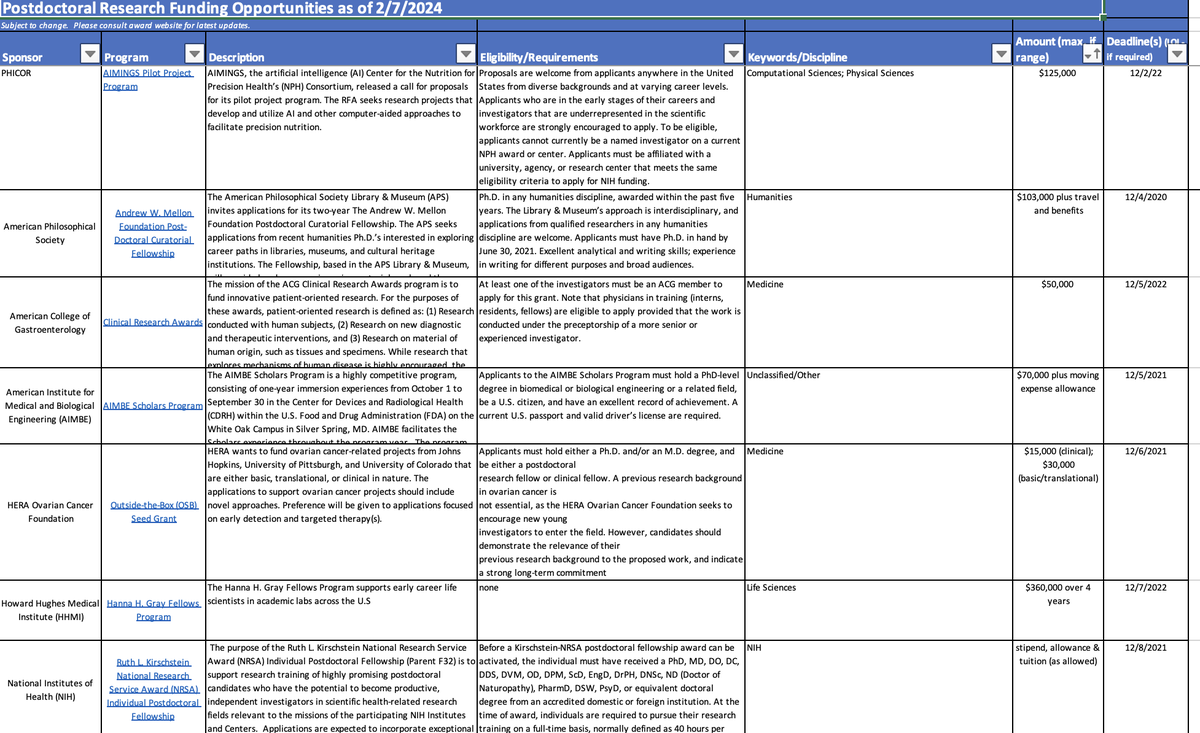
Just updated!
We updated our massive database of funding opportunities for POSTDOC fellowships.
Each entry (316!), we provide the $ amount, deadline, eligibility criteria, description, and link to funder.
Download this database freely here: https://t.co/EbTahdzJ9X
Our latest #BehindThePaper post from @asmaazidane covers recent work from @HMSeye on topical application of calcitonin gene-related peptide as a therapy for corneal injury.
https://t.co/41hXJF4ZU9
Excited to share our recent publication in @NaturePortfolio@CommsBio
, which I'm particularly proud of, investigating the application of CGRP therapy for corneal injury. @HMSeye https://t.co/UrXgFncS2l
Here’s a really interesting example of two articles, 26 years apart, describing how to cut down PCR run time and power usage by ~50% with standard equipment and reagents by optimizing your PCR program and trimming down denaturing and extension times to the bare minimum.
This approach will be relevant to most PCR practitioners (and many may already be doing it!), but it could be invaluable to anyone doing time-critical PCRs in classrooms, field research, or rapid diagnostics. For example:
⭐A 1–1.5 hr PCR would allow a complete PCR experiment to be run in 2–3 hrs, so it could fit inside a school or university lab session
⭐Power savings may be especially important if you’re running off a limited power supply like a battery or generator
⭐For some applications, halving the PCR time may allow you to double the throughput in a given time
In the first article, from 26 years ago, Mai et al. (1998) were facing the problem of routine PCRs taking over FOUR HOURS due to the slow heating and cooling rates of thermocyclers of the time.
Newer faster thermocyclers were coming onto the market, and there was an assumption that fast PCRs could only be done with the new equipment. However, Mai et al. (1998) thought this assumption had not yet been proven.
To test it, they used their existing "slow" thermocyclers and cut down each PCR step (denaturing DNA, annealing primers, and polymerase extension) to the bare minimum time needed, testing a range of different amplicon lengths.
Their successful PCR programs were as below::
⭐An initial 2 min denaturing step at 94 °C
⭐30-35 cycles of:
⭐2 sec at 94 °C (denaturing)
⭐5 sec at 55-60 °C (annealing)
⭐8 sec at 72 °C (extension)
⭐A final 5 min extension at 72 °C.
These are very short step durations, but their thermocyclers had very slow ramp and cool rates so the time the PCR was near these temperatures was probably a little longer in reality.
🧬This gave them a total run time of 1 hr 15 min to 1 hr 25 min; consistently good results for amplicons below 500 bp; but less predictable results for fragments over 1000 bp.🧬
Interestingly they observed that a denaturing temperature of 94 °C is not necessary in the later PCR cycles, and that 86 °C and 88 °C were the minimal temperatures needed for PCR to occur successfully under the conditions used.
They also highlighted that faster PCRs had the advantage of less non-specific amplification (especially larger fragments), and stronger amplification (because the polymerase hadn’t been as degraded in each cycle).
You can find this article here:
Mai et al. (1998). Shortened PCR cycles in a conventional thermal cycler. Biotechniques, 25(2), 208-210.
https://t.co/tOOHiShtOV
Fast forward 26 years to the present day, and the topic has just been revisited by Pedlar et al. (2024). These authors aimed to cut down on PCR cycling times not only for use in time-critical applications but also as a contribution towards environmental sustainability and reducing electricity usage.
Pedlar et al. (2024) took an initial 2 hr PCR program amplifying a 1,466 bp bacterial 16S rRNA gene fragment, and systematically optimised the denaturing time, annealing time, extension time, and cycle numbers to produce the quickest PCR program that consistently and successfully amplified.
They did the optimisation for three standard polymerases and three different bacterial strains with varying GC composition of the target region to make sure that their results were representative of normal samples and reagents.
🧬Their final optimised PCR took 1 hr 3 minutes, a 46% time saving and 50% saving in electricity. 🧬
The program consisted of:
⭐An initial 2 min denaturing step at 94 °C
⭐30 cycles of:
⭐ 5 seconds at 94 °C (denaturing)
⭐ 25 sec at 54 °C (annealing)
⭐ 25 sec at 72 °C (extension)
⭐A final 5 min extension at 72 °C.
The biggest time savings were:
⭐The extension step (90 seconds -> 25 seconds, saving 32.5 minutes over 30 cycles)
⭐The denaturing step (30 seconds -> 5 seconds, saving 12.5 mins total over 30 cycles).
They did observe an average reduction in PCR yield, but this was not statistically significant and made no difference to their intended results or downstream uses of the amplicons, for example for Sanger sequencing.
You can find this article here:
Pedlar et al. (2024). Amplifying PCR productivity and environmental sustainability through shortened cycling protocols. Biochimie.
https://t.co/satmzSkRK5
A few considerations however:
⭐Both studies used standardised DNA template concentrations, and samples with varied or unknown DNA template concentrations may get much less consistent results.
⭐Optimisations may need to be specific to your own PCR setup in terms of hardware, reagents and sample types. These studies were both done with standard equipment at the time, and you can probably get much quicker results with faster thermocyclers and more advanced polymerases.
But even with that said, these studies do suggest that, with some testing, many PCR protocols could be trimmed down substantially without significantly affecting results. And this could be very useful and valuable to many people around the world, especially in classrooms or during fieldwork.
So maybe give this a try if you think it may be useful!
And if you do get some results, or if you already run “faster” PCRs routinely, we’d love to hear how they work for you and how quick they are!
During a routine checkup with an ophthalmologist, it was discovered that a Boston-area man in his 30s had been living with a 3 mm splinter of wood lodged in his eye for more than 15 years.
Read More: https://t.co/YQrIZo4BAH