Dedicated Public Servant, believer in second chances. Dreams + Goals + Commitment + Consistency = Achievement. Driven by justice & impact. On guard your VALUES!
I’m not an American citizen, but I’m speaking from a place of genuine common sense and a search for a sound mind—just like how you’d protect your own home first before worrying about someone else’s. This isn’t about isolation; it’s about setting clear priorities.
It doesn’t make sense to create consumers for your product while neglecting the very people you’re relying on for profit. If you won’t invest at home, don’t be surprised when home stops working for you.
I don’t mind—and I don’t have any problem—with investing in China. But I do wonder: at what cost? Before shifting their companies overseas and offloading the price onto their own people, maybe they should focus on investing in their own workforce.
It’s frustrating to hear complaints about a “skills gap” when the skills were never even provided. How can people fill roles that lacked proper training, support, or infrastructure from the start?
Every nation should invest in its own people first—building strong foundations at home—then expand into the global workforce and international investment. It’s not either/or. It’s both—with balance and responsibility.
If they truly cared about national growth—and expanding beyond borders with integrity—they would:
https://t.co/fSEJXRmd9D real vocational training and apprenticeships.
https://t.co/dct6grX1ay local innovation and manufacturing, not just profit margins.
https://t.co/cdhzQj5dUT strong education-to-industry pipelines that prepare people for the future.
4.Stop blaming the working class for a problem rooted in decades of underinvestment.
Global investment is fine. But neglecting your own people in the process is a recipe for decline. If you don’t invest at home, don’t act surprised when home stops working for you.
I don’t mind—and I don’t have any problem—with investing in China. But I do wonder: at what cost? Before shifting their companies overseas and offloading the price onto their own people, maybe they should focus on investing in their own workforce.
It’s frustrating to hear complaints about a “skills gap” when the skills were never even provided. How can people fill roles that lacked proper training, support, or infrastructure from the start?
Every nation should invest in its own people first—building strong foundations at home—then expand into the global workforce and international investment. It’s not either/or. It’s both—with balance and responsibility.
If they truly cared about national growth—and expanding beyond borders with integrity—they would:
https://t.co/fSEJXRmd9D real vocational training and apprenticeships.
https://t.co/dct6grX1ay local innovation and manufacturing, not just profit margins.
https://t.co/cdhzQj5dUT strong education-to-industry pipelines that prepare people for the future.
4.Stop blaming the working class for a problem rooted in decades of underinvestment.
Global investment is fine. But neglecting your own people in the process is a recipe for decline. If you don’t invest at home, don’t act surprised when home stops working for you.
Tim Cook’s explanation of Apple’s reliance on China for manufacturing highlights a deeper issue: the hypocrisy and greed of corporations that prioritise profit over responsibility. Mr Cook points to China’s vast engineering talent pool and efficient ecosystem, claiming that the a nation (e.g USA) can’t match this scale or speed. But this narrative conveniently sidesteps the role companies like Apple have played in creating this disparity. It’s not that the U.S. workforce couldn’t “fill a room” with skilled workers—it’s that corporations never invested in building that room in the first place. Meanwhile, China’s “two football fields” of skilled workers exist because of decades of deliberate investment in education, infrastructure, and industrial planning—something the U.S. has neglected while offshoring jobs. Yet, the irony is that the consumers footing the bill for these globally manufactured products are often the same American workers who were left behind. What a stark display of hypocrisy and greed: companies shift production overseas to cut costs, then offload the inflated prices onto their own people, all while lamenting a “skills gap” they helped create.
The frustration here is palpable. How can American/Any nation workers fill manufacturing roles when the training, support, and infrastructure were never provided? The U.S. manufacturing sector employed 13 million people in 2023, making up 8.3% of jobs, yet there aren’t enough qualified workers to meet demand because companies have prioritised short-term profits over long-term workforce development. Instead of investing in respelling programs or technical training to bridge this gap, many corporations have chosen the easier path: outsourcing to other countries e.g China, where the government has heavily subsidised engineering education and vocational skills. Mr Cook praises China’s system, but he fails to acknowledge that Apple and other tech giants could have advocated for similar investments in the U.S. and other nations decades ago. Instead, they’ve left other workers to bear the burden of a system that never gave them a fair shot.
Every nation should prioritise its own people first—building a strong foundation at home before chasing global expansion. This isn’t about rejecting globalization; it’s about balance and responsibility.
Companies can and should invest in their domestic workforce while also engaging in international markets. For example, continuous training programs and skills assessments, as suggested by industry studies, could help manufacturers close the skills gap and stay competitive. At the same time, global expansion can bring benefits like access to diverse talent and new technologies, as seen with businesses that grow faster through globalization. But offshoring shouldn’t come at the expense of domestic workers. Before companies like Apple point fingers at a lack of American talent, they should look in the mirror and ask what they’ve done to nurture that talent. Investing in their own people isn’t just the responsible thing to do—it’s the sustainable path to long-term success.
There is nothing negative about On Guarding your generation and workforce!!
https://t.co/vTITo5PhBZ
I don’t mind—and I don’t have any problem—with investing in China. But I do wonder: at what cost? Before shifting their companies overseas and offloading the price onto their own people, maybe they should focus on investing in their own workforce.
It’s frustrating to hear complaints about a “skills gap” when the skills were never even provided. How can people fill roles that lacked proper training, support, or infrastructure from the start?
Every nation should invest in its own people first—building strong foundations at home—then expand into the global workforce and international investment. It’s not either/or. It’s both—with balance and responsibility.
If they truly cared about national growth—and expanding beyond borders with integrity—they would:
https://t.co/fSEJXRmd9D real vocational training and apprenticeships.
https://t.co/dct6grX1ay local innovation and manufacturing, not just profit margins.
https://t.co/cdhzQj5dUT strong education-to-industry pipelines that prepare people for the future.
4.Stop blaming the working class for a problem rooted in decades of underinvestment.
Global investment is fine. But neglecting your own people in the process is a recipe for decline. If you don’t invest at home, don’t act surprised when home stops working for you.
In a world where truth is compromised, seeking truth and upholding accountability isn’t just societal duty—it’s a divine call for integrity and justice!!
@DrFrankTurek The Bible tells the story of:
•God’s search for a bride for His Son.
•God’s effort to restore humanity into a perfect relationship with Himself.
1/2 ሃገር ተረሚሳ ብሓዋላ እያ ትነብር !::
What is the Roll of Eritrean embassies in diaspora? & When we say the economy of our country is beyond repair & we have a point & The Eritrean ambassador in South Sudan validated this Correctly.#Eritrea🇪🇷
Our ancestors—our fathers, grandfathers, and great-grandfathers—spoke with wisdom, using proverbs in a respectful and dignified tone.
Here are 7 Tigrigna proverbs for today:
1.He who hides his wound, hides his cure!
2.A liar and food gradually become frivolous!
3.He who borrows Satan’s flour will perish before eating it, for sure!
4.Bury the truth by its head, it will emerge by its feet instead!
5.Truth, like gold, will always unfold.
6.When a bad person hates, a greeting he negates!
7.A wise plans for the year, a fool veers every day!
Please Don’t forget to follow, share and like for more wisdom!
Truly, to see how things unfold themselves, you’ve got to be alive.
Shocking news: “The State Department used taxpayer dollars to fund therapy sessions for federal employees” after the ‘unexpected’ election outcome where Kamala Harris lost to Trump. Has democracy—the idea of winners and losers—really become too much for some to handle? And this, in America? What about the homeless, those enduring real hardships, or parents struggling just to feed their children?
Wake up!
Those dollars could’ve been better spent.
Truly, to see how things unfold themselves, you’ve got to be alive.
Shocking news: “The State Department used taxpayer dollars to fund therapy sessions for federal employees” after the ‘unexpected’ election outcome where Kamala Harris lost to Trump. Has democracy—the idea of winners and losers—really become too much for some to handle? And this, in America? What about the homeless, those enduring real hardships, or parents struggling just to feed their children?
Wake up!
Those dollars could’ve been better spent.
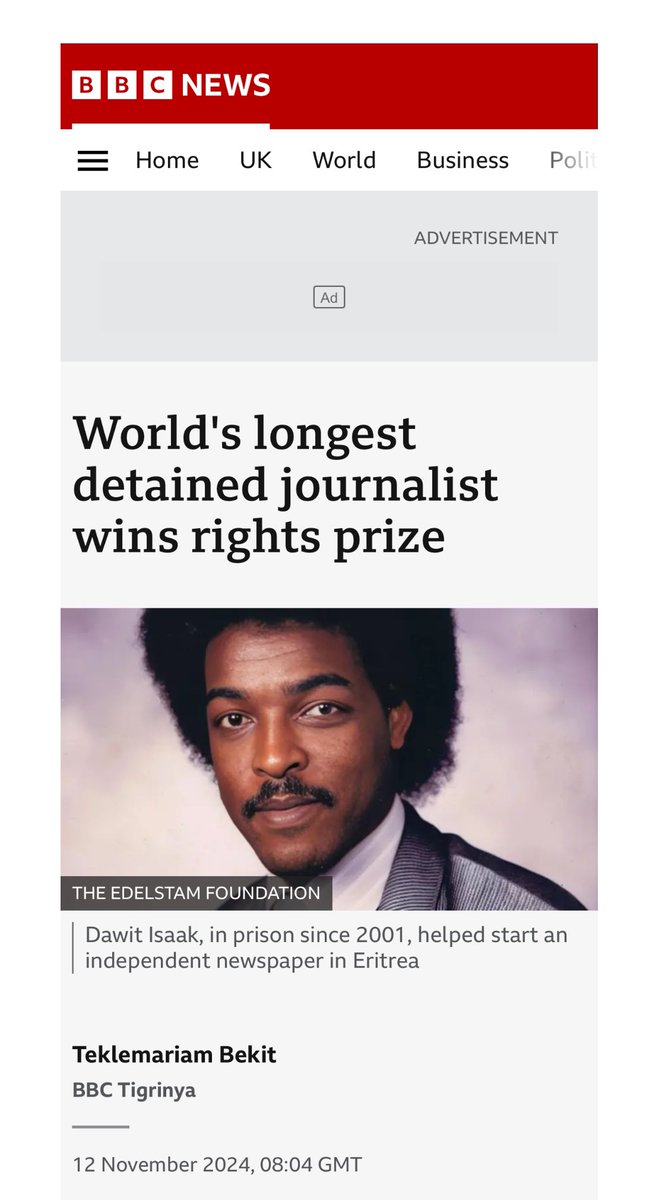
BBC reported that the world's longest detained journalist, Dawit Isaak has won the Edelstam Prize "for his... exceptional courage".
He was detained in 2001 after his paper published letters demanding democratic reforms.
Dawit was among a group of about two dozen individuals, including senior cabinet ministers, members of parliament and independent journalists, arrested in a government purge.
Over the years, the Eritrean government has provided no information on his whereabouts or health, and many who were jailed alongside him are presumed dead.
The Edelstam Prize, awarded for exceptional courage in defending human rights, will be presented on 19 November in Stockholm.
Dawit's daughter, Betlehem Isaak, will accept the prize on his behalf as he remains imprisoned in Eritrea.
Eritrea is the only African country without privately owned media, having shut down its private press in 2001 under the pretext of "national security".
There have been no elections in Eritrea since its independence, and President Isaias Afwerki has held power for nearly 31 years.