Built an open-source RLM (Recursive Language Models) package in Python!
Solves LLM "context rot" by treating context as a programmable object the model explores recursively.
Credits:
- @rasmus1610 for the initial implementation inspiration
In DeepSeek's production serving (V4): 60–85% faster generation per user, and ~50% more throughput at fixed latency.
I wrote the whole thing up as an illustrated, ground-up walkthrough diagrams over equations.
https://t.co/A0WqrK0ef3
Most explanations of speculative decoding are wrong.
It's not "a small model guesses and the big model hopes it's right."
It's an exact protocol that provably matches the big model's output while running faster.
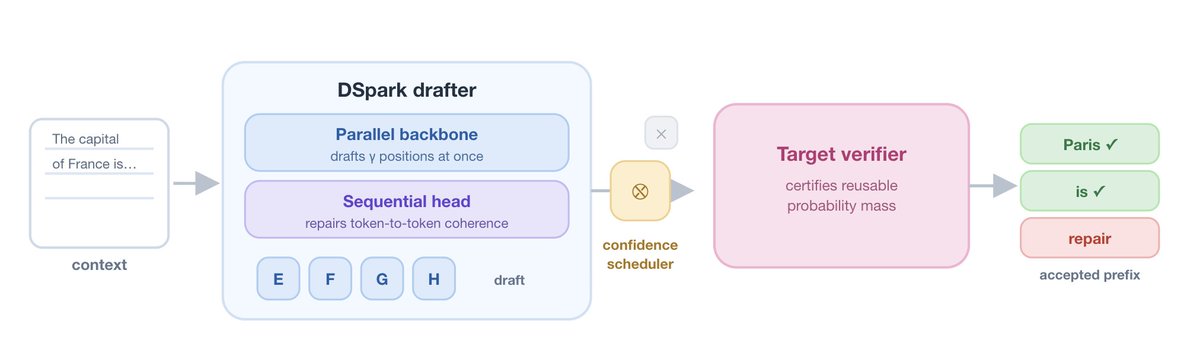
How DeepSeek's DSpark pushes it further:
Bonus intuition for why naive parallel drafting breaks:
"of course" and "no problem" are both valid. Predict each position independently and you also invent "of problem" and "no course."
Correct marginals, wrong joint. The missing piece is branch identity.
Thankyou @AirIndiaX for the lovely check-in experience and hospitality. 10/10 would recommend. Special thanks to Simran Raina, Jagdish Raj, Abhinay Kumar and Dev Singh 😍🎊🔥
🧵 I wrote my first GPU kernel solving @UnslothAI 's challenge A
Here's everything I learned about NF4 quantization and Triton
Starting from absolute zero → working kernel in 3 days
Let's go 👇
Full post includes:
✅ Toy examples (dequantize one number by hand)
✅ Every broken version of the kernel
✅ Line-by-line explanation of the final code
✅ What custom PTX assembly could add
For anyone learning GPU programming: https://t.co/WEBhJuRkpK
Thanks to @UnslothAI for Challenge B that started this rabbit hole.
What began as a competition became a masterclass in distributed systems + quantization internals.
Sometimes the best learning comes from "impossible" problems. 🦙
The lesson: tools built by different teams don't always compose cleanly.
The skill: reading source code, understanding assumptions, finding escape hatches.
Full blog with complete code: https://t.co/v5K7Ha209f