An engineer has a drawing open and needs a supplier who can machine 316L stainless to a tolerance of ±0.02 mm.
They land on your website and the first thing they read is “market-leading precision engineering solutions”.
Lovely, can you make the actual part?
Your production manager could answer that in 30 seconds. You see, the problem is the engineer hasn’t called you, it would usually be something like they’ve got 4 supplier websites open, and 1 of the others has already set out the materials they work with, the tolerances they can hold and the conditions those figures apply to.
That’s a page worth sending to procurement (so we think)
This is where we’d start with SEO for a manufacturer.
Pull the last ten decent requests for quotation (RFQs) and sit down with whoever priced the jobs. What did those buyers need to know before they were willing to send a drawing?
How much of that information can someone actually find on your site?
If you want more enquiries for a particular process, give it a page that explains what you can produce, in which materials and at what batch sizes. “From prototype to production” leaves a buyer guessing whether you’ll quote for 20 units or only get interested at 20,000.
Put the specs on the page in a table an engineer can scan. Offer the datasheet and CAD file alongside it. Making someone fill in a sales form just to check a dimension is a cracking way to send them elsewhere.
If a contract requires certification, show which standard you hold, which site it covers and what falls within its scope. Give procurement something they can actually use.
When someone’s ready for a quote, let them attach the drawing, enter the quantity and tell you when they need it. Then track which searches and landing pages bring in jobs your team actually wants to price.
And if your keyword tool says hardly anyone searches for a specific combination of process, material and tolerance, ask your sales director what ONE repeat contract for that work is worth before you bin the page idea.
Trade shows and referrals still matter, so does getting onto the shortlist when the buyer has never heard of you and nobody from your sales team is in the room.
https://t.co/v8tg6EMWm8
If your clinic is paying to get in front of more patients, pull up your Google Business Profile on your phone. Would YOU book an appointment from what you can see there?
We looked at GP surgeries in Bletchley, Milton Keynes.
The top result had 139 reviews, clear practice information and photos showing the surgery and consultation rooms.
The lowest listing we looked at had 1 review and 1 photo.
Put the rankings aside for a minute, you’re choosing a GP for your family, you’ve never set foot in either surgery and those are the two profiles in front of you.
Which one are you calling first?
This is where clinics can lose a booking before the patient even gets to the website. You know you offer evening appointments. Your receptionist knows there’s step-free access round the side.
But the person looking at Google Maps on their lunch break has no bloody idea, and the practice a mile down the road has already answered both questions.
Here’s what we’d check before spending another quid getting more people to that profile.
❓ Can someone tell whether you offer the EXACT treatment they searched for, at the location they’re looking at?
❓ Do the hours on Google match the hours someone can actually call or visit, including evenings and weekends?
❓ Have you shown people the entrance, the team and the room they’ll walk into? If someone’s anxious about coming in, a photo of the practice logo does sod all for them.
❓ What do your recent reviews tell a prospective patient about being treated there?
❓ How do you respond when someone’s had a poor experience?
Where does the booking link end up?
Try it on your phone and count how many times you have to tap before you can actually choose an appointment.
Then there’s the question we’d want answered in the monthly report. How many of those people actually booked?
Tag the website link with UTMs, track appointment enquiries and ask new patients how they found you. If profile views are up and the diary still has gaps, you need to know where people are dropping out. Another screenshot of a graph going up won’t tell you that.
Our full guide, including the Bletchley comparison 👇
https://t.co/1KtvOtsq3m
Agentic SEO is moving from idea to reality. SEO teams are already putting AI agents to work on research, audits, strategy and more.
In this guide, we walk through how to build an AI agent that can work with your website, make SEO changes, record what it does and measure the results. Over time, that feedback can help it improve its decisions.
The setup is simpler than it might sound. Your agent needs:
A place to run, such as a VPS
Skills and MCP connections to the tools it needs, including Ahrefs and SEO Stack
Access to Google Search Console and GA4 data through SEO Stack
The ability to make changes to your website
That’s the core of it.
We show you how to put the agent together, teach it how to work, and build a process for making and assessing changes over time.
Guide:
https://t.co/dBtoUHHFsh
Video:
https://t.co/laQxgwjJJv
Enjoy!
Canonical tags 101.
Key things for you to consider:
1. Canonical tags were originally created to provide a clear instruction as to the parent URL of a group of URLs that were highly similar
Older, more complex sites back in the day often had technical limitations that they couldn't overcome, so Google gave webmasters the canonical tag
2. Canonical tags SHOULD only canonicalize to another URL if the content is very similar or identical otherwise Google may ignore it
3. Canonicalized URLs pass link equity/signals on to the canonical parent URL. Google treats canonicals like redirects in terms of pagerank distribution
4. Canonicalized URLs are subject to crawl frequency delays. For link equity to transfer, Googlebot must crawl Page A, read the canonical tag, and process the relationship in its indexing pipeline. If Page A has low internal link authority or is rarely recrawled, the equity transfer can take longer compared to a hard 301 redirect
5. Consolidating canonical child URLs into the parent URL and redirecting the previous child paths to parent is generally better than giving Google the opportunity to decide
6. You should avoid canonical child URLs as much as possible, most sites now have sufficient tech capabilities to omit the need to have canonical child URLs
7. If you noindex any canonical URLs that have external links the equity won't be passed because noindex supercedes the canonical tag
8. You should NOT canonicalize pagination series back to the first URL in the series, this can be pagination for ecom product categories, search results, blogs etc. use self referencing canonicals
9. Internal links and external link counts can influence Google to incorrectly determine the canonical parent. Internal and external links act as a signal, if there are more links to a canonical child URL Google can make that the parent
10. While external equity gets consolidated, internal links pointing to non-canonical URLs waste crawl budget and dilute signal clarity. You should always update your internal navigation, footer links, and XML sitemaps to point directly to the canonical version rather than relying on canonical tags to pass equity internally
11. Canonical tags should NOT be a replacement for URL protocol management or consistency.
I.e. do your URLs return http200 with or without trailing slash? Instead of using canonicals redirects should automatically handle inconsistent URLs
12. Canonicals should NOT be left to deal with sites that have lots of URL parameters from filtering, whilst canonicals do help here, it becomes an incredible waste of crawl budget.
Manage parameters via robots.txt disallow where parameter variant URLs do not have traffic or external links, ideally redundant parameters should be blocked.
Where a parameter changes page content where the canonical no longer makes sense Google may ignore it which can cannibalise
13. Canonical URLs must always use absolute URLs (including protocol https:// and host)
SEO is dead.
Only for those who can't do it properly.
It's 2026, the search market is HUGE, and whilst LLM usage is up significantly, it doesn't stop a majority of the world using Google.
So for those taking their eye off the ball with SEO to focus on LLMS, just remember that organic is a MUCH bigger market with better attribution.
SEO should remain an important focus for businesses throughout 2026 into 2027.
YES there are SEO challenges out there.
YES, it's harder to get traffic, but that doesn't mean the opportunities aren't there.
YES, it's never been quicker, easier or cheaper to produce content, but that's not sustainable.
YES, maybe you can make Claude or chatGPT your new SEO consultant.
But the reality is, the businesses that stand to do best are:
1. Investing MORE into SEO with SEOs and agencies who are battle tested and aren't taking short-cuts with AI
2. Businesses who want sustainability over instant results - this means a properly planned and executed SEO strategy that;s not build on a foundation of butter
3. Businesses who work with agencies/SEOs where there is a strategic alignment, where there is a concerted effort to review, approve and get things done
Businesses cutting corners now by:
❌ Cutting SEO spend or investing it in the wrong places
❌ Handing off SEO responsibilities to agencies with no harness or human in the middle
❌ Using AI to mass produce content
are SIGNIFICANTLY more likely to:
👉 See rankings drop or tank across Google's spam and upcoming core updates
👉 Have to spend a lot more money fixing and recovering from Google updates/manual actions
👉 Lose time, money and ground on competitors who do things properly
Here's a warning for those handing off their SEO strategies and SEO execution to AI or sloppy cheap resources
https://t.co/OFmqd4shdI
AI search (LLMs) may be answering more than the question you asked, depending on the nature of your search and whether it requires a fresh search.
A complex prompt can lead to searches across several related topics before an answer is assembled - this is what is meant by "query fan out" - LLMs like chatGPT have relied on external indexes to go out and source more information as opposed to just relying on "pre-training data" which is often out of date.
Thus query fan out.
For LLMS (large language models), the question doesn't have to be something like “How many prompt variations can a business target?” but it can be something like “What does someone need to know before they can make this decision?”
That means answering the real questions around a searched topic: the risks, comparisons, constraints and evidence. LLMS like chatGPT have traditionally relied on external sources/search indexes - however its very probable they are building their own search indexes.
Query fan out is how an LLM can:
👉 Perform deeper searches to generate "consensus"
👉 Can identify key auxiliary information by broadening queries searched
👉 They can ground a search further for information accuracy
👉 Can identify if a source is more prominent across the query fan out pool
Ultimately turning one query/conversational search item into a subset of relevant queries/topics allows for better answer generation - as in the context, depth and accuracy of the response can be improved.
An LLM interprets the question, generates related queries, sends them to search, gathers relevant results and uses them to build an answer (in a nutshell). Google describes the searches as concurrent, but doesn’t publish the full query plan or how it weighs each result.
We wrote something on it here >
https://t.co/8JbMegHHTN
Google hates scrapers, this includes 3rd party tools and platforms that scrape Google to get data such as SERP features or rankings.
This year alone, Google has made it significantly more difficult for rank tracking tools to get ranking data, moreso since they lost their court case against SERPAPI.
So, why is Google making rank tracking harder, what solutions are there and what does this mean for the future of ranking reports for clients?
https://t.co/bqC1bgPSpy
What is Query Fan Out and why is it considered important in GEO (generative engine optimisation)?
Well, to summarise, when users perform a conversational search in an LLM (large language model) such as chatGPT - those models can go out onto the web to find additional information as well as for grounding. Query fan outs mean LLMs can refer to multiple sites and sources before deciding what to cite in the response.
The technicality?
The more prevalent your brand is in search, the higher the probability of it appearing across query fan out and subsequently the more likely you are to be cited.
https://t.co/8JbMegIfJl
Google Manual Actions are appearing in so many places - the last few months We've been seeing more and more popping up.
And it's no surprise, so much of the SEO industry has turned to short-cuts and scaled content abuse for the short term gains without considering the longer-term pains.
Do you remember the old adage, pay cheap pay twice?
That's what's happening now.
Businesses cheaped out on SEO or cut spend because AI could do it
SEOs at the lower end or spammy end turned to it for scale
and now agencies like us are part of the clean up and recovery solution.
Manual actions can be devastating - often bringing entire sites down with some losing 90%+ of their traffic overnight.
Here are some of the common manual actions businesses maybe facing now or could be expected to face as Google ramps up on scaled content abuse and spam / link spam.
❌ Back button hijacking
The site interferes with browser history so visitors can’t use the Back button to return as expected.
❌ Site abused with third-party spam
A significant part of the site is being used to publish spam, often through forums, uploads, free hosting or other interactive areas.
❌ User-generated spam
Visitors have posted spam, commonly in forums, comments or user profiles.
❌ Spammy free host
A significant share of the sites or pages on a free hosting service are spammy.
❌ Structured data issue
Markup violates Google’s structured data guidelines, for example by describing hidden, irrelevant or misleading content.
❌ Unnatural links to your site
Google has found a pattern of artificial or manipulative links pointing to the site.
❌ Unnatural links from your site
Google has found a pattern of artificial or manipulative outbound links on the site.
❌ Thin content with little or no added value
Pages provide little unique value, such as thin affiliate pages, scraped content or doorway pages.
❌ Cloaking and/or sneaky redirects
Google is shown different content from visitors, or visitors are redirected somewhere unexpected.
❌ Major spam problems
The site uses aggressive spam tactics or has repeated or egregious spam-policy violations.
❌ Cloaked images
Images shown to Google differ from, or are obscured compared with, what visitors see.
❌ Hidden text and/or keyword stuffing
Pages hide text from visitors or repeat keywords excessively.
❌ AMP content mismatch
AMP content differs materially from its canonical page.
❌ Sneaky mobile redirects
Mobile visitors are secretly redirected to content that Google’s crawlers don’t see.
❌ Site reputation policy
Some third-party content on the site is inconsistent with Google’s site reputation policy.
These are just SOME of the manual actions you can see in Google Search Console when a quality rater has visited the site and made a determination.
Googles automated spam algorithms flag suspicious patterns, or the site is highlighted through user-submitted spam reports and routine quality sweeps.
#seo #seotips
Do you use Google Trends?
If you don't, you should! but, is Google trends data overly accurate and is the data polluted with AI data?
AI platforms including Gemini perform query fan out when a user asks a question where grounding is required.
Could these query fan out searches TRULY be excluded as Google has said they are?
We beg to differ.
https://t.co/rUyoxNwSNv
Have you replaced your SEO resource with an AI Agent?
Are you using Claude or chatGPT to do your SEO now?
If so, we would recommend you read this article:
https://t.co/OFmqd4rJoa
What you save today ££££ you'll pay for later with lost ££££.
If you are running an SEO strategy through claude or chatGPT with no-one at the helm you can expect a few things to happen such as losing rankings and traffic!
We've ran lots of tests with mini sites to see what happens when you let an AI agent run your SEO strategy.
SEO RANKING FACTORS FOR 2026/2027
What you NEED to know!
There are THOUSANDS of factors for consideration when ranking - partly because ranking is the culimination of good SEO, demonstrated trust, authority and positive user behaviour.
There's a huge amount that goes into ranking, in this article we give you an overview of the ranking factor's WE'D pay attention to in 2026/2027!
We're not talking about keywords in titles or H1s, we're talking about document accessibility, rendering, domain and document level content quality factors and more!
Check out our ranking factor deep-dive for 2026/2027
https://t.co/Hj3CwCioU5
Google processes around 13.7 billion searches a day. ChatGPT handles around 2 billion queries. Perplexity, 780 million a month.
The gap is real. Traditional search still dominates.
But the question people keep framing wrong is: which one do you optimise for?
Both. And they're not as separate as they look.
SEO gets your content found. LLM optimisation gets your content used as the answer someone receives. Quality content that's clearly structured and genuinely useful tends to work in both worlds. The mindset shift is that you're no longer just trying to rank. You're trying to be chosen.
We've been at the forefront of search since 2007. Here's how we're thinking about the integration of both right now.
https://t.co/gZzSRIm9qd
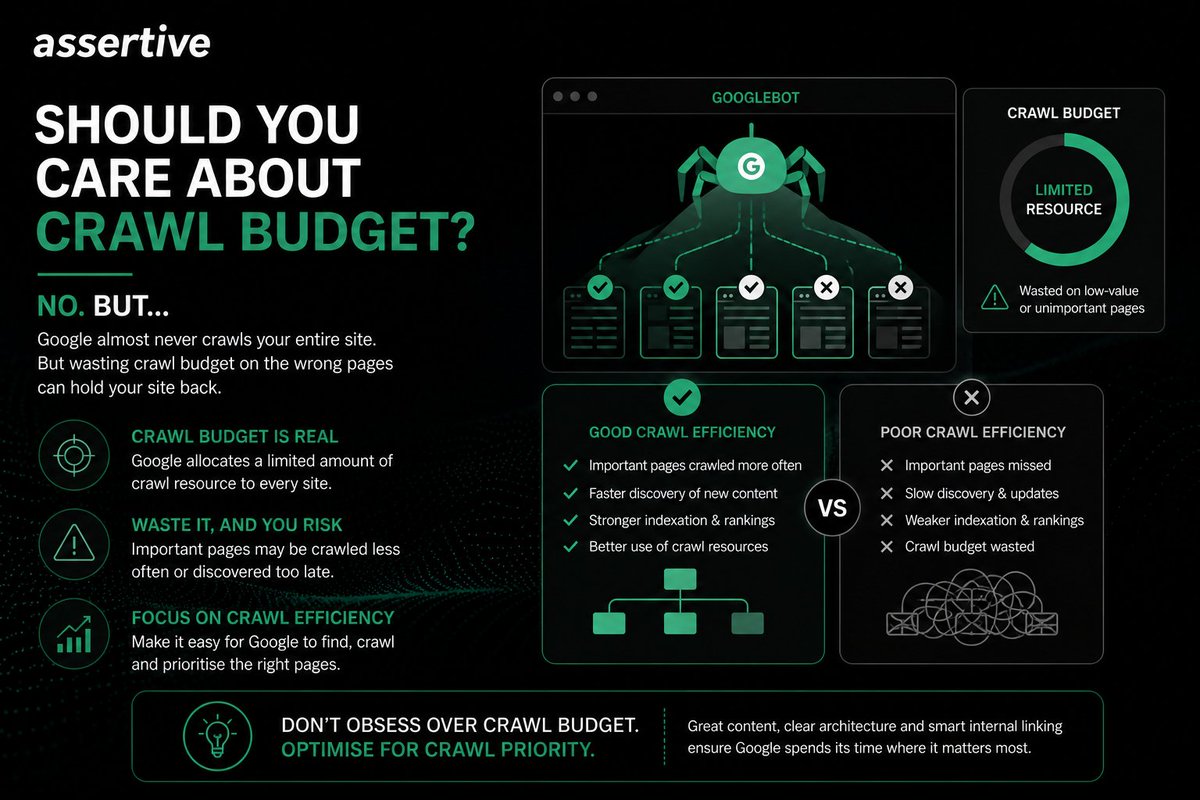
Gary Illyes, Google. Direct quote: more than 90% of websites don't need to think about crawl budget.
He also pointed out the term "crawl budget" wasn't coined inside Google. It came from outside.
So why does it appear in every SEO proposal you've ever received?
In 2018, a Google data scientist published an unusually candid post about the actual optimisation problem Google had to solve around recrawling pages. It's one of the more useful things you can read if you want to understand how your site actually gets read.
The answer to whether you should care is somewhere between "it depends" and "not really." But the reasoning behind it changes how you think about your site architecture.
https://t.co/XUKgbQl9HW
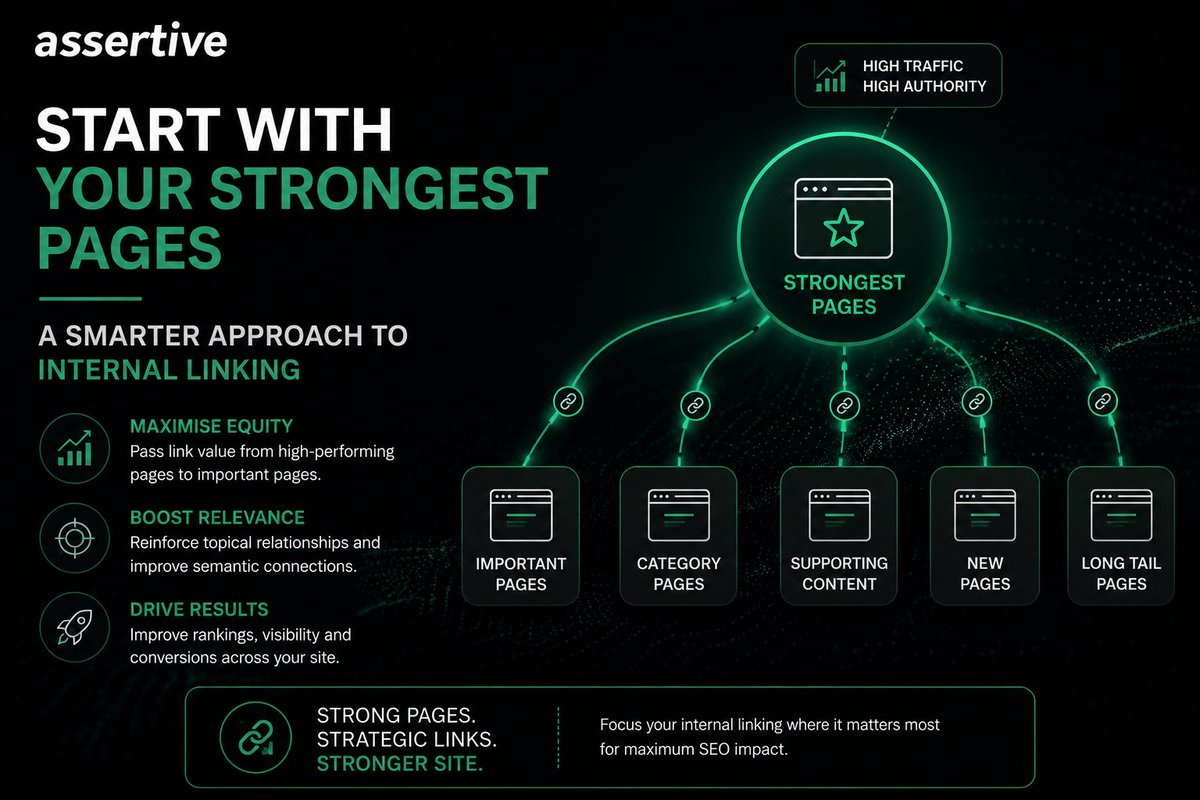
Most sites that "optimise" internal links do it by topical relevance and anchor text, then stop.
That's not wrong. It just ignores the thing that decides how much a link is actually worth: PageRank.
A link from a page with a strong backlink profile passes considerably more equity than a link from a page with none. The difference isn't marginal, yet most internal linking work treats every source page as equal.
Our SEO Lead Stefan Krcelic has written up the approach we use, starting from your strongest pages rather than the most topically convenient ones. The short version:
➡ Find your power pages. The pages attracting the most backlinks on your site. GSC's Links report is the most reliable source because those are links Google's systems recognise. Ahrefs or Semrush work too.
➡ Check the candidate before adding anything. Is it topically related enough that a reader wouldn't be surprised where they land? How many links already sit in the body copy? PageRank splits across every exit on a page, so a heavily linked page passes less through each one. John Mueller confirmed as far back as 2021 that too many links weaken the structural signal.
➡ Don't double up. If the page already links to your destination, a second link gives you next to nothing. Net new links only.
➡ Placement matters. First third of the body copy. Google's reasonable surfer patent describes links being weighted by how likely a real user is to click them, and a link buried in the final paragraph of a long article is doing far less work than the same link near the top.
One link per candidate page. High up. Topically sensible. From pages that have actually earned authority.
Both approaches look identical on the surface, the link exists either way.
Across a full site, the difference in how equity gets distributed is significant.
Full guide from Stefan:
https://t.co/IDDswiDJ6h
The posts are everywhere right now.
"I was paying an agency £5k a month, replaced it with a £20 Claude subscription."
I installed the Claude SEO skills, ran a full audit on our own site, and let it run for 20 minutes across 40 pages.
What came back was revealing. Not in the way the LinkedIn crowd wants you to think.
Before you fire your agency and hand your SEO strategy to a GitHub repo with a few thousand downloads, probably worth seeing what it actually produces.
https://t.co/SgT7xcM1nX
Position 1 to position 68 in two hours.
That was JC Penney in February 2011, mid clearance season, after the New York Times handed Google evidence of a paid link network spanning thousands of sites. Across 59 tracked keywords their average position went from 1.3 to 52 in days.
Our founder Daniel Foley Carter has pulled together the 10 biggest SEO disasters ever recorded, and some of the numbers are genuinely hard to believe:
Toys "R" Us paid $5.1 million for https://t.co/xe83J9f9oS, then migrated it with no 301 redirects. All that equity, gone, because a free technical step got skipped.
Forbes Advisor lost roughly $8.6m in traffic value in a single month during "Vouchergeddon". Time Stamped dropped 97% of its search visibility.
Renting your domain authority to affiliate operators turned out badly for the entire top tier of digital media.
BMW Germany got fully deindexed in 2006 for doorway pages. PageRank zero. Searching "BMW Germany" didn't return https://t.co/scx9DNmyFW.
Sports Illustrated published product reviews from authors who didn't exist, complete with AI-generated headshots bought from a marketplace. Futurism found the same faces for sale online.
CNET mass-deleted its own archive believing old content was holding rankings back. Google's Danny Sullivan responded publicly: that's not a thing.
xpedia, Overstock, H&M, the Daily Mail and JC Penney complete the list.
The pattern that repeats across two decades: agencies carry the risk, clients take the hit. JC Penney, BMW and Overstock all blamed or fired their agencies afterwards. Google penalised the brand every single time.
Worth remembering next time an agency proposal promises shortcuts.
Full breakdown: https://t.co/5rpHFA2rkM
Google's Search Quality Rater Guidelines mention content creators 140 times.
Then the leak went and confirmed why, 2 attributes sat in the documentation: "isPublisher" and "isAuthor".
Google isn't just processing your content, it's working out who wrote it and who published it, then deciding whether either of you can be trusted as entities. This goes much deeper into things such as E-E-A-T and Knowledge Graph.
This is the bit of the leak that got far less airtime than Site Authority or click data, yet it arguably matters more for anyone producing content in 2026.
What it means in practice:
✅ Google ties authors to the Knowledge Graph. Consistent, corroborating information about who you are makes you easier to trust. Vague or invisible authors do the opposite.
✅ Publisher credibility is assessed at brand level. Coverage in recognised publications, real relationships within your industry, up-to-date company information. It all feeds the picture Google builds of you.
✅ A finance article "written" by someone with zero visible finance background is a trust problem, not a formatting one. No byline schema patches over an author Google can't verify.
There's a reason 16 companies pull in over 3 billion Google clicks a month between them (Detailed's research). Entity strength compounds.
The uncomfortable takeaway for brands pumping out anonymous or AI-attributed content at scale: you're building nothing Google can attach trust to.
Our Head of Content Aly Johnson wrote the full breakdown, including the three-tier approach we use covering publisher optimisation, author optimisation and where traditional SEO still fits:
https://t.co/hijwNdfnYO
#seo
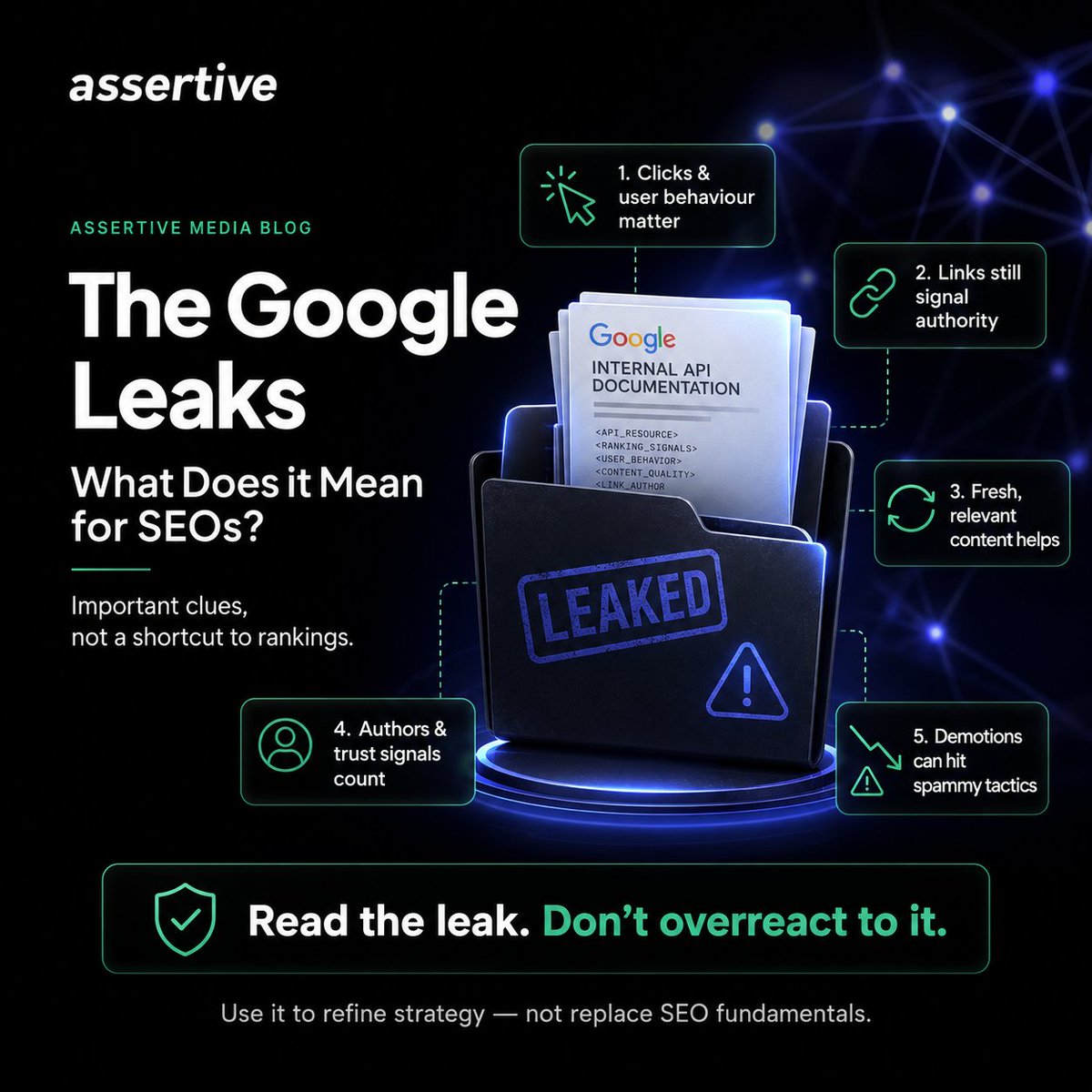
2,500 pages. Over 14,000 attributes. Google's internal API documentation, sat on GitHub for anyone to read for a short period of time until it was removed.
Google spent years telling SEOs certain things didn't exist, but the leak said otherwise.
Whilst it was MASSIVELY insightful, there was no real way for us to understand what weighting Google gives to each thing.
A few things worth knowing if you missed it or never dug in properly:
➡ Site Authority is real. Google repeatedly denied having any site-wide authority score, yet there it is in the documentation. What we still don't know is how it's calculated.
➡ Clicks feed rankings. Successful clicks, where users actually engage with the page, play a role in how Google evaluates content. All those "we don't use click data" statements aged badly.
➡ The sandbox exists. A hostAge attribute facilitates sandboxing, most likely aimed at spam and low-trust new sites rather than every fresh domain.
➡ Demotions are baked in. Anchor text mismatches and exact-match domains can both trigger algorithmic demotions.
➡ Google stores author data. Name, biography, affiliation. Authorship is being recorded even if E-E-A-T barely gets a mention in the docs.
Our honest opinion: the leak is useful context, not a cheat sheet. There's no proof every attribute is a live ranking factor, and plenty of SEOs have built shaky theories on top of it since.
As our founder Daniel Foley Carter put it at the time - you don't rank by reading leaked documents.
You rank by doing the work the documents point towards anyway. Helpful content, genuine engagement, links from sources that actually carry weight.
Full breakdown on the blog: https://t.co/L1sUKpWhGr