Assetrix DAO is a decentralised protocol issuing ASTRX, a collateral-backed token of a class we call a ratchet: the mint price is determined by the contract and
"So does the price of ASTRX go up?" The cost of entry does. That is a ceiling on what the coin is worth paying for, not a promise of where it will trade. The market price is the market's and can fall to backing. The question that matters most, so it is in the FAQ.
#DeFi#Crypto
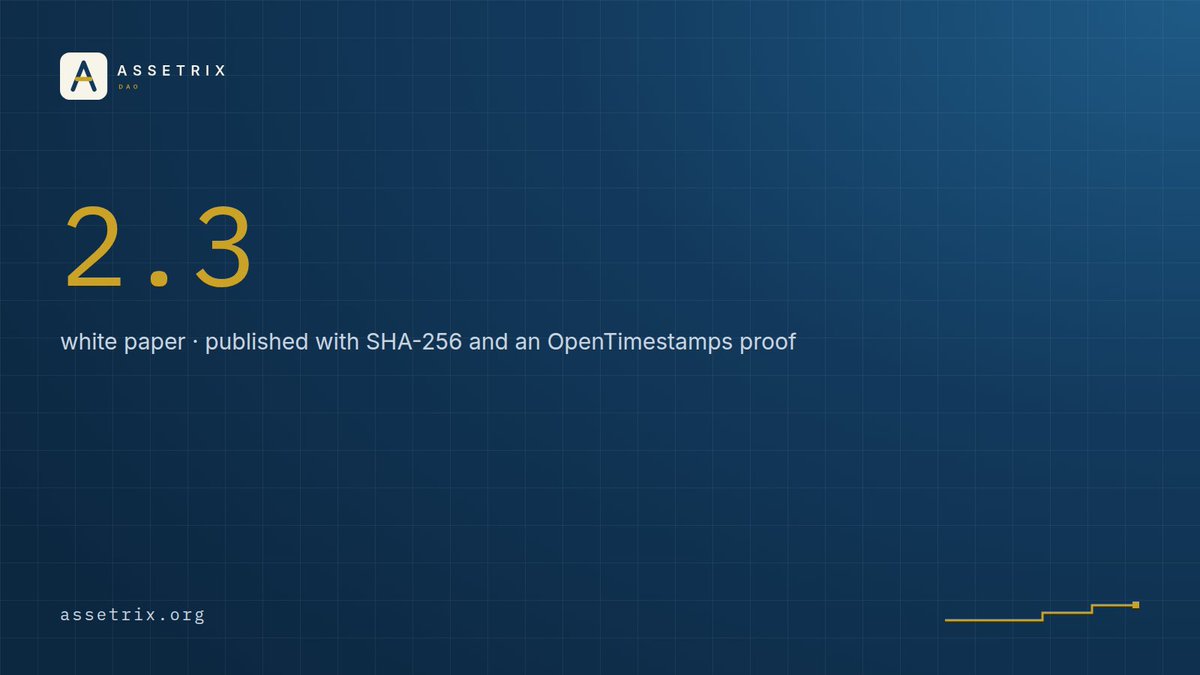
White paper 2.3 is out. A complete specification of the economics: the curve, the corridor, the protection of backing, governance, fees and their ceilings — with the arithmetic. Published with its checksum and timestamp proof. https://t.co/rn4OWoOO5k
#DeFi#Whitepaper
#OpenTimestamps#Crypto
Every document we publish has a SHA-256 checksum and an OpenTimestamps proof beside it. One tells you the file is the one released; the other, that it existed on that date. Neither needs you to trust us. How to: https://t.co/e0kweumlI5
#DeFi#Uniswap#Arbitrum
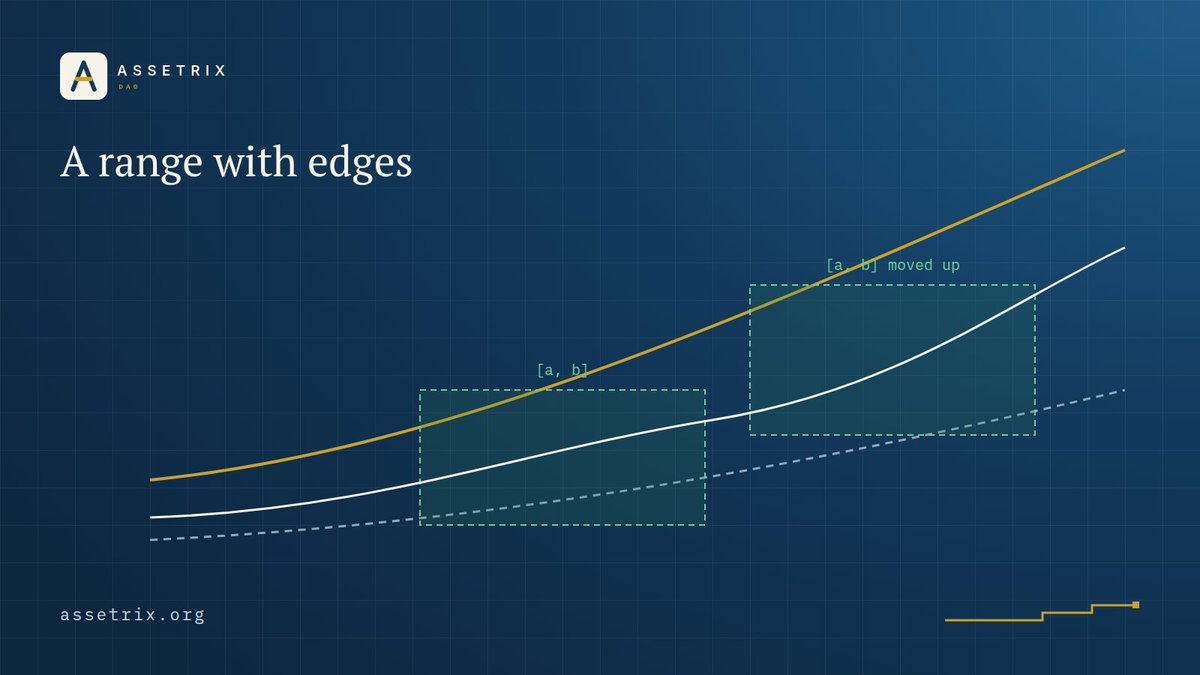
The liquidity provider. Concentrated liquidity needs a range; the corridor is one, with edges the contract publishes and defends. The price cannot leave it, so impermanent loss is bounded. Fee tiers, ranges, three phases: https://t.co/lJvt8Jr2Rn
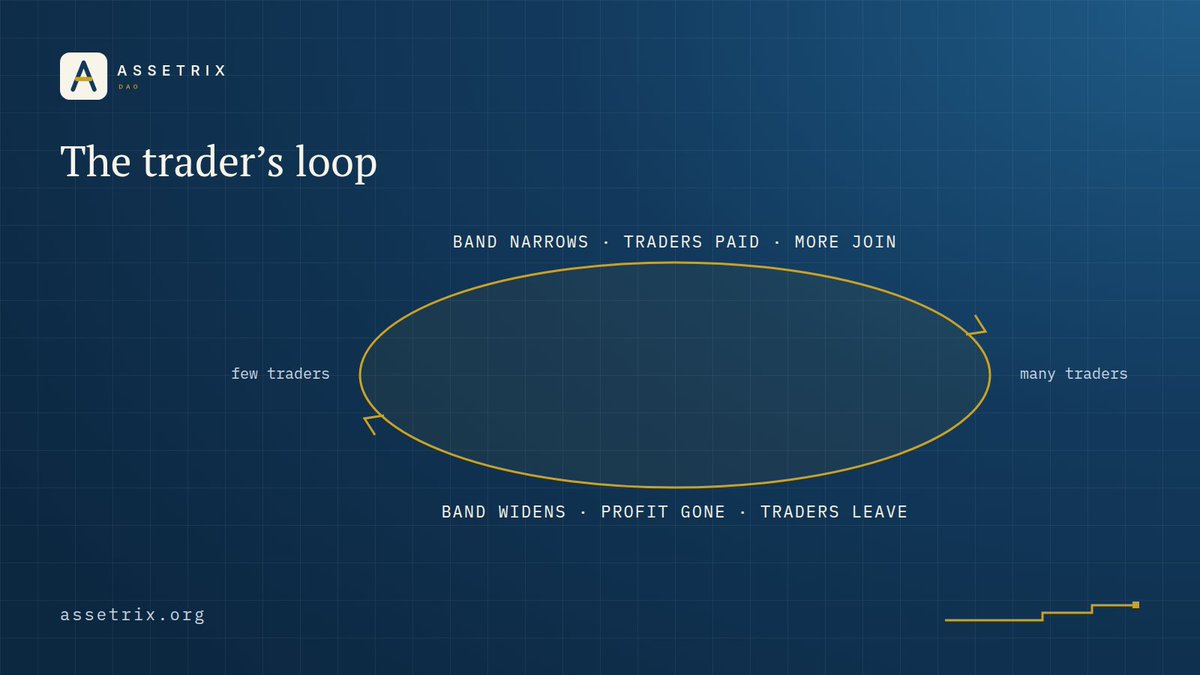
The trader. Two published levels instead of none: above the cost of entry, minting beats buying; below backing by more than the fee, redeeming beats selling. Every trade at the edges narrows the band — until it stops paying, which keeps traders in proportion.
#DeFi#Trading
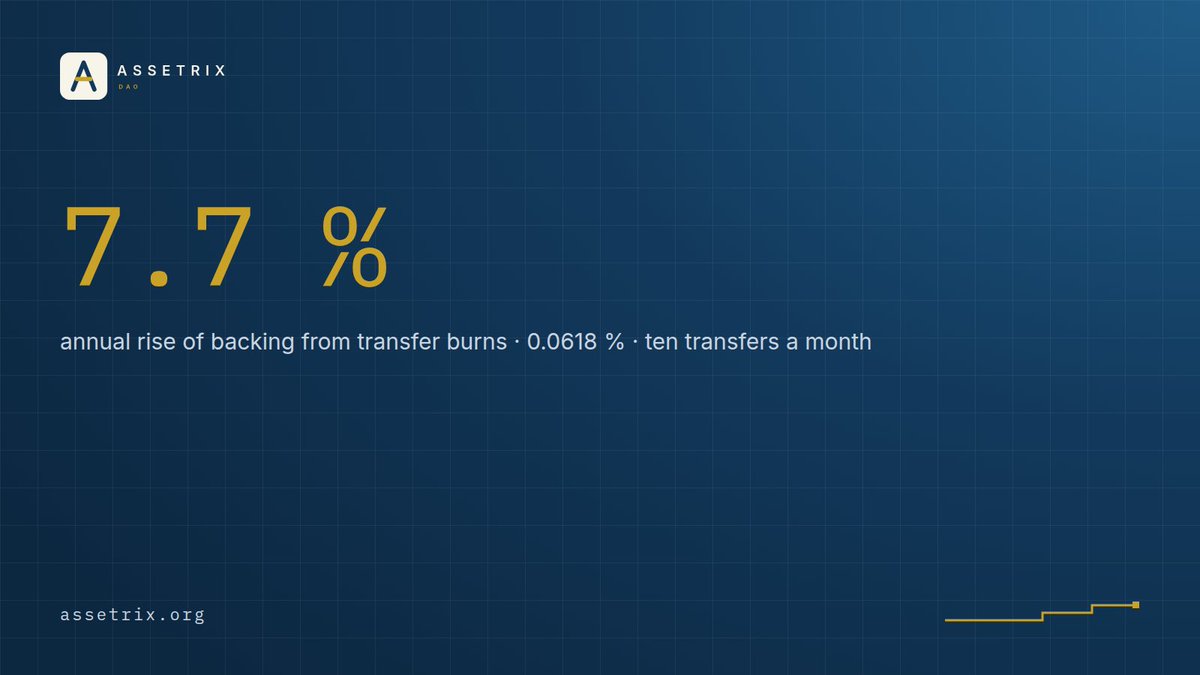
The spender. If the holders set a transfer fee, every transfer burns a sliver of the supply while the reserve stays put — and backing per coin rises with turnover. Ten transfers a month at 0.0618 % is 7.7 % a year on the floor. Use itself raises it.
#DeFi#Tokenomics
The holder. ASTRX sits in a corridor: backing below, cost of entry above. Backing rises through closings, fees and burns; an outflow of holders does not lower it when the reserve is in stablecoins. The price can fall inside the corridor — that is the risk.
#DeFi#Crypto
The saver. Deposit collateral at today's cost of entry; take it all back whenever you want. If the market price later stands above your entry price, closing beats redeeming; if not, you lose only time. Every later entrant pays more for that right.
#DeFi#Arbitrum
🚀 Take a closer look at the Assetrix DAO ecosystem.
The Assetrix holder’s account brings the key protocol tools together in one place:
◾ Track your ASTRX balance and backing
◾ Deposit assets and create positions
◾ Manage, split, transfer, or close positions
◾ Buy and sell ASTRX through Uniswap
◾ Transfer ASTRX to another wallet
◾ Redeem ASTRX for a proportional share of the protocol reserve
◾ View protocol data, fees, and voting credits
Built to make interacting with the Assetrix ecosystem clear and transparent.
Watch the account tour and see how Assetrix works in practice.
🌐 https://t.co/5EunkmlYJt
#Assetrix #AssetrixDAO #ASTRX #DeFi #Web3 #Ethereum #Arbitrum #Uniswap
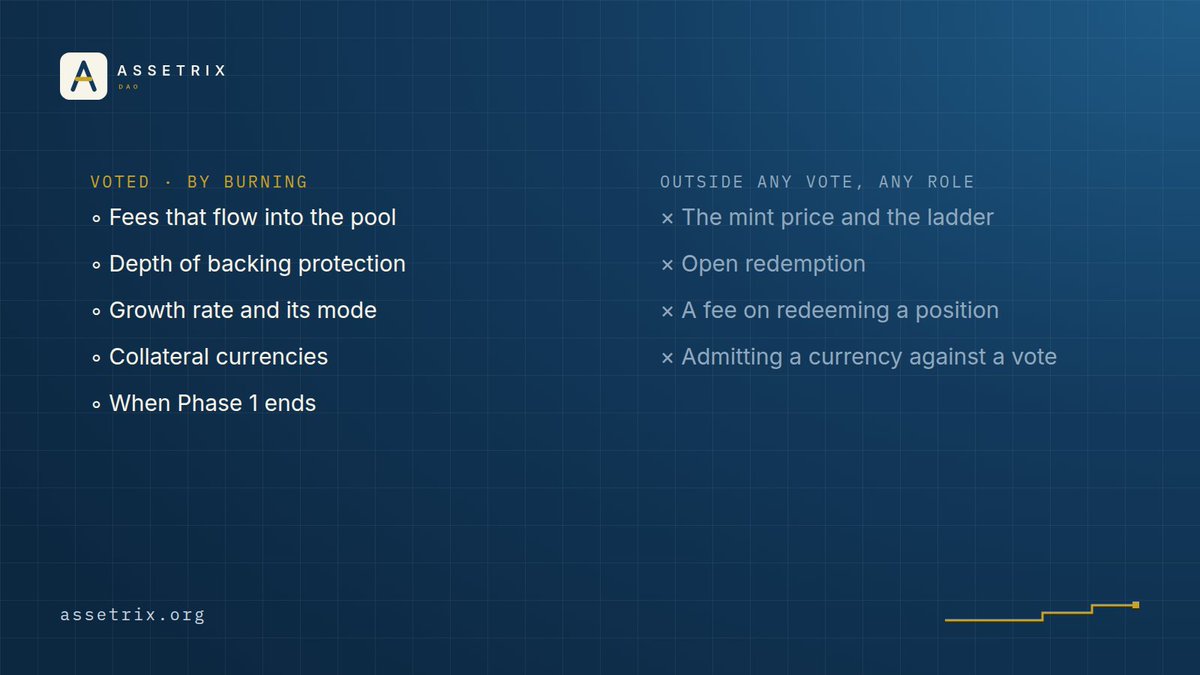
A vote is cast by burning tokens. Their collateral stays in the pool and works for everyone who remains. Fees, protection depth, growth rate, collateral currencies — all voted. The mint price, the ladder and open redemption — outside any vote, and outside any role.
#DAO#DeFi
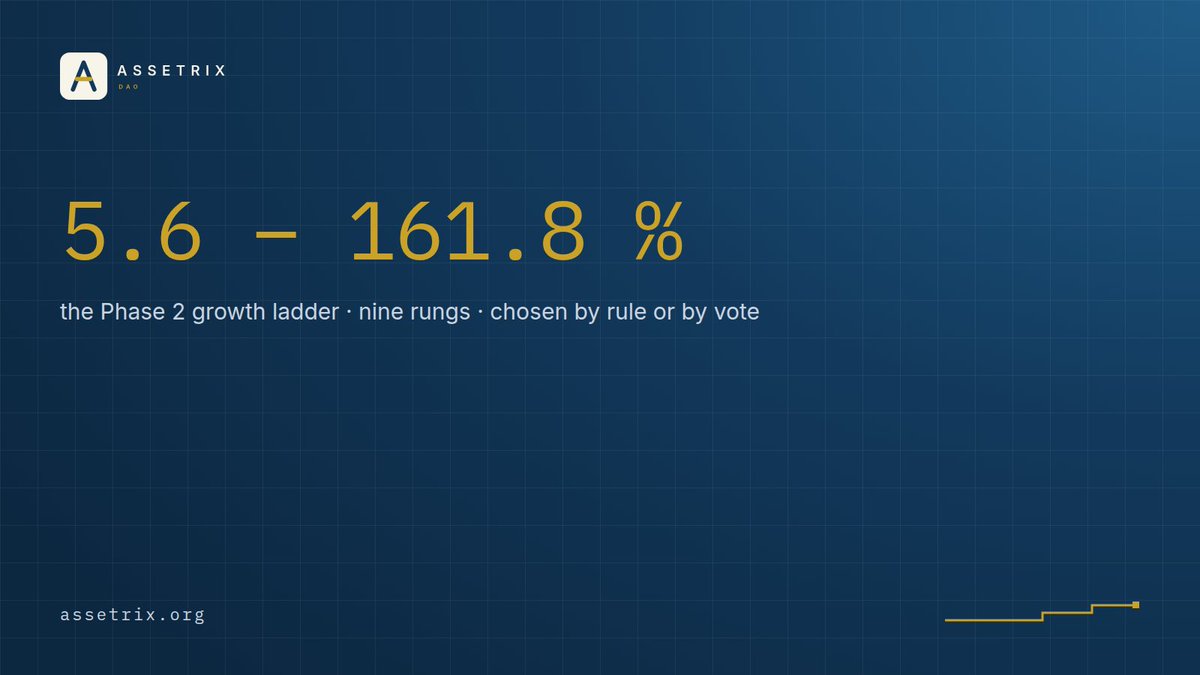
In Phase 2 the cost of entry rises with time at a rate from a fixed ladder: 5.6 → 161.8 % a year. Which rung applies is set by a rule in the contract that watches one thing — inflow of collateral — or by the holders directly, by vote.
#Tokenomics#DAO
Redemption is neutral. Whoever redeems takes exactly their proportional share of the reserve. The pool shrinks; backing per token for everyone else does not. A collapse of backing through exit is impossible by construction — not by promise.
#DeFi#Crypto
Backing per token is not allowed to fall from its record by more than a set share: 61.8 % by default, tightened by vote to 50, 38.2 or 23.6 %. A dilutive closing may use at most 38.2 % of the headroom — so the threshold is approached, never reached.
#DeFi#Tokenomics
Phase 1 in one line: the first token costs a tenth of a cent, the hundred-millionth costs $200, and the curve between them is a published formula anyone can check. Redemption does not lower the count, so the price of entry never steps back.
#Tokenomics#DeFi
Assetrix DAO in USA Wire
A new article about Assetrix DAO explores how to assess the safety of a DeFi protocol and what checks to perform before trusting it.
The article examines Assetrix’s approach to protocol verifiability and the key questions worth asking when evaluating DeFi projects.
Read the full article https://t.co/8oYc8KGyKo
What Assetrix does not do: no yield, no promise about the market price, no buy-back, no forecast, no custody. The list is the same on every page and in every post. When a description contradicts it, the description is wrong.
#DeFi#Crypto
The protocol does not set a price for ASTRX. It sets two others: backing per token below, held up by redemption that is always open; cost of entry above, held down because anyone can mint at that price. The market price lives between them.
#DeFi#Tokenomics