Since Bitcoin strong rally in late August, I no longer view the market from the perspective of an ongoing bearish cycle.
More specifically, I believe we have reached a point where the risk-reward ratio for long positions is now significantly more favorable than for short positions.
During the bearish cycle that began last year, I entered short positions a total of three times. However, even if Bitcoin's price declines again, I have no intention of opening another short position.
That said, there's something I've been emphasizing consistently.
I still believe the Bitcoin market has not gone through a sufficient accumulation phase.
In other words, I don't expect a rapid, sustained upward move to begin anytime soon. I still believe the market may need a much longer accumulation period than many people expect.
That's why I sold all the Bitcoin I had purchased in late September.
If I had believed the market was entering a phase of accelerating upward momentum, I would have bought more Bitcoin instead of selling it.
Today, I'd like to share one particular concern.
Rather than bringing it up after something has already happened, I think it's more practical to share my concerns early, when the warning signs first begin to appear.
Of course, this is simply my personal analysis and perspective.
I've been closely monitoring the behavior of spot whales on Binance.
Looking at the data objectively, the liquidity flows of Binance spot whales have looked increasingly concerning since early October.
The problem is that, rather than improving, the situation has continued to deteriorate over time.
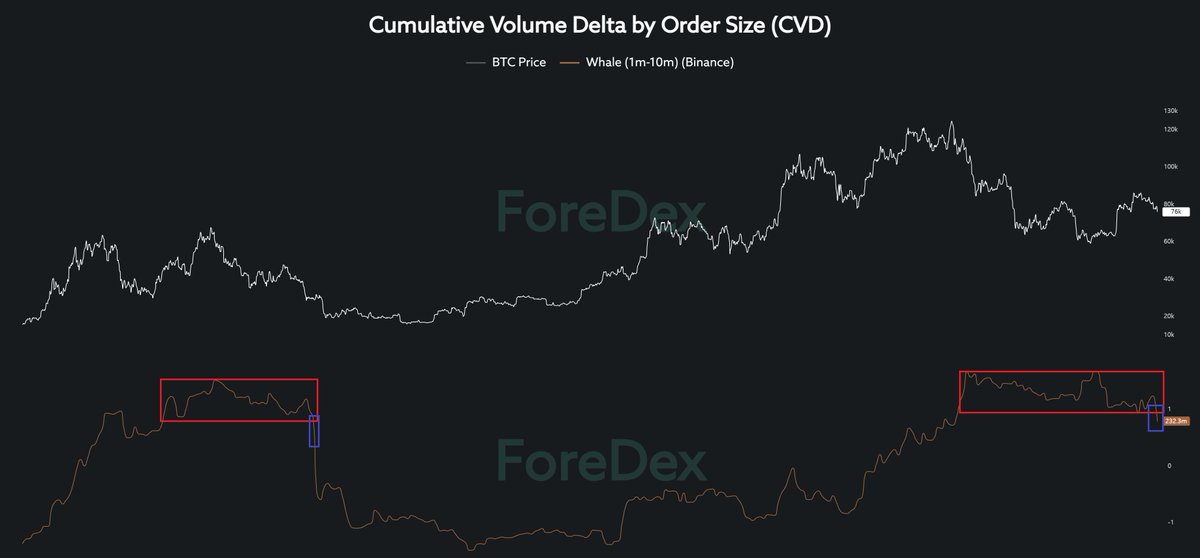
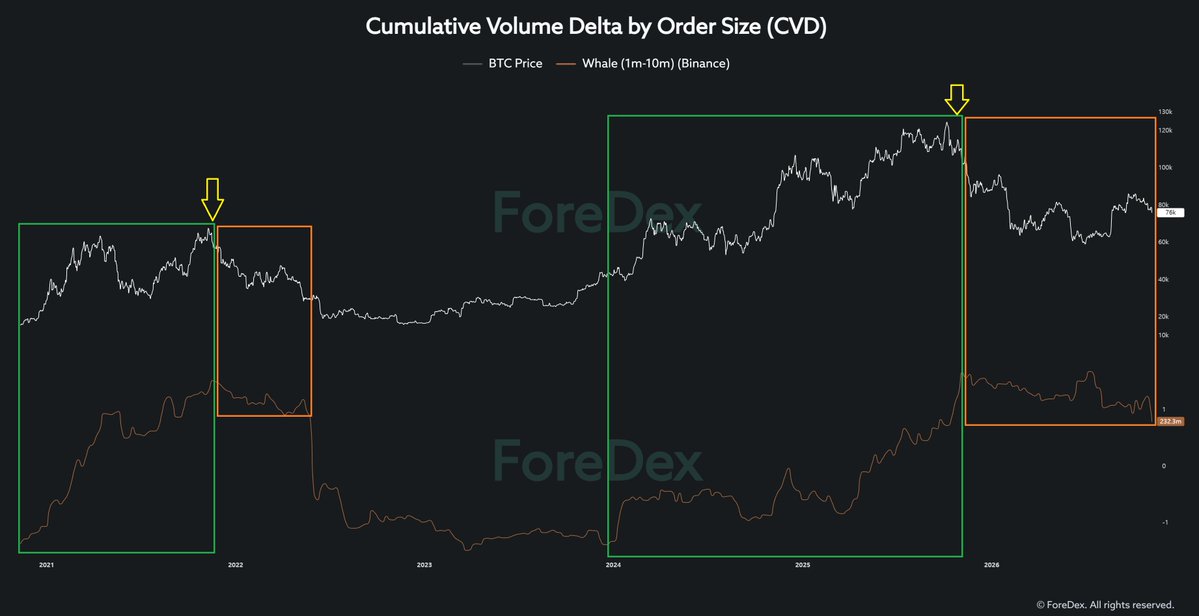
In particular, the current behavior of Binance spot whales looks remarkably similar to the market structure we saw in 2022.
Let's look back at 2022.
At that time, the rise in the brown whale CVD closely aligned with Bitcoin's upward price movement.
However, whale buying pressure eventually began to weaken, and that shift coincided with the beginning of the bearish cycle. (Image 2, green box)
Here's the important part.
Even after the bearish cycle began, Binance spot whale CVD did not immediately collapse.
Instead, it moved sideways within a relatively defined range for some time. (Image 1, red box)
The much larger shock eventually came when the lower boundary of that range broke down.
That was around the time the Terra-Luna crisis began, followed by a series of collapses and crises involving companies such as Celsius and Three Arrows Capital (3AC).
Now, looking at the current behavior of Binance spot whales, we're once again seeing a sharp deterioration in buying pressure.
And today, Bitcoin price broke below the lower boundary of a trading range that had been forming for approximately a year.
This is why I believe we need to monitor these developments very carefully.
If Binance spot whales continue selling, I think we also need to consider the possibility that an unexpected problem could emerge somewhere in the market.
Of course, aside from the Binance hacking incident, there don't appear to be any other major publicly known issues that could immediately trigger a significant market shock.
But think about this.
Back in 2022, did we know in advance that the Terra-Luna, Celsius, and 3AC crises would unfold one after another?
Most of us didn't.
And that's exactly why risk management matters.
I believe we should consider potential risks when unusual signals begin appearing in market liquidity flows, rather than waiting until those risks become obvious to everyone.
Since selling all my Bitcoin in late September, I haven't bought back in.
I still don't believe this is a time to rush into buying, so I'm keeping my distance and observing the market.
And my reasoning goes beyond Bitcoin's internal liquidity conditions.
Not only are Bitcoin's own liquidity flows looking weak, but the broader macroeconomic environment is also unfavorable.
In particular, the U.S. stock market is showing a clear downward trend.
If Bitcoin's internal liquidity flows were improving significantly despite an unfavorable macroeconomic environment, I would actually be willing to take an aggressive long position.
But that's not what we're seeing right now.
The external economic environment is unstable, and Bitcoin's internal liquidity flows remain weak.
Under these conditions, I think we need to be cautious about the possibility that an unexpected negative event could trigger a much broader market reaction.
In particular, this seems to be a period when problems originating in external markets could have a relatively high risk of spilling over into Bitcoin.
Of course, none of this means these concerns will necessarily materialize.
The market could stabilize without any major incident.
However, when warning signs are appearing in the market, I believe it's important not to ignore them and to prepare for potential risks in advance.
I intend to continue approaching the market with a longer-term perspective, rather than focusing too heavily on short-term price movements.
And at least throughout November, I believe we need to keep a very close eye on Binance spot whale CVD.
The important thing right now isn't to assume that another major decline is inevitable or to let fear dictate our decisions.
It's about objectively analyzing market liquidity flows, managing risk, and patiently waiting until a more favorable opportunity presents itself.