there are currently 50K+ Clankers and more dropping daily, thanks to @farcaster_xyz’s open social graph w/ linked EOAs and @openranknetwork’s reputation scores, you can now marry onchain buying/selling activity with social reputation, making buying decision a lot more informed!
If you're a wallet, AI agent, social client, or building a token feed, we’ve upgraded Clanker Scores to make it even more powerful for your use cases.
Now Clanker Scores include scores based on
- buyer reputation
- holders reputation
- buyer breakdown (see which reputable Farcaster user bought the clanker and vice versa)
- recency of clanker launch
Link to docs - https://t.co/x1OXGYXorv
h/t - @JackDishman@_proxystudio@SahilDewan@astralblue@jessepollak@dwr@0xDeployer
In OpenRank, a growing network—like Farcaster—also means that, if one doesn't do anything much in it, their OpenRank score (relative percentage) will be diluted. This dilution is a natural process: It does not necessarily mean that their absolute trust level is decreasing.
In order to quantify OpenRank score into an absolute score that can be quantified over time, one needs to also measure the size of the network's trust pie, and multiply it by their OpenRank score. Once I have my absolute score calculated this way, it'd actually be problematic if that absolute score decreased.
So here's an open question: How can we define the size of a growing network's trust pie for OpenRank?
Getting trust signal from one of the (strongly pre-trusted) seed peers is therefore a big boost for both your ranking and your trust opinions about others.
The a ("alpha") parameter in EigenTrust is the portion of global trust reserved for the seed peers, e.g. a=0.5 with 10 equally pre-trusted seed peers, EigenTrust guarantees each seed peer with 5% global trust (50% total), plus what they earn from other peers via local trust.
The seed trust reserved via alpha boosts not just the seed peers' own ranking, but also what they have to say about other peers (remember: in EigenTrust, what you say matters exactly as much as how trusted you are by the network).
(con't) but there should still be enough seed peers to "light up" the majority of the trust network. (A peer is "lit up" if there's a recursive trust path from at least one seed peer.)
@openranknetwork's seed trust (aka pre-trust) gives EigenTrust rankings both Sybil-resistance and their "flavors". Seed trust works by letting ranking designers put intentional bias in whose trust opinions to boost and by how much.
Ranking designers should choose a good seed trust to achieve an important balance: Seed trust should be limited to those "prudent" peers who place their direct trust sparingly so that their close neighbors (both direct and indirect) in the network are unlikely to trust sybils,
That is, OpenRank scores do not have absolute thresholds. Example: Me having only 5% of the trust pie in a network of 100,000 people will likely be still better than, say, me having had 20% of the trust pie 3 years ago when the network had only 10 people in it.
@openranknetwork score—EigenTrust global trust value—is different from traditional trust scores such as credit scores, in that it's a ratio percentage, ala "who in this community deserves how big of a share of that trust pie the community built as a whole?"
As such, it doesn't make sense to say, for example, "A 0.05 score—5% share of trust pie—is good enough over time for XYZ purposes," because that percentage is always bound to, and is relative to, the then-current network size.
OpenRank's EigenTrust is not just about #1/#2/... ranking; it binds a "global trust" value to peers. Trust values matter more than ranking! You and me being ranked #51/#52 does not necessarily mean we're in the same league: My score may be orders of magnitude lower than yours.
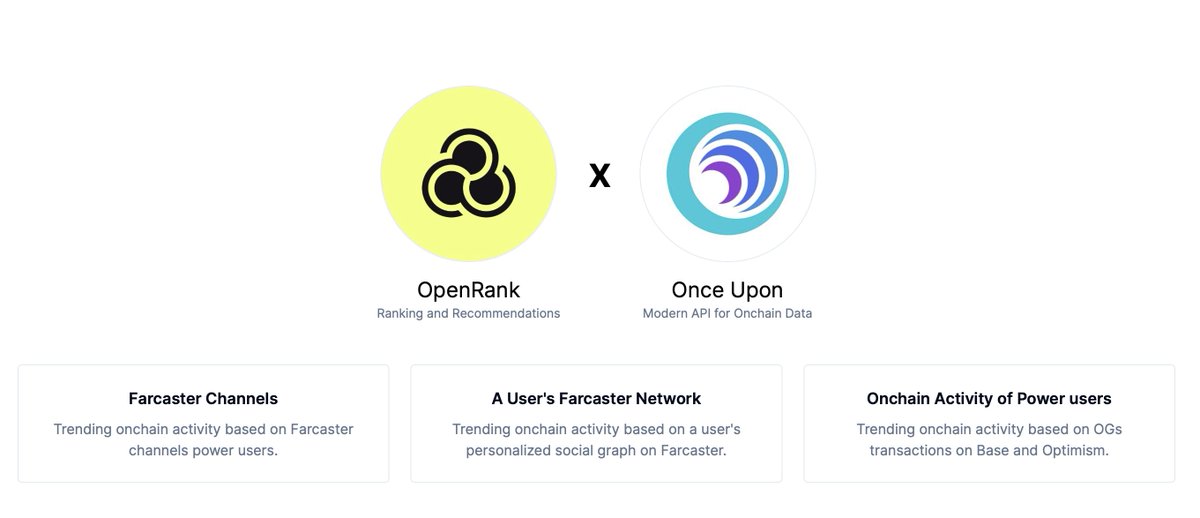
Just shipped https://t.co/QOPsjtXVoq (by openrank x @onceuponxyz ) to discover what's happening onchain based on personalized @farcaster_xyz social or onchain activity. Developers can power feeds and apps that make personalized transaction recommendations for their users.
Super excited to talk to @andrewhong5297 on data and algo layer to build Web3 reputations.
Join our Twitter Space on Monday 2pm PT, 5pm ET
💡 https://t.co/Xx3tsKvyfQ
Discuss:
- @DuneAnalytics’s newly released SQL
- Andrew and @SahilDewan latest on scores, algo, data labels