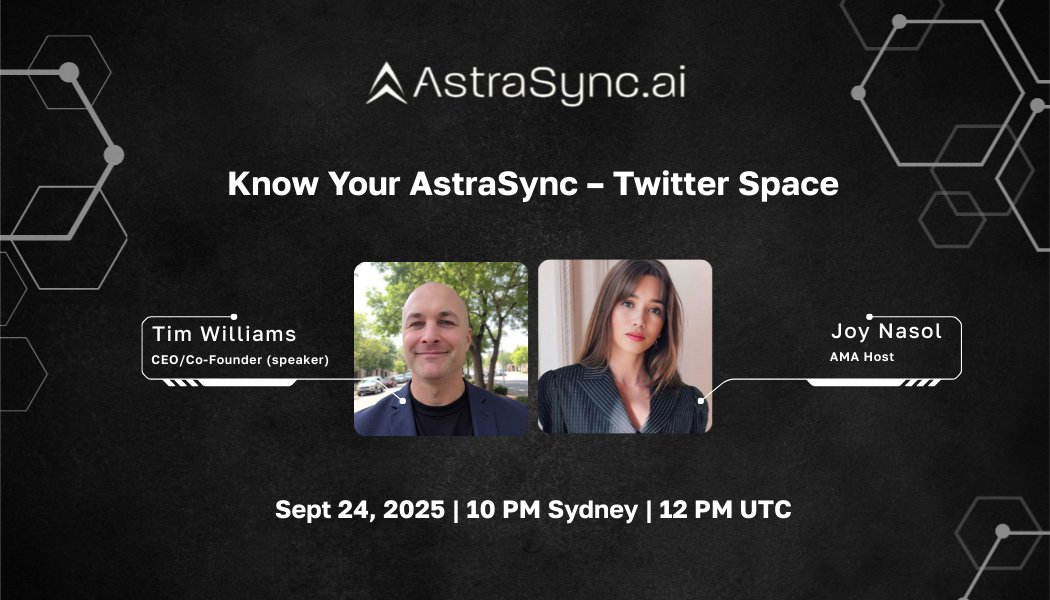
📢 Know Your AstraSync – #AMA Session
We’re excited to announce our upcoming AMA session:
🗓 Date: Wednesday, September 24, 2025
🕙 Time: 10:00 PM Sydney | 12:00 PM UTC
🎙 Host: @imjoygeous
👤 Speaker: @tim_astrasync, CEO & Co-Founder of AstraSync
Join us as we dive into the future of AI governance and explore how "AstraSync’s Know Your Agent" infrastructure is shaping accountability and trust in the age of autonomous AI.
Don’t miss this opportunity to ask questions directly and gain valuable insights from the team building governance infrastructure for the AI era.
🔹#AstraSync Know Your Agent - Identity, Trust and Verification for autonomous AI Agents.
https://t.co/EZbMuyjC2G
Our ERC-8004 wrapper is now live on @SkaleNetwork on BASE. Our first supported web3 protocol.
Every agent gets immutable chain of custody from day one. No anonymous actors. No gaps in the record.
And we're just getting started with SKALE.
https://t.co/XOyLDyCjVb
Don’t miss the bell 🔔
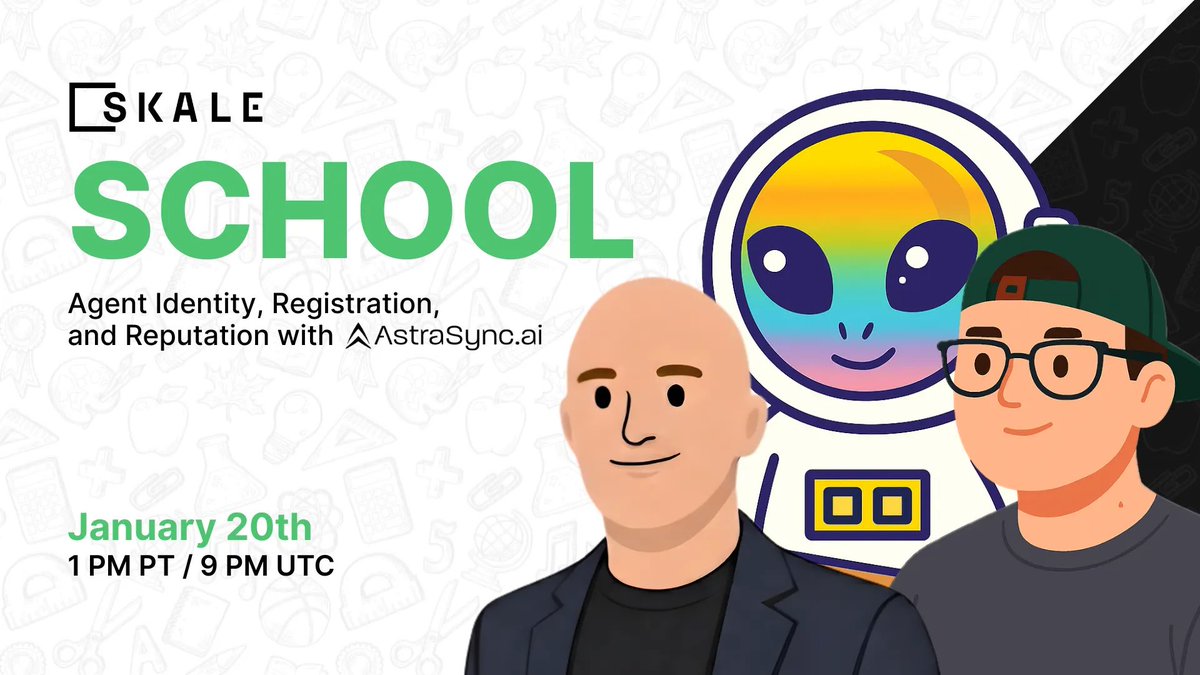
Join @TheGreatAxios, @iFalcore, and special guest @tim_astrasync, as they unpack trust and reputation for onchain agents with @astrasyncai!
Streaming live tomorrow at 1pm PT / 9pm UTC on X.
AI agents are multiplying fast, but who do you trust?
@astrasyncai is now live with SKALE on Base
Bringing real-time identity, trust scores, and verification for autonomous agents!
Agent safety meets blockchain speed!
@WilmaButle72835@whalesailors@tim_astrasync Developers can use cryptopgraphic signatures to register and manage Agents. When verifying access requests, AstraSync challenges the Agents runtime directly to ensure the Agent runtime assigned the Identity is the same Agent runtime presenting it.
@MonaMartin24788@whalesailors@tim_astrasync AstraSync abstracts that complexity away from the user by allowing them to use traditional web2 UI, SDK, MCP and API mechanisms to trigger smart contracts. AstraSync then handles the last mile to the chain
Given Agents capacity to alter traditional audit trails, Blockchain's immutable and cryptographic properties are crucial for ensuring identities remain unique and permission boundaries remain immutable. Its decentralised nature ensures both sides of Agentic transactions have a single, common view of events should fault need to be assigned.
Our identity and trust mechanisms remain the same regardless of the use case. What changes is the thresholds that are applied by the counterparty receiving the access request from the Agent. For example, an Agent who's job is simple RAG within trusted partner boundaries the counterparty may opt to accept a lower trust score. On the other hand a counterparty receiving high stakes/risk access requests may enforce a high trust score threshold.
@beck_sonja28841@whalesailors@tim_astrasync When an Agent presents their Identity number, AstraSync presents a challenge to the runtime of the Agent who was granted that Identity at registration. If the Agent presenting it is not the rightful owner of the Identity the verification request will be denied.
Because the registration, ownership transfer and verification events are recorded on the blockchain, they remain immutably recorded. All other records stored off-chain will be treated in accordance with relevant jurisdictional right to be forgotten requireent, balanced with data retention obligations.
@LAugesin31911@whalesailors@tim_astrasync Yes, we're building to align with major frameworks like HAIP, NIST, ISO/IEC, OWASP, https://t.co/7QsEnqPikY, TRiSM, A2As and the EU AI Act among others. We will be rolling out single click compliance reporting in 2026.
They key difference is access to systems (API endpoints, MCP servers, eCommerce checkout pages, other Agents). If the AI can request access to those systems, we deem them to be an agent that needs identity and trust for the counterparty to verify before granting/denying such access.
The Agent is registered by a primary Developer. If that Developer is a user within a team based account (Developer Plus, Business or Enterprise) the ownership is assigned to the account. When calculating Trust Scores we use three groups of factors 1/ Origin (where the Developer who registers the account factors in), 2/ Owner (the account that is accountable for the Agent) and 3/ Activity (how is the agent behaving).
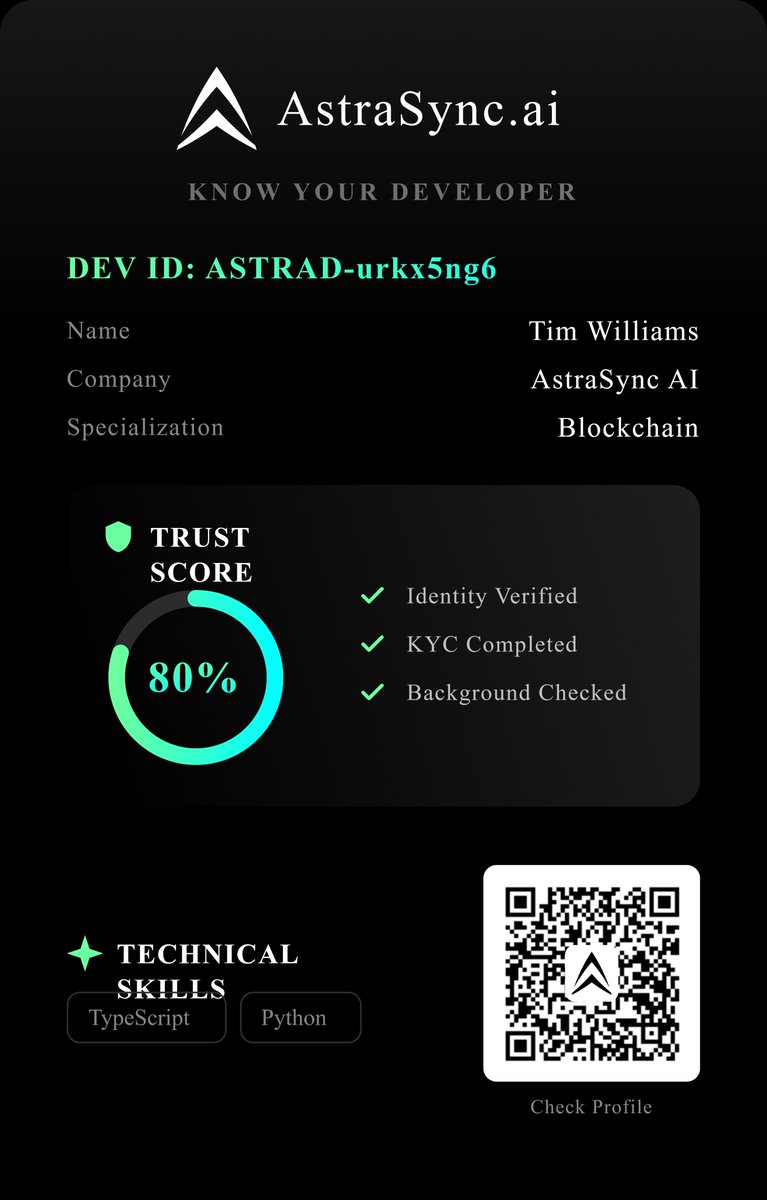
@BrinaReese1334@whalesailors@tim_astrasync Absolutely, here's our CEO's public profile page https://t.co/wTbgYaSpPg Every developer tier customer can opt-in for a public profile page like this, which will be discoverable on our Developer Marketplace in Q1.
The best incentive is a high trust score, as the developer score influences the agent's score and the higher the agent score, the more likely they are to be authorised to transact with counterparties. The Trust Score is used on our KYD visual assets (see attached). If you scan the QR code, you'll notice the public profile page enables the developer to advertise their trust score.
@murray_kri6251@whalesailors@tim_astrasync Models, tools and platforms are the primary third party components we imagine in use. These can be recorded at registration and used to calculate the trust score.
This was partially covered on the call. Effectively, once a developer registers an Agent, they are then able to transfer ownership of that agent to another user and the chain of custody is captured on the Blockchain to validate accountability. In an Enterprise account, multiple developers may be enrolled as users, the primary developer would register the agent, but ownership would automatically be assigned to the Enterprise.
@Fernand039Z@whalesailors@tim_astrasync The main factors that third parties can use to influence a trust score are at the point of verifying an agents access request and post-access. This way, only counterparties that have actually engaged with the agent can influence the score. This prevents gaming scores.
Yes, a singe API call will validate the Agent ID as valid, the permission set the Agent is authorised to act within and the dynamic trust score at the point of verification. This can be automated with our SDK installed at the endpoint used by the agent, whether that is an API, MCP server, ecommerce checkout or another agent. The verification event and result are recorded on the blockchain.
While the algorithm is proprietary in terms of the weights assigned to each factor and how we monitor and assess behavioural signals, the components are transparent. Our dashboard includes guidance on steps that can be taken to improve trust scores. We also are engaging independent auditors to certify the credibility and fairness of the score.