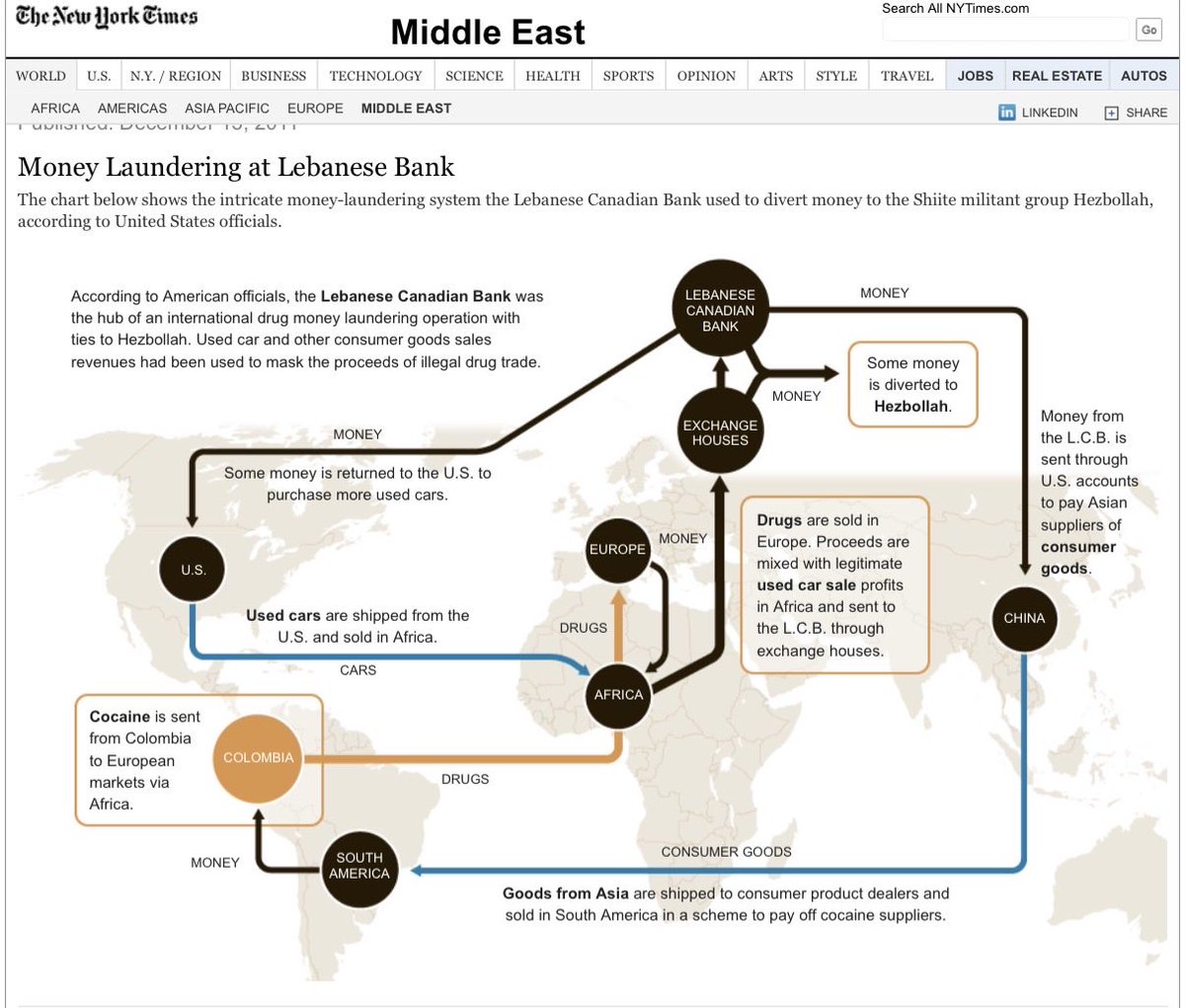
When I was in the DoD, one of the things I worked on was understanding global terrorist financing
Every scheme somehow involved Iran and drugs in America
Delete the Islamic Regime and so many problems will simmer down:
- drug supply in America
- disinfo bots
- terror proxies
President @realDonaldTrump will go down in history as one of the greatest and most consequential presidents we have ever had.
His ability and willingness to make bold and consequential decisions for the benefit of future generations based on the hard and cold facts at hand rather than short-term political considerations is one of his greatest strengths.
No longer are we governed by the politics of the weak who have brought us close to the edge with their weakness and self-interested short-termism.
God bless our nation, our military, and our president. Let’s all pray for our troops who risk their lives on behalf of all of us so we can look forward to a world where evil is eliminated and good prevails.
What we do in life echoes in eternity.
🇮🇷 47 years ago, I stood at a window in Tehran as a 3-year-old boy, smelling burning tires and hearing the chants that would steal my country. I didn’t have words for what was happening. Today, I am watching smoke rise over the same city — but this time the smoke is not the end of Iran. It is, God willing, the beginning of her resurrection.
Several weeks ago I wrote in that the fever of 1979 was finally breaking. I never imagined I would wake up to see that fever confronted so directly. Israel — with the clear support of the United States — has launched a preemptive strike deep into Tehran and against the regime’s military machinery. Explosions in the capital. Military targets hit. The IRGC’s aura of invincibility, already cracked, is shattering in real time.
I do not celebrate war. No decent person does. What I celebrate — what millions of Iranians inside the country and in the diaspora have prayed for in secret for decades — is the possibility that a regime which has no right to exist may finally be forced to go.
This is the same regime that:
- Armed and cheered the October 7 massacre against Israel for no reason other than pure genocidal hatred.
- Murdered tens of thousands of its own sons and daughters who dared to walk peacefully in the streets demanding the most basic freedoms.
- Gouges out the eyes of young women for the “crime” of wearing makeup.
- Hangs teenagers from cranes for posting a tweet.
- Exports terror, poverty, and darkness to every corner it can reach including the U.S.
No nation, no people, should have to live under that. Not Israelis. Not Americans. Not Lebanese. Not Syrians. And certainly not Iranians.
I am a physician who has spent his life trying to heal bodies and a son of Iran who has spent his life mourning a stolen homeland. What we are witnessing is not aggression — it is surgery. Painful, necessary surgery to remove a tumor that has metastasized for 47 years. The tumor is the Islamic Republic that has hijacked Iran.
To the brave pilots and special operators of the Israeli Air Force and the men and women of the United States military now carrying out this mission: I pray for you with everything I have.
May God shield you from harm. May every missile find its target and every soldier return home safely to the families who love them. You are not invaders. You are the answer to the prayers of millions who have whispered “enough” in the dark since 1979. You are giving our friends the chance to breathe free air again. The entire region will owe you a peace we have not known in my lifetime.
To my fellow Iranians watching from inside the country right now, heart pounding, maybe hiding in basements or on rooftops: Hold on. The end is clearer than it has ever been. The regime’s fear is real. Their eyes — those same eyes that once stared down at us with absolute power — now show something they haven’t shown in decades: panic. The math has changed. The window of 1979 is finally closing.
To the little three-year-old boy I once was — and to every little boy and girl in Tehran, Isfahan, Shiraz, and Tabriz today who hears explosions instead of lullabies: This time the sounds are not the closing of a door. They are the opening of one.
The road ahead will not be easy. Transitions never are. But the direction is unmistakable. A secular, prosperous, free Iran is no longer a dream — it is becoming an inevitability.
I have lived the stolen life so that others might not have to. Today, for the first time in 47 years, I allow myself to believe that the stealing is almost over.
Thank you, Israel. Thank you, America. The Iranian people — the real Iran — will never forget.
The fever is breaking.
The dawn of 2026 is here.
And this time, the light wins.
🇮🇷❤️🇮🇱🇺🇸
What Greenland’s Leaders Can Learn from the Countries That Chose Openness Over Illusion
Forty-seven years ago today— in January 1979 — Chinese Communist leader Deng Xiaoping boarded a plane for his landmark visit to the United States, just weeks after the formal establishment of diplomatic relations between Beijing and Washington. According to History Professor Chen Jian of New York University, Deng spoke candidly to his associates during that flight about what he had learned from observing the modern world:
“As we look back, we find that all those countries that were with the United States have been rich, whereas all of those against the United States have remained poor. We shall be with the United States.”
For Deng , this conclusion was born not from ideological inclination, but from empirical observation: the prosperity of US- or Western-aligned, market-integrated societies, and the relative stagnation of closed, antagonistic states. To understand the roots of this insight and why he reached that conclusion, we must reconstruct the historical and intellectual context that shaped his thinking.
That context has been explored with unusual simplicity and clarity by noted diplomat and public intellectual Kishore Mahbubani, whose work—especially The New Asian Hemisphere—argues that Asia’s rise was not a revolt against the West but a disciplined apprenticeship in what worked.
After the catastrophe of Mao’s Cultural Revolution and ideological confrontation with the West, Deng Xiaoping reversed the Marxist-Leninist-Maoist order of things, welcomed foreign investment, and aligned China with the global market—especially the US-led system. Deng’s leadership marked a decisive pivot toward pragmatism and openness. The January 1979 visit was preceded by the first formal handshake between China and America, and Deng’s optimism reflected a belief that China’s modernization project required strategic engagement with global systems, particularly those influenced or led by the United States.
This was a stark departure from earlier revolutionary rhetoric. By the late 1970s, Deng and his circle recognized that economic development and technological advancement could not be achieved through isolation or ideological purity. Instead, it required learning from successful examples abroad.
Months before his U.S. visit, Deng toured Southeast Asia in late 1978, including stops in Thailand, Malaysia, and Singapore. These visits were consequential. According to Kishore Mahbubani, Deng expected to encounter fellow “Third World” cities struggling under post-colonial constraints. Instead, he saw modern, orderly, increasingly affluent urban societies—in several respects ahead of Chinese cities at the time. This encounter forced a painful inference: China’s relative poverty could no longer be blamed solely on history or imperialism. Other Asian societies, starting from weaker positions, had already surged ahead.
Mahbubani added that Singapore made the deepest impression. In Singapore — a small city-state transformed into an economic powerhouse — Deng saw what disciplined governance, openness to trade, and meritocratic investment in human capital could achieve. Lee Kuan Yew, Singapore’s founding leader, had long championed what might be called strategic openness: a willingness to learn from global best practices while retaining national autonomy. Within Lee’s inner circle was Dr. Goh Keng Swee, the principal architect of Singapore’s economic strategy. Goh had studied the Meiji Restoration — a period in which Japan adopted Western technology and organizational methods to transform itself into an industrial power by distilling its lesson: modernize by borrowing institutions and methods from the most successful societies, while preserving sovereignty and social cohesion.
That Meiji logic—learn ruthlessly, adapt selectively—had turned Japan into a modern power, the first Asian country to defeat a European powerful country (Russia) in 1905 . Goh also applied the pillars of Western wisdom to Singapore through the rule of law, meritocracy, pragmatism, education, openness to trade, foreign investment, science and technology, and disciplined governance. Goh’s thinking — later valued by China — was influenced by this very model of selective adaptation: adopt what works, adapt it to local conditions, and shield the process from destabilizing ideological conflict. Indeed, Deng would recruit Goh to advise China on coastal development and special economic zones, drawing on Singapore’s insights into state-guided but globally integrated development.
After his trip from abroad, Deng implemented the “Reform and Opening-Up” policies that dismantled autarkic controls, welcomed foreign investment, and created Special Economic Zones designed to absorb technology and capital from abroad. China’s embrace of global markets and science-based development transformed it from a stagnant, rural society into the world’s second-largest economy within a generation. The normalization of U.S.–China relations and the consequent cooperation in science, technology, education, and trade were pivotal to this trajectory.
Deng Xiaoping was not alone in drawing lessons from global experience. The late historian Lawrence Harrison systematized these patterns in Who Prospers? How Cultural Values Shape Economic and Political Success and The Central Liberal Truth. His case studies are success stories of nations that transformed socially, politically and economically by opening themselves to ideas, markets, and institutions that worked tended to grow; those that defined success as resistance tended to stagnate. One of the most uncomfortable but powerful arguments in development studies comes from The Central Liberal Truth is that "Nations do not rise or fall primarily because of geography, race, or exploitation—but because of the ideas their leaders choose when confronted with reality."
Again and again in modern history, countries facing existential crisis succeeded not by rejecting the West, but by learning from it, partnering with it, and integrating into the liberal economic order largely anchored by the United States. This lesson is especially relevant today for Greenland, a territory rich in resources, strategically located, but economically constrained and politically uncertain about its future direction.
History offers Greenland a mirror. Let’s examine what some of Lawrence Harrison’s case studies actually teach.
When young Meiji leaders confronted the technological and institutional superiority of the West, they did not romanticize Tokugawa tradition. They studied Western law, military organization, industry, and education, while preserving sovereignty. Japan became rich not by resisting the West, but by mastering its methods.
The influence of historical analogies like the Meiji Restoration — when Japan transformed itself by learning from Western industrial powers — was not lost on figures like Goh or on Deng’s broader strategic circle. The Meiji reformers faced a similar conundrum: how to preserve national identity while embracing foreign knowledge. Their answer was to study and adapt without wholesale imitation — a pattern later echoed in Singapore and China. Likewise, the post-World War II era demonstrated the power of constructive engagement with the United States.
When Singapore was expelled from Malaysia, Lee Kuan Yew chose neither populism nor anti-Western rhetoric. He built a disciplined, corruption-free, investment-friendly state integrated into Western markets and protected by U.S. security. According to Chua Beng-Huat, a sociologist at the University of Singapore, one of the factors for the country’s rapid social and economic development is getting a head start in attracting foreign investment primarily from the United States and other Western nations.
Facing military annihilation, both Tiawan and South Korea chose U.S. alliance, export-led growth, and foreign capital. After the defeat of Japan in 1945, both countries were liberated from the Japanese Imperial Army. However, they also confronted major security threats. Taiwan fell under the rule of Mao Zedong’s Communist Party. After the defeat of Chiang-Kai Shek’s forces by the Communists, the Chinese Nationalists fled to Taiwan. South Korea, on the other hand, had to confront a Soviet- and Chinese-supported military assault by the North Koreans. Both received substantial military and economic support from the United States. Nearly half a century later, both Taiwan and South Korea had joined the ranks of the developed countries also known as "The Four Asian Dragons" alongside Hong Kong and Singapore.
After the collapse of the Ottoman Empire, Kemal Atatürk rejected nostalgia and reoriented Turkey toward Western law, education, and institutions. Turkey survived because it chose modernity over memory.
Under Seretse Khama, Quette Masire, and Festus Mogae, Botswana welcomed Western capital, built rule of law, and avoided resource nationalism. It became Africa’s most successful democracy. All had attended schools founded by Britons. According to Lawrence Harrison, Botswana performs significally better than most African countries, in terms of economic growth rates and
In Venezuela, the discovery and development of oil — heavily financed and technology-supported by the United States — transformed a once agrarian economy into one of Latin America’s wealthiest. In the 1970s and early 1980s, Venezuela stood as the richest nation in Latin America, boasting the highest per-capita income. In Chile, even after the Pinochet dictatorship, center-left democratic leaders maintained the free-market reforms initiated there, enabling continued growth into the 1990s and 2000s. These cases demonstrate that benefiting from U.S. and Western investment and institutional frameworks was often tied to real improvements in living standards, even in countries where political systems varied. After Pinochet, Chile returned to democracy but retained free-market reforms initiated with the help of the Chicago Boys.
From Sean Lemass’s Ireland to Italy’s rejection of protectionism, to Juan Carlos opening Spain, to Jean Lesage’s Quiet Revolution in Quebec, the same lesson appears: Modernization required: opening to Western ideas, liberalizing markets, reforming institutions, and abandoning protectionist myths.
Even within the United States, the same pattern is visible. Less than half of the world’s top 10 richest foreign-born entrepreneurs and innovators are immigrants who succeeded, including @elonmusk (South Africa), Sergey Brin (Soviet Union/Russia) and Jensen Huang (Taiwan), because of American institutions: the rule of law, venture capital, universities, intellectual property, open markets, innovation ecosystems. This demonstrates a deeper truth: the American system does not merely generate wealth for Americans; it generates wealth for those who enter it. This is why so many societies sought partnership with it.
Deng Xiaoping’s plane-side commentary was not ideological capitulation. It was a strategic recognition of a historical pattern: nations that align with global prosperity systems — especially those led or sustained by the United States and Western institutions — tend to grow wealthier and more resilient. For China, this meant reversing decades of isolation and embracing reform and openness. For Greenland, which navigates both economic potential and geopolitical competition, the lesson remains relevant:
So how does this history resonate with contemporary situations like Greenland? Greenland today faces strategic choices that echo those confronted by Japan in the 19th century and China in the late 20th:
Do national leaders anchor their development in self-imposed isolation and ideological rigidity — or do they embrace the global economy? Can strategic engagement with advanced economies catalyze technological learning, infrastructure development, and human capital formation? Does alignment — not simply in military or diplomatic terms, but in economic, educational, and scientific cooperation — open pathways to prosperity that closed nationalism cannot?
The historical evidence and case studies summarized by Lawrence Harrison and Chen Jian — that many of the world’s richest and most dynamic societies were those who integrated with U.S.-led global systems — suggest a profound truth: prosperity is often a function of openness to ideas, capital, and cooperation.
For Greenland — rich in natural resources but with a small population and unique structural challenges — strategic engagement with global partners, including the United States, offers potential pathways to accelerate development, build capacity in education and technology, and integrate its economy into broader networks of trade, knowledge exchange, and investment.
Please repost and follow my account if you believe in peace 🕊️ and that better US-Russia relations are good for the world 🌍. Get positive updates from a Russian 🇷🇺 perspective.
Stay tuned. 🇷🇺🤝🇺🇸
Alaska, August 15, 2025.
@elonmusk "How come the scientific establishment of the United States doesn't collapse? America has a secret weapon. That secret weapon is the H-1B. There would be no Silicon Valley without the H-1B." - Dr. Michio Kaku, theoretical physicist
https://t.co/DjzbiAmilE