#LecturasDeDomingo - La misión @ESA_Euclid de la @esa presentó el 24/06/2026 la imagen más grande y detallada jamás obtenida del centro de la Vía Láctea en luz visible. Con más de 60 millones de estrellas, esta imagen abre la puerta a confirmar la existencia de exoplanetas en esta región y a medir su masa mediante los diminutos cambios en el brillo estelar a lo largo del tiempo.
@esascience
https://t.co/TvKNpolQZm
Barnard's Star racing through space over a seven year period
Barnard's Star is a faint red dwarf located just 6 light-years away in Ophiuchus. It holds the record for the highest proper motion of any known star, racing across the sky at over 10.3 arc seconds per year, first measured by E.E. Barnard in 1916. This rapid apparent motion makes it shift noticeably against the far more distant background stars.
In 2024–2025, astronomers confirmed four tiny sub-Earth-mass planets orbiting it (Barnard’s Star b, c, d, and e). With masses between 0.19 and 0.34 Earth masses, these rocky worlds orbit very close to their star on periods of just 3–7 days.
Detected via precise radial velocity data from ESPRESSO and MAROON-X, they are far too hot for life but represent an exciting breakthrough in finding planets around one of our nearest stellar neighbors. A true cosmic speedster with its own planetary system!
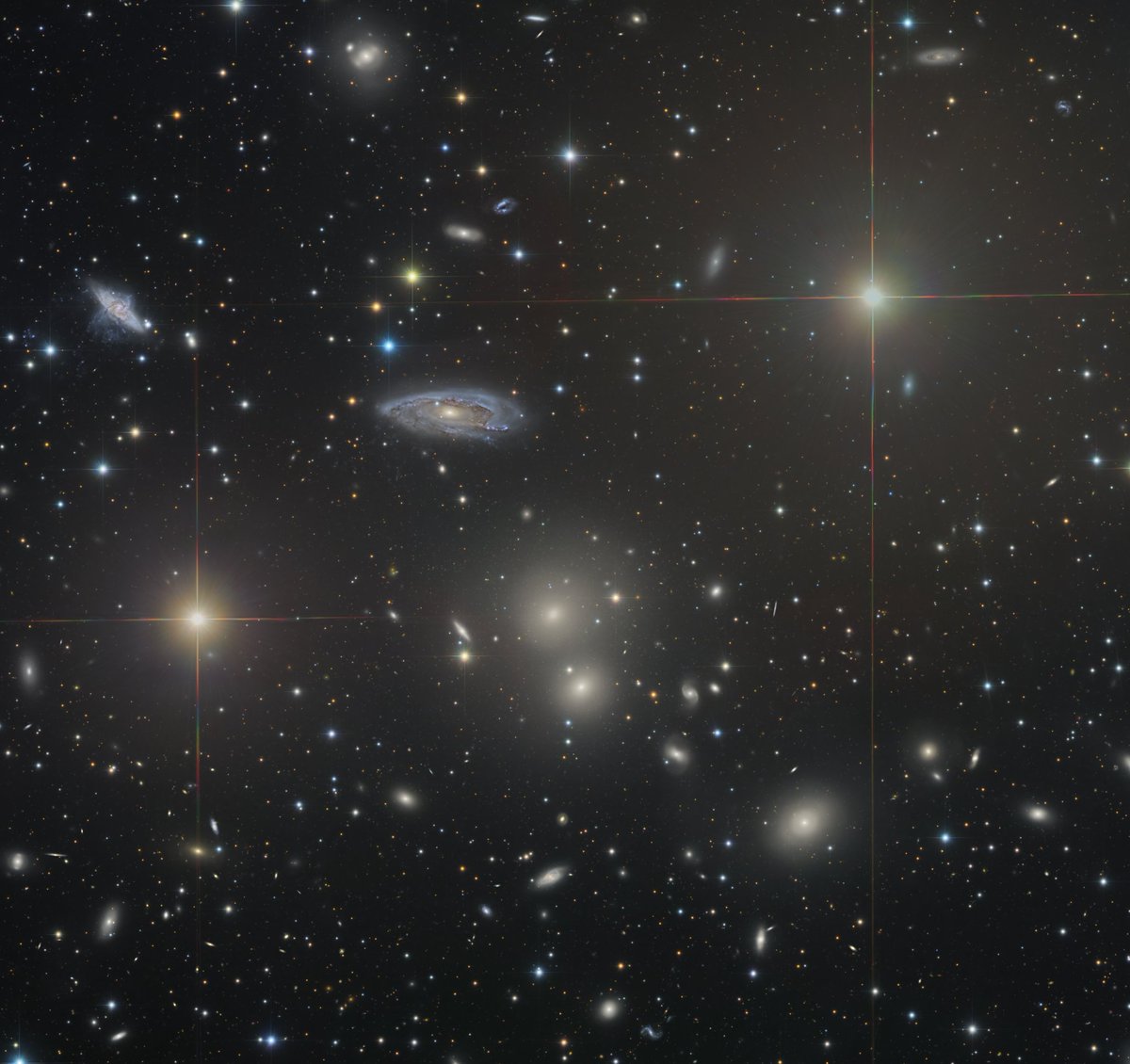
Image of Pazmino Cluster, by John Walsh, using the Leviathan Spectral Pro light pollution filter by Leviathan Optical.
Total integration: 12h 48′
Image: https://t.co/hiD2BznHpl
Thanks for looking!
S.