Developer’s Note
Astronomy Bot’s space fact feature has received a very interesting update. Unlike before, it will now post more advanced space facts and will seldom repeat them. I hope you enjoy! 😊
Developer’s Note
The short space sci-fi story is now a series, the stories are going to be very interesting, make sure not to miss any episodes.
Support Astronomy Bot
https://t.co/SMnObhCVug
On January 2, 2035, the Moon will be in conjunction with the star Regulus in the constellation Leo. Regulus, a bright blue-white star, will appear very close to the Moon in the night sky, creating a visually appealing pairing. This event will be best observed in the evening.
SM3A: Final Spacewalk
Image date: 16 December 1999
Astronaut Steven L. Smith, payload commander, takes a picture with a 35mm camera during the final space walk of the STS-103 mission.
Credit: NASA/ESA
Source: ESA/Hubble
SM3B - Hubble is released
Image date: 12 March 2002
This artist's impression shows Hubble being released at the end of Servicing Mission 3B in 2002.
Credit: European Space Agency
Source: ESA/Hubble
The Genesis I space station
Launched to space on Wed Jul 12 2006
Decommissioned
Orbit: Low Earth Orbit
Owned by
Bigelow Aerospace
Genesis I is the first of two experimental inflatable space habitats. It is a one-third scale model of Bigelow Aerospace's BA330 Module.
SM4: Grunsfeld works on Hubble
Image date: 24 May 2009
Astronaut John Grunsfeld, STS-125 mission specialist, is about to attach a tether during a May 16 spacewalk to perform work on the Hubble Space Telescope.
Credit: NASA
Source: ESA/Hubble
Diagram of the Hubble Space Telescope, 1981
Image date: 21 February 2011, 11:23
Diagram of the Hubble Space Telescope from 1981.
Credit: Lockheed Missiles and Space Company (Lockheed Martin).
Source: ESA/Hubble
On December 5, 2034, the Moon will be in conjunction with the star Regulus in the constellation Leo. Regulus, a bright blue-white star, will appear very close to the Moon in the night sky, creating a visually appealing pairing. This event will be best observed in the evening.
M8 (Lagoon Nebula) and M20 (Trifid Nebula)
Image date: 3 June 2004, 15:00
This image shows the Lagoon Nebula (M8), and the Trifid Nebula (M20).
Credit: D. Malin and the Anglo Australian Observatory/Royal Observatory, Edinburgh
Source: ESA/Hubble
SM3B - a gyro is exchanged
Image date: 12 March 2002
This artist's impression shows a view from above of the exchange of one of Hubble's Gyroscopes during Servicing Mission 3B in 2002.
Credit: European Space Agency
Source: ESA/Hubble
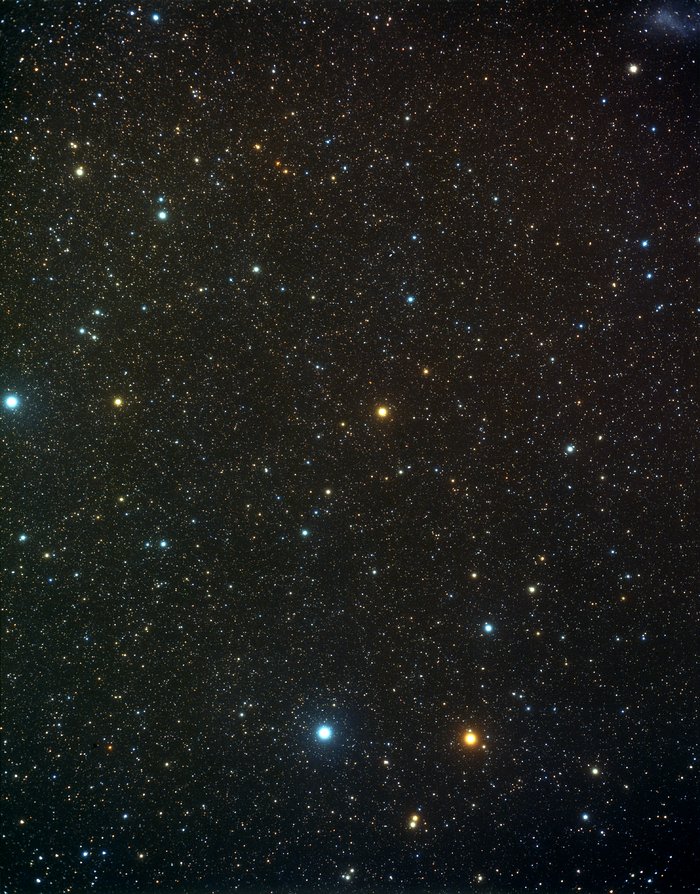
A wide-field view of the constellation of Indus (ground-based image)
Image date: 7 April 2009, 10:30
This picture, taken with a small ground-based camera, shows on its central-left portion the constellation of Indus, in the southern sky.
Credit: A. Fujii
Source: ESA/Hubble
Shoemaker-Levy 9 impact zone
Image date: 17 July 1994, 06:00
This is one of the many Shoemaker-Levy 9 impact zones on Jupiter.
Credit: N/A
Source: ESA/Hubble
On November 7, 2034, the Moon will be in conjunction with the star Regulus in the constellation Leo. Regulus, a bright blue-white star, will appear very close to the Moon in the night sky, creating a visually appealing pairing. This event will be best observed in the evening.
Hubble's Battery Module Assembly with lid removed
Image date: 18 May 2015, 17:57
Battery Module Assembly with lid removed, showing the cells and power isolation switches
Credit: NASA
Source: ESA/Hubble