Incoming @esa ESAC research fellow, previously @CmPA_KULeuven, studying solar prominences. Gamer. Husky Trainer. Enjoys but knows nothing about wine. He/Him
In our latest work now available at https://t.co/cM2DLUkNu8 we look into the radiative connection between solar prominences and their underlying chromosphere. Tl;dr: Prominence albedo is non-negligible, altering the chromospheric /and/ prominence Ne and emergent intensity. 🌞
Last week I flew back from Canada to attend CoCo-Con 2024, the wrap-up conference from the @ERC_Research Adv. PROMINENT @CmPA_KULeuven. It was a huge success with 70+ attendees, fascinating talks, and so so many discussions. My poster is available here: https://t.co/wunJZ3MYcw
@ExploreCosmos_ Perhaps it's just a misunderstanding and indeed someone else has described these as this somewhere else, but it would be great to know where as it's not correct. If it's on a NASA page then we can perhaps get in touch and draw their attention to the mistake.
@ExploreCosmos_ Hi Erika, could you point me to where you found these structures described as solar tornados? This is a solar prominence, indeed viewed by SDO/AIA, where the vertical monolithic internal structure is transient but best linked to the 'barbs' of their filament counterparts.
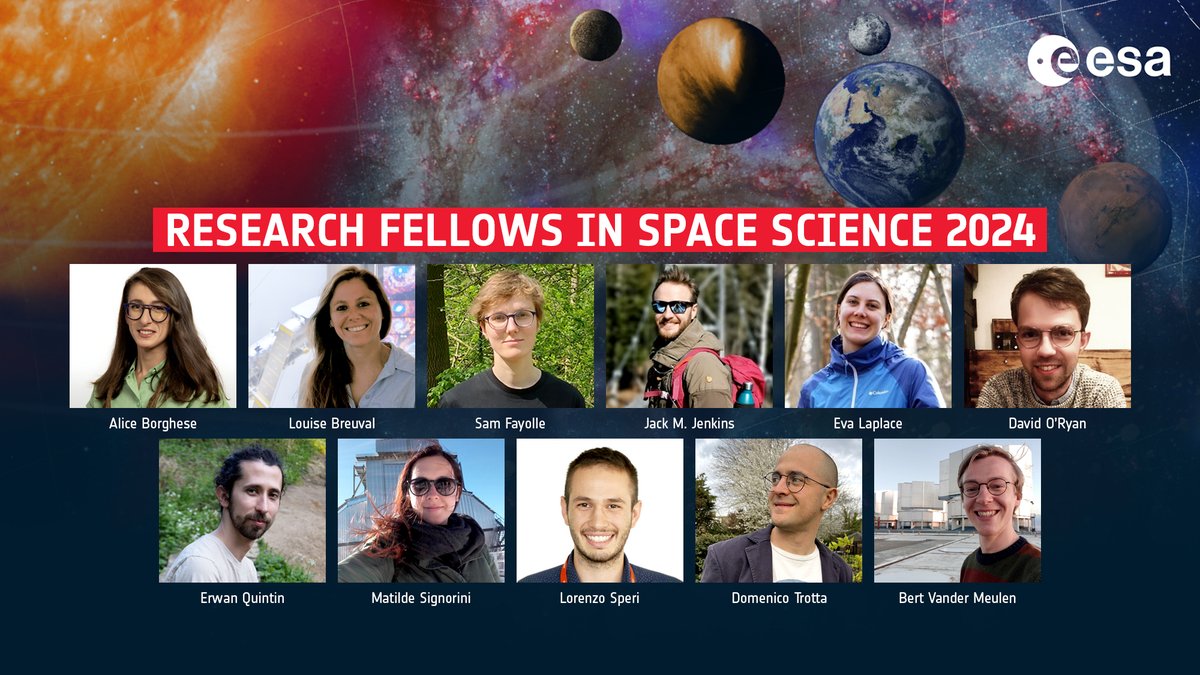
Secret's out 👀 I'll be joining ESAC next year to continue research focused on uncovering yet more of the mysteries surrounding solar prominences, one of the most majestic phenomena that the Sun has to offer us 🌞
In our latest work now available at https://t.co/cM2DLUkNu8 we look into the radiative connection between solar prominences and their underlying chromosphere. Tl;dr: Prominence albedo is non-negligible, altering the chromospheric /and/ prominence Ne and emergent intensity. 🌞
This work was made possible using the Lightweaver ✨ radiative transfer framework's recent 2.5D extension by @Goobley, in combination with the HEALPix quadrature sets to avoid 'spotlighting'. With this, we're close to disk-wide 1-1 observational comparisons, exciting!
It's official! Another huge congratulations to Christine for reaching the final of the #PhDCup ! Find her and the other fantastic candidates on the 19th of October at the Vaudeville Theater in #Brussels for what promises to be quite the spectacle. 🌞
Last week, Silvia Ferro kicked off this year's seminars with a fantastic talk on how the Kelvin-Helmholtz instability structures the magnetopause. Her two-fluid simulations show how magnetic shear influences the double mid-latitude reconnection, biasing it to one hemisphere 🌊 🛰️
Prof. Dr. Ing. @GiovanniLapenta of the CmPA was recently interviewed by the DEEP-SEA project. Listen here as he breaks down the importance of their work, and how it pertains to the study of space physics, in particular the near-Earth environment.
https://t.co/0jtTNzBkxi
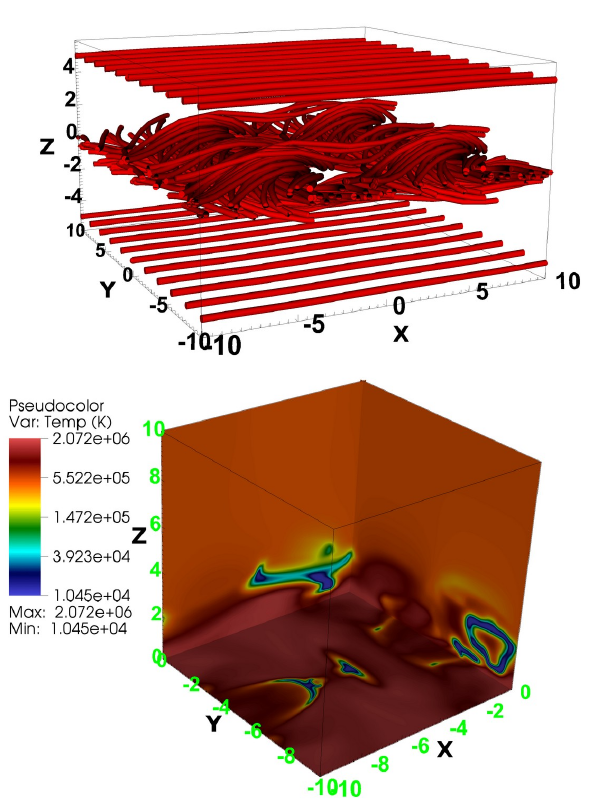
A new study by a group at CmPA has unveiled the dynamic and thermodynamic evolution of current sheets in the solar atmosphere. Combining the effects of tearing and thermal mode instabilities, they shed light on the multi-thermal nature of the solar corona: https://t.co/ccKlBrzxdv
The news is out! Our 'Coronal condensations: formation, evolution, and energy transport' topic was selected by the RAS as a specialist discussion meeting, happening this November 10th at Burlington House! How exciting! More information: https://t.co/978eFdtAw0