Canadian astrophysicist focused on extragalactic astronomy & early-universe galaxies. Seeking mountain peaks. Writing through the chaos; riding away from it.
.@ESA_Euclid was built to investigate dark matter and dark energy by mapping billions of distant galaxies. While carrying out that survey, ESA’s space telescope has also discovered something much closer to home: its first previously unknown comet, C/2026 S1 (Euclid), recorded in images taken between 16 and 24 September 2026.
The discovery came through software developed by Mikko Pöntinen, a doctoral researcher at the University of Helsinki @helsinkiuni working with the Euclid Consortium’s Solar System Objects Science Working Group. His program searches for moving objects against the background of stars and galaxies. During a long exposure, a comet changes position enough to leave a small streak. Around this one, the images also revealed a diffuse cloud, or coma, indicating that it was releasing dust and gas. The streak itself records its movement during the exposure; it should not be confused with a comet’s physical tail.
With no matching object in existing catalogues, Pöntinen reported it to the Minor Planet Center. Ground-based follow-up helped confirm the discovery on 8 October. The comet lies approximately 1.3 billion kilometres from Earth, high above the planets’ orbital plane. Its journey around the Sun takes many thousands of years, although its orbital period still needs refinement.
Finding it required a fortunate alignment of circumstances. Euclid avoids regions close to the Solar System’s plane, where sunlight scattered by interplanetary dust interferes with its sensitive observations. This comet’s steeply inclined trajectory carried it into the telescope’s Deep Field North, where it appeared in 16 exposures across five fields of view. Those repeated sightings allowed the team to trace its motion and investigate its nature.
Comets contain ice and dust inherited from the formation of the Solar System around 4.6 billion years ago. Studying them helps astronomers investigate the materials from which the planets formed. Euclid’s observations already show activity around this distant object, giving researchers an opportunity to follow how it develops as it continues along its orbit.
The discovery also provides practical experience for ESA’s future Comet Interceptor mission, which will wait in space before travelling towards a suitable comet. C/2026 S1 is unsuitable for that mission, but finding and confirming it has tested the discovery and alert process that could help identify a future target.
The Moon is not slowly falling toward Earth, as many people instinctively imagine.
In reality, it is doing the opposite: it is gradually moving away from us at a rate of about 3.8 centimeters per year. The change is tiny on human timescales, but it reveals something deeply counterintuitive about gravity.
Gravity does not always pull things inward. Sometimes, it redistributes energy and pushes orbits outward.
The process begins with tides. The Moon’s gravity pulls on Earth’s oceans, raising tidal bulges on opposite sides of the planet. If Earth did not rotate, those bulges would remain aligned with the Moon. But Earth spins much faster than the Moon orbits, one rotation every 24 hours compared with about 27 days for a lunar orbit, so the oceans are carried slightly ahead of the Moon’s position.
In short, Earth is dragging the tidal bulge forward.
That small offset changes everything. The displaced ocean mass exerts a gravitational pull on the Moon, tugging it forward along its orbit. Moving forward in orbit means gaining energy. And gaining orbital energy does not make an object fall inward, it makes it climb outward, into a larger orbit.
The Moon slowly moves farther away while Earth’s rotation gives up a tiny amount of its energy to make that happen.
As Earth loses rotational energy, its spin gradually slows. Our days are becoming longer, by only milliseconds per century, but the effect is measurable. The long-term slowing of Earth’s rotation, driven mainly by tidal interaction with the Moon, along with smaller geophysical effects, is one reason we occasionally need leap seconds in our timekeeping systems to keep atomic clocks aligned with Earth’s actual rotation.
This exchange follows conservation laws: angular momentum is not lost but transferred from Earth’s rotation to the Moon’s orbit. Gravity here acts less like a simple attraction and more like a coupling between two moving bodies.
The Earth–Moon system is continuously evolving even though nothing external is driving the change.
We know this process is real with remarkable precision thanks to experiments that began during the Apollo missions.
Astronauts placed retroreflectors on the lunar surface, and scientists still fire laser pulses at them today. By measuring the return time of the light, researchers determine the Earth–Moon distance with millimeter accuracy, directly tracking the Moon’s steady outward drift.
Over hundreds of millions of years the consequences become dramatic. The Moon was once much closer, tides were far stronger, and Earth rotated faster. Fossil coral growth patterns record this history, showing that a day once lasted only about 18 hours.
Far in the future, if the system continues undisturbed, Earth and the Moon could eventually become tidally locked to each other, always showing the same face across the sky.
What makes this story compelling is how it overturns intuition. We tend to imagine gravity as a force that only pulls objects together. Yet in rotating systems, gravity can transfer motion and energy in ways that slowly expand orbits.
The Moon’s retreat is not a weakening of gravity but evidence of a long gravitational partnership, one that has been reshaping the Earth–Moon system for billions of years and is still unfolding, quietly, today.
For a long time, we’ve treated gravity as one of the fundamental forces of nature. Something built into the fabric of reality itself, alongside electromagnetism and the nuclear forces.
It curves spacetime, governs the motion of planets, shapes galaxies, and dictates the large scale structure of the universe.
But what if that picture is incomplete?
What if gravity isn’t fundamental at all?
In physics, we’ve seen this kind of shift before. Temperature feels like a basic property of matter, but it isn’t. It emerges from the collective motion of microscopic particles. Pressure, too, is not fundamental. It arises from countless interactions at smaller scales.
In that sense, what we perceive as a smooth, continuous phenomenon is often the result of something deeper and more discrete.
Some physicists have wondered whether gravity might be similar.
This idea is known as emergent gravity. Instead of being a fundamental interaction, gravity could arise from underlying microscopic degrees of freedom. In some approaches, those degrees of freedom are tied to quantum information and entanglement, suggesting that spacetime itself may be built from how information is organized at the most fundamental level.
One of the key clues comes from black holes.
Black holes are not just gravitational objects. They also have temperature and entropy. Their entropy is proportional to the area of their event horizon, not their volume.
That’s a surprising result.
It suggests that the fundamental description of reality might live on lower dimensional boundaries, an idea closely related to the holographic principle.
There are even deeper proposals. In some frameworks, connections between regions of spacetime may be related to quantum entanglement itself, an idea often summarized as ER = EPR.
In that picture, spacetime is not just a stage where physics happens. It could be something that emerges from entanglement.
Even more intriguingly, when you combine quantum theory, thermodynamics, and relativity, equations resembling Einstein’s field equations can be derived as emergent relations, not as fundamental laws. In this view, spacetime geometry, and therefore gravity, would be more like an equation of state than a basic ingredient.
So gravity wouldn’t be “causing” motion in the traditional sense. It would be the macroscopic manifestation of deeper microscopic processes.
There are also attempts to connect this idea to cosmology. Some versions of emergent gravity try to explain phenomena usually attributed to dark matter by modifying how gravity behaves on large scales, without introducing new particles. These models are still debated, and they don’t yet match all observations as well as the standard picture, but they highlight how much we still don’t know.
The challenge is that we don’t yet have a complete underlying theory.
If gravity is emergent, what is it emerging from? What are the fundamental degrees of freedom? How do they give rise to spacetime itself?
Right now, those questions are open.
And that’s what makes the idea so compelling.
Because it shifts the question. Instead of asking how gravity works, we start asking why it exists at all, and whether what we call gravity is just the large scale shadow of something deeper.
If that’s true, then spacetime itself may not be fundamental.
And what we experience as the curvature of the universe might be closer to a thermodynamic illusion than a basic feature of reality.
But like wind, which emerges from the motion of air molecules yet is undeniably real, an emergent phenomenon is not less real, only less fundamental.
Earth and Mars May Have Formed in Very Different Ways.
Earth and Mars formed in the same region of the Solar System, from the same enormous disk of gas and dust that surrounded the young Sun around 4.5 billion years ago. We might therefore expect them to have followed similar paths during their formation. But a new study suggests that, despite being planetary neighbours, they were assembled in surprisingly different ways.
The research provides new evidence in a long-standing debate about how rocky planets form.
For decades, planetary scientists have investigated two principal mechanisms. The first involves collisions between planetesimals, rocky bodies that gradually merge into larger objects through gravitational interactions and impacts. The second, known as pebble accretion, occurs when growing protoplanets capture much smaller particles, typically millimetres to centimetres across, drifting through the surrounding protoplanetary disk.
Both mechanisms are physically plausible, but their relative contributions to the formation of Earth and Mars have remained uncertain.
Rather than relying exclusively on computer simulations of planetary collisions or traditional isotopic measurements, the researchers examined the chemical compositions of the planets themselves. In particular, they studied moderately volatile elements, including sodium, potassium and zinc, whose abundances can be altered by heating and evaporation during planetary formation.
These elements provide valuable information because their concentrations in a planet's rocky interior depend partly on the conditions under which its original building materials accumulated. Although billions of years of geological evolution have erased much of the evidence, the chemical composition of the mantle still preserves important traces of those early processes.
By combining these chemical signatures with physical models of how pebbles lose volatile material while falling through the hot gaseous envelopes of growing protoplanets, and using Bayesian statistical analysis, the team reconstructed the most likely formation histories of Earth and Mars.
The results indicate that at least 75% of Earth's mass originated from two protoplanets that had grown predominantly through pebble accretion. Collisions involving planetesimals contributed up to approximately 25% of the material.
Mars appears to have followed almost the opposite pathway. According to the team's preferred model, around 73% of its mass came from planetesimals, while approximately 27% originated from material accumulated through pebble accretion.
This suggests that the two planets were not simply different-sized products of an otherwise identical formation process. Their growth histories may have been fundamentally different, even though both developed within the same young Solar System.
An important aspect of the research is that it does not establish one mechanism as universally correct while rejecting the other. Instead, it supports a hybrid model of planetary formation, in which both processes operate but contribute in different proportions depending on the planet.
There are still uncertainties. The original chemical composition of the Solar System's building materials cannot be reconstructed perfectly, and the calculations partly assume that some planetesimals resembled the asteroid Vesta in their chemical properties. Different assumptions can alter the estimated percentages. The authors also acknowledge that their findings are model-dependent rather than direct observations of the formation process.
Nevertheless, the distinction between Earth's and Mars' formation histories remains reasonably robust within the range of scenarios they examined.
The implications extend beyond our own Solar System. One of the central challenges in exoplanet research is understanding how planets acquire and retain the substances necessary for potentially habitable environments. Water and other volatile compounds are particularly important, but their eventual abundance depends on several processes, including the temperatures and conditions experienced during planetary assembly.
If different accretion mechanisms produce different patterns of volatile depletion, studying those patterns could eventually help researchers interpret the compositions of rocky exoplanets and better constrain their formation histories. It would not, by itself, establish whether a planet is habitable, but it could provide another important piece of the evidence.
What makes this study particularly interesting is that it challenges the assumption that neighbouring terrestrial planets necessarily share similar origins. Earth and Mars emerged from the same protoplanetary environment, yet their present-day chemical compositions suggest that they accumulated much of their material through different processes.
Their differences may therefore have begun much earlier than the geological and atmospheric evolution that eventually produced the two very different worlds we see today.
👉 https://t.co/BoWp1pHnut
Imagine that everything you see, the vastness of galaxies, the depth of oceans, the entire three-dimensional world around you, could, at a deeper level, be described by information encoded on a distant two-dimensional boundary.
It sounds like an idea borrowed from science fiction, yet it emerged from one of the most surprising discoveries in modern theoretical physics. The possibility that the universe might be “holographic” did not begin as speculation about simulations or digital realities. It began with black holes.
In the 1970s, physicists studying the thermodynamics of black holes encountered a puzzle that seemed almost impossible to reconcile with conventional intuition.
Normally, the amount of information a physical system can contain, what physicists describe through entropy, grows with the system’s volume. A larger box can hold more particles, and therefore more possible microscopic configurations.
But calculations by Jacob Bekenstein and Stephen Hawking showed something very different for black holes. The entropy of a black hole is not proportional to its volume. It is proportional to the area of its event horizon, the two-dimensional surface that surrounds it.
This result immediately raised deep questions. If the maximum amount of information inside a region of space is determined by its surface area rather than its volume, perhaps the true degrees of freedom describing that region do not live throughout the volume at all.
Perhaps they are encoded on the boundary itself. In other words, what we experience as a three-dimensional region might be fully described by information stored on a two-dimensional surface surrounding it. This idea eventually became known as the holographic principle.
The analogy comes from optical holograms. In a holographic image, a flat surface encodes the information needed to reconstruct a three-dimensional picture when illuminated appropriately. The holographic principle suggests something conceptually similar in physics: the complete description of a volume of space may be equivalent to a theory defined on its boundary, which has one fewer spatial dimension.
For years this idea remained intriguing but speculative. That changed dramatically in 1997, when Juan Maldacena proposed a remarkable theoretical relationship now known as AdS/CFT duality. In this framework, a universe containing gravity in a higher-dimensional curved spacetime can be mathematically equivalent to a quantum field theory without gravity defined on its lower-dimensional boundary.
Two seemingly different descriptions, one with gravity and one without, can encode exactly the same physics.
What makes this correspondence extraordinary is its precision.
Calculations performed in one description produce results identical to those obtained in the other. Phenomena that appear geometric in one picture can emerge from purely quantum interactions in the other.
The equivalence does not mean the universe literally exists on a physical surface somewhere. Instead, it shows that the same underlying reality can be described in radically different ways, and that spacetime itself might emerge from more fundamental informational relationships.
The connection between geometry and information becomes especially striking when we look again at black holes. When matter falls into a black hole, the information describing that matter cannot simply vanish without violating quantum mechanics. Yet the event horizon seems to hide that information from the outside universe.
One possible resolution is that the information is encoded on the horizon itself. In this sense, the surface of a black hole behaves like a storage layer containing the information about everything that has fallen inside.
Over time, these insights have reshaped how physicists think about gravity.
1/2
When a nuclear reactor is switched on for the first time, an intense, almost hypnotic blue glow appears in the water surrounding the reactor core.
This light is neither fire nor heat; it is Cherenkov radiation, a physical phenomenon that occurs when charged particles, such as high-energy electrons produced during nuclear fission, travel through a transparent medium faster than light can propagate within that same medium.
While nothing can exceed the speed of light in a vacuum, light travels more slowly in materials like water.
When a charged particle surpasses this reduced speed, it emits a coherent shock-like electromagnetic wave, often described as an optical analogue of a sonic boom. This radiation produces the distinctive blue glow.
The colour arises because Cherenkov radiation is strongest at shorter wavelengths, which are dominated by blue and ultraviolet light.
The phenomenon was first observed experimentally in 1934 and later explained theoretically, work that led to the Nobel Prize in Physics in 1958. Its explanation confirmed how relativity and electromagnetism operate in material media.
Today, this deep blue light is both a warning and a scientific tool. It signals the presence of intense ionising radiation, while also being exploited in particle detectors, nuclear reactors, and neutrino observatories. It provides a rare, visible manifestation of subatomic processes that are otherwise hidden from direct human perception.
#GottaLovePhysics #Physics
Astronomers have discovered an extraordinary star orbiting Sagittarius A*, the supermassive black hole at the centre of the Milky Way, on the most extreme stellar orbit observed there so far.
The star, designated S301, was identified using the GRAVITY instrument and its upgraded GRAVITY+ system on ESO’s Very Large Telescope Interferometer in Chile. What makes S301 particularly important is not simply its enormous speed, but how deeply its orbit carries it into the strongly curved spacetime surrounding the black hole.
S301 completes one orbit in only about 8.7 years, the shortest known period for a star around Sagittarius A*, and during its closest approach it passes roughly 1.78 billion kilometres from the black hole, only about 12 times the Earth–Sun distance and comparable to the distance between Saturn and the Sun. At that point it reaches around 25,000 km/s, more than 8% of the speed of light, making it the fastest known star in the Milky Way.
Sagittarius A* contains approximately 4.3 million times the mass of the Sun, compressed into a region small enough to behave observationally as a black hole. Astronomers have been studying stars around it for decades because their trajectories provide exceptionally clean tests of gravity.
The most famous example is S2, whose 16-year orbit has already allowed researchers to detect gravitational redshift and relativistic orbital precession exactly where general relativity predicts them. S301 takes this experiment much further. Its orbit is extremely elongated, with an eccentricity of about 0.98, and at pericentre it approaches Sagittarius A* roughly ten times more closely than S2 in terms of Schwarzschild radii. The resulting relativistic effects should therefore be considerably stronger.
The most interesting consequence is that S301 may allow astronomers to directly measure the spin of Sagittarius A*. According to general relativity, a rotating black hole does not simply curve spacetime through its mass; its rotation also drags the surrounding spacetime with it.
This phenomenon, known as frame dragging or the Lense–Thirring effect, produces an additional precession in the orbit of an object moving close to the black hole. The effect becomes rapidly weaker with distance, which is why it has been extremely difficult to detect using previously known stars around Sagittarius A*.
S301 travels close enough that the change in its orbit caused by the black hole’s rotation may become measurable within roughly the next decade. Importantly, the researchers have not yet measured the spin of Sagittarius A* from S301. Rather, they have discovered a star whose orbit is sensitive enough to that spin that such a direct measurement may now be realistically achievable.
The discovery was technically difficult because S301 is extraordinarily faint. In the infrared K band it has a magnitude of about 19.3, and ESO notes that it appears roughly two billion times fainter than Betelgeuse in the sky. GRAVITY achieves the necessary angular resolution by combining the light from four 8.2-metre Unit Telescopes of the VLT through interferometry, effectively producing a virtual telescope with far greater resolving power than any individual telescope.
The team first clearly identified S301 in observations from 2023 and subsequently followed it during 2024 and 2025. Once its preliminary orbit was established, astronomers were able to trace it retrospectively in earlier data from 2021 and even find evidence for it in observations obtained in 2017. Altogether, 19 astrometric measurements were used to constrain its orbit.
There is still an important limitation: S301 is currently too faint for researchers to obtain a reliable spectrum and radial velocity. Without that information, two possible three-dimensional orientations of its orbit remain compatible with the observations.
Future instruments should resolve this problem. In particular, MICADO on ESO’s Extremely Large Telescope should be sensitive enough to obtain spectroscopy of S301 and determine its radial velocity, while continued observations with GRAVITY+ will refine its astrometry. Its next pericentre passage is expected in 2031, and observing at least two complete orbits should give researchers the precision needed to search for the subtle additional precession produced by the spin of Sagittarius A*.
S301 may also provide clues about how stars end up so close to a supermassive black hole. Stars are unlikely to form normally at such small distances because the black hole’s tidal forces make the collapse of ordinary star-forming clouds extremely difficult.
The researchers instead favour a scenario involving the Hills mechanism. S301 may originally have belonged to a tight binary system that approached Sagittarius A*. The black hole’s tidal gravity could have torn the binary apart, capturing S301 onto its present highly eccentric orbit while ejecting its companion at enormous velocity, potentially fast enough for that star to escape the Milky Way entirely. The observed orbit of S301 is consistent with this interpretation.
The importance of the discovery therefore goes beyond setting a speed record. S301 effectively acts as a natural test particle moving through one of the strongest gravitational fields that astronomers can study using individual stars.
Tracking its motion could provide the first direct stellar-dynamical measurement of the rotation of Sagittarius A*, improve tests of general relativity in the strong-field regime and, over longer timescales, potentially probe more subtle properties predicted for rotating Kerr black holes.
Instead of observing the black hole itself, we can use the trajectory of S301 to map how Sagittarius A* deforms and twists the spacetime around it.
👉 https://t.co/lPszcEkoY3
Not necessarily. Most large galaxies, including our Milky Way, have a supermassive black hole at their centre. Smaller galaxies are more varied: some have central black holes, while others may lack one. The tricky part is that a small, quiet black hole can be hard to detect, so not finding one doesn’t automatically mean it isn’t there.
Planets around supermassive black holes.
The dusty surroundings of a supermassive black hole could be a birthplace for planets. A new study explores whether processes that build planets around young stars could also operate in the centres of active galaxies.
The proposed formation sites lie far from the hottest inner regions, where solid grains would evaporate. In the cooler outer material, dust can survive and interact with the surrounding gas. Through a mechanism called streaming instability, this interaction concentrates particles into dense structures. If enough material gathers, its own gravity can make it collapse into a bound object. The model suggests that the resulting bodies could have masses ranging from Earth’s to several times Jupiter’s.
Despite those masses, these objects would initially form from solid material, rather than being gas giants like Jupiter. They could subsequently collect more dust and gas, with some potentially growing into the brown dwarf or stellar mass range. Their internal evolution remains an open question.
The researchers estimate that around a million objects of planetary mass could form during a single episode of activity. That figure depends on the conditions assumed in the model; it is a theoretical estimate, rather than a population astronomers have counted.
Their survival would also depend on their surroundings. Some could be disturbed from their original orbits and enter hotter regions, where they would evaporate and return material to the disk.
None of this population has yet been confirmed observationally. Detecting it would be difficult: an individual object would obscure only a tiny fraction of the luminous background, while an active galactic nucleus already produces substantial brightness variations. Gravitational microlensing is one possible approach, although favourable alignments would be needed.
The calculations still need to be tested with more detailed models. For now, they offer a physical route by which the dusty outskirts of active galactic nuclei could assemble enormous populations of worlds orbiting a supermassive black hole.
👉 https://t.co/rXytcAYAOS
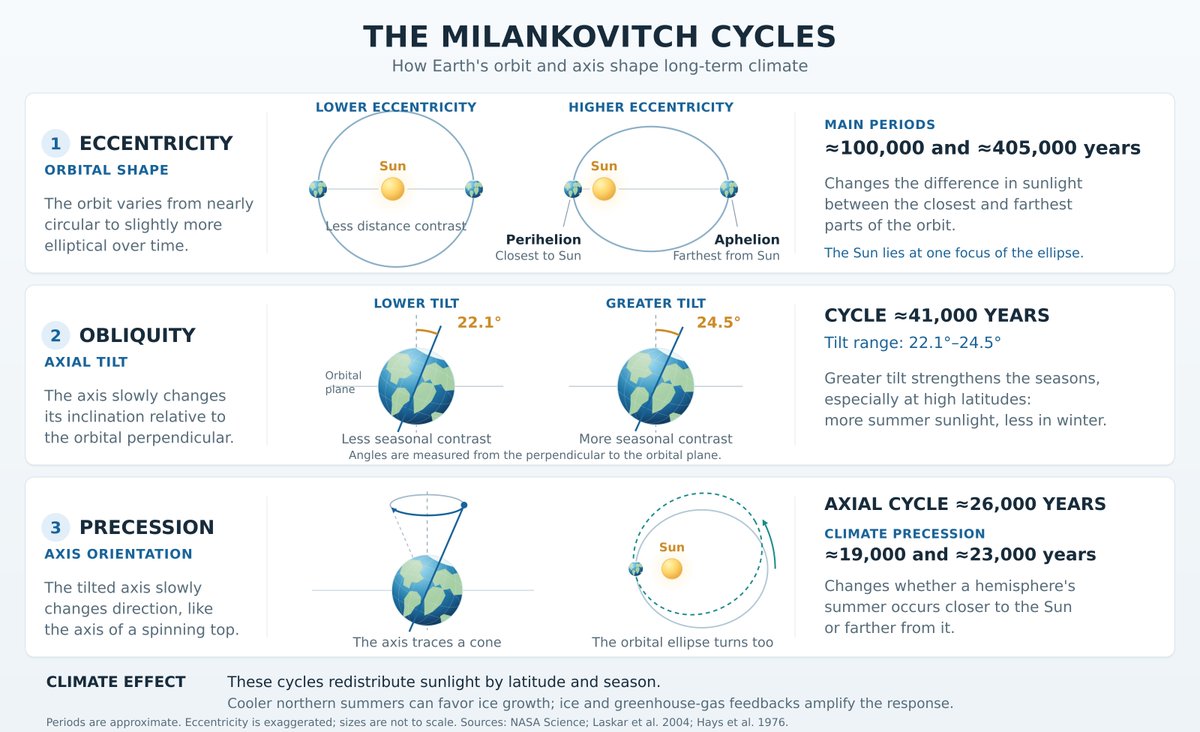
How Milankovitch cycles shape climate
An ice sheet can start with snow that survives the summer. Keep adding more snow each winter than the next summer removes, and the layers accumulate, compress and eventually become ice. The crucial season is summer.
Earth's motion around the Sun helps set that seasonal balance. Gravitational interactions gradually alter the orbit's shape, while Earth's rotation axis changes both its tilt and the direction in which it points. Over tens to hundreds of thousands of years, these movements redistribute sunlight across seasons and latitudes. They are the Milankovitch cycles.
Milutin Milankovitch, the Serbian mathematician who gave the cycles their name, spent much of the early twentieth century calculating how those movements changed incoming solar radiation. He wanted to explain the ice ages. His calculations paid particular attention to summer sunlight at northern latitudes, where huge ice sheets had once spread across land.
Eccentricity describes how far an orbit departs from a circle. Earth's orbit shifts from nearly circular to slightly more elliptical and back again, with prominent variations around 100,000 years and a longer component near 405,000 years. Diagrams usually stretch the ellipse to make the change visible. In reality, the orbit stays close to circular.
When eccentricity increases, the difference between Earth's closest and farthest distances from the Sun grows. That gives precession a stronger influence on seasonal sunlight. The average solar energy received by the whole planet over a year changes only a little. The important rearrangement is in where and when the energy arrives.
Earth's tilt has a familiar consequence: the seasons. This inclination, called obliquity, varies from about 22.1 to 24.5 degrees in roughly 41,000 years. The angle is measured from a line perpendicular to the orbital plane. Greater tilt brings more summer sunlight and less winter sunlight to high latitudes, increasing the seasonal contrast.
Meanwhile, the tilted axis slowly changes direction, like the axis of a spinning top. This is axial precession. The Sun and Moon pull on Earth's equatorial bulge, gradually turning the axis through a full cycle in about 26,000 years.
That 26,000-year figure is easy to confuse with the periods relevant to climate. The orbital ellipse also turns. Because the seasonal effect depends on both motions, climatic precession has major periods near 19,000 and 23,000 years.
Picture a Northern Hemisphere summer that occurs when Earth is closer to the Sun. Now put that summer at the far end of the orbit. With the other factors held equal, the second arrangement supplies weaker summer sunlight, which can help snow survive. As precession shifts the seasons along the orbit, the two hemispheres exchange these arrangements.
We return, then, to the snow left after summer. Milankovitch focused on sunlight around 65 degrees north because it was a useful reference near the regions where large Northern Hemisphere ice sheets developed. An ice sheet still needs snowfall, and its behaviour depends on the wider climate. One latitude cannot describe the whole process.
Once ice starts to spread, it changes the calculation. Bright snow and ice reflect sunlight that darker land or open water would absorb. Expansion can therefore reinforce cooling; retreat exposes darker surfaces and helps reinforce warming. Scientists call this the ice-albedo feedback.
Carbon dioxide adds another amplification. During glacial cycles, changes in the oceans and the wider carbon cycle altered atmospheric carbon dioxide. Because the gas absorbs outgoing infrared radiation, those changes affected how much heat the climate system retained. A regional, seasonal shift in sunlight could thus set off a response reaching much further.
The evidence that tied these astronomical rhythms to actual climate history came, in part, from mud. In 1976, James Hays, John Imbrie and Nicholas Shackleton analysed sediment cores from the southern Indian Ocean covering approximately 450,000 years. Their records contained strong variations near 23,000, 42,000 and 100,000 years, close to the periods predicted by orbital calculations.
One of their clues was the oxygen preserved in tiny marine shells. Oxygen comes in forms of different mass, called isotopes. As ice sheets grow, they preferentially store water containing the lighter isotope, leaving the ocean relatively enriched in the heavier one. Shells formed in that water record the change, although temperature also affects their isotopic composition. The cores held a physical record against which the astronomical theory could be tested.
Ice cores preserve a different part of the history: the atmosphere. Bubbles sealed into the ice retain ancient air, allowing past carbon dioxide concentrations to be measured directly. Set those measurements beside evidence from marine sediments and calculations of past orbits, and the growth of ice sheets can be examined alongside changes in greenhouse gases.
Today's rapid warming has a different cause and pace. Human activities, especially the addition of greenhouse gases from burning fossil fuels, are driving the warming of recent decades. Orbital cycles unfold over tens to hundreds of thousands of years and cannot account for that rapid rise.
Even on geological timescales, the climate does not simply tick off orbital periods. Between about 1.2 million and 800,000 years ago, the dominant glacial rhythm shifted from roughly 41,000-year cycles towards longer, larger cycles averaging around 100,000 years. Astronomical forcing underwent no corresponding transformation that could by itself explain this shift, the Mid-Pleistocene Transition.
Something in the climate system had changed. Researchers are testing the roles of carbon dioxide, more persistent ice sheets and the erosion of soft sediments beneath the ice. Each could have altered how ice sheets responded to summer sunlight; several may have acted together.
The problem is partly one of evidence. Researchers need reliable reconstructions of carbon dioxide before and during the transition, and those older records are difficult to obtain. Better constraints would help distinguish whether the atmosphere helped drive the shift or responded to changes already underway in the ice sheets.
The universe is filled with enigmatic structures, and among the most captivating are the Fermi Bubbles, massive, gamma-ray-emitting regions that extend from the center of our Milky Way galaxy.
Discovered in 2010 by the Fermi Gamma-ray Space Telescope (@NASAFermi)(@NASAUniverse), these bubbles have puzzled astronomers ever since. Recent studies, including a comprehensive analysis published in the Proceedings of the National Academy of Sciences (@PNASNews), and insights from the field of astronomy, shed new light on these intriguing phenomena.
Additionally, research from the University of Michigan (@UMichiganNews) provides further evidence supporting the theory that the bubbles are linked to our galaxy's supermassive black hole.
The Fermi Bubbles are two colossal, bubble-shaped structures that emanate from the Milky Way's core, stretching approximately 25,000 light-years above and below the galactic plane. They are visible in gamma-ray light, which is the highest-energy form of electromagnetic radiation. These bubbles are not static; they exhibit intricate structures and variations in brightness, indicating dynamic processes at play.
Several theories have been proposed to explain the origins of the Fermi Bubbles:
Supermassive Black Hole Activity: One leading hypothesis, now supported by University of Michigan research, suggests that the bubbles were formed by past outbursts from the supermassive black hole at the center of the Milky Way. These outbursts could have expelled high-energy particles, creating the bubble-like structures. This theory is bolstered by recent findings indicating that the black hole's activity around 6 million years ago could have driven the formation of these massive structures.
Star Formation and Supernovae: Another theory posits that intense periods of star formation, followed by supernova explosions, could have driven powerful winds that sculpted these bubbles. The energy released from numerous supernovae in the central regions of the galaxy could account for the observed features.
Cosmic Ray Interactions: Interactions between cosmic rays and interstellar gas may also play a role in generating the gamma-ray emissions seen in the Fermi Bubbles. These interactions can produce gamma rays as cosmic rays collide with gas particles, creating the high-energy radiation detected by the Fermi telescope.
The PNAS study, along with research from the University of Michigan, (linked bellow) delves into the structure and composition of the Fermi Bubbles, utilizing data from multiple observatories and advanced simulations.
Key findings include:
Complex Internal Structure: The bubbles are not uniform; they exhibit filamentary structures and regions of varying density. This complexity suggests a turbulent history, possibly influenced by multiple energetic events.
Magnetic Fields and Shockwaves: The research indicates that magnetic fields and shockwaves play crucial roles in shaping the bubbles. These elements contribute to the containment and distribution of high-energy particles within the bubbles.
Ongoing Processes: The Fermi Bubbles are still evolving, with evidence of ongoing particle acceleration and gamma-ray production. This suggests that whatever processes created them may still be active today.
Black Hole Outburst Evidence: The University of Michigan study specifically ties the bubbles to outbursts from the supermassive black hole. It posits that a significant eruption around 6 million years ago could have supplied the necessary energy to inflate these massive structures, aligning with the observed characteristics of the bubbles.
Understanding the Fermi Bubbles extends beyond our galaxy. These structures provide a laboratory for studying high-energy astrophysical processes, which are relevant to other galaxies and cosmic phenomena. Insights gained from the Fermi Bubbles can help refine models of galactic evolution, star formation, and the behavior of supermassive black holes.
The Fermi Bubbles remain one of the most fascinating and mysterious features of our galaxy. As we continue to probe their secrets, we are likely to uncover more about the violent and dynamic processes that shape the cosmos. Each new discovery brings us closer to comprehending the vast and energetic universe we inhabit.
For those eager to dive deeper into this cosmic enigma, the detailed studies and ongoing research provide a treasure trove of knowledge, propelling us on a journey through the high-energy frontier of astrophysics.
References:
👉 https://t.co/zNRbQBOLwm
👉 https://t.co/4nNZYLh1fn
Thank you. I agree that the cost deserves serious scrutiny, but I disagree about the physics value. IceCube has already tested neutrino interactions at energies beyond laboratory experiments and found evidence for sources in distant galaxies. Gen2 aims to study fainter sources and extend those tests to higher energies. Greater sensitivity can make previously inaccessible questions experimentally answerable.
The immediate benefit is knowledge; practical applications are uncertain. Whether that justifies the investment is a legitimate debate. But “no conceivable human value” goes much further than the evidence supports. I’d judge Gen2 by the questions it could answer, the cost, and whether another approach could answer them more effectively.
Neutrinos and the IceCube Observatory.
At the South Pole, a cubic kilometer of deep Antarctic ice has become an astronomical observatory. Its instruments search for the faint light left by particles arriving from space, carrying information about processes that can be difficult to study with ordinary telescopes.
On 6 October 2026, the Nobel Prize in Physics was awarded to Francis Halzen, a Belgian-born physicist at the University of Wisconsin–Madison, for his decisive contributions to the @uw_icecube Neutrino Observatory and the discovery of high-energy neutrinos of astrophysical origin. It recognizes the work that made this way of investigating the universe possible.
Neutrinos are elementary particles: as far as we know, they have no smaller constituents. They carry no electric charge and interact with matter through the weak nuclear force, as well as gravity. Vast numbers pass through your body every second without producing any noticeable effect. The Sun makes them during its nuclear reactions; radioactive decays, nuclear reactors and interactions in Earth’s atmosphere produce them too.
They come in three known flavors, called electron, muon and tau neutrinos. These names refer to the charged particles associated with their weak interactions. A neutrino produced with one flavor can later be detected with another, a phenomenon called oscillation. The underlying explanation is quantum mechanical: a flavor state is a mixture of states with different masses, and their relative phases evolve during propagation. The result is a changing probability of detecting each flavor. Oscillations establish that at least two of the three mass states have nonzero mass, although they do not determine the absolute masses.
That finding had major consequences for particle physics. The original, minimal Standard Model treated neutrinos as massless, so their masses require an extension of that description. The discovery of neutrino oscillations was recognized with the 2015 Nobel Prize in Physics, awarded to Takaaki Kajita and Arthur B. McDonald. The 2026 prize celebrates a different achievement: using high-energy neutrinos to investigate their astrophysical origins.
The story began with an apparent problem in radioactive beta decay. In 1930, Wolfgang Pauli proposed an unseen neutral particle to account for energy that seemed to be missing from the measured decay products. In 1956, Clyde Cowan, Frederick Reines and their colleagues detected reactor antineutrinos, confirming that the proposed particle existed. The gap between those dates gives some sense of the patience involved. Proving that the particle existed required years of work to develop an experiment capable of detecting it.
Neutrino astronomy also predates IceCube.
Observations of solar neutrinos allowed scientists to test nuclear reactions inside the Sun, while the burst detected from supernova SN 1987A provided direct evidence about the collapse of a star in the Large Magellanic Cloud. Those observations involved much lower energies than the astrophysical neutrinos that became IceCube’s principal astronomical target. IceCube built on this earlier work by establishing observations of a population of exceptionally energetic neutrinos arriving from the wider cosmos.
Energy is an important distinction. Solar neutrinos typically have energies on the scale of millions of electronvolts. IceCube’s high-energy astronomy studies particles reaching trillions of electronvolts, or teraelectronvolts, and even quadrillions, or petaelectronvolts. Those numbers describe the energy carried by a single particle. Such neutrinos offer information about environments in which particles are accelerated far beyond the energies typical of stellar fusion.
The reason astronomers want that information is closely connected to cosmic rays, the energetic protons and atomic nuclei that reach Earth from space. Because these particles are electrically charged, magnetic fields bend their trajectories. Their arrival directions usually do not point cleanly back to where they were accelerated. Neutrinos have no electric charge, so magnetic fields do not scramble their directions in this way. Their weak interactions also allow many of them to escape dense surroundings and travel enormous distances without being absorbed.
In a cosmic accelerator, energetic protons or nuclei can collide with surrounding gas or radiation. The resulting reactions produce secondary particles, including charged pions, whose decays generate neutrinos. Gamma rays can be produced in related reactions. Detecting the neutrinos therefore helps identify places where energetic hadrons, such as protons, are interacting. It also gives access to environments in which some of the accompanying high-energy photons are absorbed before they can escape.
Their ability to pass through matter makes neutrinos useful astronomical messengers and difficult experimental targets. Most simply cross a detector without interacting. A useful observatory therefore needs a huge amount of target material, enough for a small fraction of the passing particles to produce measurable events. IceCube uses the Antarctic ice itself as that material. A cubic kilometer contains roughly a billion tonnes of ice, making the detector’s scale an essential part of the experiment.
Halzen first presented his vision for detecting neutrinos in South Pole ice in 1988. Pursuing it meant convincing colleagues that the idea could work, testing the detection medium and building a collaboration capable of developing the observatory.
The original IceCube array contains 5,160 optical modules attached to 86 vertical strings. They are frozen into the ice at depths between about 1,450 and 2,450 meters. The full array began operating in 2011, following the installation of the last string in December 2010. Beneath the surface laboratory, the sensors form a three-dimensional network that records light from interactions in and around the instrumented volume.
Deep ice provides both a large target and a medium through which light can travel far enough to be measured. At these depths, the pressure has removed the ordinary air bubbles that make shallower ice cloudy. The South Pole also has the infrastructure needed to support the experiment. Before IceCube, the AMANDA detector demonstrated that Antarctic ice could be used for this kind of observation, providing an essential practical foundation for the larger facility.
Building the array meant drilling deep holes with hot water, lowering cables and sensors into them, and allowing the water to refreeze. Once embedded, the modules could no longer be reached for physical repairs. Their design and testing had to account for that constraint. Behind every scientific result are the people who built those instruments, deployed them during Antarctic field seasons, and keep the data systems running through the polar winter.
IceCube detects the consequences of a neutrino interaction. When a neutrino transfers energy to matter in or near the detector, it can produce fast charged particles. These emit Cherenkov radiation when they move faster than light travels through ice. This does not violate relativity: light propagates more slowly in ice than it does in a vacuum, and the charged particles remain below the vacuum speed of light. The optical modules register the resulting light, providing a measurable trace of an otherwise invisible event.
Different interactions leave different patterns. A high-energy muon can travel a long distance and produce an elongated track, which is particularly useful for estimating an arrival direction. Other interactions produce compact showers of particles, known as cascades. These tend to give a better estimate of deposited energy, while their directions are generally harder to reconstruct. Both kinds of event contribute to the scientific picture, and combining them improves the observatory’s coverage.
The reconstruction depends on how much light reaches each sensor and when it arrives. Researchers must also understand how that light is scattered and absorbed by the surrounding ice. Calibration is therefore part of the measurement itself. Better knowledge of the ice and the sensors can improve estimates of neutrino energy and direction, including for events recorded years earlier. An event comes with uncertainties that must be carried into any attempt to identify its source.
There is also a substantial background. Cosmic rays striking Earth’s atmosphere produce muons and neutrinos that can enter the detector. An energetic event is not automatically evidence for a distant galaxy. Researchers use event geometry, energy and other information to separate likely astrophysical signals from this background. For some searches, Earth helps: a particle arriving from below has crossed the planet, which blocks atmospheric muons while allowing many neutrinos to pass through.
Even that filtering has limits. As neutrino energy increases, the probability of interaction rises, and Earth becomes appreciably less transparent along long paths through its interior. IceCube has measured this absorption. The observation tests how neutrinos interact at energies beyond those explored in many accelerator experiments and is a reminder that their remarkable ability to cross matter is a matter of probability, rather than an absolute immunity to it.
In 2013, the collaboration reported 28 high-energy events from two years of data. Their energies, directions and event types were inconsistent with a purely atmospheric explanation. The sample included particles at petaelectronvolt energies and provided the first strong evidence for the high-energy astrophysical neutrino population that IceCube had been built to find. It was a decisive result, but it did not immediately reveal the sources. Finding a population of cosmic neutrinos and identifying the objects producing them are separate observational tasks.
A major advance followed an alert issued on 22 September 2017. IceCube detected a high-energy neutrino whose direction was consistent with TXS 0506+056, a blazar with a relativistic jet directed toward Earth. Gamma-ray observations showed that the object was active. Published in 2018, the combined observations provided compelling evidence for a neutrino source. An independent search of earlier IceCube data also found an excess from that direction during 2014 and 2015, strengthening the case that the association was physically meaningful.
In 2022, IceCube reported evidence for neutrino emission from NGC 1068, also known as Messier 77, an active galaxy roughly 47 million light-years away. The analysis found an excess corresponding to about 80 neutrinos associated statistically with its direction. That number describes a signal inferred above the expected background; individual events do not arrive with a label identifying their home galaxy.
NGC 1068 is particularly useful because its central region is obscured. Leading interpretations place the neutrino production in dense plasma close to the central supermassive black hole, outside its event horizon. Matter and radiation there can absorb high-energy photons while neutrinos escape more readily. Comparing the neutrino emission with observations at other wavelengths helps test those models and investigate conditions in the galaxy’s central environment.
In 2023, IceCube also reported high-energy neutrino emission from the plane of our own Milky Way. The neutrino map is a statistical reconstruction built from events accumulated over years, with improved methods for recognizing and reconstructing cascades. It measures emission associated with cosmic-ray interactions in the Galaxy and gives astronomers another way to investigate how energetic particles move through and interact with galactic matter.
These results also explain why source identification requires care. A neutrino’s reconstructed direction covers an area of sky, and an object within that area may be there by chance. Researchers ask whether an excess persists, whether its timing fits activity at other wavelengths, and how often a similar pattern could arise from the background. Searching many locations also creates more opportunities for accidental excesses. Statistical significance, calibration and independent observations all matter when deciding what an association means.
Many of the detected astrophysical neutrinos still have unresolved origins. Questions remain about which populations of objects produce most of the emission and exactly where within those objects the particles are accelerated and interact. Increasing the number of well-supported sources will allow researchers to compare their spectra, variability and other properties. The field is developing from detecting a cosmic population toward understanding the physical environments that produce it.
IceCube also studies the neutrino itself. Its denser central detector, DeepCore, extends its reach to lower energies, where atmospheric neutrino oscillations can be measured. Other analyses test interaction probabilities at high energies and search for possible departures from established particle physics, including signals motivated by dark matter models. These searches yield measurements and constraints; a proposed new particle or mechanism becomes a discovery only when the evidence supports it.
There is a much older neutrino population as well. Cosmology predicts a background of relic neutrinos that decoupled from the early universe when it was about a second old. Cosmic expansion has reduced their energies enormously, placing them far outside IceCube’s detection range. Their presence is supported indirectly by cosmological observations, while direct detection remains an experimental goal. Because neutrinos have mass, their gravitational effects also influence the growth of cosmic structure. The same family of particles therefore connects studies of individual cosmic accelerators with questions about the universe as a whole.
The observatory is continuing to develop. The IceCube Upgrade was installed during the 2025–2026 Antarctic season, adding more sensitive instruments and improving calibration. It is intended to strengthen measurements at lower energies and improve reconstruction across the observatory. In its Nobel announcement on 6 October, the collaboration said it expected the first science data from the Upgrade later in 2026. Installation is an important milestone, followed by commissioning and the work needed to turn new instruments into reliable measurements.
The proposed IceCube-Gen2 would extend the optical detection volume to about eight cubic kilometers and add a radio array aimed at still higher-energy neutrinos. A larger observatory would collect more of these rare events, making more detailed studies of sources possible. Gen2 remains a proposed facility. Its scientific motivation comes directly from IceCube’s results: the existing experiment has demonstrated that the sources can be investigated, while also showing how much more data the field needs.
Halzen’s Nobel recognizes an individual whose scientific vision and persistence were central to that progress. In his response to the award, he emphasized the recognition it brings to the collaboration. That is an appropriate way to celebrate IceCube. Its discoveries depend on experimental design, engineering, Antarctic operations and years of analysis, with contributions from people working across many institutions and countries.
What makes the achievement satisfying is the distance between the original question and the means of answering it. Understanding energetic events in distant galaxies required learning how light travels through Antarctic ice, building instruments that could survive inside it, and distinguishing a small cosmic signal from a much larger background. The questions about the neutrinos’ origins are still open. Researchers can now test their ideas against observations gathered by instruments buried deep in the ice.
An ancient impact crater beneath Ames, Oklahoma, may be almost 100 million years younger than previously thought. The structure is about 16 kilometres across, buried beneath roughly 2.7 kilometres of sedimentary rock, and was discovered through seismic surveys in 1991. New research places its formation around 370 million years ago, close to a major episode of the Late Devonian mass extinction.
For decades, scientists associated Ames with a period of intense asteroid bombardment about 467 million years ago. That age relied on fossil fragments of conodonts, extinct marine animals, found within the crater. The new interpretation suggests those fossils were already ancient when the asteroid struck: material from older rocks could have been mixed into the impact deposits, preserving fossils that did not date the collision itself.
A team examined zircon crystals from rocks affected by the impact. Zircon contains uranium, which gradually decays into lead, allowing researchers to estimate ages from their isotopic composition. The youngest zircon population yielded a date of 369.7 ± 5.9 million years. Imaging conducted with NASA also revealed microscopic evidence of impact deformation in some crystals.
That age range overlaps the Frasnian–Famennian extinction crisis, around 372 million years ago, when marine biodiversity suffered severe losses. The Ames impact was probably too small to explain a global extinction by itself, but it could have contributed alongside other environmental pressures, including oxygen depletion and major volcanic activity.
The connection remains provisional. The dating uncertainty spans several million years, and the researchers need more samples to strengthen the link between the zircon ages and the collision. Their results support reconsidering when Ames formed; they do not establish that it triggered, or even coincided precisely with, the extinction.
👉 https://t.co/RF4dVOskQ1
Much bigger than Jupiter! A simple estimate ignoring rotation puts its event horizon at about 24 million kilometres across, roughly 170 Jupiters lined up!
“Sagittarius” is the constellation it appears in from Earth, and “A” labelled the brightest radio source there. The asterisk distinguishes the compact central source associated with the black hole. It was borrowed from the symbol for excited atoms, and we pronounce it “A-star”.
Sagittarius A*, the supermassive black hole at the centre of the Milky Way, could accelerate protons to exceptionally high energies using part of its rotational energy.
A new theoretical study investigates how this might happen through the magnetic Penrose process, and what we could observe if the mechanism is operating. The calculations predict proton energies reaching roughly 1 to 10 petaelectronvolts, depending on the conditions assumed around the black hole.
There’s already evidence for a powerful particle accelerator near the Galactic centre. Observations by H.E.S.S. revealed gamma-ray emission from surrounding molecular clouds consistent with collisions involving protons accelerated to PeV energies. One PeV is a million billion electronvolts, and an astrophysical accelerator capable of reaching this range is called a PeVatron. Sagittarius A* is a leading candidate for supplying these particles, although the acceleration mechanism remains uncertain.
The Penrose process provides a way to extract rotational energy from a black hole. As a rotating black hole drags spacetime around it, it creates a region called the ergosphere, outside the event horizon. Within this region, objects must co-rotate relative to distant observers, but particles can still escape. Under suitable conditions, an incoming particle can split into products whose trajectories allow one to fall into the black hole while another escapes carrying additional energy. That energy comes from the black hole’s rotation. Electromagnetic interactions can make this process considerably more efficient.
Neutrons offer a possible route for this to happen naturally. A free neutron decays into a proton, an electron and an electron antineutrino. In the appropriate electromagnetic environment, the electron can enter the black hole while the proton escapes with a substantial energy gain. The captured electron occupies a negative-energy state, with that energy defined relative to a distant observer. This allows the black hole to lose rotational energy while the escaping particle gains it.
The researchers calculated neutron production through nuclear reactions in the hot accretion flow around Sagittarius A*, then followed neutron trajectories through the spacetime of a rotating black hole. This let them estimate the population reaching the ergosphere before decaying and derive the resulting spectrum of accelerated protons. Their approach connects the supply of neutrons with the energy-extraction mechanism, providing a more detailed prediction of the escaping particles.
Once those protons reach the surrounding gas, their collisions can produce gamma rays and high-energy neutrinos through the decay of secondary particles. These signals provide an indirect way to investigate the accelerator, since magnetic fields deflect the charged protons themselves. The predicted gamma-ray spectrum has features that could help identify a contribution from the magnetic Penrose process.
The mechanism hasn’t been confirmed observationally. SWGO could test the predicted gamma-ray emission, while KM3NeT/ARCA and IceCube-Gen2 could provide complementary neutrino measurements. The forecasts depend on uncertain conditions, including the black hole’s spin, magnetic field and particle transport. What interests me most is the possibility of using radiation from the surrounding gas to investigate energy extraction very close to the event horizon.
👉 https://t.co/AaqQSCS1gB
The chemical composition of an ancient star can tell us about stars that lived and died before it formed. We call the first stellar generation Population III. These stars formed from gas made almost entirely of hydrogen and helium, and some released newly produced heavier elements into their surroundings when they exploded. Later generations formed from that enriched gas, preserving chemical information that we can still measure in old stars today.
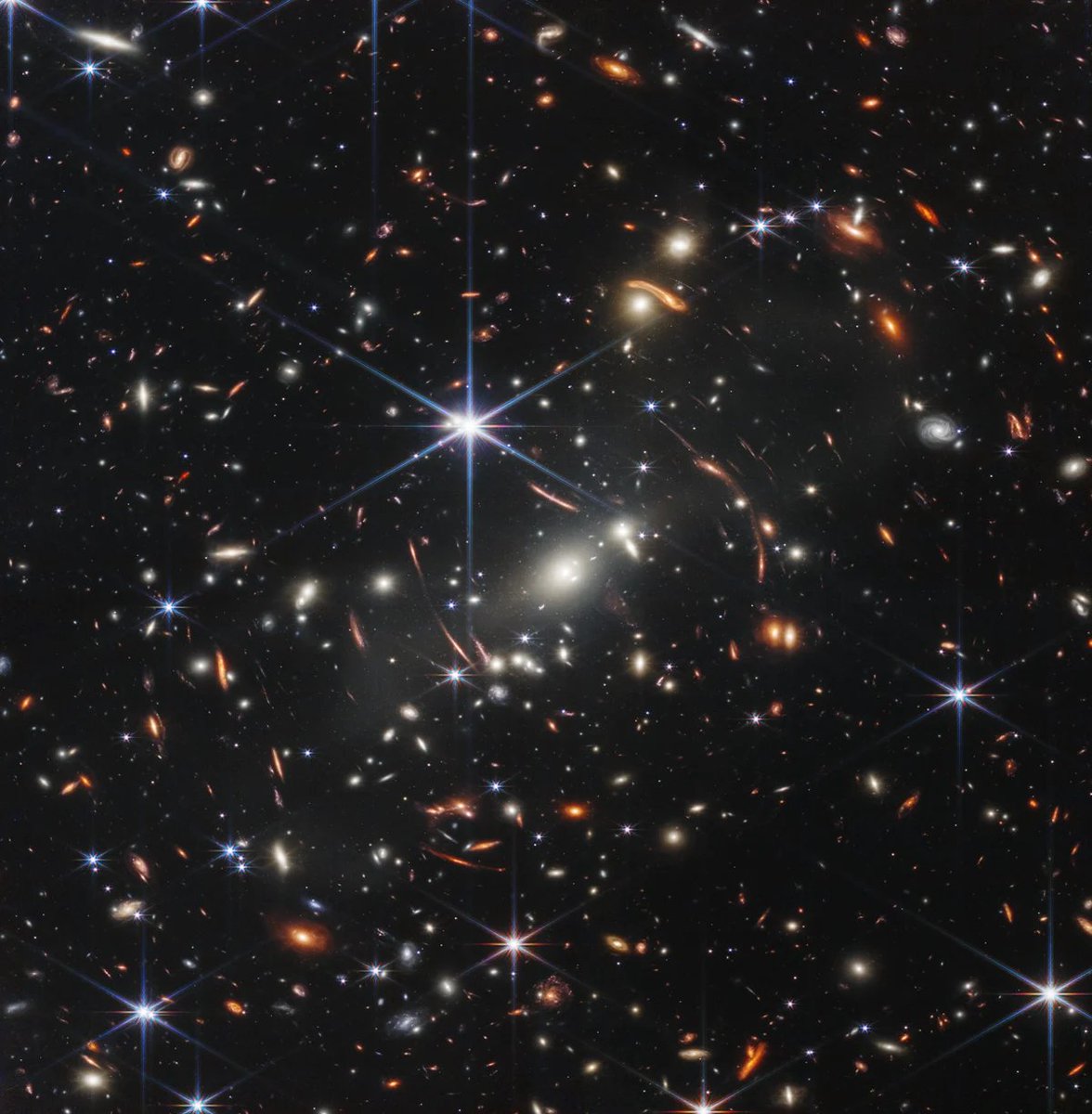
New simulations from the MEGATRON project aim to connect those measurements with what the #JWST observes in distant, young galaxies. JWST shows us galaxies during their early development, while ancient stars in the Milky Way and its smaller neighbours retain evidence of early chemical enrichment. Comparing the two is difficult: they represent different environments, different measurements and more than thirteen billion years of cosmic evolution. The researchers are developing a physical model that can interpret both.
The simulations follow an early cosmic region expected to develop into a galaxy with a mass similar to the Milky Way. They calculate the movement of gas, the propagation of stellar radiation and the changing chemistry together. That allows the researchers to predict the light emitted by the simulated galaxies, including the spectral lines astronomers use to estimate the properties of their gas. A companion study produced more than 175,000 simulated galaxy spectra, reproducing much of the diversity seen by JWST within the standard cosmological model.
The role of radiation is particularly important. Ultraviolet light from young stars can break apart molecular hydrogen, which helps primordial gas cool enough to collapse. In the simulations, this suppresses the formation of first-generation stars in the smallest dark matter haloes and shifts their formation towards more massive systems. Where a star forms therefore depends partly on the radiation produced by other stars, including those outside its immediate surroundings.
One study examines a pattern in today’s faintest dwarf galaxies. Despite substantial differences in their stellar masses, many have similar average iron abundances relative to hydrogen, roughly three hundred times lower than the Sun’s. MEGATRON reproduces this pattern and links it to pair-instability supernovae, explosions capable of completely destroying extremely massive first-generation stars. In the model, these explosions occur in haloes massive enough to retain much of the expelled material. The iron then becomes incorporated into later stars, producing an abundance pattern that could persist until today. This remains a proposed explanation whose dependence on the assumed properties of the first stars needs further testing.
There are also limits to the spectral comparisons. The simulations omit active galactic nuclei, and their predictions depend on models of stellar populations and the amounts of individual elements stars produce. Agreement with observations can help constrain those assumptions, but it doesn’t establish a unique history for the galaxies being observed.
The useful part is having two ways to test the same underlying physics. Measurements of young galaxies and nearby ancient stars can place complementary constraints on how the first stars formed, affected their surroundings and supplied the elements used by subsequent generations.
👉 https://t.co/SealxNCExI