The Chinese firewall is not just limited to social media. Their dramas and films (at least on OTT) also show an extremely curated image of the country. Most Chinese shows are either about a past (where they makers take liberty with the depiction of the social milieu), or about the urban Chinese society.
The former give them space to create a larger than life historical image with grand palaces and opulent costumes. The latter show an already urbanised China, even when the stories are about the aspirations of the middle class .
One wonders at the sophistication and permeation of the surveillance that happens in that country in every aspect of human expression and experience. It is as if the China that the broken firewall has shown is stranger than fiction.
Having said that, there's a lot that that country has achieved, and while playing their game, we must never lose sight of what we have to achieve in the coming years.
I am not against Jaishankar, but he needs to fix his communication department. CCP trollbots and ISI handles relentlessly spread fake news, while MEA fact checks come after two days. They need to hire some chronically online nationalist hyper accounts to tell them what's happening in real time and counter it spontaneously
Hindu Varna system was also "4 ancient jobs / occupation" classification.
If Chinese system is not Caste system then neither is Indian Hindu system.
Varna system is much better than Chinese caste system because at least a person has freedom to select their own Varna.
In Nanjing, Qing China, Upper Caste Shi Men enforced a Brutal "Breast Tax" that criminalised covering breasts of lower caste nong and gong women.
The Tax still carries out today in Rural China because of the CPC Hukou System that legalises Upper Caste Shi Men's Feudal Dominance.
Big day for all of us at Sarvam.
I want to start by thanking my team for shouldering this mission with immense belief, urgency, and care.
Reflecting on the last few years of the founding journey, my conviction has only deepened:
- AI will be far more consequential than most of us realize even today
- The value loops of this new world cannot be owned by a couple of companies
- Country of India scale cannot rent intelligence. We have to build it ourselves
We are going to push hard across every layer of the company, but the thing that excites me most right now is our shot at building frontier-class AI systems from India. We are assembling the team, the compute, and the deployment engine to make this happen.
I also want to thank our new investors. HCLTech’s partnership opens joint opportunities to bring our research and platform to many of HCLTech’s clients - this is also a unique template to bring together India’s strengths. BVP brings to the team the rare combination of being at the forefront of India's biggest tech shifts for the past two decades while globally having partnered with category defining enterprise AI companies.
Onwards
AI that thinks in India's own languages.
IIT Bombay is proud to present BharatGen to the world: Open, multilingual AI for India's languages and people, at Bharat Innovates 2026 in Nice, France (14–16 June).
BharatGen is built at IIT Bombay's Department of Computer Science and Engineering, led by Prof. Ganesh Ramakrishnan, with Rishi Bal (CEO) and Dr. Maneesh Singh (VP, ML) with a consortium of 9 premier academic institutions. A team of 60+ researchers, engineers and linguists are building AI that includes all scheduled Indian languages, across text, speech and documents.
-> Param2, its foundational text model with reasoning, coding, and tool calling capabilities works across all 22 scheduled Indian languages
-> Shrutam2, for automatic multilingual speech recognition/ STT across Indian languages
-> Sooktam2, a text-to-speech models with zero-shot voice cloning across Indian languages
-> Patram, a document vision model built for understanding Indian-specific documentation
BharatGen powers services in governance, healthcare, education, insurance, finance, and cultural preservation.
A national effort backed by DST and the IndiaAI Mission, BharatGen is India's push for open, homegrown AI, built for 1.4 billion people.
For more information, visit https://t.co/bZul5Lr3yC
Bharat Innovates 2026 · 14 - 16 June · Nice, France
@BharatInnov2026@EduMinOfIndia
#BharatInnovates2026 #IITBombay #BharatGen #DeepTech
I thought I should write something really measured and accessible explaining why this headline from @nytimes is so misleading. I wanted to do it in a way that would make sense to people who don't already see the problem. So first, I meditated. You know, to calm down.
Then I looked at the headline again and thought: WHAT THE ACTUAL REFRIGERATOR.
Okay, breathe in...and out.
To begin with, Chhatrapati Shivaji Maharaj is not a "new" hero to Indians and Hindus. That's a laughable proposition. Even I know that, and I grew up here in the United States before the internet. This is like saying George Washington is a new hero to Americans. Buildings, airports, train terminals, roads, universities, and public institutions have borne Shivaji's name for decades. Long before the current administration took office. So the question is not whether Shivaji is actually a new hero. The question is why the Times would frame him that way.
And this is where media literacy becomes useful. Notice the language. Not "new memorials have been built." Not "additional statues have been commissioned." Not even "Shivaji statues have become more common." Instead, we are told that statues of Shivaji are "rising across India." It is a fascinating choice of verb because statues do not normally "rise" in journalistic writing. Movements rise. Armies rise. Extremism rises. Threats rise. The word "rise" transforms what could have been described as commemorative acts into something vaguely threatening. The image it conjures is almost cinematic: Shivaji statues menacingly erupting from the earth across India like something out of a Marvel movie.
What makes this especially frustrating is that there are genuine debates taking place in India about history, textbooks, colonization, historical memory, and the representation of Hindu civilization. Some scholars and members of the public argue that post-Independence narratives minimized aspects of Mughal conquest, neglected Hindu resistance movements, or failed to adequately account for Hindu civilizational contributions. Others disagree. But these are real debates, and they are neither new nor confined to one political party.
In fact, Americans should find this entirely familiar. We revise textbooks all the time. We revisit historical narratives. We argue about whose stories were centered, whose stories were marginalized, and whether previous generations of historians got important things wrong. We understand that academic consensus is not infallible and that history is constantly being reexamined as new evidence emerges and new questions are asked.
Yet when these debates about Indian history are translated for Western audiences (often by Indians themselves), they often become a much simpler story: the Hindu right is resurrecting forgotten heroes for political purposes and to oppress the minorities. The problem is that Shivaji was never forgotten in the first place. The debates themselves disappear, replaced by a narrative that is far easier for Western readers to recognize and consume.
This is why bias is often less about outright falsehoods than about framing. The article does not simply describe Shivaji Maharaj. It encourages readers to understand him through a very particular lens: not as a historical figure who has occupied a central place in Indian historical memory for centuries, but as a symbol recently manufactured by "the Hindu right." Yet Shivaji was never forgotten. The framing tells us far more about how the Times wants its readers to view contemporary India and Hindus than it does about Shivaji himself.
Of course, for those of us who have been paying attention to how @nytimes covers India and Hinduism for a long time, this distorted reportage isn't out of the ordinary.
Absurd? Yes. Intellectually dishonest? Absolutely? Clearly seeking to manufacture negative public associations regarding the third-largest religion in the world? 100%
Surprising? Not even a little bit.
CNBC is now warning global investors not to invest in India because Cockroach Party can bring regime change like Bangladesh, Nepal and there is a "good chance Modi government will fall"
CNBC was same organisation which spread the fake news of Government taxing foreign travel which PM himself fact checked
We're thrilled to announce that we have raised $234M in the first close of our $300M Series B at a $1.5B valuation.
@HCLTech and @BessemerVP have joined us in this round, alongside continued support from @khoslaventures and @peakxvpartners
For countries and companies, sovereign control on the AI stack is no longer an optionality. Sarvam will be the partner of choice for this aspiration. The capital allows us to accelerate our momentum towards this full stack of models, compute, and deployments.
A huge thank you to our customers, partners, investors, and the Sarvam team for your trust and belief in what we are building. We’re just getting started.
Read more: https://t.co/VmLtpnj8gx
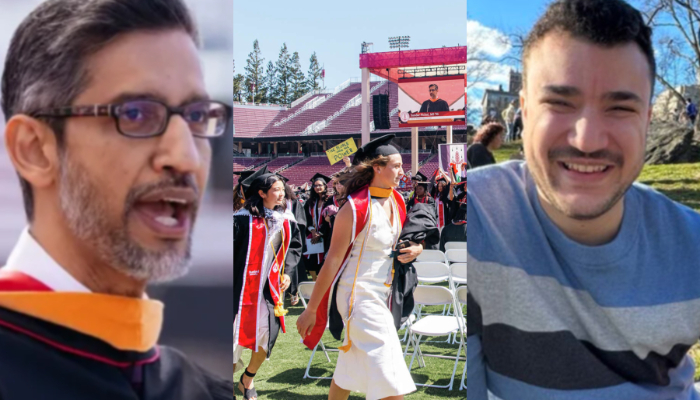
Who is Mahmoud Khalil, the radical Palestinian activist who instigated Stanford students to walk out when Sundar Pichai addressed them
@willofvalhalla writes
https://t.co/ezW7pOoR30
What an insensitive thing to say. Pathetic attacks in the name of politics, forgetting he's not a politician and has worked his whole life for securing India under many governments.
The man is 81 years old, his job is to use his brains and strategy to keep India secure from multiple threats and project power, in which he has done a commendable job. Like one comment said, it's like attacking Stephen Hawking as incompetent.
The hallmark of an Indian LeLi is that he/she will be superhawkish on even the smallest of things Hindus/Hindu orgs do, while being innocently doveish when it comes to other groups in the Subcontinent, even if they do genocides and human trafficking.
Every group, person or ideology that stands or can stand up to this imagined scary Hindutva demon has to be justified, defended, 'contextualised', 'understood' and lionised, like the different heads of the same Hydra, so that they come up on the top as the uber good guys with this broad 'alliance' of theirs where everybody would LARP as oppressed.
Truschke has of course only learnt from them. She could never have got away with such behaviour in any other country and would have been rightfully been confronted for projecting such a demonising image of a 'third-world brown natives' community and he heroised for it by people in that country for it. It would instead led to her being cancelled and she would have been issuing apologies, but not in India.
The problem is, she's not the disease, but a symptom. There are hundreds of other Truschkes sitting in both foreign and Indian universities, with similar or worse levels of disdain for Indians and Hs, just not so vocal, lacking either the platform and support or the desire to do so.