Pretty cool milestone to share.
Due to the success of the weekly online articles, my ASX Trader column will now also be published in print every Tuesday across the major News Corp newspapers.
So if you're old school like me and still enjoy grabbing a physical paper, keep an eye out each Tuesday in publications including The Courier-Mail, The Daily Telegraph, the Herald and other News Corp papers around Australia.
The print edition will be a condensed version, to fit on one page, of my weekly online article, breaking down what I'm seeing across markets, where money is flowing and the areas I'm watching next.
This week we're looking at why the miners are starting to outperform the metals themselves, particularly across gold and silver, and why Australia's emerging companies (small caps) could be approaching an important period.
There's still something pretty cool about seeing your work in an actual newspaper.
Grab yourself a copy every Tuesday. 🗞️📈
At Melbourne Live, we spent some time talking about diversification, and I shared how my own portfolio is spread across multiple asset classes, including real estate, equities, precious metals, cash, private companies and alternative investments.
But there was one particular asset class I showed everyone that currently makes up around 4% of my portfolio, and it's something I've been really enjoying trading and investing in.
I wasn't quite sure what reaction I'd get!
One thing I've always believed is that once you truly understand how markets work, those skills become transferable across almost any asset class.
You've seen me apply that knowledge to equities, commodities, crypto and real estate. Now I'm applying those same principles to something a little different.
Over the coming weeks, I'm going to share more about this market, why I believe there's a massive opportunity developing, how I've already been taking advantage of it, and where I believe it's heading.
In fact, I see some fascinating similarities to cryptocurrency in early 2017, before the entire market grew from around $20 billion to over $800 billion.
I'm not suggesting the same returns are guaranteed, but the similarities in market development, adoption and opportunity are fascinating.
And the best part? Many of the skills you've already learned about trading, investing, market cycles, supply and demand, and valuations can be applied here too.
What really surprised me was the reaction in the room.
At the end of the presentation, Adam asked everyone to put their hands up if this was something they'd be interested in learning more about.
I'd say around 80% of the room put their hands up!
That was pretty cool to see, especially considering it's an asset class most people probably haven't seriously considered investing in.
Anyway, I'll be sharing plenty more over the coming weeks. I think this one might open a few eyes!
Australia's unemployment rate has climbed to 4.9%, the highest in five years, with 43,500 jobs lost in October.
Unfortunately, I believe unemployment is heading much higher.
We're entering a period of stagflation, where economic growth slows, unemployment rises, yet inflation remains stubbornly high.
Add AI and technological disruption to the equation, and the risks become even greater.
Yes, new jobs will be created, but many require years of education and retraining. Jobs can disappear much faster than workers can transition into new industries.
This is why I've been warning about the economic cycle for some time.
As ive been saying for a while I believe we're still in the early stages of a much more difficult economic environment.
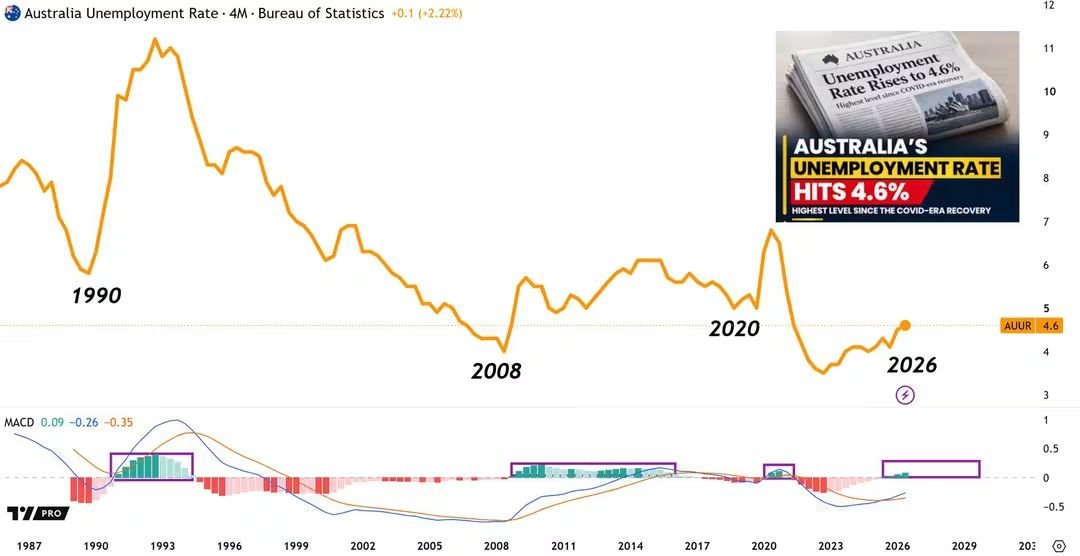
UNEMPLOYMENT JUMPED TO 4.6% & IT'S LIKELY GOING MUCH HIGHER
Five days ago, the ABS reported that Australia's unemployment rate rose from 4.4% to 4.6%.
And this is something I've been talking about for a long time.
Rising unemployment.
Stubborn inflation.
Slowing economic growth.
Put those ingredients together and you start moving towards something we haven't seriously dealt with since the 1970s:
STAGFLATION.
So why have I been expecting this?
Look at this chart.
We're zoomed right out onto three-monthly candles, because sometimes you need to stop worrying about the daily noise and look at the bigger economic cycle.
Pay attention to the MACD.
There have only been a handful of major bullish crosses like this over the period I'm showing. (Purple boxes)
1990, around the "recession we had to have."
The GFC.
COVID.
And now.
Each previous signal appeared around a major deterioration in economic conditions.
COVID was obviously different. Governments and central banks responded with extraordinary fiscal and monetary stimulus, and the economy rebounded incredibly quickly. But that response also came with consequences, including the inflation problem that followed.
Now we're seeing unemployment rising again while inflation remains elevated and economic growth is relatively subdued.
That combination is what I'm watching.
I'm not saying a MACD cross magically causes a recession. It doesn't.
The point is that markets and economic data often start flashing warning signs before the story becomes obvious in the headlines.
And while Australia isn't technically in a GDP recession based on the latest numbers, I believe the underlying conditions are becoming increasingly recessionary.
The headlines are normally the last place you'll see it.
The charts usually start talking first.
We're likely already in a recession the headlines just haven't arrived yet!
Precious metals absolutely EXPLODED last night! 🚀🔥
I was having a laugh with my son yesterday when we went to buy some silver at $48USD.
He goes, "Dad, why were there so many people lining up last time when it cost so much more, but now it's heaps cheaper and there's no line?"
I looked at him and said, "I don't know, son. It's one of life's great mysteries." 😂
But there's actually a pretty simple explanation.
Most people were buying precious metals because prices were going up and everyone was talking about them. They weren't buying because they understood the market cycle, valuations or where we were in that cycle.
They were buying because everyone else was.
And when prices fell, that confidence disappeared just as quickly.
This is why financial education is so important. Without it, you're relying on other people's opinions rather than your own understanding.
You really have two choices:
1. Increase your financial education so you understand what you're holding, where you are in the cycle and have the conviction to stick to your plan when markets get volatile.
2. Decrease your position size to a level you can comfortably handle, because if you don't understand what you're holding, you won't know whether you're right or wrong when prices move against you.
The price of an asset doesn't tell you whether it's a good investment. Understanding what you're buying and why you're buying it does.
Education builds conviction. Position sizing manages risk.
Ideally, you need both.
For the past couple of months, I've been encouraging investors to play defence.
I've written two News Corp articles, discussed it extensively on Ausbiz, and shared analysis on mean reversion, market cycles, excessive valuations and the dangers of becoming a buy high, sell low investor.
That's really what this has been about. Understanding risk and preparing for opportunities rather than chasing markets at their highs. I know plenty of people are feeling the pinch right now. Watching your hard-earned money fall in value is never enjoyable.
As many of you know, I manage three accounts, each with a different purpose and mindset.
- $100k Short-term trading account: My in-and-out account. Short-term opportunities and, honestly, a bit of fun.
- $1 million swing trading account: Actively managed using technical analysis, with positions held for months or years.
- Long-term investment account: Building wealth over decades, looking for historically undervalued assets and major market cycles.
Three accounts, three different mindsets.
The screenshot shows my swing trading account and how I've been managing risk through this correction.
Currently sitting in:
- Around 40% in cash, over $400,000.
- Approximately 6% allocated to bearish hedges.
- Remaining positions largely in defensive sectors, including healthcare, consumer staples, energy and some materials.
This positioning has helped cushion recent weakness, although it doesn't eliminate risk. I'm sharing this as an example of my approach to portfolio management, not as a strategy everyone should follow.
Here's something I think a lot of investors overlook.
Everyone talks about buying the dip, but if you're fully invested when the correction arrives, where is the capital going to come from to take advantage of those opportunities? Playing defence isn't just about protecting capital. It's about having the flexibility to take advantage of opportunities when they arise.
And that's what I'm genuinely excited about right now.
For anyone who attended Adelaide Live, you'll remember Craig and I discussing the strong possibility of a decent correction over the coming months.
We explored playing defence, the risks of market excess and how to identify key retracement zones. As this correction has developed, some of those concepts have become directly relevant.
That's what I love about studying market cycles. Not predicting every move, but understanding market behaviour and preparing for different scenarios.
That's different from assuming everything that has fallen is suddenly cheap. I'm optimistic some markets could start looking healthier again. But as always, I'll let the data guide me.
I'll be discussing this with around 150 people at Melbourne Live today, then going through the latest market data with MtM students during Sunday night's Weekly Outlook.
For anyone finding this correction difficult, I genuinely understand. I've experienced plenty of uncomfortable markets myself. One of the biggest lessons I've learned is that you don't need to catch every move or be fully invested all the time. Sometimes protecting your capital and having the patience to wait is just as important as making money.
Markets move in cycles. The same corrections that create fear today can create the opportunities of tomorrow.
Preparation is the key to success. It's nearly time to go shopping!
GENERAL ADVICE WARNING: Mastering the Markets Pty Ltd (ABN 99 671 639 704) is a Corporate Authorised Representative (CAR 001309433) of ShareX Pty Ltd (AFSL 519872). This information is general in nature and does not take into account your personal objectives, financial situation or needs. Consider whether it is appropriate for your circumstances before making financial decisions. Past performance is not a reliable indicator of future performance.
🎤 Three industry voices. Plenty of market insights ahead!
The @MtM_australia team is heading to CryptoCon Sydney 2026, bringing their expertise in trading, investing and market education to the stage! 🚀
Get ready to hear from:
⭐ Craig Tapping - @xipskcrr
⭐ Tung Nguyen
⭐ David Bird - @ASX__Trader
From understanding market trends to exploring investment strategies and building long-term financial knowledge, the team will be sharing valuable insights to help you navigate the ever-evolving world of investing and digital assets.
Don't miss your chance to hear from the experts, ask questions and expand your market knowledge this November! 🔥
📍 ICC Sydney
📅 28–29 November 2026
🎟️ FREE General Admission: https://t.co/5wCwNFPBWv
#CryptoCon2026 #MasteringTheMarkets #CryptoAustralia #Trading #Investing #DigitalAssets
TSX (Canada) | Weekly Chart
The Canadian share market has shifted to a bearish market structure for the first time since April 2025.
From a technical perspective, this increases the risk of further downside, with the 30,000 region an important support area to monitor.
Historically, bearish market structure shifts of this nature have been associated with periods of increased volatility and further market weakness.
General Advice Warning: This content is general information and education only and does not take into account your personal objectives, financial situation or needs. It is not personal financial advice. Mastering the Markets Pty Ltd (CAR 001309433) is a Corporate Authorised Representative of ShareX Pty Ltd (AFSL 519872). Consider whether this information is appropriate for your circumstances and seek professional financial advice where necessary.
Copper - Top of a wave
For the last few weeks at MtM, we've been discussing copper potentially putting in a wave top, and this week's price action has now confirmed that view.
I'm expecting a 10 to 20% correction from the highs, which should be enough to shake out some of the bulls and reset market sentiment.
This is a healthy part of a larger bullish cycle. Markets don't move up in straight lines, and these corrections often create the next buying opportunities.
Gold and silver have sat in a big correction since the beginning of the year. Copper’s starting to correct too. But Craig says uranium “is completely different to all the other metals.”
In this week’s metals update, he compares each metal with its miners and producers, and shows one example where gold miners broke out three weeks before gold did.
So what are the miners showing now?
Watch the full update in the comments 👇
https://t.co/4xkNBcBY0b
AUSTRALIAN PROPERTY: WHY I BELIEVE THIS BEAR MARKET WILL LAST YEARS, NOT MONTHS
Everywhere you look, people are trying to call the bottom of the Australian property market.
And to be fair, I wouldn't be surprised if we see a temporary recovery soon, particularly as interest rates approach what I believe could be a short-term peak.
But don't confuse a pause with the end of a cycle.
Remember last year when rates were being cut and everyone was celebrating? I warned those cuts would likely be temporary, and rates would rise again faster than 2022.
As I often say, the answers we seek about the future can often be found by studying the past.
Last week, I spent an hour on Zoom with Rick Rule discussing why we both believe we're moving into an economic environment similar to the 1970s, characterised by stagflation, elevated inflation, rising unemployment and high interest rates.
Now look at the chart.
It shows Australian residential property prices adjusted for inflation, and history tells an interesting story.
1972 peak: Approximately 15 years of little real growth.
1990 peak: Around nine years.
2008 GFC: Around six to seven years.
Now consider what's happened over the past 27 years.
In 1999, the Howard government removed capital gains tax indexation for newly acquired assets and introduced the 50% CGT discount.
Look at the chart around that period. Property broke out into an extraordinary bull market, supported by tax incentives, falling interest rates and expanding credit.
Now those conditions are changing.
The CGT discount is being reduced, negative gearing is being restricted for certain future purchases from July 2027, and borrowing costs have risen.
Cycle frameworks in assets suggests bear markets can last one-third to two-thirds of the preceding bull market. It's not a fixed rule, but it highlights why correcting a 27-year boom could take years.
"BUT THERE'S A HOUSING SHORTAGE!"
This is where people overlook the credit cycle.
Property is heavily dependent on debt. Buyers don't just need somewhere to live. They need access to finance.
A housing shortage doesn't magically restore borrowing capacity.
And don't confuse housing demand with investment demand.
A shortage of homes to live in doesn't necessarily mean there's a shortage of properties available to purchase at current prices.
"BUT PROPERTY IS A HARD ASSET. IT DOES WELL DURING INFLATION!"
Not necessarily.
Unlike gold, most property is purchased using significant leverage. When interest rates rise, borrowing capacity falls and mortgage repayments increase. That's why property can struggle during inflationary periods, even when nominal prices appear relatively stable.
SO WHAT'S MY OUTLOOK?
I believe Australian residential property could experience a nominal correction of around 15% to 20% from its peak, potentially wiping out much of the growth achieved by buyers who entered from 2023 onwards.
But the bigger issue is inflation.
Over the next five to ten years, I believe we could see a cumulative decline of 30% to 40% in REAL property values.
Will there be rallies along the way? Absolutely.
Interest rates will pause, sentiment will improve and people will declare the bottom is in.
But a temporary recovery doesn't mean the long-term cycle has changed.
History doesn't guarantee the same outcome, but when I combine property cycles, interest rates, credit availability, affordability and changing tax incentives, I believe this downturn will last years, not months.
Remember, we're not simply correcting a few years of growth. We're potentially correcting a multi-decade bull market.
And property doesn't need to crash for investors to lose significant purchasing power.
Sometimes prices simply go nowhere for years while inflation does the damage.
@PBDProperty Correct just dont be over leveraged. Also you need to factor in opportunity cost. Money tied up in a dead asset misses opportunities else where
Yeah, great question, mate. Property is made up of two components: the dwelling itself and the land it sits on.
If you study the US GFC, you'll see that construction costs actually rose around 3%, while land values fell by roughly 70% in some estimates. That's what drove much of the overall decline in property prices.
Now look at Australia. Our land-to-structure value ratio is around 3:1, compared with a historical level closer to 1.3:1. That's a significant stretch.
So my view is that we're facing a correction in land values, not necessarily the cost of constructing a dwelling.
That's why I don't put much weight on the argument that property prices can't fall because construction costs are so high. The building can hold its value while the land underneath it falls significantly.
And historically, it's the land component that tends to experience the biggest corrections when property cycles turn.
One thing I'd be careful with before publishing: the 70% US land decline and Australia's 3:1 versus 1.3:1 ratios depend on the dataset and measurement period. They're worth verifying so the argument remains defensible.