Hello, I’m Craig Tapping
Focused on U.S. market structure and trading strategies. No hype. Only free signals.
Only trends, logic, and disciplined execution.
Join us to share trading ideas and market insights.
👇
https://t.co/4xLr5r3vKh
🔥 Plan A $MRLN Latest Update
Up 27% yesterday, with an intraday gain of up to 30%, reaching our target price of $10 🎯
👉 We have closed our position and locked in profits.
Pre-market movement remains strong, potentially reaching $12, but we have already exited – discipline is paramount.
🎉 VIP Average Return: 35-40%
💡 This isn't luck – it's strategy + execution
Want similar investment opportunities?
📩 Follow and message to join
$INTC $NVDA $TSLA $MU $AAOI $DKI $GMLD $WULF $MU $AXTI
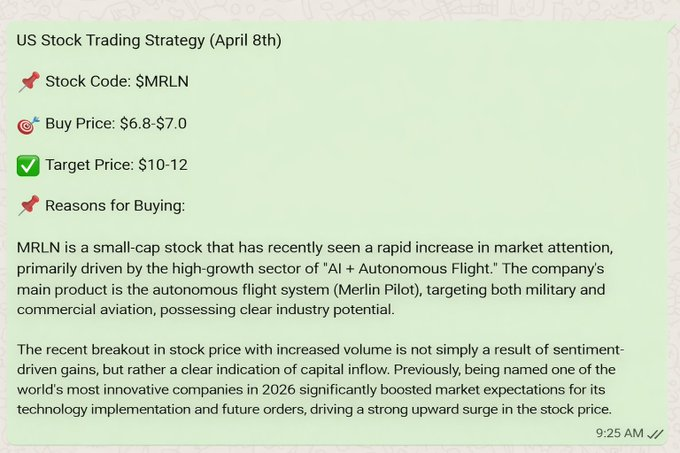
US Stock Trading Strategy (April 8th)
📌 Stock Code: $MRLN
🎯 Buy Price: $6.80-$7.00
✅ Target Price: $10
📌 Reasons for Buying:
MRLN is a small-cap stock that has recently seen a rapid increase in market attention, primarily driven by the high-growth sector of "AI + Autonomous Flight." The company's main product is the autonomous flight system (Merlin Pilot), targeting both military and commercial aviation, possessing clear industry potential.
The recent breakout in stock price with increased volume is not simply a result of sentiment-driven gains, but rather a clear indication of capital inflow. Previously, being named one of the world's most innovative companies in 2026 significantly boosted market expectations for its technology implementation and future orders, driving a strong upward surge in the stock price.
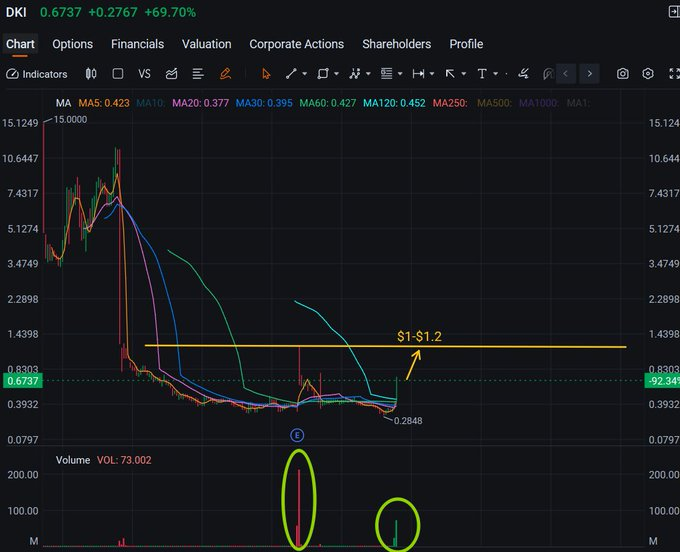
As expected, $DKI surged over 100% intraday, reaching $1.20 🚀This movement once again validates the effectiveness and accuracy of our analysis. If you'd like to learn more about this type of high-return trading strategy, please follow my page and feel free to contact me.
$MSFT $GOOG $INTC $WDC $CRWV $AFGK $BBGI $CLIK $ARAI $ZNTL
The $MRLN I recommended yesterday sold for $9.2, currently showing a 31% profit. If you'd like to join our study group, 👉please follow me.
$INTC $NVDA $TSLA $MU $AAOI $DKI $GMLD $WULF $MU $AXTI
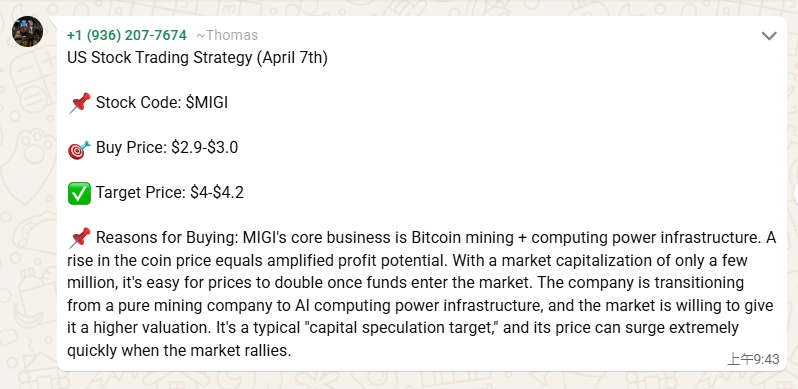
$MIGI has surged over 20%, reaching $3.50 and moving closer to our target price.🚀
Congratulations to everyone in our group who got in early! 🎉 I’ll update the group once we hit the target level.
#IonQ#ONDS#SKYT#AMC#UUUU#MP#GLD#SLV#FCX#PLG $AAPL $NVDA $DIS $GOOGL $AMZN #HIMS
$MIGI has surged over 20%, reaching $3.50 and moving closer to our target price.🚀
Congratulations to everyone in our group who got in early! 🎉 I’ll update the group once we hit the target level.
#IonQ#ONDS#SKYT#AMC#UUUU#MP#GLD#SLV#FCX#PLG $AAPL $NVDA $DIS $GOOGL $AMZN #HIMS
US Stock Trading Strategy (April 8th)
📌 Stock Code: $MRLN
🎯 Buy Price: $6.80-$7.00
✅ Target Price: $10
📌 Reasons for Buying:
MRLN is a small-cap stock that has recently seen a rapid increase in market attention, primarily driven by the high-growth sector of "AI + Autonomous Flight." The company's main product is the autonomous flight system (Merlin Pilot), targeting both military and commercial aviation, possessing clear industry potential.
The recent breakout in stock price with increased volume is not simply a result of sentiment-driven gains, but rather a clear indication of capital inflow. Previously, being named one of the world's most innovative companies in 2026 significantly boosted market expectations for its technology implementation and future orders, driving a strong upward surge in the stock price.
Tesla Q1 2026 Deliveries Strengthen The Bearish Outlook
Tesla, Inc.'s Q1 2026 delivery report highlights three critical numbers that encapsulate the company's current trajectory.
Inventory build is getting worse with 50,363 vehicles.
Energy storage is under pressure after missing estimates by 38.9%.
TSLA's competitive EV moat has narrowed, raising questions about its long-term market dominance and valuation.
Background
On April 2, 2026, Tesla, Inc. (TSLA) released its Q1 production and delivery report, which showed several challenges for the company. Vehicle deliveries were below expectations, while production exceeded deliveries, pushing inventory to a record high. At the same time, energy storage deployments missed estimates by a wide margin. If this trend continues, achieving the FY 2026 consensus will be difficult and will support the bear thesis.
Q1 2026 Delivery Report Analysis
1. Deliveries:
For Q1 2026, the company delivered 358,023 vehicles, missing the street consensus of 365,645 vehicles by 7,622 units. The company-compiled consensus was based on estimates from 23 sell-side analysts, including Goldman Sachs, Morgan Stanley, and JP Morgan.
The 6.3% year-over-year increase may seem good at first. But that's not the case here. Q1 2025 included several weeks of production disruption due to the changeover of Model Y lines across all four global factories. Hence, the comparison with Q1 2025 is not like-for-like. Therefore, comparing against a weak quarter and still missing consensus is not a positive signal. On a quarterly basis, deliveries declined by 14.4% from Q4 2025.
The missed expectations seem to be due to company-specific issues in key markets rather than a global slowdown in EV demand. Tesla generates its highest revenue from the U.S., followed by China and the rest of the world. Any issues in the U.S. or China can therefore have a significant impact on overall demand for Tesla. The U.S. $7,500 EV tax credit expired in September 2025, reducing demand. According to Cox Automotive, new EV sales in the U.S. market declined by 28% in Q1 2026 compared to Q1 2025. In China, stiff competition from domestic manufacturers is creating further challenges for the company.
2. Production:
In terms of production, it produced 408,386 vehicles in Q1 2026 compared to a delivery of 358,023. This gap is the key point for investors, as it added 50,363 vehicles to inventory in the quarter. A mismatch between supply and demand may not be temporary and could be structural. Investors should watch for this in the next report. On a quarterly basis, production declined 6.0% from Q4 2025, when 434,358 vehicles were made. On a yearly basis, production increased 12.6% compared with a 6.3% growth in deliveries. Further, the gap between production growth and delivery growth is not a positive indicator, as the excess goes into inventory. In a nutshell, comparing deliveries and production highlights a structural crack in Tesla’s bull case due to inventory buildup.
3. Energy Storage:
Energy storage deployed was 8.8 GWh in Q1 2026 as compared to a consensus expectation of 14.4 GWh, missing estimates by 38.9%. This represents a 38.0% decline from Q4 2025 and a 15.4% drop from Q1 2025. In my view, this is a very weak performance.
The company reports revenue in three segments: Automotive, Energy Generation and Storage, and Services. Based on the Q1 delivery report, two of these segments are underperforming. This supports the bear investment thesis.
Recovery Looks Challenging In FY 2026
To understand the challenges Tesla faces, investors should look at key metrics on an annual basis. The trend suggests the company may have difficulty achieving its FY 2026 targets in the remaining quarters.
Data compiled by the author using the Tesla annual delivery reports and analyst consensus compiled by the company.
The company had its highest deliveries in FY 2023 at 1.81 million vehicles. Since then, performance has fallen for two years, with 1.79 million in FY 2024 and 1.64 million in FY 2025. The consensus for FY 2026 is 1.69 million vehicles, showing a 3.3% upside. The Q1 2026 delivery data make this target harder to reach. The company now needs about 444,000 deliveries per quarter to meet the full-year goal. This looks very difficult given recent performance.
Inventory Build Is Getting Worse
In Q1 2026, the company had a production-to-delivery gap, which is not new for Tesla. This repeated pattern is now widening, suggesting a structural issue driven by softening demand. In Q1 2024, production exceeded deliveries by 46,561 vehicles. The same trend continued in Q1 2025 and Q2 2025, with inventory building by around 25,000 vehicles each quarter.
Q4 2025 was slightly encouraging as the inventory gap fell to 16,131 vehicles. But Q1 2026 surpassed the previous high from Q1 2024, reporting the largest quarterly inventory build at 50,363 vehicles. It appears that the minimal-inventory model of producing to order is now broken for Tesla. This points to a demand problem with a sustained inventory build across multiple quarters. Any further deterioration from here could be a key bear catalyst for the company.
Energy Storage Is Now Under Pressure
Energy storage numbers in the Q1 2026 report were a setback for investors who were looking for positive trends amid declining vehicle deliveries. In FY 2025, energy storage deployments reached 46.7 GWh, up from 31.4 GWh in FY 2024, with an increase of 48.7%. This strong growth had given investors hope that the energy business could deliver growth even as vehicle deliveries struggled.
However, Q1 2026 has put that momentum under pressure. Energy storage is 8.8 GWh below the consensus of 14.4 GWh. This creates a significant gap for the FY 2026 consensus of 65.2 GWh. To meet that target, the company now needs to deploy 56.4 GWh across the remaining three quarters, or about 18.8 GWh per quarter.
Hence, Tesla will need to exceed the Q4 2025 record of 14.2 GWh in each of the remaining quarters of FY 2026. This is a challenging task and a key metric to watch in the next quarter.
Valuation Is Too High For The Fundamentals
The stock trades at 171x forward earnings based on FY 2026 Street consensus EPS of $2.08. In my view, this valuation is hard to justify for a company having two consecutive years of delivery decline with a record inventory build and a significant miss in energy storage for Q1 2026. The current valuation is based on the bull case that Tesla can transform from an automotive-focused company into a technology platform generating revenue from autonomous driving, robotics, and AI services. With the core business already under pressure, these assumptions look increasingly risky, supporting the bear thesis around Tesla’s story.
Final Thoughts
Tesla has seen deliveries decline for two years in a row, and inventory is at a record high. On top of that, energy storage missed consensus by a wide margin in Q1. All of this makes the FY 2026 target difficult to achieve without a significant increase in demand. Investors should track Q2 2026 deliveries to see how things are trending and whether the bear case is gaining strength. Further, the Q1 2026 earnings call on April 22 will show if management has a plan to recover or if the bear case gets stronger.
Full entry & SL in WhatsApp group 👇https://t.co/3m3ij8NQz6
#StockMarket #DayTrading #SPX #TSLA #NASDAQ
📈Stock to watch today:TSLA
·Tesla, Inc.'s Q1 2026 delivery report highlights three critical numbers that encapsulate the company's current trajectory.
·Inventory build is getting worse with 50,363 vehicles. Energy storage is under pressure after missing estimates by 38.9%.
·TSLA's competitive EV moat has narrowed, raising questions about its long-term market dominance and valuation.
·It will be extremely difficult for Tesla to achieve its expected targets in the 2026 fiscal year, which will support the bearish view on Tesla's stock price.
Full entry & SL in WhatsApp group 👇https://t.co/3m3ij8NQz6
#StockMarket #DayTrading #SPX #TSLA #NASDAQ
📈Stock to watch today:TSLA
·Tesla, Inc.'s Q1 2026 delivery report highlights three critical numbers that encapsulate the company's current trajectory.
·Inventory build is getting worse with 50,363 vehicles.
Energy storage is under pressure after missing estimates by 38.9%.
·TSLA's competitive EV moat has narrowed, raising questions about its long-term market dominance and valuation.
·It will be extremely difficult for Tesla to achieve its expected targets in the 2026 fiscal year, which will support the bearish view on Tesla's stock price.
Full entry & SL in WhatsApp group 👇https://t.co/3m3ij8NQz6
#StockMarket #DayTrading #SPX #TSLA #NASDAQ
@MentoviaX TSLA remains in a short term adjustment phase marked by a double whammy of deteriorating fundamentals and valuation compression, with no reversal signals yet emerging
@garyblack00 TSLA remains in a short term adjustment phase marked by a double whammy of deteriorating fundamentals and valuation compression, with no reversal signals yet emerging
@Ryan__Rigg TSLA remains in a short term adjustment phase marked by a double whammy of deteriorating fundamentals and valuation compression, with no reversal signals yet emerging
@JEFETRADES TSLA remains in a short term adjustment phase marked by a double whammy of deteriorating fundamentals and valuation compression, with no reversal signals yet emerging
@clintoptions TSLA remains in a short term adjustment phase marked by a double whammy of deteriorating fundamentals and valuation compression, with no reversal signals yet emerging
@daltonbrewer TSLA remains in a short term adjustment phase marked by a double whammy of deteriorating fundamentals and valuation compression, with no reversal signals yet emerging
@KinggTrades TSLA remains in a short term adjustment phase marked by a double whammy of deteriorating fundamentals and valuation compression, with no reversal signals yet emerging
@wholemars TSLA remains in a short term adjustment phase marked by a double whammy of deteriorating fundamentals and valuation compression, with no reversal signals yet emerging
@pdicarlotrader TSLA remains in a short term adjustment phase marked by a double whammy of deteriorating fundamentals and valuation compression, with no reversal signals yet emerging