Introducing Asyncium. $ASYNC is live.
Your Elysium contract sends an order to HyperCore and finally hears back: one receipt, called into the contract.
Press Send on the site and watch one come back.
CA: 0x3a6d21bafa830c9571ee2aa63629451255b63f6c
https://t.co/zjQusXVXY3
Every receipt, in public.
Each receipt Asyncium stores on Elysium is listed with the transaction that posted it and the HyperCore order it answers, so anyone can check one against the other. Also open as JSON.
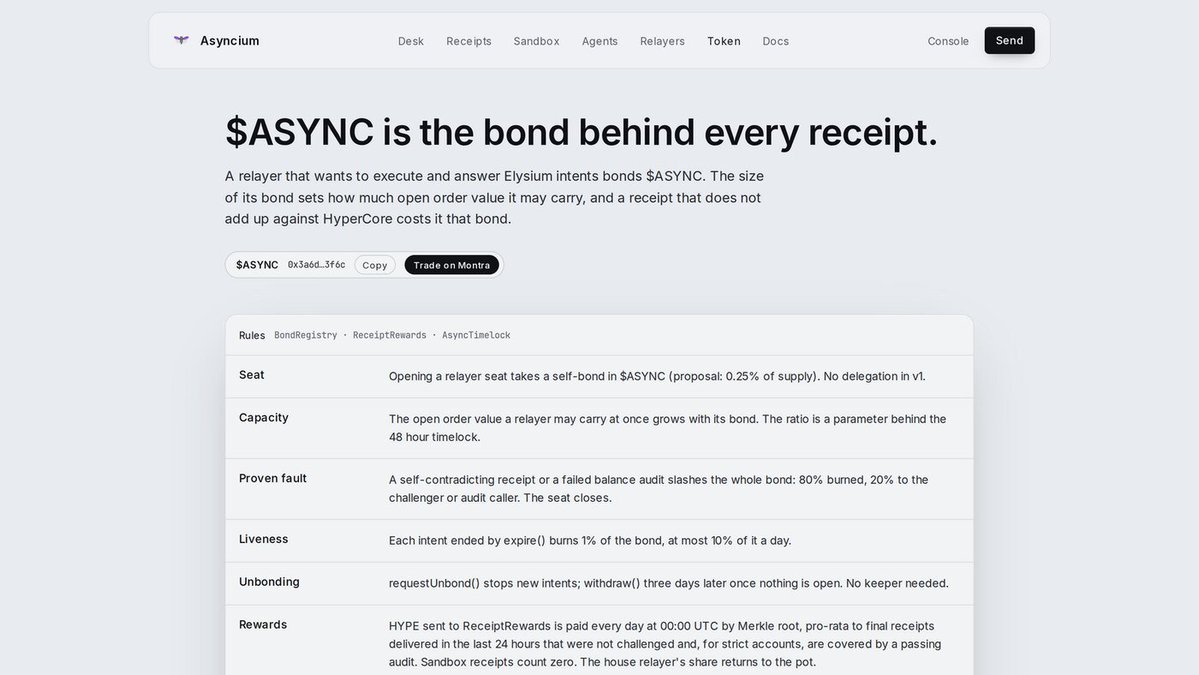
$ASYNC is the bond behind each one.
https://t.co/saY7tW8L86
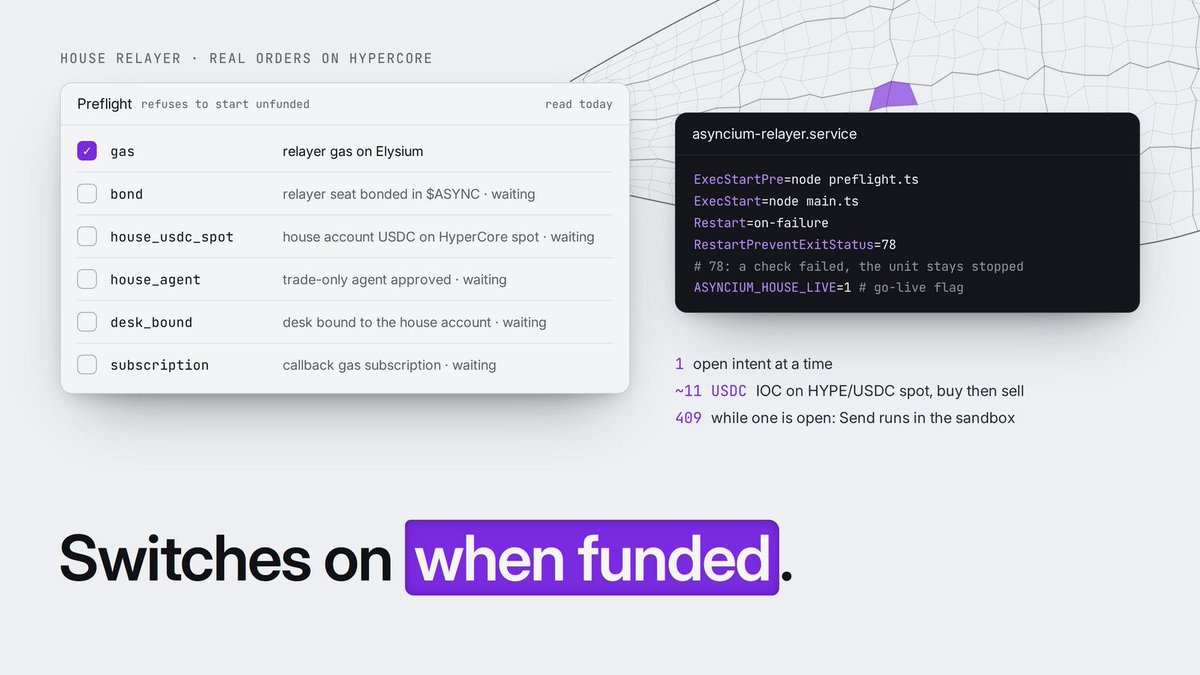
Live: Send places a real order on HyperCore.
Press Send. The house relayer places the order on Hyperliquid, the receipt lands back in the contract on Elysium, and it appears on the receipts page with both links.
$ASYNC bonds the relayer that carried it.
https://t.co/zjQusXVXY3
Open: anyone can run an Asyncium relayer.
Bond $ASYNC, run one command, answer intents. The relayer checks its bond and gas before it starts, and every receipt against the router's rules before it posts. Live bonds and capacity are on the relayers page.
https://t.co/YxVETGUI9N
Builder codes, on every order.
The Asyncium relayer attaches a Hyperliquid builder code to every HyperCore order, and reports the builder fee next to the trading fee. The receipt your contract receives stays the same.
Relayers bond $ASYNC to carry them.
https://t.co/YR7ZZGpvPH
Two venues, one price.
HYPE trades on Elysium and on HyperCore. When the two disagree, CoreArb sends the HyperCore leg as an intent and books only what the receipt says filled. Template and fork test in the docs.
A relayer bonded in $ASYNC carries it.
https://t.co/f4pZCyFxyM
Burned: the first KNTQ buy is on-chain.
A share of what Asyncium earns now buys KNTQ on Elysium and sends it to 0x…dEaD, in one swap priced against HyperCore's books. Totals are read live from a verified contract.
$ASYNC is the bond. KNTQ gets burned.
https://t.co/rFLGdAR1Bw
Like a VRF consumer, for trades.
Inherit AsyncClient, call request(), implement onReceipt(). Your Solidity contract sends an order to HyperCore and is called back with what really filled. Foundry template, fork tests and an MCP server are in the docs.
https://t.co/hgVmJKWFrg
$ASYNC is the bond behind every receipt.
A relayer bonds $ASYNC to carry intents, and its bond sets how much open order value it may hold. A receipt that does not add up against HyperCore costs it the bond. Honest relayers earn HYPE every day.
https://t.co/QLyhVpT1Es
1.9 seconds.
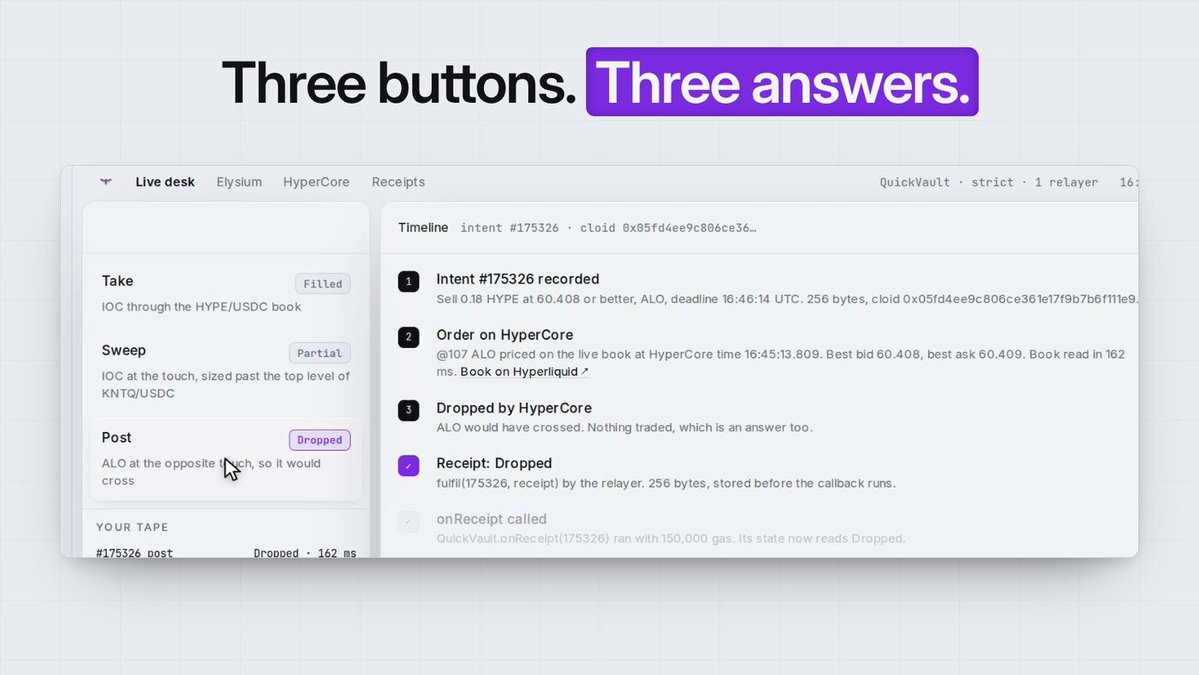
Press Send on https://t.co/zjQusXVXY3. An intent is recorded, priced on the live HyperCore book, filled, and onReceipt() lands back in the contract with what really happened. The whole round trip, end to end, in the sandbox.
https://t.co/zjQusXVXY3
Ready for upgrade day.
Kinetiq is bringing a native write path to Elysium. Asyncium is built for it: relayers become bonded registrars, and your contract keeps the same receipts, the same deadline guarantee and the same onReceipt(). Nothing to migrate.
https://t.co/y5tGmg5OUq
Approved: the full Asyncium stack is on Elysium mainnet, verified.
The router, the relayer bonds, the auditor, receipt rewards, the timelock and the house desk, plus the snapshotter on HyperEVM. Every address opens its source on the explorer.
https://t.co/u6ruAtagDE
$ASYNC is the bond behind every receipt.
A relayer that wants to carry Elysium orders to HyperCore bonds $ASYNC. Its bond sets how much it may carry, and a receipt that does not add up against HyperCore costs it that bond.
AI agents that trade need answers too.
claude mcp add, one line, and your agent gets quote_intent, sandbox_intent, receipt and request_calldata from https://t.co/GNxdRdHYGw. Keyless. Any Streamable HTTP client works.
Building a vault on Elysium?
Inherit AsyncClient, call _request, implement _onReceipt. The same shape as a VRF consumer, with a Foundry mock that answers Filled, Partial or Dropped on cue for your tests.
A sandbox of your own.
One click forks Elysium in a microVM and deploys the contracts on it. Send an IOC, let an intent expire, then play a lying relayer and challenge its receipt. Everything you see is a real transaction on your fork.
Every order traces back.
Each HyperCore order carries a client order id built from the intent id, so one order maps to exactly one intent and one receipt. Look any of them up by id on https://t.co/zjQusXVq8v.
What if nobody answers?
Deadline Guarantee: past the deadline plus five minutes, anyone can call expire(). Your contract receives Unanswered and the relayer pays for the silence. It works with every keeper stopped.
Most infra asks you to read the docs first. Ours has a button.
The Live Desk sends three orders that end three different ways, in sandbox mode on the live HyperCore book. No wallet.
Receipts.
Every intent ends in exactly one: Filled, Partial, Dropped or Unanswered. It carries the filled size, the average price, HyperCore's order id and the time, and it is stored before your callback runs.
Kinetiq has announced a native write path from Elysium to HyperCore.
Your contract will not change when it lands. Same request, same receipt, same onReceipt. Asyncium's relayers move to it as bonded registrars, and the receipts keep their shape.