@binghott Honestly the best is Gemini on Pixel Phones, it is really great at your exact example.
If more custom, Claude Opus 5.5 + ElevenLabs V4 Voices. Then give it a phone number.
JUST IN: Epic Games reportedly tells developers “No more hand-written code,” ordering them to use Claude to vibecode its upcoming Marvel & Star Wars game.
Banger paper from Meta Superintelligence Labs on self-improving agents.
(bookmark it)
It's hard to know exactly what drives self-improvement, since so many variables are at play (notes, skills, tool calls between runs, etc.).
Meta researchers explore and discuss a way to measure whether self-improvement pays off.
They call it agent plasticity. It is the gain on held-out tasks per dollar spent on learning, with model weights frozen and every run starting from a fresh context.
They find that the model that performs the best is often a different model from the one that learns most efficiently.
In chess, Go, and Hex, Claude Fable 5 reaches the highest final score, while GPT-5.6 Sol gains the most per dollar.
In NetHack, only Claude Opus 5.5 improves significantly, by 66 normalized points for about $1,073 of learning.
Another interesting finding is that slow learners often ignore artifacts they already wrote. Faster learners reuse their artifacts and still fail when an artifact is low quality.
Paper: https://t.co/u4QM1lFNIM
Chat with Paper: https://t.co/IKRBNKf0p4
Build your own harness, folks.
Reading papers like this makes me realize how underexplored harness engineering really is.
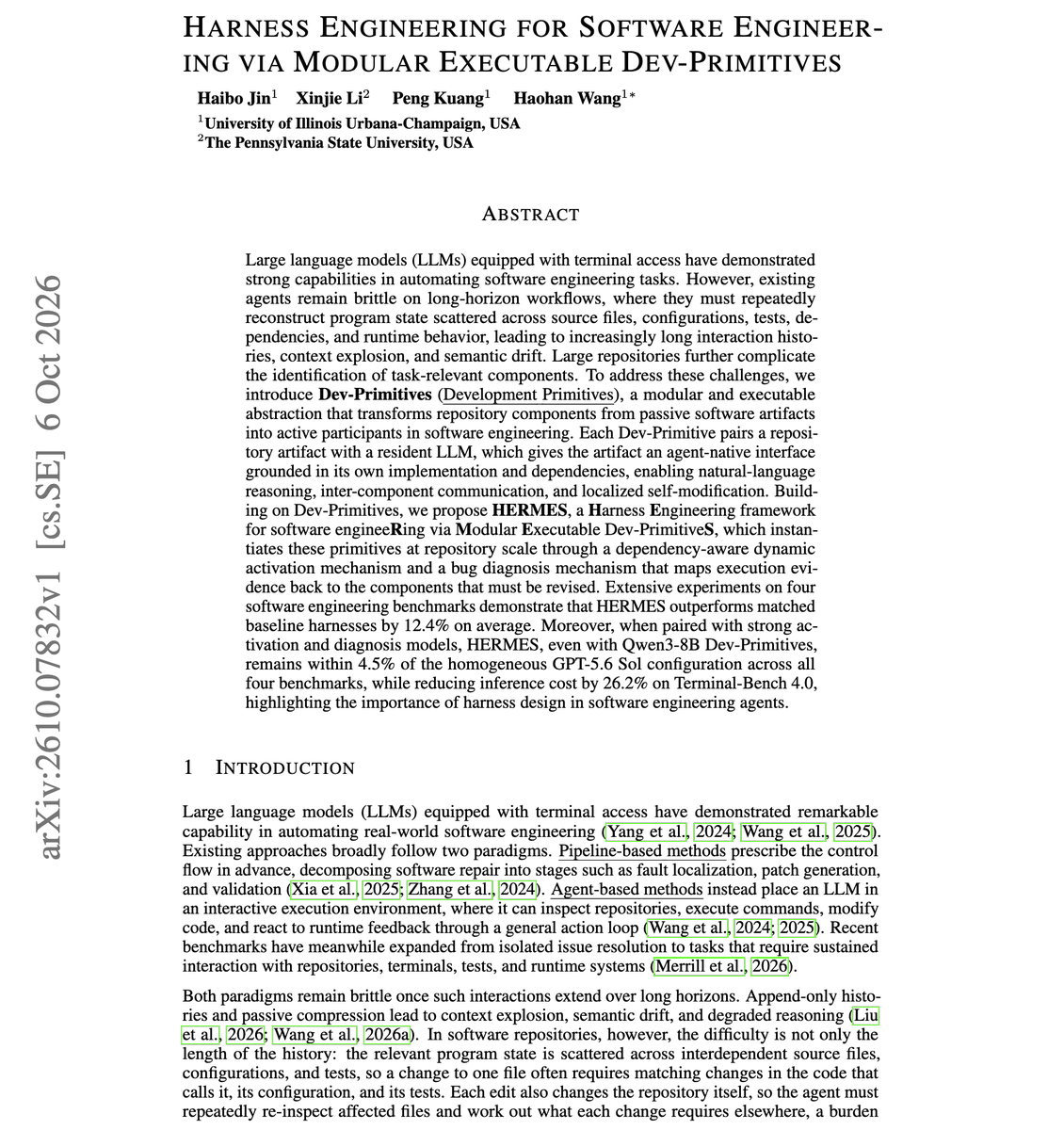
The authors find that on whole-repository migration, GPT-5.6 Sol goes from 6.5% to 31.0% when Codex is replaced with the HERMES harness, with the same model and effort setting.
The gain comes from the harness.
HERMES pairs each repository component with a resident LLM that knows its own code and dependencies. A dependency-aware step decides which components to activate, and a diagnosis step maps test failures back to the components that need changes.
Across four software engineering benchmarks, it beats matched baseline harnesses by 12.4 points on average.
With strong activation and diagnosis models, Qwen3-8B components come within 4.5 points of an all-GPT-5.6 Sol setup and cut Terminal-Bench 4.0 inference cost by 26.2%.
Paper: https://t.co/gfEecJnDPm
Chat with Paper: https://t.co/5B7EQjf7u6
GPT-6.1 Sol on Higgsfield built a prototype that gives ranchers a bird’s-eye view of their herd.
It turns drone footage into live herd counts and tracking, with alerts when an animal wanders off.
ElevenLabs v4 is live on Higgsfield.
Give your characters a voice with emotion in every line. Add whispers, laughter, and sound effects directly into your script.
Create dialogue and voiceovers in 90+ languages.
Available now on Higgsfield.
Keep your agent harness minimal, folks.
This paper from MIT CSAIL shows why.
(bookmark it)
While being very minimal it looks effective and promising for building self-improving agents.
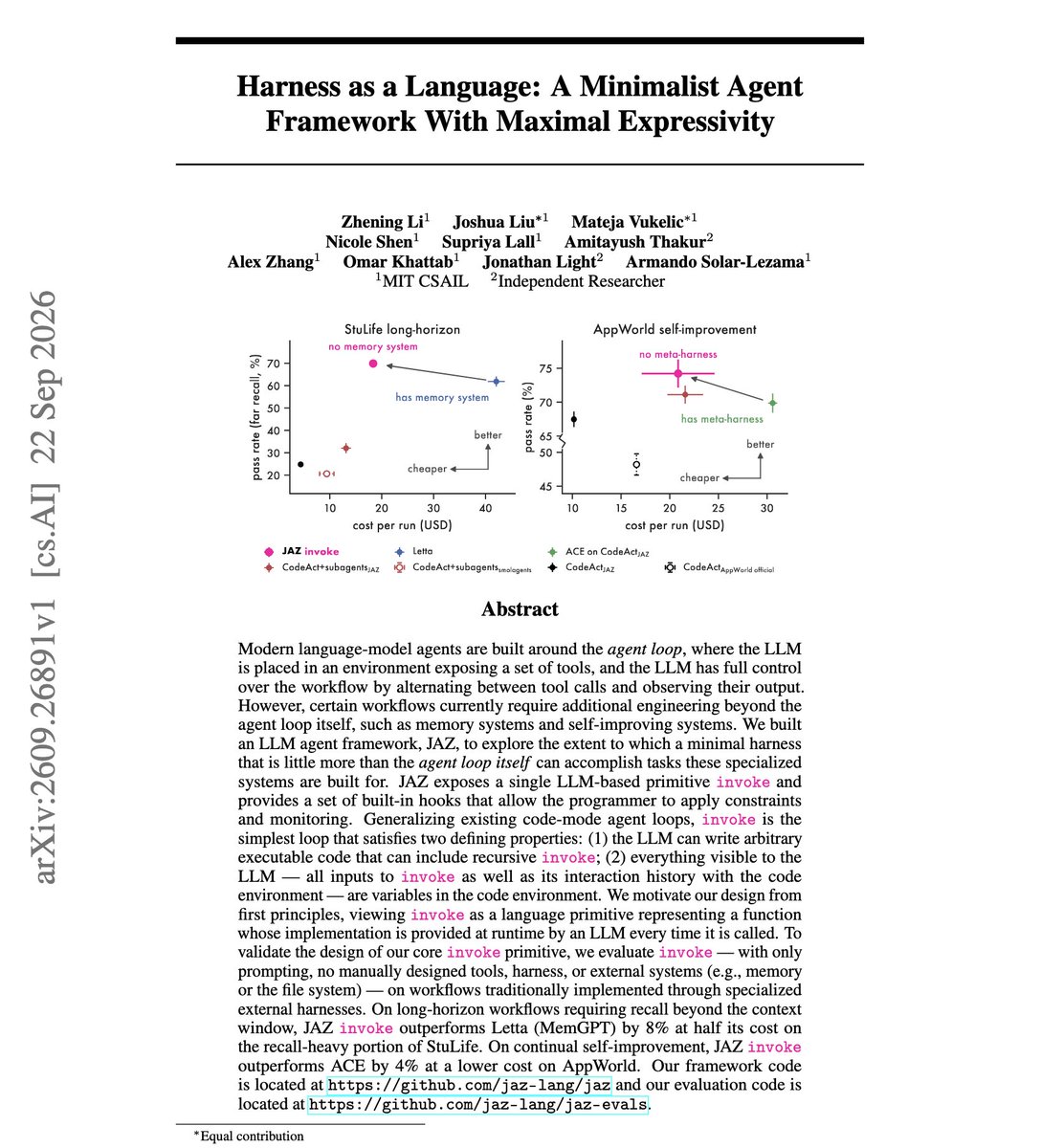
They present JAZ, an agent framework with one primitive, invoke. The LLM writes code, can call invoke recursively, and sees all of its inputs and history as variables in the code environment.
With prompting only and no memory system, it beats Letta (MemGPT) by 8% at half the cost on the recall-heavy part of StuLife.
On AppWorld it beats ACE, a self-improvement method, by 4% at lower cost.
Memory and self-improvement are usually built as separate subsystems. Here both are code the agent writes inside the loop, and hooks handle the constraints and monitoring you want to enforce.
Paper: https://t.co/qNk9mhY4vQ
Explore Paper: https://t.co/rl6KWkpZ64
Must-read paper from Google on self-improving agent harnesses.
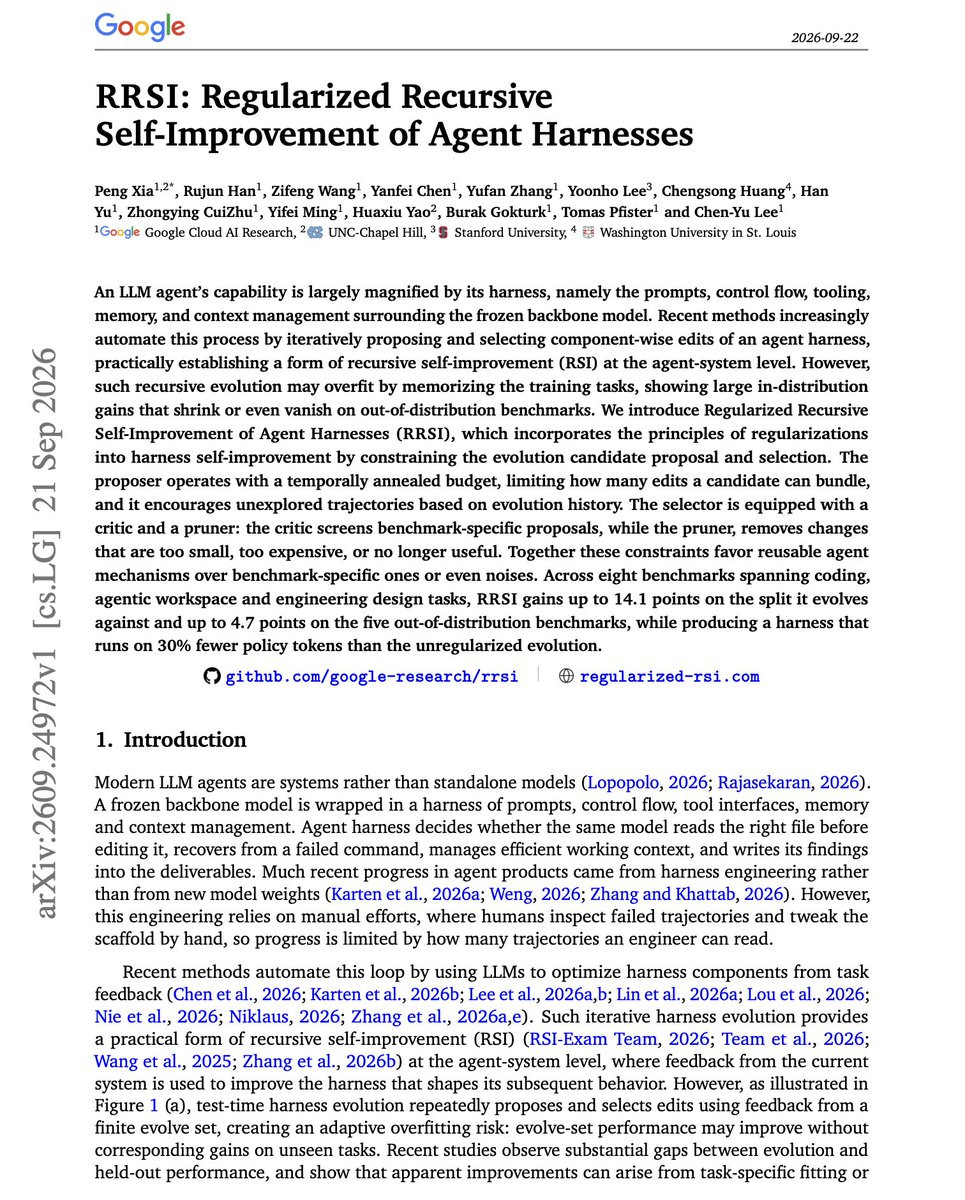
If you auto-optimize your agent's harness, your eval score can go up while the agent gets worse on real tasks.
This paper shows how to prevent that.
Of five harness-evolution methods compared on agentic workspace tasks, RRSI scored the lowest on the tasks it evolved against and highest on all three out-of-distribution benchmarks.
Automated harness evolution proposes edits to prompts, control flow, tools and memory, keeps the ones that raise the score, and repeats.
The authors show this overfits the training tasks. Meta-Harness reached 93.0 on the Harvey LAB evolve split but gained only 0.3 to 1.5 points on JobBench, GDPval and APEX-Agents.
RRSI adds regularization on both sides of the loop.
The proposer gets an edit budget that shrinks over time and is pushed toward directions it has not tried. A critic rejects benchmark-specific edits, and a pruner removes edits that are too small, too costly or no longer useful.
RRSI scored 90.5 on the evolve split and gained 3.5 to 4.7 points on the three held-out benchmarks. In the ablation, unregularized evolution used 3.80M tokens per trial against 2.42M for RRSI. With Gemini 3.5 Flash, RRSI raised Terminal-Bench 2.1 from 64.6 to 78.7 and carried a 2.2-point gain over to SWE-bench Verified.
Paper: https://t.co/SlfjDg96VI
Chat with Paper: https://t.co/gBotiH6Jfq
Anthropic has reported Yemeni militants used Claude to vibecode ballistic missile software.
The company said its safeguards prevented "many of their requests, but not all of them".
Build and own your harness, folks.
Very few people understand the magic behind customizing and optimizing an agent harness for your work.
You can start seeing incredible results quickly, even with a minimal harness. Just better code, better outputs, better costs, better writing, and so on.
As an example, I see way too many people complain that they are tired of their out-of-the-box agent harness producing verbose outputs. If you built a harness, that's easier to fix with a system prompt optimized for you.
This is why Pi is getting insane adoption these days. You want to control your harness. I agree that it's hard to optimize where things stand, but self-improving algorithms will make it easier to learn from trajectories. And if you use local models, you can tune all of that end-to-end (through a co-evolution of the harness and the models) as you work with them.
Look into open-source projects like Eve, Exo, and Prime Agent, and you will see what I mean.
I gave the fly brain $100 to trade bitcoin.
Dopamine neurons are stimulated when the fly makes profit. Neuron activity controls buy/sell decisions and makes trades on coinbase.
Will the fly get rich?
GPT-6 Astra + Higgsfield just built a ridiculously polished 3D logo editor.
Chrome and glass materials, live previews, 360° animation and export, all in the browser.