یہ وہئ پل ہے جسکے سالوں بعد کھلنے پر شرجیل انعام میمن کی آمد کیلئے ریڈ کارپٹ لگے، بالکل اسی یونیورسٹی روڈ پر جو چھ سال سے اس نالائق حکومت نے کھود کر عوام کی جان اجیرن کر رکھی ہے۔ کراچی کے عوام واقعی شریف ہیں جو انکے گریبان پکڑ کر ان سے اس سوال نہیں کرتے۔
جو شہر کو پانی سے فراہم نہ کر سکے، شہر کو کچرے کے ڈھیر میں تبدیل کردیا، ٹوٹی سڑکیں، گٹر ابللتے نالے، جنہوں نے چھ سال یونیورسٹی روڈ کو کھود کر تباہ حال رکھا، پھر بھی BRT مکمل نہ کرنے کی وجہ سےFWO کو بلوانا پڑا، آج سالوں بعد ایک فلائی اوور بننے پر یہ نالائق اپنے ہی لئیے ریڈ کارپٹ بچھوا کر بادشاہوں کی طرح پریڈ کر رہیے اور عوام انہیں سلامیاں دینے پر مجبور ہے۔ ان عوام کے نوکروں نے عوام کو نوکر سمجھ لیا ہے۔
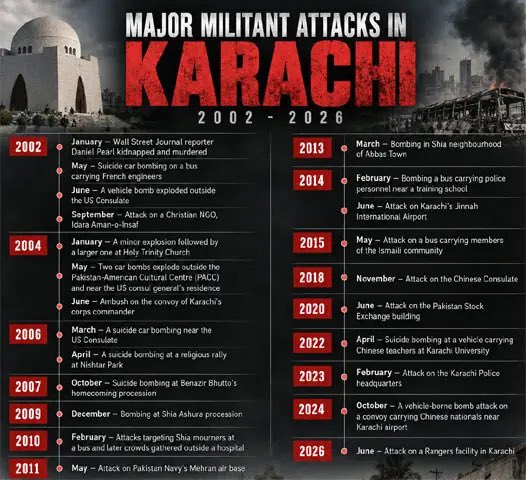
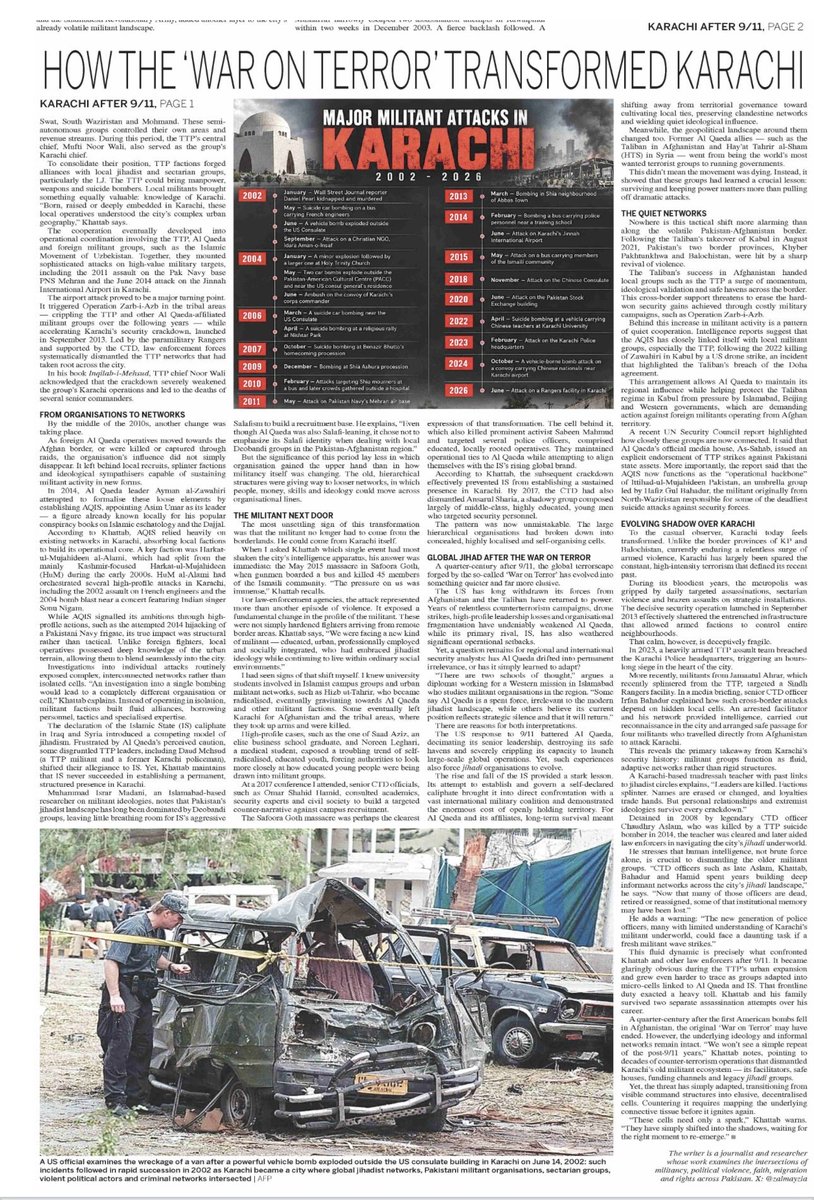
Drawing on my own reporting over two decades and the experiences of veteran counter-terrorism officer Raja Umer Khattab, I assess how the terror landscape has evolved in the 25 years following 9/11. For Dawn
(1)
Nearly 5,000 years ago, the people of the Indus Valley Civilization built Mohenjo Daro. Filmmakers Haya Fatima Iqbal and Nadir Siddiqui charted this ancient city from above—and they took National Geographic readers along for the journey. 🔗 https://t.co/SpjwAJq9xC
Before he died of cancer, Jeon Gyeong-cheol spent his last months forcing a strained care system to find a lasting home for his son.
The South Korean writer, known as Peter Pan’s Dad, died on 5 September 2026. He was sixty-four, a single father, and had been told in 2025 that late-stage liver cancer left him about six months. His son, Je-won, is twenty-seven, has severe autism, and functions at the social age of a toddler.
Jeon went to nearly a thousand residential facilities. Most said no. Staff were short, and few places would take an adult with such intense needs. He wrote the search on a public platform and then in the essay collection Goodbye, Peter Pan, or Annyeong, Peter Pan. The story went on television. Readers sent about 80 million won, or 59,000 dollars. That support helped place Je-won in a community village for people with profound developmental disabilities in North Chungcheong Province.
Jeon pledged book royalties toward a foundation for independent living homes. He wanted his son to have a life after him, and he used the time he had left to make that possible.
"My father Michael Massaroli...you do my dad's legacy and the legacy of all these victims no honor by using this tragedy to spread hate. We have seen a medley of people come up today, of all races, all religions, all creeds and this tragedy is just that, it's a tragedy. I've had to grow up and spend the past 25 years seeing people use it to hate on our Muslim brothers and sisters, to hate on people who don't look like them. That's wrong. That does no honor to the victims here...please stop."
Full video here: https://t.co/nWIx9b9yGR
Being brutally honest about the state of Pakistan’s middle class: one medical emergency and you’re broke. Lose your job and you’re on the street. This was never normal, not that I’ve known in my lifetime.
A medical doctor called me today asking help for concessions on his own child’s delivery at a private clinic in Islamabad. Professionals here live in debt, spend years just trying to pay it off, get harassed by debt collectors, and some don’t survive the weight of it.
This misery goes completely unheard while the country celebrates national milestones and international wins. Progress means nothing if the people living through it are quietly breaking.
Once men turned their thinking over to machines in the hope that this would set them free. But that only permitted other men with machines to enslave them.
—Frank Herbert, DUNE
Forty reform commissions later,the basic structure of civil service remains largely intact. Dr Saeed Ahmed makes a compelling case for breaking the generalist monopoly,recruiting specialists for specific jobs, monetising perks and ending military induction into civilian services.
Help Save 10-Year-Old Faiz’s Life ❤️
Ten-year-old Faiz is battling a complex heart condition. His parents, family and friends, however, refuse to give up.
A few years ago, thanks to generous donations from kind-hearted Pakistanis, Faiz underwent a long and complicated surgery in Boston, USA, which helped save his life.
Today, Faiz needs another critical surgery in Boston. Unfortunately, the required treatment is not available in Pakistan, and his family cannot bear the enormous cost alone.
I humbly appeal to everyone who can help: please come forward and support Faiz. Even a small contribution can make a difference and help give this young child another chance at life.
For further information, or to learn how you can help, please contact Faiz’s parents directly:
📞 +92 321 4988290
Let’s come together and give Faiz a fighting chance. ❤️
@MahimMaher This structure stands as Karachi’s most dangerous building—a catastrophic disaster in the making. Marred by critical architectural flaws and structural engineering failures.
One of the world's most brutal murderers is finally dead.
At 84 years old the former Bosnian Serb general, Ratko Mladić lived way longer than he allowed his tens of thousands of victims.
The more than 7000 Muslim men and boys he had slaughtered in Srebrenica will be his enduring shame.
At least he was tried by an International Criminal Tribunal and found guilty of his enormous crimes of genocide.
I am proud of the work we journalists did in the 90s to document his crimes against humanity, to finally hold him accountable.
Over the years I have posted about countless crimes against women, the hashtags, the horrors - today I’m posting because my cousin Hina Javed was murdered in her in-laws home yesterday. She’d been married less than 10 months. Pray for her, pray for justice. Demand justice.
In 1948, a 32-year-old at Bell Labs published a paper nobody fully understood.
Engineers found it too mathematical. Mathematicians found it too engineering-focused. One prominent mathematician reviewed it negatively.
That paper - "A Mathematical Theory of Communication", became the founding document of the digital age.
The man was Claude Shannon. Father of Information Theory.
At 21, he wrote the most important master's thesis of the 20th century.
Working at MIT on an early mechanical computer, Shannon noticed its relay switches had exactly two states - open or closed. He had just taken a philosophy course introducing Boolean algebra, which also operated on two values: true and false.
Nobody had ever connected these two things.
His 1937 thesis proved that Boolean algebra and electrical circuits are mathematically identical, and that any logical operation could be built from simple switches.
Howard Gardner called it "possibly the most important, and also the most famous, master's thesis of the century."
Every digital computer ever built traces back to this insight.
At 29, he proved that perfect encryption exists.
During WWII, Shannon worked on classified cryptography at Bell Labs. His work contributed to SIGSALY, the secure voice system used for confidential communications between Roosevelt and Churchill.
In a classified 1945 memorandum, he mathematically proved the one-time pad provides perfect secrecy, unbreakable not just computationally, but provably, permanently, against an adversary with infinite power.
When declassified in 1949, it transformed cryptography from an art into a science. It laid the foundations for DES, AES, and every modern encryption standard.
At 32, he defined what information is.
His 1948 paper introduced one equation:
H = −Σ p(x) log p(x)
Shannon entropy. The average uncertainty in a probability distribution. The minimum bits required to encode a message.
Three things followed:
> He defined the bit - the fundamental unit of all information. His colleague John Tukey coined the name.
> He proved the channel capacity theorem, every communication channel has a maximum rate of reliable transmission. You can approach it. You can never exceed it.
> He unified telegraph, telephone, and radio into a single mathematical framework for the first time.
Robert Lucky of Bell Labs called it the greatest work "in the annals of technological thought."
Where his equation lives in AI today:
Cross-entropy loss - the function training every classifier and language model, is derived directly from H. Decision tree splits use information gain, which is H applied to data. Perplexity, the standard LLM evaluation metric, is an exponentiation of cross-entropy.
Every time a neural network trains, Shannon's formula runs inside it.
He also built the first AI learning device.
In 1950, Shannon built Theseus, a mechanical mouse that navigated a maze through trial and error, learned the correct path, and repeated it perfectly. Mazin Gilbert of Bell Labs said: "Theseus inspired the whole field of AI."
That same year he published the first paper on programming a computer to play chess. He co-organized the 1956 Dartmouth Workshop, the founding event of AI as a field.
The man:
He rode a unicycle through Bell Labs hallways while juggling. He built a flame-throwing trumpet, a rocket-powered Frisbee, and Styrofoam shoes to walk on the lake behind his house.
He called his home Entropy House.
When asked what motivated him: "I was motivated by curiosity. Never by the desire for financial gain. I just wondered how things were put together."
In 1985, he appeared unexpectedly at a conference in Brighton. The crowd mobbed him for autographs. Persuaded to speak at the banquet, he talked briefly, then pulled three balls from his pockets and juggled instead.
One engineer said: "It was as if Newton had showed up at a physics conference."
He died in 2001 after a decade with Alzheimer's, the cruel irony of information slowly leaving the mind of the man who defined what information was.
Claude, the AI model, is named after Claude Shannon, the mathematician who laid the foundation for the digital world we rely on today.