Then & Now: Athens' opulent Hotel Aktaion of Neo Faliro. After the Greek-Turkish War, the structure sheltered Anatolian Greek refugees. The hotel was badly bombarded during WWII, and as a result, it was demolished after the war.
A view of the Odeon of Herodes Atticus where during in the Ottoman period the horses of Athens' military commander would graze. The drawing dates from the year 1787.
Bessarion, from the Empire of Trebizond, was aware of the Ancient Greek origin of Trebizond being in ancient Athens. He said “Our city prides itself on the origin of its race — if I must start by recounting it’s earliest history —that is to say it’s Attic mother-state”(continued)
The Acropolis Museum will host the traveling exhibition “A More Perfect Union: American Artists and the Currents of Our Time” which includes works of some of the most respected contemporary artists in America, including Bruce Nauman, Yoko Ono, Christine Sun Kim and more!
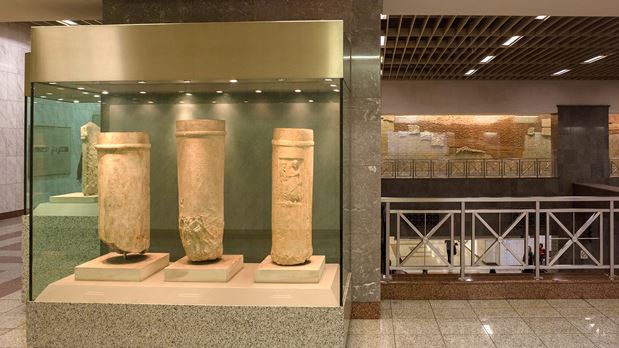
A unique metro station: During the 1990s excavations for the Athens metro brought to light around 50,000 artifacts from all periods of Athenian history. As a result, an Archaeological Museum was created within the Syntagma Metro Station, where Lines 2 and 3 converge.
Fun fact: The earliest mosque in Athens was built by Arabs in the 10th or 11th centuries, not the Ottomans. This is supported by the discovery of Kufic inscriptions in the Ancient Agora which suggests that Arabs lived in Athens during the Middle Ages!
#OnThisDay back in 1941, Manolis Glezos and Apostolos Lakis Santas, removed the flag of the Nazi occupiers from the Acropolis. This daring action was the first act of resistance in occupied Athens.
A unique snapshot into a now-lost world: The bazaar of Athens during the last years of the Ottoman period. The artwork comes from the album “Views in Greece,” which was created in 1821 by Edward Dodwell, an Irish painter and traveler.