we launched muse a month ago today
for the past month, reality felt like a dream. we watched the world catch fire with muse. every day we read stories of people saving money and precious time. every day it made people’s lives better in small and big ways. every day i watched the muse team pour their hearts into bringing a little more wonder in the world.
the response to muse has surpassed anything i could have imagined. i know the muse team will remember it for the rest of our lives.
it is easy to become jaded in tech. products launch every day but they very rarely make any dent in the world. but i have seen muse make a real difference for moms, for grandpas, for students, for coworkers. many of you using it in ways we never expected.
thank you to the muse team. thank you to everyone who’s tried muse. this is only the beginning. we have so much more to build.
Everyone holding their phone up at a sporting event or concert or kid’s recital will feel that moment live exactly zero more times.
This is exactly what I want to be building: the gift of presence.
Everyone holding their phone up at a sporting event or concert or kid’s recital will feel that moment live exactly zero more times.
This is exactly what I want to be building: the gift of presence.
It has to be some gods endgame plot that latest theoretical breakthrough on gradient descent and matrix multiplication came from
Gradient descent and matrix multiplication
Great @Muse experience, the type that keeps you around:
Mom fell. (She’s fine). Dad sent long text saying she fell and needs help.
Muse sent ping before I got the message alert, with phone number of where they’re staying. Called with one tap to get her status.
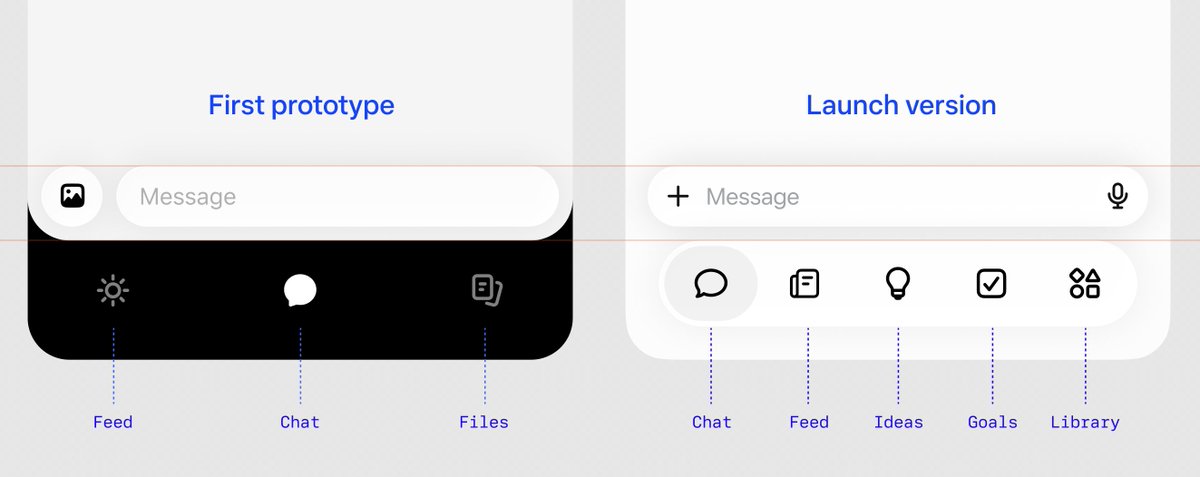
A distinctive feature of Muse is the tab bar. It was one of the first things in the initial prototype, and it felt like a foreign addition for an AI app. So foreign that I recall leaving on PTO early on and leaving one instruction: "do not remove the tab bar," knowing how tantalizing it would be to simplify the app by removing it.
Beyond ergonomics, the tab bar’s core benefit is framing. Agents are capable of more than people realize – the tab bar provides the surface area to expose that functionality and make it conceptually (and physically) accessible. Each tab does this in its own way.
Ideas is the most literal example. True to its name, the Ideas tab lists ideas from your Muse about how it can help you. This is a great way to learn about the many things Muse can do, especially for people who aren’t technical. At first the ideas are universal, but as your Muse gets to know you, its ideas become much more personalized and update frequently.
If Ideas shows you what Muse could do, the Goals tab shows you what Muse is doing – whether it’s helping you with a goal or keeping track of something. Muse does so many things that it helps to visualize it all as a kind of mutual to-do list where you can monitor status. Again this serves both a practical and conceptual benefit.
More thoughts to come, but I’m glad we kept the tab bar and I’m excited about how it will evolve time.
Scheduled Tasks on @Muse - An update on reliability
We deployed a fix to Muse to improve scheduled task and cron recovery and reliability especially, and have hardened our monitoring and alerting of the cron systems in the VMs.
Over the last few days the Muse team has been deploying a few changes to:
Improve the KV cache hit rate after increasing the context window size of the underlying model
Improve our VM scheduling algorithm to reduce downtime during deployments
Deploy a new authentication token format across the fleet for more fine-grained access.
During these changes we had a few SEVs (outages) where the inference tier was unresponsive, and the VM scheduling resulted in VMs not being available for longer periods of time during deployment and being unresponsive to clients.
We observed after we recovered from these outages that several crons and scheduled tasks failed to resume / heal properly when the outage was done, resulting in several users receiving reports from their Muse that the crons have been failing for a while.
We apologise for this incident, and know how much this disrupts your flow especially since many users rely on muse to reliably deliver outcomes for them. We take these outages seriously, and are running a full audit of our recovery systems and tools, and are adding more dashboards and alerts so you can continue to receive the high quality service we want all users to have.