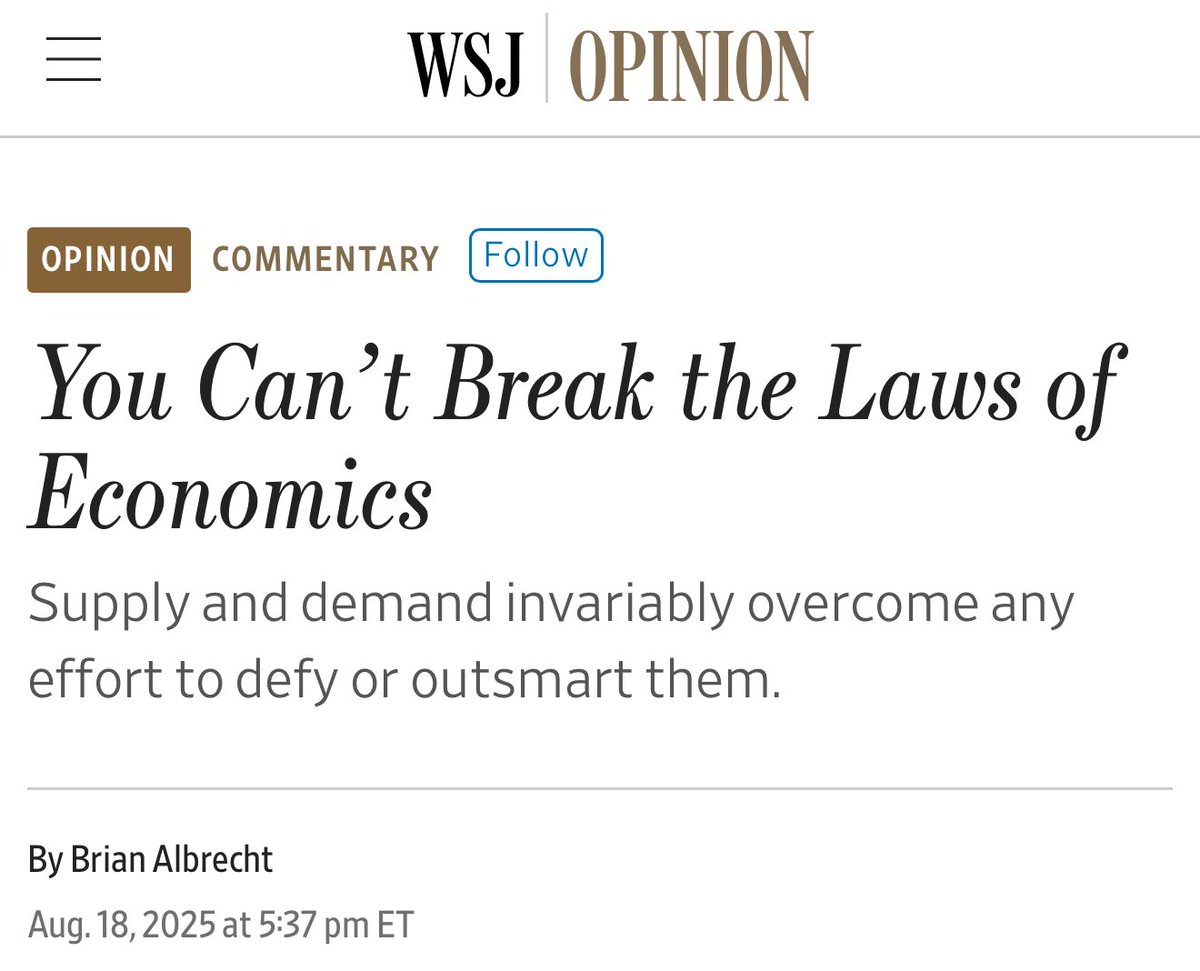
Simple economics is damn good at making real-world predictions.
Yet, if you only read oped columns, you’d think economics was a failure. Our models are too abstract. Our predictions are always wrong.
I push back in the @WSJopinion 👇
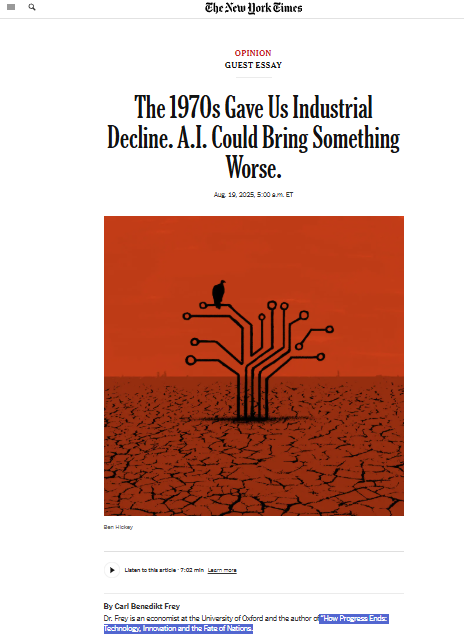
My guest essay in @nytimes today. I make 5 key points:
1. There’s little clear evidence of AI eliminating jobs at scale yet. But waiting to see is risky. Pittsburgh’s steel towns saw early signs with mini-mills before the losses showed up. Service capitals like London and New York should prepare now rather than after the shock.
2. Diversification helps—but only so much when the disruptor is a general-purpose technology. Being “in many industries” isn’t a shield if the same tool touches them all.
3. High-skill, knowledge jobs have big local multipliers. Each manufacturing job supports 1.6 local jobs; each high-skill tech/professional role supports 5. That means even modest losses of analysts, developers, or paralegals can ripple through restaurants, retail, and transit systems.
4. AI needn’t fully replace workers to matter. It only needs to make work easier. As location and experience matter less at the margin, more work will offshored to cheaper places (e.g. India, UAE, or Philippines).
5. The lesson from deindustrialization isn’t inevitability—it’s reinvention. Detroit poured resources into legacy industries and still declined. Boston repeatedly bet on talent, education, and new sectors.
Read this #preprint on @researchsquare: Unpacking Food Security Beyond the Plate: A Deep Dive into Food Security Dimensions in Southern Ethiopia https://t.co/NODkZsJJ4r
📘 My book Impact Evaluation in Firms and Organizations is officially out today with @mitpress! An accessible, non-technical introduction to impact evaluation (& causal machine learning) designed for practitioners & students, with use cases in R & Python: https://t.co/7l3CrweNem
Education accounts for 45% of global economic growth
Education accounts for 60% of pretax income growth among world poorest 20% 1980-2019
New paper by Gethin in @QJEHarvard
https://t.co/FMGTL8sm9t