Menlo Park, 1877. He hands his mechanic a rough sketch. Price: eight dollars.
Thirty hours later: a hand-cranked cylinder wrapped in tinfoil.
The foreman bets a box of cigars it won't work.
He turns the crank and recites a nursery rhyme. It speaks back.
Guess the inventor.
Alfred Nobel, inventor of dynamite. He told Bertha von Suttner he wished for a machine "of such frightful efficacy ... that wars should thereby become altogether impossible."
Portrait: Annie Russell Marble, The Nobel Prize Winners in Literature (1925).
https://t.co/fTTA2NeTR9
1864. A factory explosion in Sweden killed his younger brother. Their father never recovered.
He told French bankers he had invented "an oil that would blow up the world." They refused him credit.
His 1895 will left most of his fortune to prizes.
Guess the inventor.
Cardinal Richelieu. Mary de' Medici told Louis XIII to rid himself of one of them. Richelieu: "In that case, it would be reasonable that it should be of me."
Portrait by Michel Lasne, in J. B. Perkins, Richelieu and the Growth of French Power (1900).
https://t.co/B1B4gbXlBe
Paris, November 10, 1630. The queen mother shut the doors to make the king fire his chief minister.
He walked in through a chapel door nobody had barred.
Next day her allies divided up his offices. He followed the king to Versailles and kept his power.
Guess the statesman.
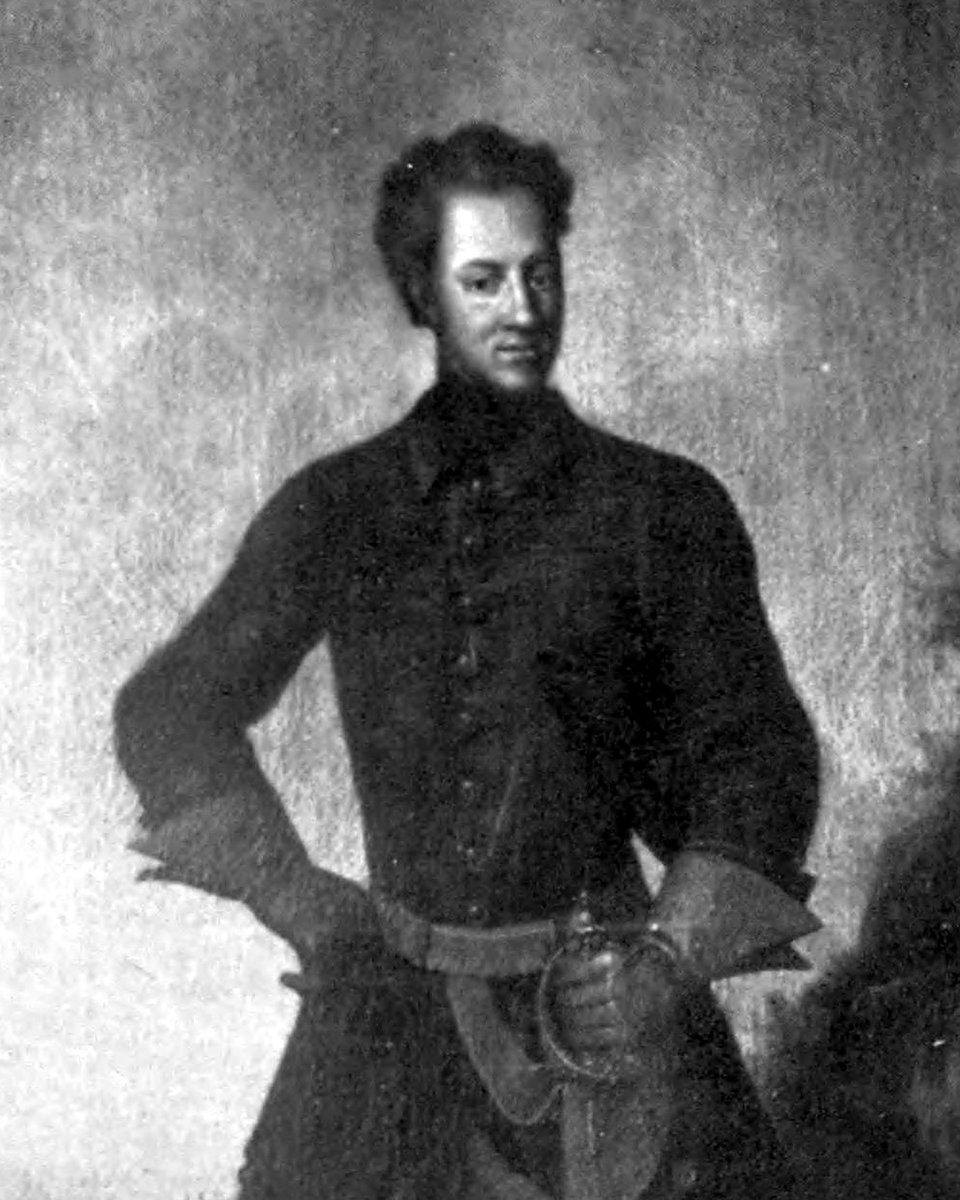
Charles XII of Sweden, who routed the Russians at Narva in 1700. At Bender, pressed to give in as the house burned, he said: "There is no immediate danger, so long as our clothes are not on fire."
Portrait: Oscar Browning, Charles XII of Sweden (1899)
https://t.co/zSx7ZY02Z5
February 11, 1713, near Bender. 8,000 Turks and Tartars with eleven guns storm a Swedish camp.
The king holds his house with 42 men until the roof is set alight.
He breaks out, sword in one hand, pistol in the other. A few steps on, his own spurs trip him.
Guess the king.
Julius Caesar, who later crossed the Rubicon and marched on Rome. Ransomed for fifty talents, he hired galleys at Miletus and caught the pirates at Pharmacusa. He crucified them all.
Bust: Charles Oman, Seven Roman Statesmen of the Later Republic (1902)
https://t.co/roGUclugvb
Cilician pirates seize a young Roman off Pharmacusa and ask twenty talents for him.
He says he is worth fifty.
For 38 days he orders them to keep quiet while he naps. He tells them he will come back and crucify them all. They think he is joking.
Guess the general.
Napoleon. Ney soon issued an order of the day: "Soldiers, the cause of the Bourbons is lost for ever." On March 20 Napoleon entered Paris, and Louis XVIII fled across the Belgian frontier.
Portrait: Lord Roberts, The Rise of Wellington (1895)
https://t.co/F1yBouS6pP
March 1815. An exile lands in France with only a thousand men.
The War Minister calls him "nothing more than an adventurer." Marshal Ney promises to bring him back in an iron cage.
Ney does not get far. "I cannot stop the waters of the sea with my hand."
Guess the emperor.
A few surprising things I learned from reading about Napoleon Bonaparte, the man who made himself Emperor of France:
1. At Toulon, he tested a general's battle plan by firing a single cannonball before he risked one soldier on it.
2. In 1814 he won four battles in six days. Eight weeks later, he had lost Paris and his throne.
3. He was offered a peace deal that would have kept him on the throne. He turned it down because he could see one more battle he could win.
4. As a young general with almost no money, he was offered gold to sell his position. He refused to be bought.
5. He left official letters sitting unanswered for weeks on purpose. He had learned that most requests answer themselves if you give them time.
6. He described his mind as a chest of drawers. Open one, finish what is in it, shut it completely, then open the next.
7. His written orders used numbers, not adjectives: exact men, exact guns, exact hours, written so nobody could misread them.
8. He wrote the bulletins that announced his own battles. France always read his version first.
9. The famous painting shows him crossing the Alps on a rearing horse, calm and heroic. He actually crossed on a mule, in bad weather, behind a local guide.
10. He dictated at a pace his secretaries could barely follow, moving between a battle order, a law, and a personal letter in the same sitting.
11. He slept in short bursts, at his desk, in his carriage, between battles, and woke his secretaries in the middle of the night to take dictation.
12. He turned nobodies into marshals of France, then trained them to wait for his word so completely that he became the only brain in his own army.
13. One of those marshals, Marmont, a friend since Toulon, handed Paris over to the enemy in 1814.
14. He slipped out of Egypt in secret and left General Kléber in command of the army there. Kléber learned he was in charge from the letter Napoleon left behind.
15. He had his own ministers watched and read the reports that told him he was wrong. His paranoia was not a mood. It was a system.
16. Exiled on Saint Helena, he spent his last years dictating his version of his life for hours a day. It was his final campaign, fought over how history would remember him.
17. Even his will was a weapon. In it, he publicly took responsibility for having the Duke of Enghien shot, and said he would do it again.
18. "Work is my element," he said. "I was born and made for work." He kept working until his body gave out at 51.
19. The habits that made him unbeatable are the same ones that destroyed him. He never learned when to stop.
Napoleon is a relentlessly obsessive work machine who conquered Europe on his habits, and then let those same habits take everything from him. You don't want to miss this episode.
Catherine the Great. The soldiers, she wrote, "began to kiss me, to embrace my feet, my hands, my dress." Next morning Peter III, her husband, gave up the throne.
Portrait: Philip W. Sergeant, The Courtships of Catherine the Great (1905)
https://t.co/fVSJvv8PgN
June 28, 1762, 6 a.m. An officer wakes her: "It is time to get up; all is ready for your proclamation."
A plotter was arrested overnight. She dresses fast and goes.
At the barracks: twelve men and a drummer.
That night she rides at the head of the Guards.
Guess the empress.
George Washington, at Newburgh. No one stirred while he read. Afterward the officers resolved, unanimously, that no distress or danger would make them sully what eight years of war had won.
Portrait: Woodrow Wilson, George Washington (1896)
https://t.co/FeDRJ8pmRL
March 1783. The war is nearly won, the army unpaid. A paper in camp urges the officers to "redress yourselves."
Their commander calls them together and stops to put on spectacles.
"I have not only grown gray, but almost blind, in the service of my country."
Guess the general.
Isaac Newton. After Halley left he redid the lost calculation, and the work grew into the Principia, published in 1687.
Portrait: Sir David Brewster, Memoirs of the Life, Writings, and Discoveries of Sir Isaac Newton (1860)
https://t.co/mXaYu8sLb1
August 1684. Halley goes to Cambridge with a question Wren and Hooke never settled: if gravity weakens with the square of distance, what path do the planets take?
A professor answers at once. "An ellipse."
He has calculated it. He can't find the paper.
Guess the scientist.
Peter the Great. Next he worked over four months in the East India Company yard at Amsterdam, and on Sept 19, 1697 laid the keel of a 100-foot frigate, the Apostles Peter and Paul.
Engraving: Jacob Abbott, History of Peter the Great (1900)
https://t.co/XzFG0S3fzS
Zaandam, 1697. A very tall stranger in a tarpaulin hat signs on as a ship's carpenter.
The barber has seen a letter from Moscow. The Tsar, it says, is nearly seven feet tall, with a mole on his right cheek.
A week later the crowds drive him off in a storm.
Guess the emperor.