@Alpine_Hermit@Thomashornall Lunch is not the main meal here and I would strongly disagree with your assessment of the cafeteria-made meals. They are neither nutritious not well balanced.
Dans le manifeste "techno-optimiste" de Marc Andreessen, il y a une phrase qui m'a marqué :
"Our enemies are not bad people – but rather bad ideas."
Nos ennemis ne sont pas des mauvaises personnes. Ce sont des mauvaises idées.
Prenons Jancovici. L'homme est brillant, sincère, travailleur. Il ne se lève pas le matin en se disant qu'il va nuire à l'humanité. Mais l'idée qu'il porte la décroissance, le rationnement, la frugalité érigée en horizon civilisationnel est une idée profondément destructrice. Elle prend des esprits brillants et les transforme en commissaires politiques d'un futur appauvri.
Et le plus fascinant, c'est ce que cette idée fait aux gens qui l'adoptent.
Dans mon entourage, une grosse partie de mes amis est sur cette ligne décroissantiste, avec tout le package qui va avec. L'argent c'est mal mais ils en veulent. Il faut moins prendre l'avion mais ils rêvent de voyager partout. Il faut consommer moins mais ils ne renoncent à rien de ce qu'ils aiment vraiment.
Et tous ont un point commun : ils sont déprimés. L'un d'eux m'a même confié qu'il était sous antidépresseurs.
Ce n'est pas un hasard. C'est mécanique.
Quand tu crois que ton désir de vivre, de créer, de t'élever est moralement suspect tu te détruis de l'intérieur. Tu passes ta vie à t'excuser d'exister. Tu vis dans la dissonance permanente entre ce que ton corps veut (plus, mieux, plus loin) et ce que ton idéologie t'ordonne (moins, sobre, immobile).
D'où ma théorie :
Quand on pense quelque chose de fondamentalement faux décroissance, communisme, extrémisme religieux (de tout ordre) ce n'est qu'une question de temps avant que ça devienne vraiment destructeur.
D'abord pour soi. Puis pour les autres.
Les mauvaises idées tuent. Lentement chez ceux qui y croient, brutalement chez ceux qui les subissent.
C'est pour ça que la bataille des idées n'est pas un luxe d'intellectuel. C'est la bataille la plus importante de notre époque.
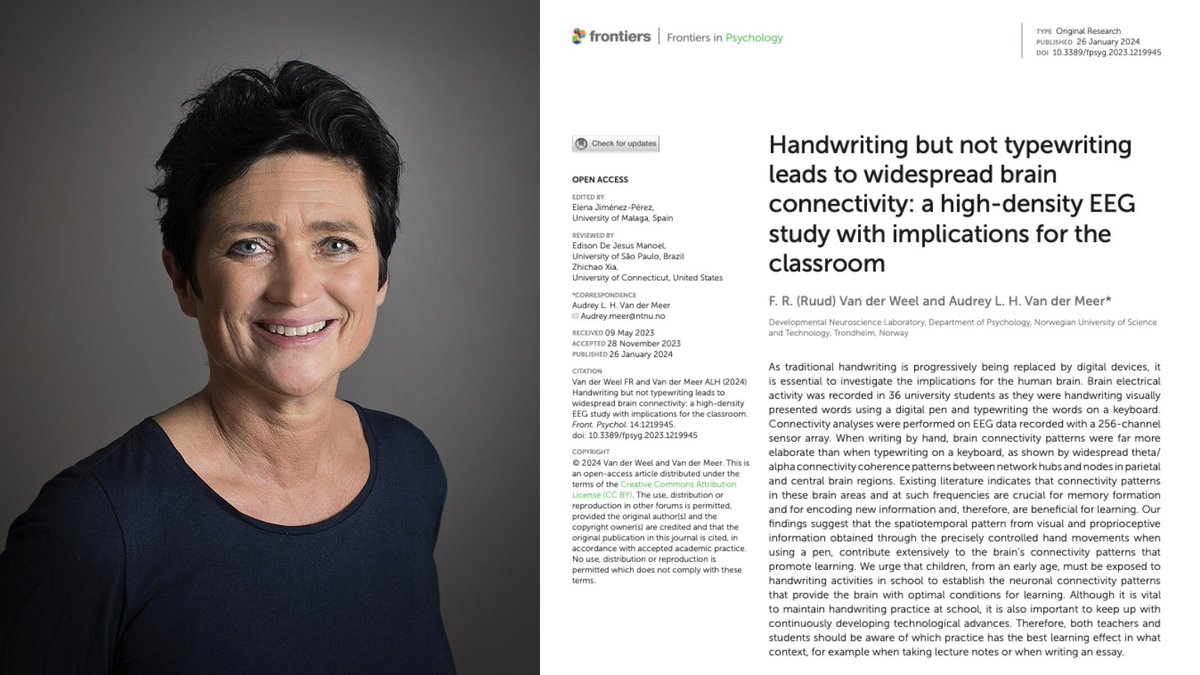
A Norwegian neuroscientist spent 20 years proving that the act of writing by hand changes the human brain in ways typing physically cannot, and almost nobody outside her field has read the paper.
Her name is Audrey van der Meer.
She runs a brain research lab in Trondheim, and the paper that closed the argument was published in 2024 in a journal called Frontiers in Psychology. The finding is brutal enough that it should have changed every classroom on Earth.
The experiment was simple. She recruited 36 university students and put each one in a cap with 256 sensors pressed against their scalp to record brain activity. Words flashed on a screen one at a time.
Sometimes the students wrote the word by hand on a touchscreen using a digital pen, and sometimes they typed the same word on a keyboard. Every neural response was recorded for the full five seconds the word stayed on screen.
Then her team looked at the part of the data most researchers had ignored for years, which is how different parts of the brain were communicating with each other during the task.
When the students wrote by hand, the brain lit up everywhere at once.
The regions responsible for memory, sensory integration, and the encoding of new information were all firing together in a coordinated pattern that spread across the entire cortex. The whole network was awake and connected.
When the same students typed the same word, that pattern collapsed almost completely.
Most of the brain went quiet, and the connections between regions that had been alive seconds earlier were nowhere to be found on the EEG.
Same word, same brain, same person, and two completely different neurological events.
The reason turned out to be something nobody had really paid attention to before her work. Writing by hand is not one motion but a sequence of thousands of tiny micro-movements coordinated with your eyes in real time, where each letter is a different shape that requires the brain to solve a slightly different spatial problem.
Your fingers, wrist, vision, and the parts of your brain that track position in space are all working together to produce one letter, then the next, then the next.
Typing throws all of that away. Every key on a keyboard requires the exact same finger motion regardless of which letter you are pressing, which means the brain has almost nothing to integrate and almost no problem to solve.
Van der Meer said it plainly in her interviews.
Pressing the same key with the same finger over and over does not stimulate the brain in any meaningful way, and she pointed out something that should scare every parent who handed their kid an iPad.
Children who learn to read and write on tablets often cannot tell letters like b and d apart, because they have never physically felt with their bodies what it takes to actually produce those letters on a page.
A decade before her, two researchers at Princeton ran the same fight using a completely different method and ended up at the same answer. Pam Mueller and Daniel Oppenheimer tested 327 students across three experiments, where half took notes on laptops with the internet disabled and half took notes by hand, before testing everyone on what they actually understood from the lectures they had watched.
The handwriting group won by a wide margin on every question that required real understanding rather than surface recall.
The reason was hiding in the transcripts of what the two groups had actually written down.
The laptop students typed almost word for word, capturing more total content but processing almost none of it as they went, while the handwriting students physically could not write fast enough to transcribe a lecture in real time, which forced them to listen carefully, decide what actually mattered, and put it in their own words on the page.
That single act of choosing what to keep was the learning itself, and the keyboard had quietly skipped the choosing and skipped the learning along with it.
Two studies. Two countries. Same answer.
Handwriting makes the brain work. Typing lets it coast.
Every note you have ever typed instead of written went into your brain through a thinner pipe. Every meeting, every book highlight, every idea you captured on your phone instead of on paper was processed at half depth.
You did not forget those things because your memory is bad. You forgot them because typing never woke the part of the brain that would have made them stick.
The fix is the thing your grandmother already knew.
Pick up a pen. Write the thing down. The slower road is the faster one.
Two days ago, the Serbian people in the Republic of Srpska, celebrated Christmas according the Eastern Orthodox Christian tradition. As they rejoiced in the good tidings of the day and prayed for peace, goodwill, & brotherhood, it is important to shout out to the American people about the effort to destroy the Republic of Srpska—a devoted and faithful bastion of Judeo-Christian values in the Western Balkans.
30 years after the 1995 Dayton accords ended the Bosnian war, the Serbian Christian minority is still being ruled by an unelected administrator from another country with unlimited and unconstitutional powers. He has been steadily dismantling the autonomy of the Serbian people with the goal of ending Srpska’s self government, and absorbing the Christian minority into an Iranian influenced Muslim Majority in the heart of Europe.
Today, the High Representative from the EU, Christian Scmidt issued a statement threatening criminal prosecution against anyone in Srpska celebrating, what is in effect, their 4th of July.
Shocking but true.
Can you imagine what we Americans would do if some foreign bureaucrat from another country told us we couldn’t celebrate the Fourth of July?
Denmark was one of the First Nations to recognize Kosovo, and since 1999 has sent more than 10,000 troops to the KFOR occupation force.
Don’t expect any sympathy from me when the tables are turned.
NATO is a morally corrupt organization that has long since lost any legitimacy.
The fact that it has turned to eating itself is no surprise.
Denmark loses Greenland, and the world loses NATO.
That’s a good trade in my book.
As the Europeans shudder at an "Expansionist" USA, they quickly forget how they queued up to support the theft of Serbian territory to "Create" a fake country called Kosovo.
What goes around comes around.
Much of Western Europe:
2008
“We recognize #Kosovo as no longer part of #Serbia, in spite of [legally binding] UNSC Resolution 1244 [still confirming Kosovo as a part of Serbia], the UN Charter & Serbia’s Constitution. Kosovo is a unique case! Why? Because we say so!”
2026
“GREENLAND IS DENMARK! WE MUST PROTECT INTERNATIONAL LAW! NO EXCEPTIONS!”
Hate to say it, but Serbs told you so. It may not be too late. Withdraw recognition of Kosovo, apologize to Serbia. Start respecting international law in every case & recognize your mistakes. Because you can’t have both a ‘rules-based’ order & a ‘because we say so’ system. You can’t have it both ways.
At some point, your nearsightedness will slam you against a wall.
🛑 Confiscating Russian assets to fund Ukraine? A declaration of war. Taking the money of one side and giving it to the other would drag the EU into the conflict. This must not happen. Thankfully, I am not the only one who sees it this way.