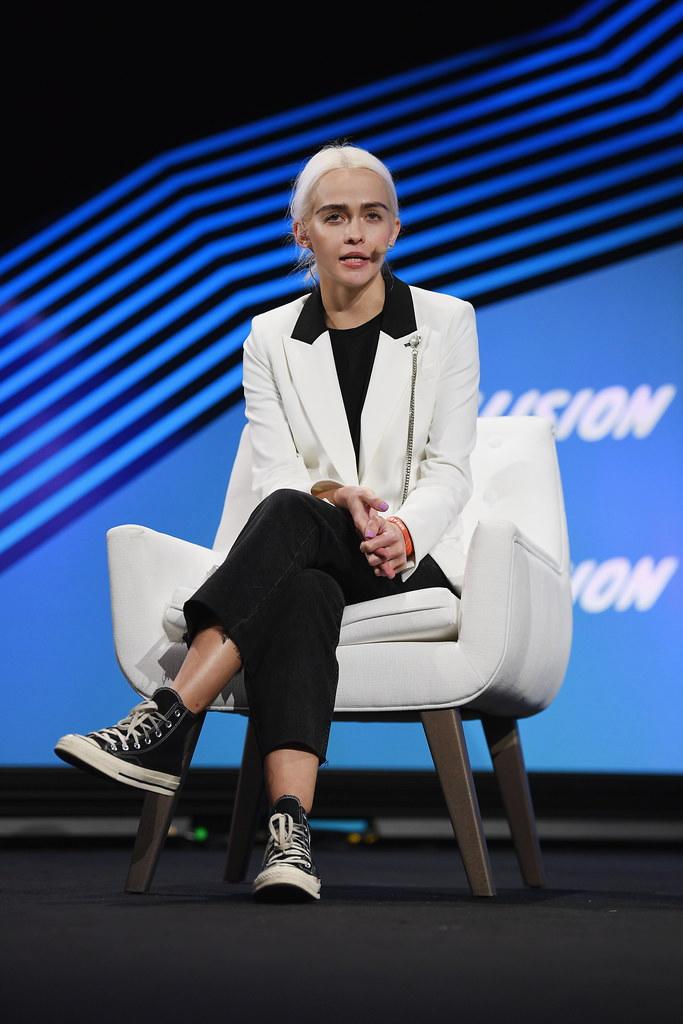
Persi Diaconis - Stanford mathematician and former professional magician.
almost no deck in your entire life has been truly random. and the man who proved it once made his living cheating at the card table.
in this lecture he shows how many times you actually have to shuffle, gives a simple test that catches an under-shuffled deck in seconds, and retells how online poker's deal got broken and players started reading everyone's hand.
randomness isn't a feeling, it's a number. and it's not just cards - in bets, in markets, in our own choices we mistake "not shuffled enough" for "truly random." what looks like chaos still hides a trace of order. Diaconis proved our intuition about randomness almost always lies - and someone profits from it.
13:00 he runs the pile test that catches an under-shuffled deck. 19:10 he tells how online poker got broken.
27 minutes after which you'll never trust a "shuffled" deck again.
Follow me to know more. Save the post so you don't lose.
Eric Rosenfeld, co-founder of Long-Term Capital Management:
"We should have run this at a lower risk."
That is the understatement of the century, and it is the whole lesson in one sentence.
LTCM was supposed to be unbeatable.
Two Nobel laureates, Myron Scholes and Robert Merton, the men who literally won the prize for pricing risk, sat on the board.
Their models said the trades were almost riskless. For three years the fund printed around 40% a year, and the smartest money on earth begged to get in.
Then the improbable landed. Russia defaulted, the correlations that were supposed to cancel out all moved the same way at once, and the same math that made them look like gods turned on them.
The fund lost $553 million in a single day. Roughly $4.6 billion evaporated in weeks. It was so big and so leveraged that the Federal Reserve had to organize a bailout to stop it from dragging the whole system down.
None of them were stupid. That was the point. Being the smartest people in the room is exactly what let them mistake a few calm years for a permanent edge. Their model was fit to a market that had never been stressed, and when the stress came, the edge turned out to be luck all along.
The market does not punish the dumb. It punishes the most certain. The edge was never the model, the returns, or the Nobel prize. It was the doubt they never had.
This is a Martin Louis XIII Cognac. It costs $500 a shot here. Are you willing to pay that much for a single shot? I wouldn’t but I don’t judge those that would.
CODING, AI, CRYPTO, TRADING AND PREDICTION MARKETS ARE ALL SITTING AT ONE POKER TABLE NOW
@doppelgamesco stacked every niche worth watching into a single product. Autonomous AI agents play the hands -- you trade their reads live.
> AI agents run the table, you trade the outcome.
> Every move priced as a real market.
> Onchain rails, real positions, real edge.
The match is Doppel Onion vs Doppel Wendys.
I've got money on Doppel Wendys -- that one never folds a bluff.
Who are you going with?
Place your predictions here:
https://t.co/ACRg21LWDC
Six months from now you'll either still be paying for AI...
Or you'll own the system that replaces most of those subscriptions.
Same models.
Same capabilities.
Different economics.
Instead of paying hundreds every month, you build your own AI stack once and run it locally for a fraction of the cost.
Research.
Writing.
QA.
Publishing.
Monitoring.
Multiple AI agents working together instead of switching between apps all day.
This isn't another AI wrapper.
It's a complete local AI workflow you control.
Open source.
Expandable.
Yours.
The next wave isn't better prompts.
It's building systems that do the work for you.