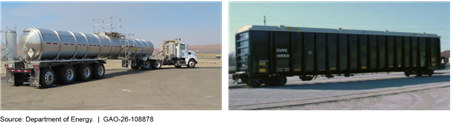
We found that grouting 24 million gallons of this waste could cost $480 million to $1.1 billion. Shipping pretreated waste as liquid via truck to disposal sites would cost ~$12 million to $36 million. DOE estimated the cost to ship solid grouted waste would likely be double that.
As DOE prepares to grout ~24 million gallons of low-activity waste from 22 tanks at its Hanford site, it must decide whether to grout (1) at Hanford and transport the grout or (2) offsite, which could mean transporting liquid waste.
https://t.co/NzViUT57AK
DOE could design and construct a new grouting facility at Hanford or transport liquid waste to existing grouting facilities. DOE must consider a range of factors, including cost and schedule, risks, and disposal options.
Hanford, EM’s largest site, lost over a third of its staff in FY25; most of the 96 who left accepted Deferred Resignation Program offers, and about 30% of those were in mission-critical positions. Another 30% will be retirement-eligible by the end of 2030.
DOE’s nuclear cleanup office (EM) lost staff in every location in FY25 (overall attrition 38%), raising concerns about the safety of operations now and in the future, especially as more staff become eligible for retirement. https://t.co/hcvz27U1Lb
Future attrition is expected to be high with 30% of EM staff retirement-eligible in 2030. New staff will require years of training to fill positions such as federal project directors, who oversee safety, cost, scope, and schedule for projects costing millions.
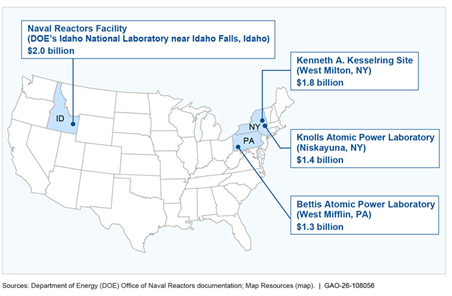
Naval Reactors, which develops nuclear propulsion for the navy, estimated that it could take up to 100 years to D&D contaminated facilities at 4 sites it is responsible for. However, partnering with EM could help it finish D&D as soon as 2035, pending funding availability.
Some good news: the Office of Naval Reactors is on track to save billions on decontamination & decommissioning (D&D) of excess facilities by partnering with DOE’s Office of Environmental Management (EM) & leveraging its network of experienced contractors.
https://t.co/bWTUdpQ9L8
This plan also identified 19 unfunded maintenance projects that could use surplus funds to save ~$120 million. We recommend that DOE communicate these projects’ benefits to Congress and improve data collection and communication between sites and HQ.
DOE spends nearly $1 billion annually to maintain the facilities it needs for its nuclear cleanup efforts—an increase of 80% since FY20. Improving how it manages and communicates data on this spending could save money and better address maintenance needs. https://t.co/idfb6RwlXc
We and others have expressed concern over DOE’s management of its >4,000 operating cleanup facilities. DOE identifies infrastructure needs in its Master Asset Plan, but 8 of its 13 cleanup sites say this plan doesn’t capture their site-level needs.
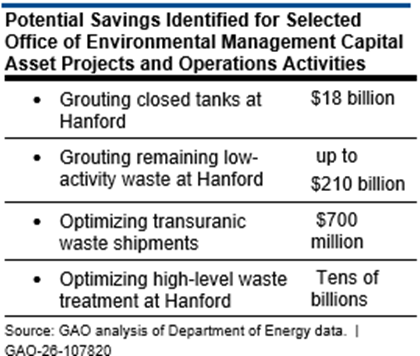
EM has taken some steps to reduce nuclear waste cleanup costs, but it has yet to pursue a wide range of additional opportunities to save potentially tens of billions of dollars more. We recommend that DOE fully pursue such opportunities.
Clarifying the statutory definition of “high-level radioactive waste” (HLW) could help DOE save tens of billions of dollars in nuclear cleanup costs, including for treatment and disposal of ~90 million gallons of waste stored in underground tanks.
https://t.co/VawGlgpPFX
We and others (such as the National Academies of Science) have raised concerns about the HLW definition for decades. We recommend that Congress convene a panel to address ambiguities in the definition and identify specific recommendations to clarify it.
We identified opportunities for significant cost savings on several cleanup projects and activities, such as by grouting certain radioactive waste and pursuing less costly approaches to cleaning up highly radioactive waste at the Hanford site.
📷
According to DOE data, costs are up and schedules are delayed for many major nuclear cleanup projects and activities since our last report in 2022. Reasons include contractor performance issues, unanticipated site conditions, and technical challenges. https://t.co/t1OOAztBc0
DOE also struggles to coordinate with cleanup sites to ensure that cost and schedule data for its operations activities are current, consistent, and accurate.