Atomic Dynamics builds fully autonomous AI for metal science: AI that designs new alloys, and autonomous labs that make and test them, so every experiment teaches the next.
Headquartered in San Francisco, with labs in Bellevue, Ohio and San Francisco.
https://t.co/OzdRT9wkfg
Inside our Ohio lab, part 2: one control layer and our AI agents run the lab as a single system, so every result flows straight back into the model.
#AIforScience#SelfDrivingLabs#LabAutomation
@JeffBezos at @semafor on metal casting: still mostly trial and error, rarely instrumented, and "you're never going to virtualize casting."
That is the case for AI that lives inside the plant: real experiments, new data every day, one loop from prediction to production.
https://t.co/vW5UKMfKqc
#AIforScience #Metallurgy #AdvancedManufacturing
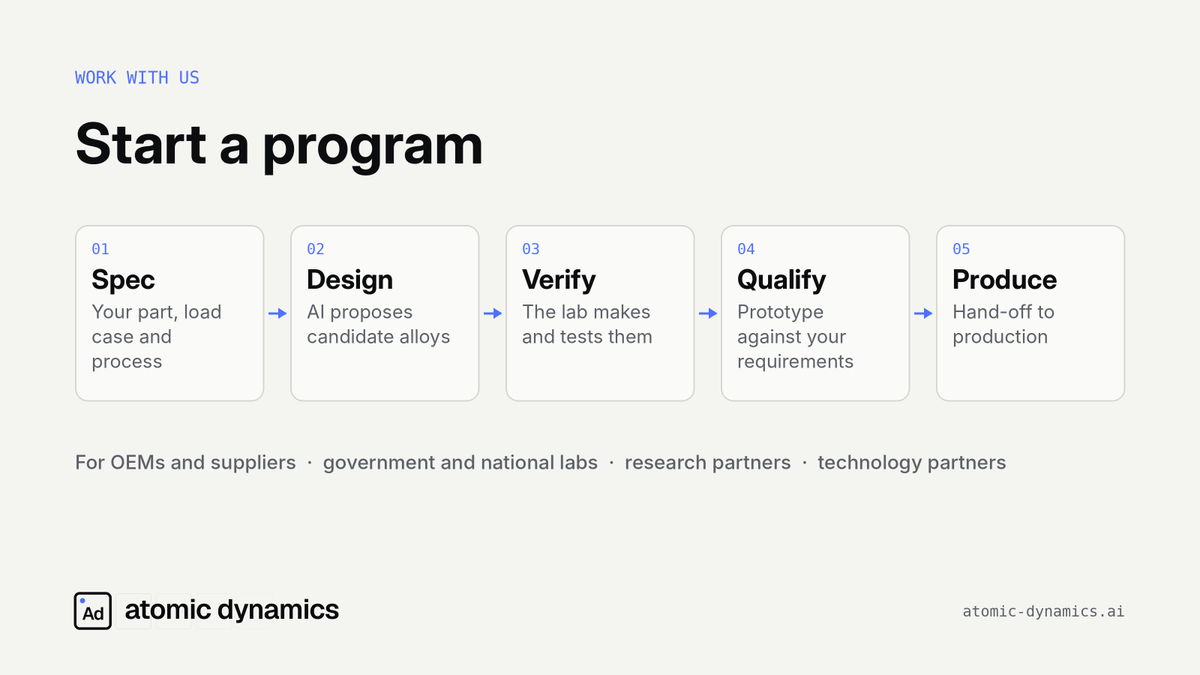
Working with Atomic Dynamics starts with a spec: your part, load case and process.
From there, AI designs candidate alloys, the lab makes and tests them, prototypes are qualified against your requirements, and the result is handed to production.
OEMs, suppliers, national labs and research partners can start a program at https://t.co/BP6uhCHPQh
#AlloyDesign #AIforScience #Manufacturing
An alloy is only useful if it can be made at scale.
Every program we run follows the same path: discovered and verified in the lab, made at part scale as a prototype, qualified against the application's requirements, then transferred to production.
Because our lab sits inside a working plant, the first step already speaks the language of the last.
#AdvancedManufacturing #Metallurgy #AIforScience
Every kilogram removed from a vehicle structure pays back in range and efficiency.
High-strength aluminum and creep-resistant magnesium make lighter parts possible, and alloys made from recycled feedstock make them cleaner. Designing them faster is where our loop started.
#Lightweighting #EVs #AIforScience
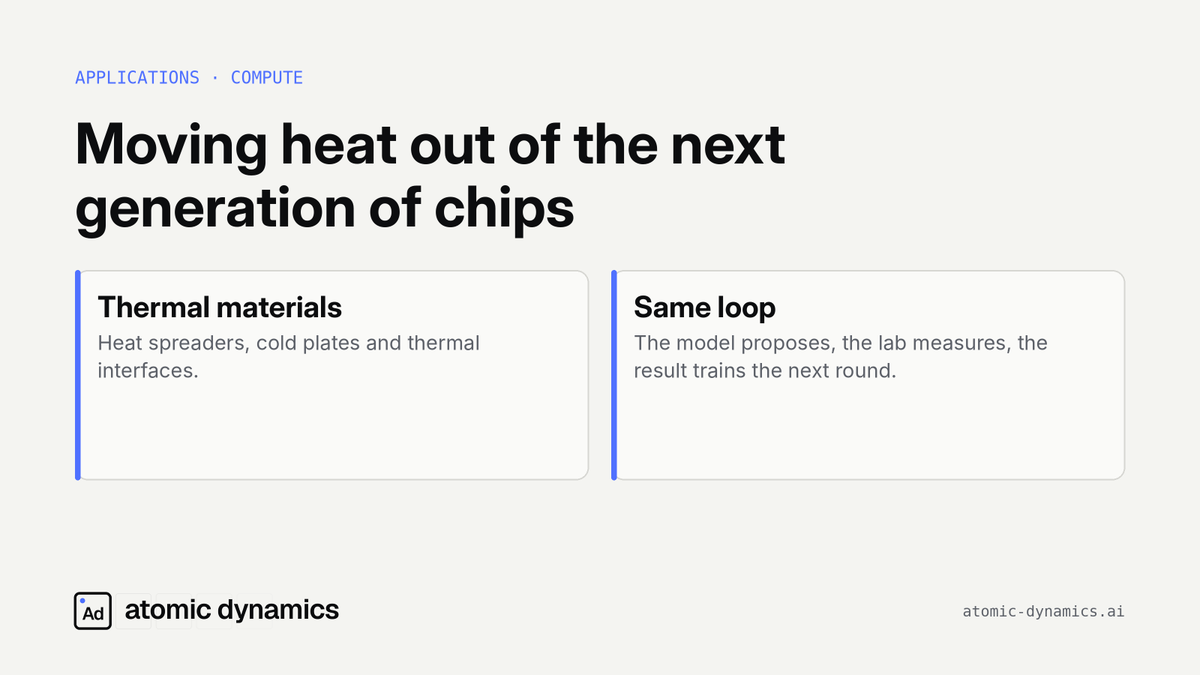
Beyond structural alloys, the same loop is being pointed at a new kind of problem: the thermal materials that next-generation computing depends on, from heat spreaders to cold plates.
Different targets, same method: the model proposes, the lab measures, the result trains the next round.
#AIforScience #ThermalManagement #Semiconductors
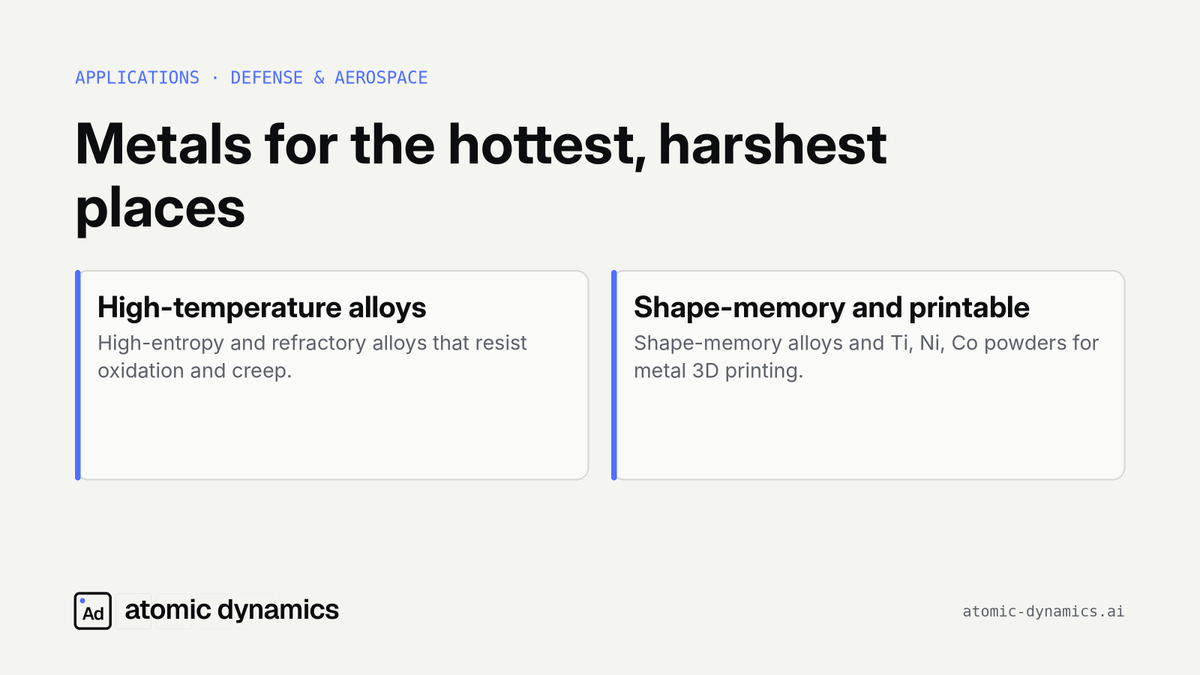
Metals for the hottest, harshest places.
Hypersonic leading edges, turbine sections and other extreme components are limited by how long an alloy survives heat, oxidation and creep. High-entropy and refractory alloys could raise that limit, but their design space is vast. That is the kind of search our loop is built for.
#Aerospace #HighEntropyAlloys #AIforScience
Next for the loop: high-entropy and shape-memory alloys for medical implants, defense and aerospace.
Our San Francisco lab at 410 Harriet Street in SoMa opens in 2027 with AI-driven synthesis, materials characterization and metal 3D printing. This is the space today, before the equipment arrives.
#AIforScience #AdditiveManufacturing #SanFrancisco
The data flywheel:
More experiments produce more verified data.
More verified data makes better models.
Better models choose better experiments.
Every turn compounds. That is the advantage of owning both the AI and the lab.
#AIforScience#SelfDrivingLabs#MaterialsDiscovery
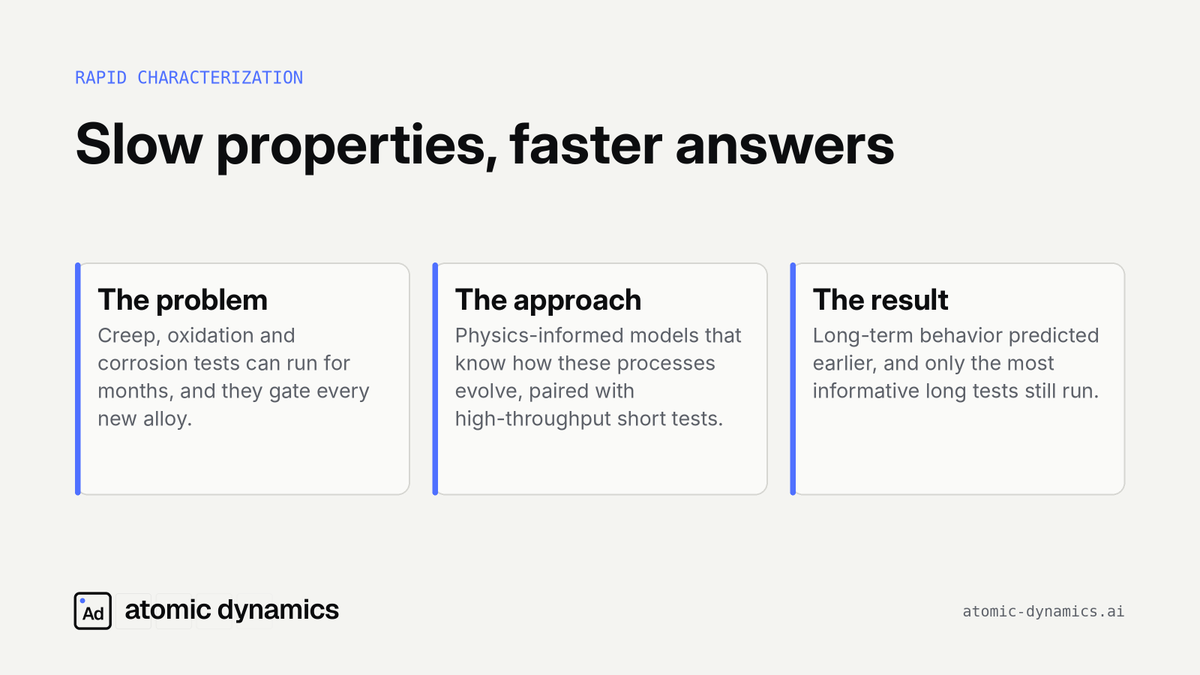
Some properties take months to measure. Creep, oxidation and corrosion gate almost every new alloy.
Our approach: physics-informed models that know how these processes evolve over time, paired with high-throughput short tests. Long-term behavior is predicted earlier, and only the most informative long tests still need to run.
#AIforScience #Metallurgy #PhysicsInformedML
Great take from @JeffDean at @Stanford with @drfeifei on self-improving AI: automation speeds the loop up, but it won't make it infinitely fast. Every cycle still has to be grounded in reality.
In materials, reality is the lab. So we built the lab into the loop: AI proposes an alloy, a robotic lab makes and tests it, and every result trains the next round.
https://t.co/cMkMIeekRC
#AIforScience #SelfDrivingLabs #MaterialsScience
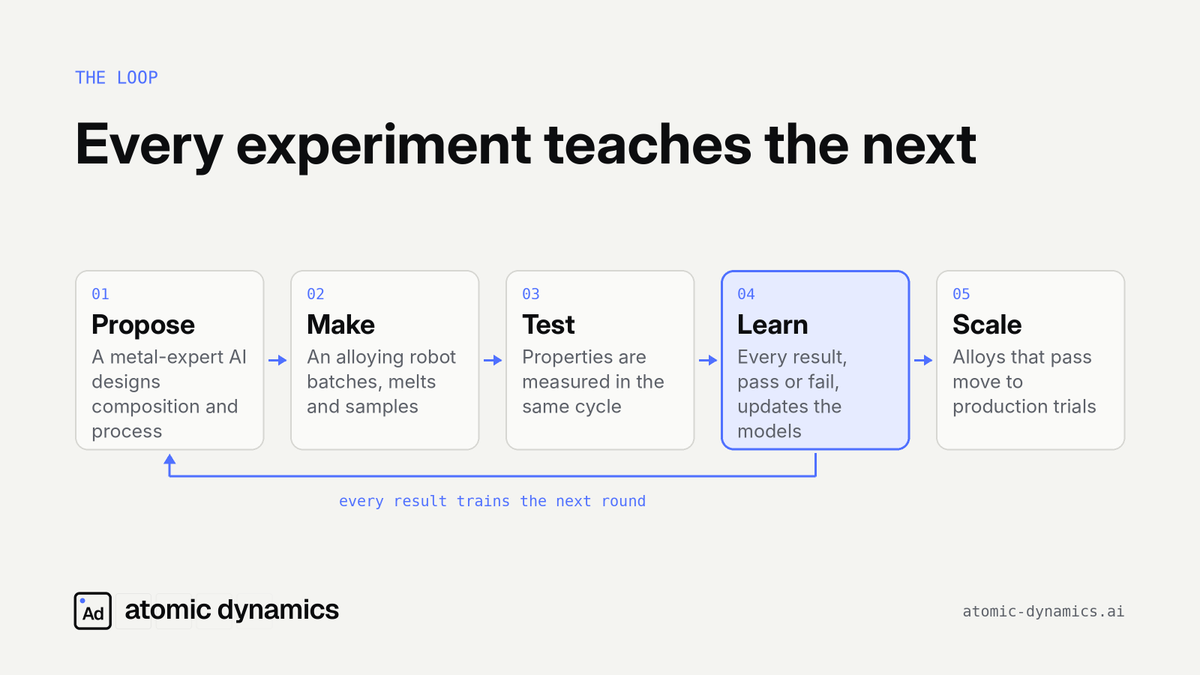
Week one, in one picture.
Propose. Make. Test. Learn. Scale.
A metal-expert AI designs the alloy, an autonomous lab makes and measures it, and every result trains the next round.
Next week: the models, the metals and where they are going.
#AIforScience#MaterialsScience #SelfDrivingLabs
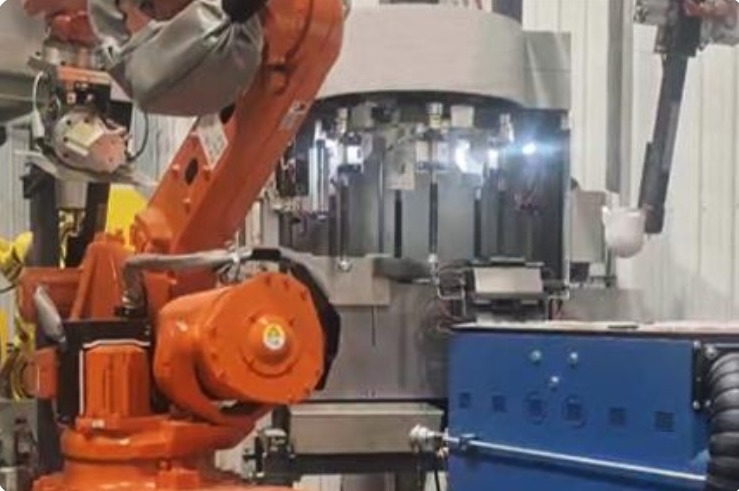
Inside our lab in Bellevue, Ohio, one verification cycle runs end to end: master-alloy pucks are batched, dosed into liquid metal, homogenized, brought to test temperature and sampled automatically for property testing.
Robots run every step, so the data comes back the same way every time.
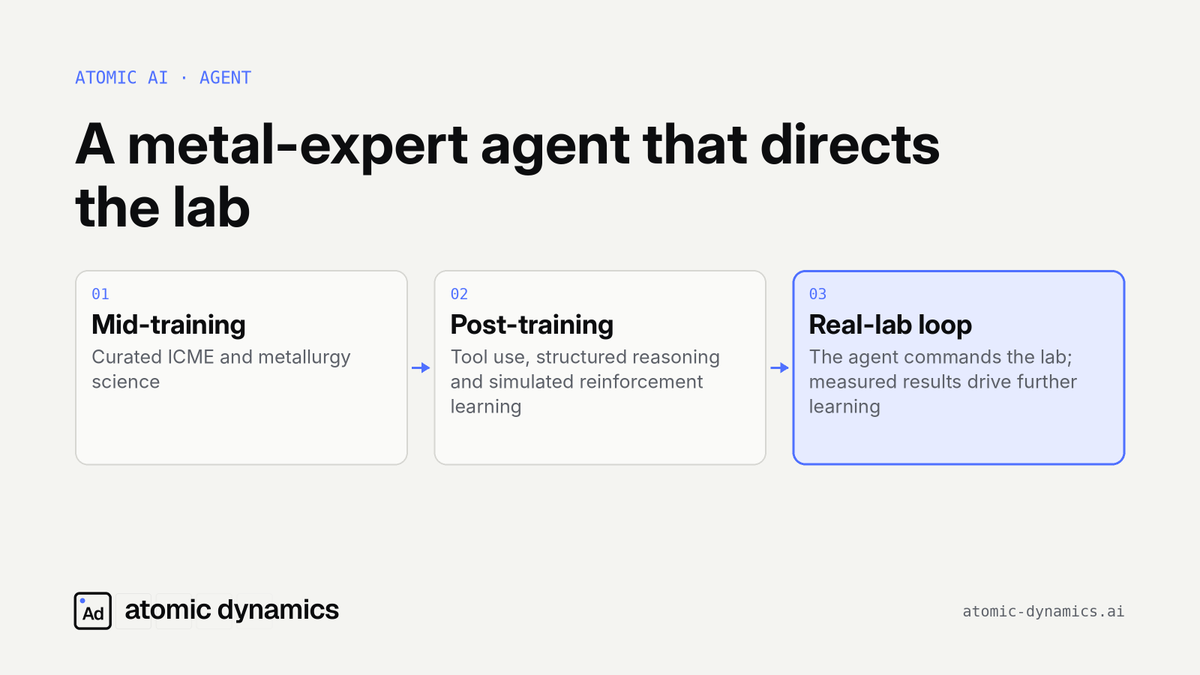
How our metal-expert agent is trained:
Mid-training on curated metallurgy and computational materials science.
Post-training for tool use and reasoning, with reinforcement learning in simulation.
Then the real-lab loop: the agent directs experiments, and measured results drive further learning.
The lab is the final teacher.
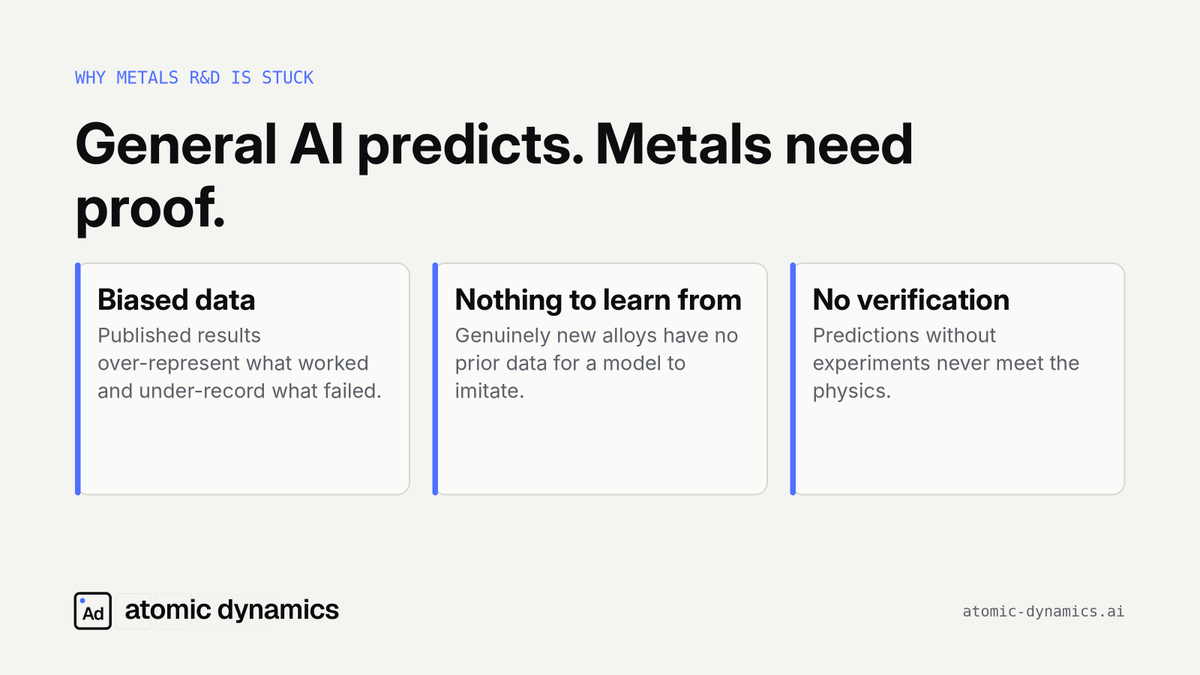
Most AI for materials learns from papers. We learn from a production floor.
Our models are trained on real casting outcomes, including the batches that missed spec. Negative results are where a model learns its boundaries, and they almost never get published.
A physics-informed model carries those laws inside it. It needs less data, extrapolates more sensibly into new compositions, and its errors are easier to diagnose.