Structural engineers model before they build.
Aeronautical engineers run CFD before a prototype enters a wind tunnel.
#AdvancedMaterials has traditionally skipped this step because the tools didn't exist to qualify candidates before physical exploration.
We're building the computational infrastructure to change that.
Learn more here: https://t.co/ZrGetm1q3t
#SimulationFirst #MaterialsEngineering
A material candidate and a qualified material are not the same thing.
A candidate is a prediction. Proposed composition, predicted structure, modelled properties. It has not been synthesised, tested, or qualified.
Physical testing remains the ultimate validation. What has changed is how much of the qualification work can be done before a single sample is built.
Traditional defence materials qualification takes over a decade. Simulation-first development compresses that to around 2.5 years.
Generating candidates is the start of the process.
At 2.5 years, materials development becomes a variable that programmes can plan around.
Read more here: https://t.co/r8UCNZt4zv
For half a century, nothing changed the materials development timeline.
Today, development cycles that have historically taken years can be compressed into weeks.
The reason is infrastructure. Simulation accuracy has reached the point where predicted properties guide physical development rather than merely support it.
High-throughput screening of thousands of candidates is now feasible within the timelines programmes actually operate under.
The science has been sound for fifty years. What changed is the speed at which it can now be executed.
Read more: https://t.co/1KsXPZeIQA
We're excited to welcome Edison Florez to the team.
Edison brings a rare combination of a PhD in computational chemistry and physics, a deep experience building simulation-driven discovery platforms, and a track record of connecting hard science to commercial outcomes.
That last part matters as much as the first.
We're building the computational infrastructure for materials discovery.
Having someone who has done this from first principles makes us significantly better at it.
Welcome, Edison.
Every era of human progress has a #materialsdiscovery at its centre.
The Bronze Age. The Silicon Age. We name entire civilisations after the materials they learned to work with.
The bottleneck has always been discovery.
We're building the infrastructure to remove it.
We compress materials development cycles that have historically taken years into weeks.
By moving the search upstream, into computation, before physical resources are committed.
Simulation changes the quality of candidates that arrive at the build stage.
Find how we do it here: https://t.co/RHqMXdOrKl
#SimulationFirst #MaterialsEngineering
#SimulationFirst materials development means arriving at physical testing with a small number of high-confidence candidates.
Not a wide field of unknowns.
The organisations that operate this way are not simply working faster.
They are making better decisions earlier, with less capital at risk.
#MaterialsDiscovery #AdvancedEngineering
A single #DFT calculation for a moderately complex system can take hours to days on high-performance hardware.
Screening thousands of candidate compositions through DFT alone is not feasible within defence or aerospace programme timelines.
This is the problem hybrid workflows were built to solve - #MLIPs, physics-informed embeddings and dynamic resolution DFT.
This is the infrastructure we are building.
We've been building something that requires a different kind of thinker.
Computational materials infrastructure sits at the intersection of physics, data, and scale. The questions we're asking don't have obvious answers yet, which means the people we need have to be comfortable operating in that space.
That's why we're excited to welcome Juliusz Abramczyk (Jules) to the Atomic Tessellator team.
Jules brings over a decade of engineering experience across cloud, data, and ML, most recently leading Data and AI at https://t.co/BsUDyUJGv7 and Head of Cloud at XPON Technologies. He holds more Google Cloud certifications than most teams combined, and has spent his career building the kind of infrastructure that turns raw data into genuine intelligence.
Whilst Jules' technical depth was impressive, it was his worldview that sealed it. He sees AI as 'a global fabric of computation, memory, and intelligence' and that kind of thinking fits naturally into what we're building.
We're here to do work that matters at a civilisational scale. It helps to have people who find that motivating rather than daunting.
Welcome, Jules.
The search space for possible #AdvancedMaterials is effectively infinite.
Physical experimentation explores a fraction of it.
Computation explores orders of magnitude more, at orders of magnitude less cost.
The #MaterialsBottleneck is infrastructural, not scientific.
Every engineering challenge eventually becomes a materials challenge.
The battery that cannot store enough.
The armour that cannot hold.
The component that fails under thermal stress.
These are not failures of engineering.
This is the #MaterialsBottleneck in action - the constraint behind every constraint.
#AdvancedMaterials #Engineering
@delveroin We're Atomic Tessellator (https://t.co/dDau1tXMQE).
The materials bottleneck is the hidden constraint on human progress. We built the infrastructure to remove it.
MLIPs. DFT. Ab initio simulation.
The science has been advancing for years.
What has been missing is the infrastructure to make it accessible, reproducible and deployable within the constraints of real programmes.
That is what we are building.
#MaterialsScience #ComputationalMaterials
The global supply of samarium runs 94% through a single country.
It sits in every advanced aerospace and defence system allied nations depend on. The US government recently flagged it as one of the highest-risk supply chain vulnerabilities to national GDP.
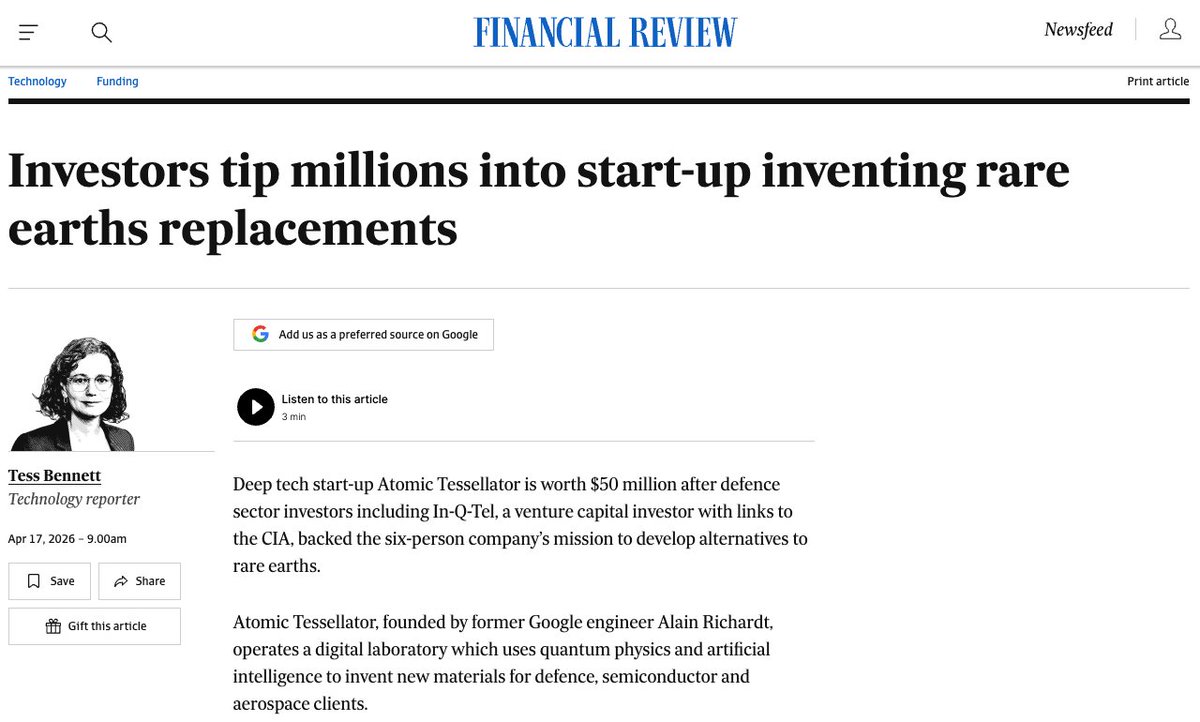
Today, we closed an A$11.3M seed round led by Crane Venture Partners — their first investment in APAC — joined by IQT, Icehouse Ventures, GD1, Outset, Salus Ventures, Side Stage Ventures and Confluent.
We built the computational infrastructure to remove this dependency.
Our simulation-first platform models material behaviour at the molecular level before a single gram is synthesised — compressing what normally takes years into weeks. The result is Vireon: a rare earth-free magnet built entirely from materials mined locally, with performance that matches or exceeds samarium-cobalt alternatives.
Behind Vireon, we have 10 synthesised materials and 20 more candidates in the pipeline. This month alone we synthesised four new materials. We know institutions that do one or two a year.
This capital takes us further — a world-class research facility, vertical integration, and scaling our first materials through to commercialisation.
The next generation of critical materials will be designed, tested and produced on sovereign soil.
Every material in our pipeline is evidence the bottleneck is solvable.
This is the infrastructure the next century of human progress runs on.
#CriticalMinerals #SovereignCapability #DeepTech
There is a layer missing in advanced engineering.
Between the scientist who imagines a material and the engineer who builds with it, there is a process that has not fundamentally changed in decades.
We are building the infrastructure for that layer.
Computational materials infrastructure for advanced materials.
https://t.co/rPpBNfhjbm
#ComputationalMaterials #AdvancedMaterials #AtomicTessellator
Computational materials infrastructure is not a product category yet.
It will be.
We are building the infrastructure that makes simulation-first materials development possible at enterprise scale.
The category exists. It just hasn't been claimed.
Until now.
#ComputationalMaterials #DeepTech #AtomicTessellator
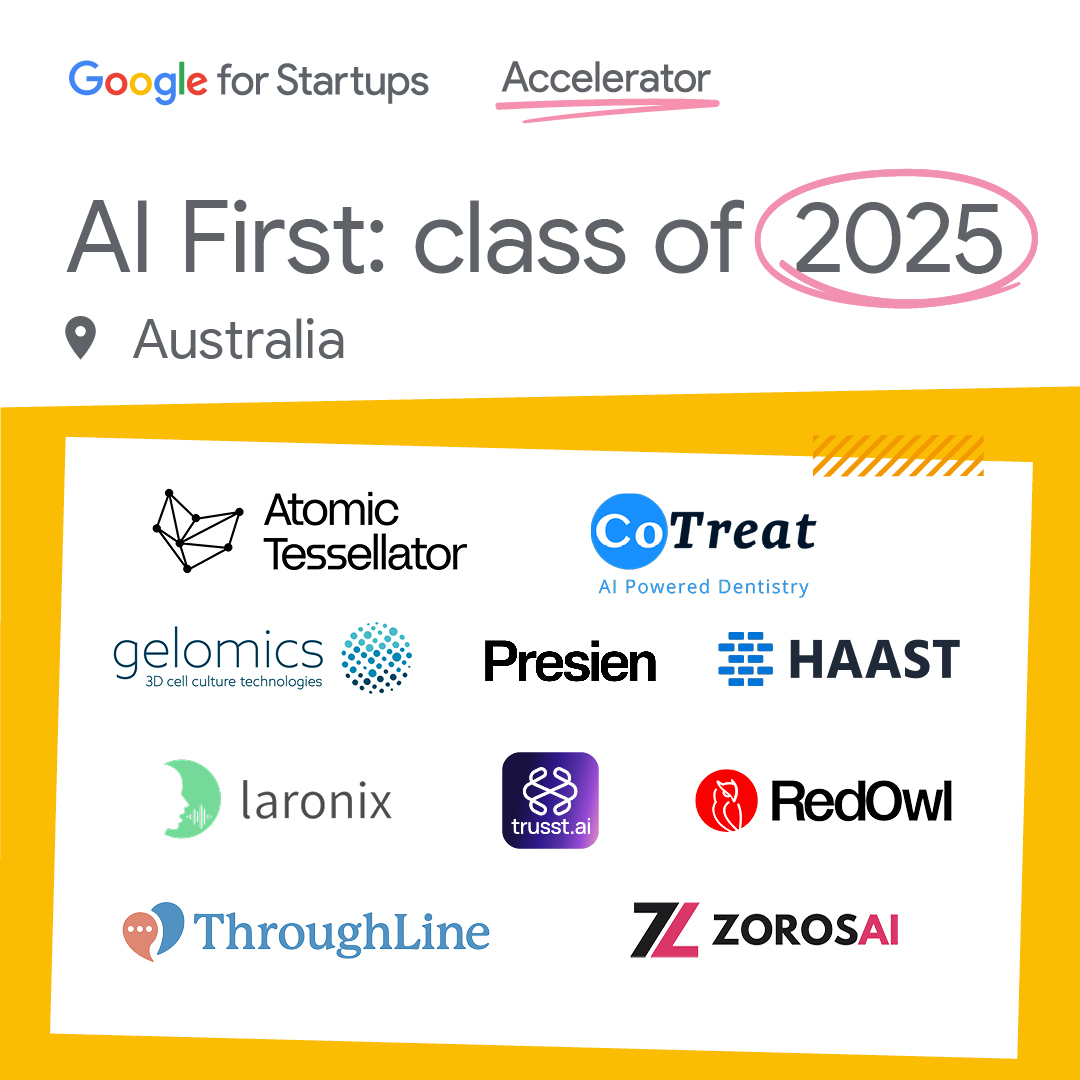
Big news from Down Under 🇦🇺 Our Google for Startups Accelerator: AI First program is underway. Meet some of the startups in the cohort:
🧪 @AtomicTessellat reimagines the way material scientists conduct experiments.
🦷 @CoTreatAI transforms dentistry treatment and planning.
🍦 @GelomicsPtyLtd accelerates therapeutic medical breakthroughs.
🦅 Haast automates marketing compliance and manages digital risk.
🗣️ Laronix delivers effective voice technologies to people who need a better voice.
📊 @Presien enhances workplace safety via hazard detection and risk assessment.
🦉 RedOwl streamlines corporate spending to drive financial efficiency.
Incredible paper on the symmetry-breaking that happens during buckling in mechanical metamaterials, dataset includes 1,020 2D microstructures with all 17 planar symmetries and their mechanical responses. Great progress for computational materials science.
https://t.co/cdLNRP778P
Really interesting NeurIPS paper from 2024 shows how to optimise classical & ML force fields end-to-end via differentiable simulations (using JAX-MD). No more finite differences; just gradients all the way through elastic tensors, phonons and RDFs. Force fields that actually match target properties!
https://t.co/ZHYxKklGqY