trying a bunch of cloud agents with @linear and so many papercuts. Still very early to create a good experience here.
Also finding that linear isn't really as good a command center to delegate to these agents as I want. May writeup my thoughts here
Introducing EgoVerse: an ecosystem for robot learning from egocentric human data.
Built and tested by 4 research labs + 3 industry partners, EgoVerse enables both science and scaling
1300+ hrs, 240 scenes, 2000+ tasks, and growing
Dataset design, findings, and ecosystem 🧵
@mattpocockuk It's possible but you have to do a dynamic import at runtime, which is far from ideal, esp as a library author that wants to make integration as simple as possible for devs
https://t.co/AbZT82oaxE
I've decided to shutdown Compose and go all in on tiny, free online tools.
The first one: a fast, minimalist JSON formatter. No ads, no sign up.
Link below.
replies to this are either agreeing with OP or making some natalist argument about the duty to have kids…
when the real answer seems seems obvious?
It’s love
the real unconditional type that you build a life around. One of the most meaningful things you’ll ever experience
@signulll I’m 28 - straight white guy, great job making really good money, robust social life, good support system from friends/family/therapist and I do fine for the odd hookup when that itch needs to be scratched.
What possible reason would I have to date? It adds zero value to my life
Excited to introduce Soham Parekh as @compose_hq's first ever engineering hire
Soham had so many references that we decided we didn't even need to talk to any of them
Soham's only ask was that all team comms were async so that he could "lock in harder". A true 10x engineer
never gets old being a user of your own product
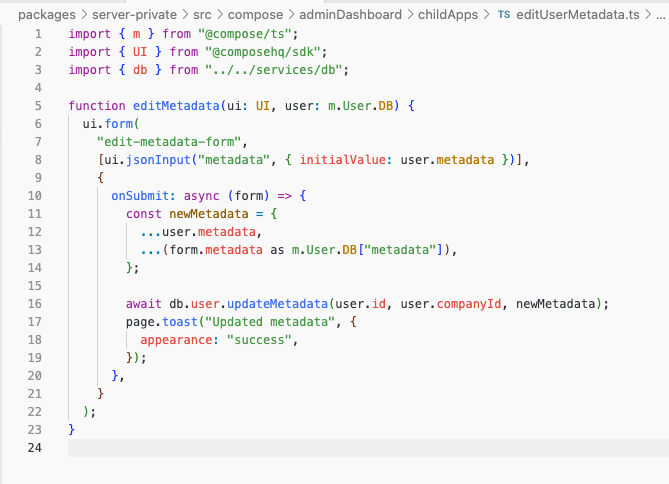
today I had to create an internal tool to edit metadata for users.
took about 2 min and 20 lines of code in the backend
I overhauled Compose's onboarding. Why?
Compose's conversion is terrible. People sign up, click around for 30 seconds, then disappear never to be seen again.
Getting onboarding right for dev tools is hard. Users have to figure out how to integrate your tool into their stack before getting any value.
That gets complicated when you realize there are infinite different tech stacks and you need to make it dead simple for users to know how to get going fast with their exact setup.
Generally you have about 1-2 minutes before the user will give up and click away.
Hence, the new onboarding:
✔︎ creates excitement with an initial introductory screen
✔︎ has a dozen framework specific guides that removes all the thinking from how to get started with Compose on your exact stack
✔︎ tells you exactly where to click to get to the aha moment
✔︎ gives you next steps once you've actually completed the onboarding
This gets followed up by a personalized email sequence that's laser focused on getting you to successfully build an internal app.
If you haven't already, please sign up and give the new onboarding a go!
.@compose_hq has a new hero.
Why did I change it? What does this one improve?
1. Differentiate the product
The old hero sounded nice but explained nothing about what makes Compose different from the 20 other internal tool builders. The new hero puts it front and center.
2. Speak to an ICP
The new subheader makes it clear that Compose is made for backend engineers. For people who fit that group, it raises curiosity, making it more likely Compose will reach the correct user.
3. Build trust
This is unchanged, but there are three different things being done to help build trust.
- call out that Compose is open-source, which demonstrates that we're invested in the community
- let developers sign up and hack around for free - essential for any developer tool
- link to demo. For most b2b products, the second cta is a "talk to sales" button. No developer wants to do that. Instead, make it easier for them to learn on their own.
I had a small moment this morning where I "felt the AGI":
Was driving to get some coffee but didn't remember how late the two shops in my area were open. Since I was driving, I couldn't use maps to figure it out. So I started a voice chat with chatgpt instead.
"Hey there are two craft coffee shops near me but I forgot their names. What're their names and how later are they open?"
I fully expected chat to fail. Yet within 10 seconds, it gave me the correct answer with the extra info I asked for.
Think about everything going on in the background to make that work. Look up my location, look up coffee shops in the area, figure out which ones are the two "craft" coffee shops, get their opening hours, then deliver the answer to me like a friend I'd called over the phone.
For years, maps has been how I find out info about places around me. Now, why not just use chatgpt?
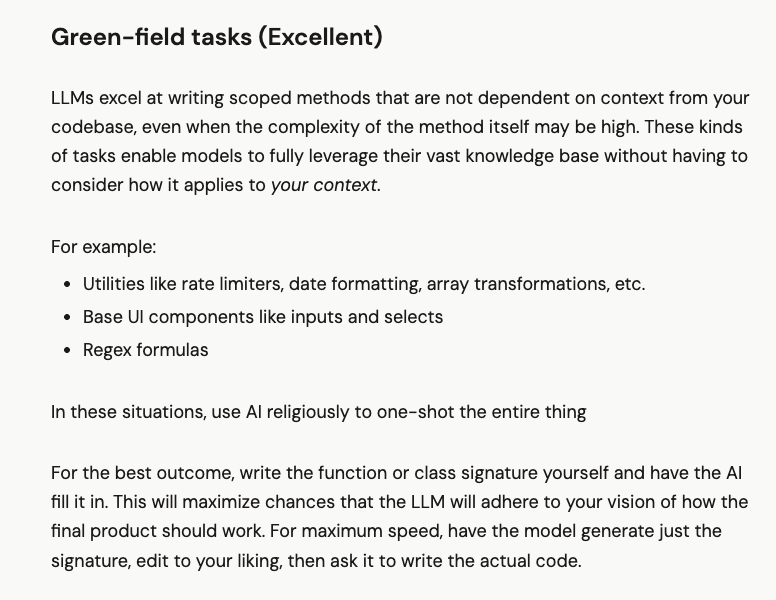
AI coding on existing codebases is an entirely different experience than greenfield work.
Literally the first section of the new essay I wrote on how I actually use AI coding:
Something I hear very little talk about:
How AI coding tools are so much LESS useful when used on existing, large codebases at work (with custom frameworks, conventions, coding style etc)
... compared to doing greenfield work or side projects
So common for me to hear: "yeah I love it on my side projects, but at work it's 'meh'"
A rude awakening for early founders is realizing that most distribution channels are already deeply saturated.
But I think I've figured out a way around it.
AI has massively increased the amount of low-quality slop being produced into the world. But, what I'm seeing is this has actually increased the desire for high-quality work.
What's worked well for me with compose is high-effort, deeply technical essays on interesting topics. It takes me 8-12 hours to write just a single one.
But that's good! The effort required deters other people from trying. Your competitors are lazy. Use that to your advantage.
Tables are the foundation of internal tools - so we built the most powerful table you could imagine.
Introducing: supercharged tables.
Search, sort, filter, pin, hide, paginate, format, and configure data in any way you can imagine, with just a couple lines of backend code.