As someone who has personally spent $500k / mo+ on Google Ads for years, I can tell you with certainty:
This revenue growth in Search is artificial & extremely unhealthy for Google’s business long term
Search volumes are declining as legacy search is being increasingly cannibalized by non-monetized LLM queries
Google’s response?
Manufacture revenue growth via short-sighted, highly extractive, customer-hostile tactics. I.e. charge advertisers more for lower quality clicks, including clicks they do not want and explicitly did not approve Google to charge them for
A few examples to illustrate:
For all of its history until recently, Google operated on a 2nd price auction model
I.e. if you bid $5 CPC and the next highest bidder bids $1 CPC, Google charged you $1.01 for the click (one penny more than the 2nd highest bidder) rather than the $5 you bid
This was a genius move by Google early on as it incentivizes advertisers to input their true maximum willingness to pay rather than trying to play the game of bidding low and constantly adjusting to try to stay just ahead of the next highest bidder while still not paying too much
However recently, Google silently deprecated the 2nd price auction and began charging advertisers as much as their bid and budget caps allow, regardless of what anyone else is bidding
It’s a short-sighted cash grab at the expense of the long term health of the advertiser ecosystem
Making thing worse, Google also recently nerfed keyword targeting precision
Google previously had precise keyword targeting settings that allowed advertisers pick individual search phrases to bid on, defined down to the character w/ exact match or phrase match targeting
This was one of the core features that made search advertising magic, enabling advertisers to run extremely precise campaigns based on exactly what their target customer typed
But now, even if you bid on a specific term or phrase using the strictest exact
-match targeting settings, Google will show your ad across 1000’s of unrelated keywords, labeling them as as “exact match (close variant)”
The definition of “close variant” means whatever they want it to and changes constantly. The result is advertisers get billed for clicks that are totally irrelevant to their business and that their targeting settings explicitly forbid Google from targeting. Google does it anyway and there’s no ability to turn this off
So now exact match is broad match, and broad match is just meaningless spam
This is all very bad for advertisers, but for Google, it allows them to show your ad and bill you for clicks across 1000x more searches that were previously going unmonetized (mainly because they’re garbage queries no one wants)
This is how you grow revenue atop declining search volumes
Lastly, and perhaps most egregiously, Google quietly stopped respecting budget caps by a factor of 2x. For example campaigns we’ve been running for years with $1000 daily budget caps suddenly began spending $2000+ per day
And the extra spend is entirely on the garbage keywords Google arbitrarily throws in as “exact match (close variants)” which have no value to our business, but can’t be turned off
Google offers no refunds nor any recourse for overspend or spend on keywords you explicitly did not target
These are not the actions of a healthy business. These are the actions of company whose core business is in decline but desperately needs to pump quarterly earnings so Wall Street will continue to fund insane capex while hopefully looking through their rapidly deteriorating negative free cash flow
Google operated a benevolent monopoly for the better part of 25 yrs
Meaning the value Google captured from Search was but a small fraction of the value it created, and that spread produced a potential energy that justified expectations of high earnings growth far, far into the future
This is now no longer the case
At the alter of AI capex, Google is sacrificing the golden goose
Peshwa Wheat down 60% from IPO Price in 11 trading days.
Here is the list of all the frauds who sold their soul for 500Rs and trapped innocent retailers. 👇🧵
155 mm artillery shells are all the rage and many companies - big & small - are expanding capacity.
Hilton metal forgings announced a ₹720 crore order in March 2026. Its entire market cap today? About ₹84 crore.
Before you start hyperventilating: Disclaimer - Not invested. The company seems to have serious issues ⛳️
A railway wheel maker. A mould maker. A steel tube maker. All of them are artillery shell manufacturers now.
Let me explain how we got here. And why it may not be rainbows and butterflies for these players.
The 155mm shell is the workhorse of modern artillery. It's the NATO standard. The Indian Army is also moving every gun to 155mm.
Before 2022, militaries planned for short wars. Three-day wars. Air wars. Nobody stockpiled shells for years of grinding combat.
Then Russia invaded Ukraine. Europe emptied its depots. One industry source said US reserves, at peak Ukraine firing rates, would have lasted barely 15 days.
A more recent interview from a Polish Defence trade fair pegs Ukraine's daily consumption of of 5,000 - 7,000 rounds.
A shell that sold for under ₹1 lakh before 2020 hit ₹4–5 lakh in 23-24.
That price spike is the "what". Now the "why" behind the rush.
The shell body hasn't changed in 50 years. There's no design IP. You need a forging press, a heat treatment line and CNC machines. Automate it, and it mostly runs itself.
One industry source put it bluntly: if you know the process, anybody can make it.
Okay, maybe not "anybody" - customer qualifications and quality are key but its not rocket science. Competitive intensity will increase / is increasing already.
In India - it seems everybody is adding capacity. Listed companies alone have announced nearly 20 lakh shell bodies a year:
📌 NIBE: 5 lakh planned
📌 Goodluck India: 1.5 lakh, going to 4 lakh
📌 Balu Forge: 3.6 lakh, already commissioned
📌 Reliance Infra: up to 2 lakh planned at Ratnagiri
📌 Tirupati Forge: 1.2–1.5 lakh
📌 Pradeep Metals: 1.5 lakh, a ₹250 crore plant due in Q4 FY27
Industry experts peg India's total at 10–12 lakh. The filings already say more.
But here's where makes me doubtful - The timing.
A shell plant takes 12–18 months to build. Then comes army quality certification, which adds a few more months.
Most of these plans were drawn up in 2024–25, chasing 2023–24’s prices. The capacity is landing in 2026 and 2027.
By then, the demand supply imbalances may correct furter. Here's why:
🔹 Money dried up. Aid to Ukraine tightened. Ukraine's procurement agency stopped buying the basic M107 shell. We read somewhere that two EU countries are sitting on about 90,000 unsold rounds.
🔹 Drones changed the maths. Fibre-optic drones now hunt guns 25–30 km away. A gun firing 18 km shells is a sitting duck. Buyers now want shells that can go 30–40 km.
🔹 Demand got echoey. Sources say the same requirement often reaches one exporter from five different directions. Only 1 in 10 enquiries turns into an order. It feels like a boom. It's often the same buyer, shopping around.
As a result? A basic shell now goes for under ₹2 lakh. and may correct further by another 20% fall.
Now the most important part. Who actually makes money?
A complete round is four things:
1. The steel body.
2. The explosive inside.
3. The propellant that launches it.
4. The fuze that sets it off.
The body is the cheapest bit. Roughly ₹26,000 of a ₹2 lakh round. About 13%.
Hilton's order works out to about ₹20,000 a body. Goodluck's ₹52 crore order for 20,000 shells works out to about ₹26,000.
And ALMOST ALL domestic capacity is for artillery Shell bodies - the most commoditised part.
So, what's in the other 87%?
Explosives, propellant, fuzes and filling. That's where the scarcity lives.
TNT is chemistry plus art. Buying the machines doesn't get you there. Munitions India, a 100-year-old ordnance maker, reportedly reached top-grade TNT only about three years ago.
Propellant is tighter still. It's made from nitrocellulose, which comes from cotton linters. Europe can't make enough, and China dominates the linters. In India, experts say only MIL (Govt owned) is meaningfully expanding.
Filling lines are a bottleneck too. Only a handful of firms worldwide build them. Adani's two lines reportedly sat idle for months because its Czech partner hadn't handed over the blueprints.
And then there's red tape. Explosives plants need land far from people and licences that take years.
Bharat Forge applied for its explosives licence and is still waiting.
GOCL ltd - a Hinduja group company sold its primary operating business IDL explosives to Apollo Microsystems because (one reason) its plant was situated in a densely occupied residential area.
See the pattern? Anyone can forge steel. Very few can make the TNT, propellants to fill it.
That's why Solar Industries, the explosives leader, did ₹9,838 crore of sales last year at a 28% operating margin and trades at a PE of 90x.
Some of the smaller players are commanding equally rich or more valuations but with fraction of capability & margins.
Sunita Tools trades at about 119x earnings on ₹46 crore of sales. Tirupati Forge trades at 146x, on a 10% margin.
That's seems like scarcity pricing for what is increasingly becoming a commodity product.
Companies love to quote 35–40% EBITDA margins on shells. However, 20- 25% (if that) is more realistic ceiling, even for the full shell.
Then there are some players who are genuinely climbing the ladder:
✅ Balu Forge is making extended-range bodies.
✅ Sigma Advanced won a ₹1,000 crore export order for base-bleed shells.
✅ Goodluck is now the only qualified bidder for a specialised Munitions India shell.
That's the right direction. Up the value chain, toward range and energetics but our current view is that the hype around 155mm shells scarcity might be on the higher side.
Now, here's what could go wrong our current view:
A real war. The Indian Army holds a 40-day war reserve, and a conflict on either border would empty it fast.
One source said even MIL and Adani at full tilt can't meet Army needs. A border skirmish on either side could flip this overnight.
Restocking may be bigger than I think: ReArm Europe is about €800 billion. Another source sees today's demand lasting 12–15 years. If he's right, bodies stay tight longer.
Interim deals may convert. Many small-cap orders are interim agreements, subject to sample approval. If they become firm contracts, the numbers improve quickly.
Yours,
Rahul Rao
Disclosure: Invested in Sigma Advances Systems. Not a recommendation. Do your own work.
In this post i tried to break it down what is happening with hospital and pharma stock. Hope this will help.
To understand how this new 30% trade margin cap reshapes the pharmaceutical supply chain, let's walk through a concrete "Before and After" scenario using clear numbers.
The Baseline Scenario (Before the Rule)
Suppose a pharmaceutical company manufactures an advanced anti-cancer injection, and its cost of production plus fair operational markup results in a Price to Stockist (PTS) the price at which the company sells the drug to the distribution channel of ₹10,000.
Before this regulation, non-scheduled anti-cancer drugs carried massive markups (sometimes averaging 170% or reaching up to 700%) because distributors, stockists, and retail pharmacies used high margins to drive sales.
The Old MRP: The company, stockist, and hospital/retailer might set a final Maximum Retail Price (MRP) of ₹27,000 for the patient.
The Total Trade Spread: The gap between what the stockist paid (₹10,000) and what the patient paid (₹27,000) is ₹17,000.
This ₹17,000 spread is the trade margin pool shared across the entire distribution chain (super stockists, carrying and forwarding agents, local stockists, retail chemists, and hospitals) to incentivize them to push this specific brand.
The Aftermath (Under the 30% Margin Cap)
The government is not directly forcing the manufacturing company to lower its base selling price (the PTS of ₹10,000 stays untouched, meaning the manufacturer's revenue per vial is protected). Instead, the rule caps the *total trade margin at 30% of the final MRP*.
(Note: Mathematically, a 30% margin on MRP translates to a maximum allowable markup of *42.86% over the Price to Stockist*.)
The New MRP Calculation: If the stockist price is ₹10,000, adding the maximum allowed trade markup (42.86%) means the new MRP can only be roughly ₹14,286.
The New Trade Spread: The total margin pool shrinks from ₹17,000 down to ₹4,286 (which represents exactly 30% of the new ₹14,286 MRP).
The Impact on Patient Price: The patient now pays ₹14,286 instead of ₹27,000—a massive price drop of nearly 47%.
Why the Supply Chain (Stockists and Retailers) Must Comply
When the government mandates this change, the entire distribution margin pool shrinks dramatically from ₹17,000 down to ₹4,286.
Retailers, stockists, and hospitals cannot simply tell the pharma company to lower its manufacturing base price (₹10,000) because that covers the company's R&D, complex biotechnology manufacturing, and quality compliance. Instead, *the distribution chain absorbs 100% of the compression.*
The Squeeze: The heavy commissions, high discounts, and lucrative profit margins that local stockists and retail chemists used to enjoy on that drug are slashed.
The Power Dynamic: Because the government legally caps the MRP at ₹14,286, retailers cannot sell it above that price, nor can they legally demand a higher trade margin. They are forced to operate within the new 30% ceiling.
Now what may or may not happen in long-term competitive shift this policy will trigger among pharmaceutical companies!
While the immediate rule only caps the distribution margin, it fundamentally changes how pharma companies compete for market share.
Here is why :
1. The Death of "High-Markup" Brand Push
Before this cap, a pharma company could launch a new anti-cancer drug at a very high MRP and use a massive trade margin pool (like offering a 150% or 200% markup) to bribe or incentivize the distribution chain.
They would tell local stockists, chemists, and hospital pharmacies: "Push our brand instead of our competitor’s, and we will give you a huge cut of that ₹17,000 margin."
Because doctors and hospitals often influence or directly dispense these brands, companies competed on *who could offer the highest trade margins* to the channel, not necessarily who had the best price for the patient.
2. Shifting to Price Competition on MRP
Under the 30% trade margin cap, that weapon is taken away. Every competing company’s distribution margin is legally handcuffed to a maximum of 30% of the MRP.
Because the trade margin percentage is now standardized and flattened across the industry:
The Playing Field Levels: A stockist or hospital can no longer make massive profits just by choosing Brand A over Brand B based on higher distribution kickbacks.
The New Battleground Becomes the Base Price (PTS): If Company X manufactures the drug more efficiently and sells it to the stockist at a Price to Stockist (PTS) of ₹7,000 instead of ₹10,000, let's see what happens to the final MRP under the same 30% cap:
The Result: Company X’s drug hits the market with an MRP of ₹10,000, while Company Y’s drug sits at ₹14,286.
3. Price Wars and Margin Compression for Pharma Companies, Too
Even though the government says "we are only capping trade margins, so manufacturers' revenues are safe," market forces will quickly prove otherwise:
Patient & Hospital Sensitivity: Once anti-cancer drugs become transparently priced under these lower caps, patients, oncologists, and institutional hospital buyers will aggressively gravitate toward the lowest MRP available.
The Squeeze Moves Upstream: To win volume, pharma companies will be forced into intense price competition. They will have to lower their own base manufacturing selling prices (PTS) to keep their MRP lower than their rivals.
So, while the regulation starts by crushing the margins of stockists and retail channels, it will quickly spark a fierce price war among pharmaceutical manufacturers, driving down base prices and squeezing company profit margins from the top down!
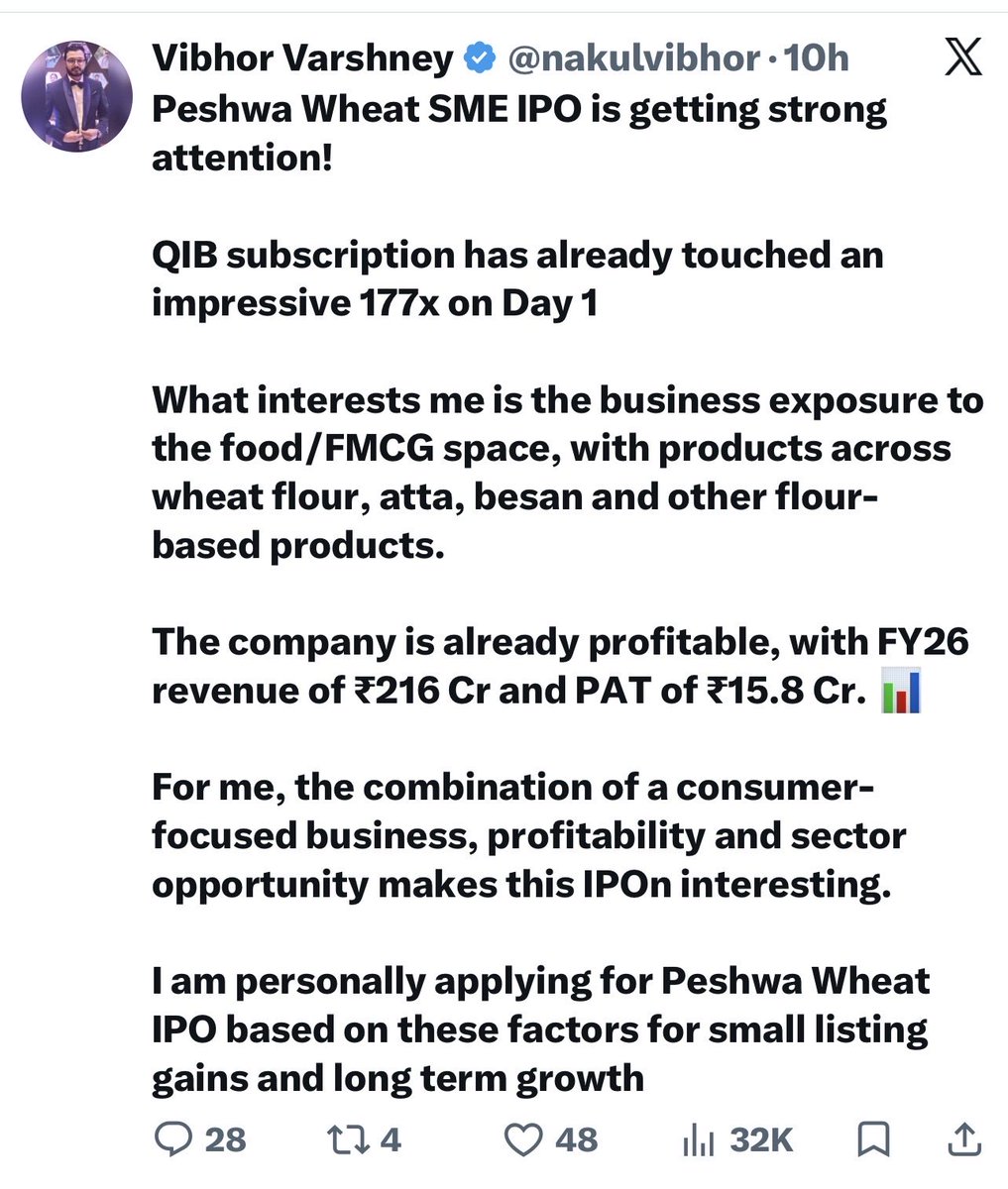
#Peshwa Wheat IPO
Highly popular figures on X (Twitter)—who have millions of followers and some of whom are even SEBI-registered—are posting paid promotional post in favor of this IPO.
Be cautious..🤗
Some of the influencers who made paid promotional posts (all the posts are almost similar and copy-pasted) have been tagged here 👇👇
(1) @nakulvibhor
@your_niaaaa Sounds quite impossible. Have never seen pure non vegetarians. Even non veg ones need chapati or rice as accompaniment which falls under veg category. So it’s quite a conflicting statement.
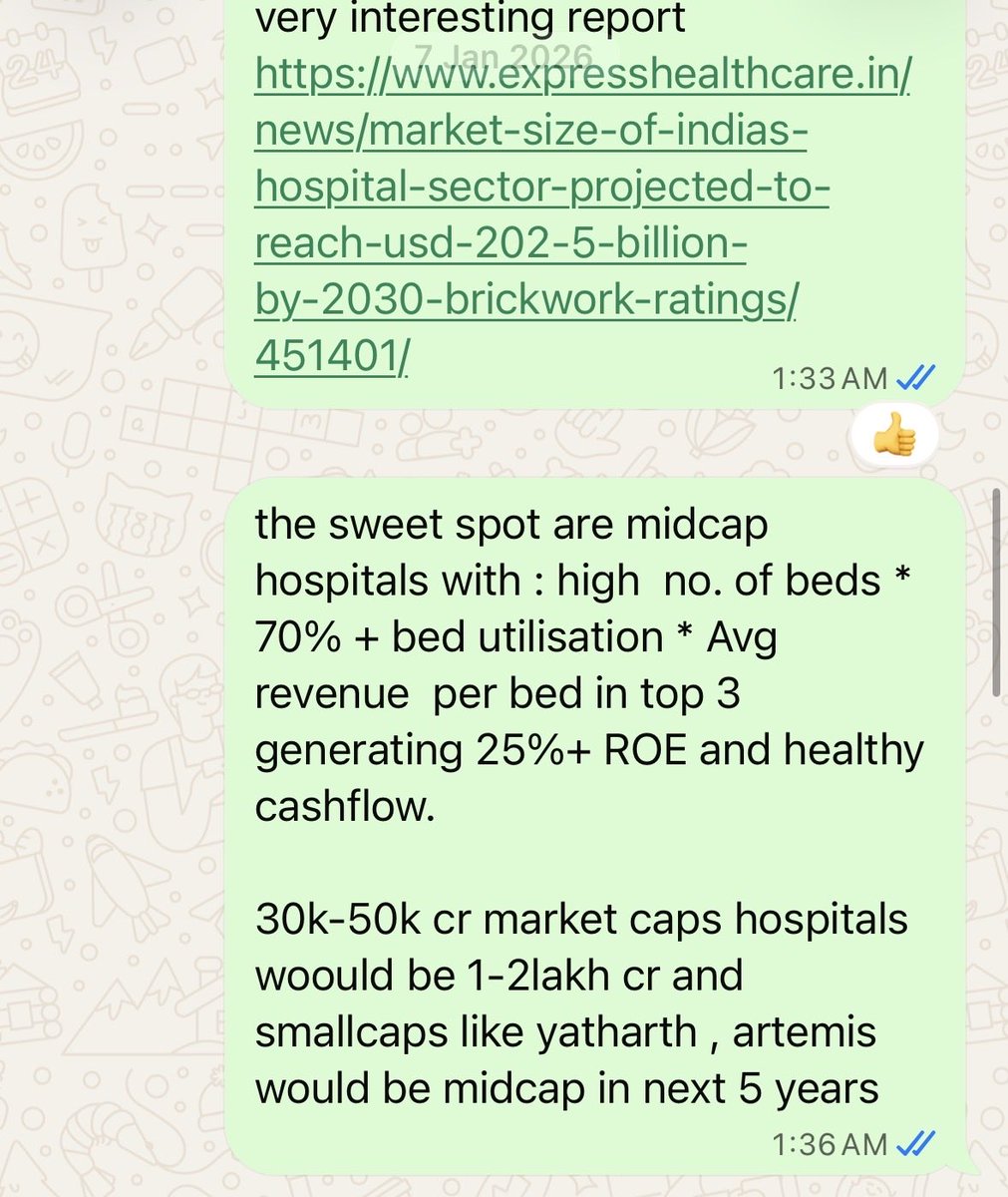
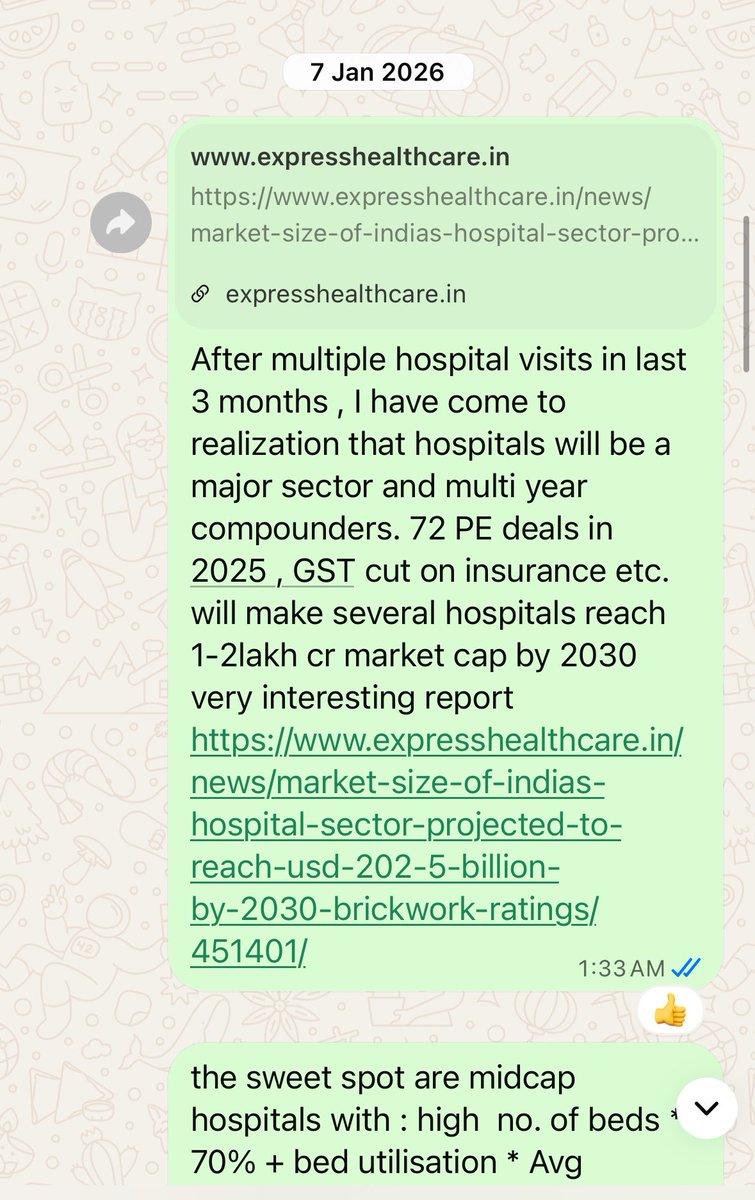
#Yatharth is quite in news due to PE investment. Had started to buy this stock around Rs 600 and average it upwards to 711. Management clarity , aim to build 5k+ beds , ARPB upwards strategy and many more factors made it great buy. Was targeting 3-4x earlier before PE came in.
If anyone is wondering why is #DhootTransmission falling 10% on back to back 2 days this image tells you all. The answer is hidden in shareholding pattern and the lock in period completion for anchor investors. 🧵
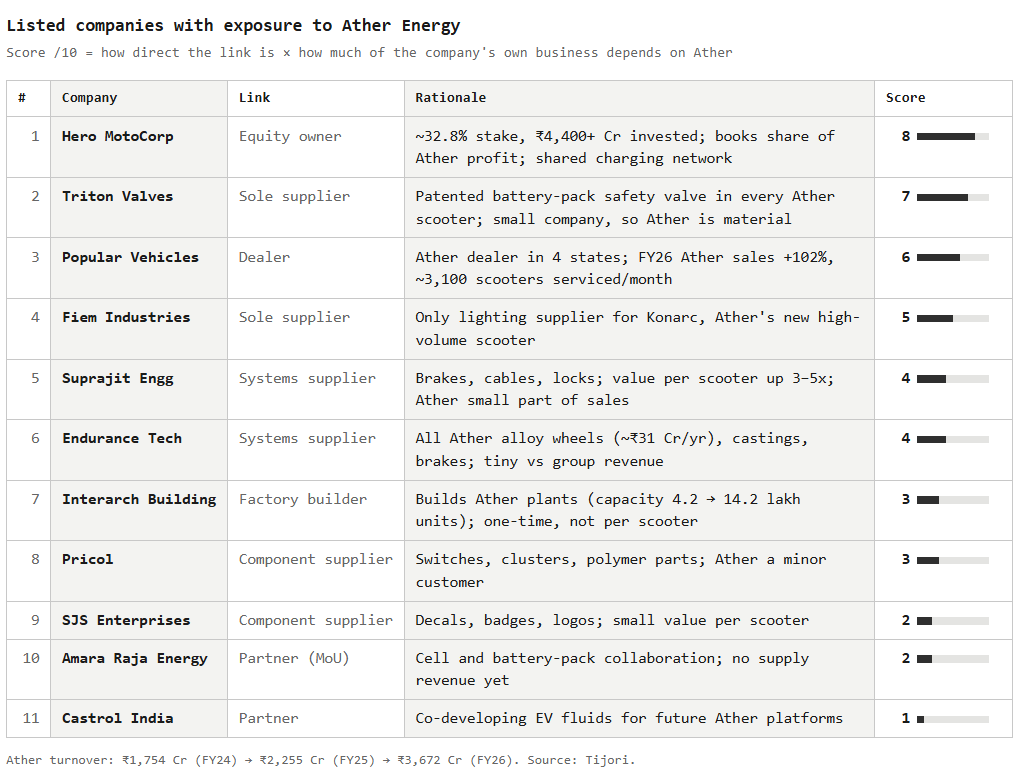
The stock still has very strong fundamentals - large growing TAM due to ADAS mandate, wring harness and sensors demand due to EV & preimunization via higher value content and more content per 2W-3W.
Valuation is for individuals to decide.