Java Backend Developer in Mumbai (~2 yrs) — Spring Boot, microservices, PostgreSQL, BFSI/KYC.
Building production REST APIs and learning in public.
Open to full-time mid-level Java / Spring Boot roles (Mumbai or India-remote).
Resume/LinkedIn → https://t.co/p8vGEde077
@Ksound22 Most prod defects in our banking KYC flows came from bad queries and missing indexes, not from the monolith itself. Fix the PostgreSQL plan first, split services later.
@Kiplongu Same lesson on our KYC APIs: Actuator said UP while the PAN vendor was timing out, so we added a custom HealthIndicator for the vendor plus a Grafana alert on p95 latency. Now we usually spot a slow dependency before the bank's ops team calls us.
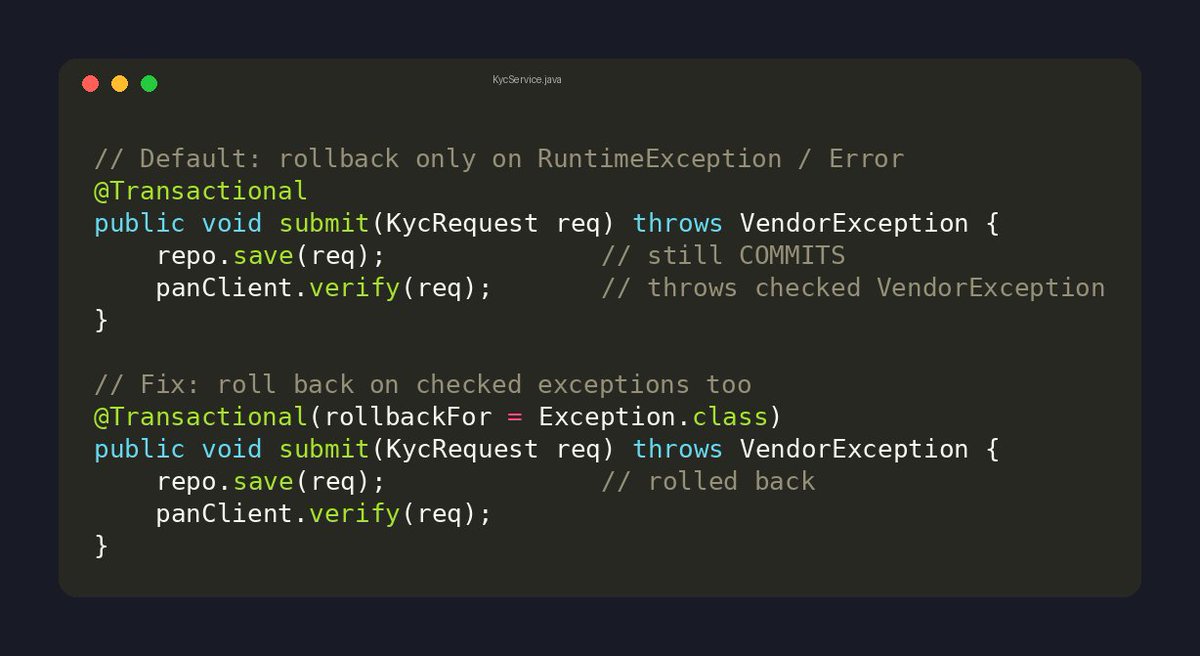
Spring tip: @Transactional rolls back only on unchecked exceptions by default.
Throw a checked exception from your service and the inserts before it still commit.
Add rollbackFor = Exception.class, or wrap it in a RuntimeException.
Checked exception, half-saved data.
@OjasSharma276 I'd add timeouts to that list. On our bank KYC APIs the PAN verification vendor was the slowest dependency, and tight timeouts plus safe retries mattered more in prod than any CAP theorem diagram.
@CodeWithSravya The model still needs someone who knows what to ask. On our bank KYC APIs the costly prod defect was a duplicate record from a retried PAN verification timeout, and it only stopped once we added an idempotency key in PostgreSQL.
@mayuri_3015 First I'd sort pg_stat_statements by total time, not per-call time: on our bank KYC APIs the CPU eater was a 'normal' 20 ms lookup running thousands of times a minute after an index went missing. Then pg_stat_activity for anything stuck in a retry loop.
Backend folks: how much do you log on an API that handles PAN/KYC data?
My take: a request id in MDC, masked fields only (ABCDE****F), never the raw vendor payload at INFO. Enough to debug a prod defect, nothing a log reader shouldn't see.
Aapka rule kya hai?
@AdarshWritess For our bank KYC APIs we kept PostgreSQL even for messy vendor responses: JSONB for the raw payload, real columns with constraints for the PAN and status fields we query on. I'd only pick MongoDB when data is truly document-shaped and never needs cross-record transactions.
@jondot Same lesson from banking KYC flows: splitting PAN verification into its own service only paid off because vendor latency and rate limits needed separate scaling. Everything else stayed in one Spring Boot app, and prod defects were far easier to trace there.
@ConsciousRide The caching part is where I'd read slowest. In banking KYC flows we learned to evict cache entries only after the PostgreSQL commit, otherwise a rollback leaves stale data being served.
@SakshiML_20 Add one more to estimate: your slowest dependency. On our bank KYC APIs, the PAN verification vendor's latency at peak load limited us long before our own servers or PostgreSQL did.
Java lesson: comparing two Long ids with == passes every test, because test ids are small and Java caches Long values from -128 to 127.
In prod ids cross 127 and the check quietly turns false. Use Objects.equals().
Test data chhota tha, bug bada tha.
Java lesson: comparing two Long ids with == passes every test, because test ids are small and Java caches Long values from -128 to 127.
In prod ids cross 127 and the check quietly turns false. Use Objects.equals().
Test data chhota tha, bug bada tha.
@TusharSabh43376 My bet is debugging production. In banking KYC flows the defects I've fixed came from wrong transaction boundaries and slow PostgreSQL queries, and AI-written code makes those easier to ship, not easier to spot.
@hexaclustercorp On our banking KYC APIs the slow pending-status queries were fixed by a partial index we found through EXPLAIN ANALYZE, not a bigger instance. Extra hardware would only have hidden the bad plan until the table grew again.
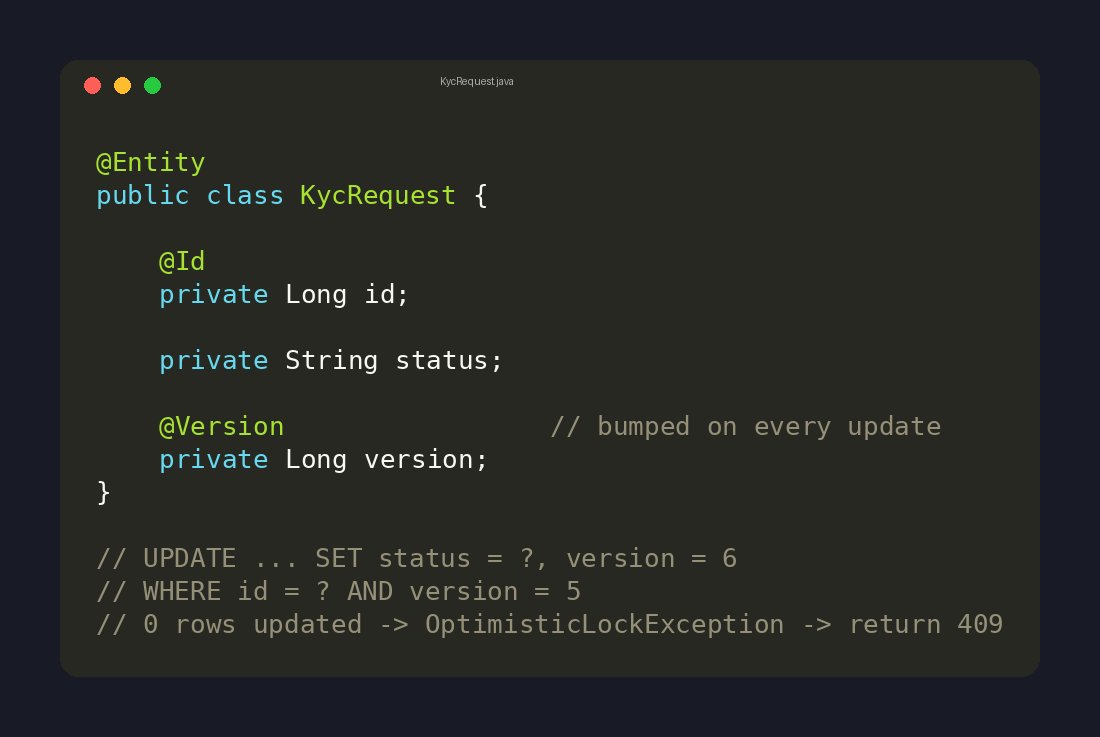
JPA tip: two requests update the same row and the last write silently wins.
Add a @Version field. JPA puts it in the update's WHERE clause and throws OptimisticLockException if the row changed first. Map it to 409, let the client retry.
Chupchaap overwrite se error better hai.
@harikesh_devops A system design failure: the agent is just another client that retries. In our banking KYC APIs every write carries an idempotency key under a PostgreSQL unique constraint, so the fifth retry returns the first result instead of charging again.
@dark_coderz D for me, but the framework is rarely what breaks at that load. On our KYC APIs the real limits were the Hikari connection pool and slow PostgreSQL queries, so short DB transactions and cached reads mattered more than the stack.