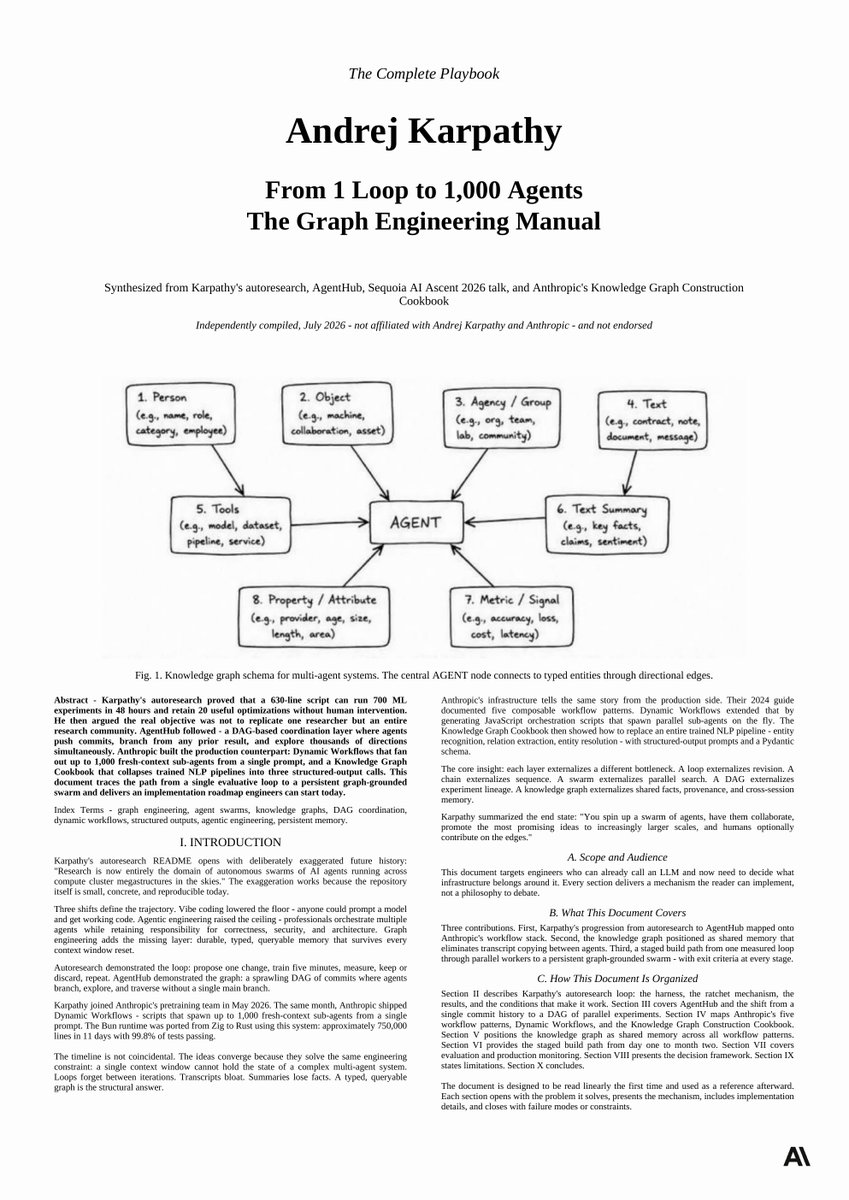
Andrej Karpathy just dropped 12-page PDF on "Graph Engineering" for multi-agentic systems
the shift: Karpathy's loop runs 700 experiments and forgets all of them. A graph remembers forever
here's the full system:
step 1 → build one loop: generate, critique, revise. 630 lines, 700 experiments in 48 hours
step 2 → go parallel: agents in separate worktrees, same repo, different branches, no conflicts
step 3 → add a knowledge graph: extract entities, resolve aliases, assemble typed edges, query through subgraphs
step 4 → ground your evaluator: it checks claims against graph edges, not vibes
step 5 → plug the graph as shared memory. workers write to it. evaluators fact-check against it. Loops persist overnight
step 6 → the agent forgets. the graph does not. stop rebuilding context from scratch every session
Karpathy ran 1 agent in 1 direction. Anthropic's graph runs 1,000 with shared memory - same model, it's the architecture
this 11-page PDF changed how I'm building multi-agent systems today
read it now - then explore the full graph engineering article below ↓
I created a handbook to help you learn AI agents.
It gives you:
• Must-know AI GitHub repos.
• Free courses to master AI agents.
• Papers to understand AI fundamentals.
• Curated videos to learn AI agent foundations.
• Books to get started with AI agent engineering.
• Condensed guides to broaden your AI agent knowledge.
(24 HOURS ONLY!!!)
To get it for free:
1 Follow @systemdesignone [MUST]
2 Like & Retweet to get DM
3 Reply "Handbook"
Then I'll DM you the details.
Andrew Ng just dropped 8-page PDF on 4 agentic steps "from Loops to Graphs from scartch"
The twist: agent has amnesia without both: Loops let agents think - Graphs let agents remember
here's 4 workflows, step by step:
step 1 → reflection - agent writes, second prompt critiques, agent rewrites - one self-review loop beats a smarter model with none
step 2 → tool use - give it search, code execution, APIs - thinking without tools is hallucinating
step 3 → planning - break the task into JSON steps before running - Step fails? Agent replans around it
step 4 → multi-agent - stop running one agent - run a team - one codes, one reviews, one tests
how to wire this today:
step 5 → add one critique call after every generation - 10-30% quality lift, one day of work
step 6 → connect all 4 into a graph - agents share memory instead of transcripts - agent forgets, graph doesn't
the result: a weak model with 4 steps destroys a strong model without them - same cost, it's the architecture
this 8-page PDF is what comes after loop engineering
save this - then read the full build workflow in the article below ↓
el fundador de una empresa china de IA valorada en más de $20,000,000,000 acaba de dar una clase de 40 minutos sobre enjambres de agentes
la explicación más clara que he visto sobre sistemas de IA a gran escala
cámbiala por tus 2 horas de Netflix de esta noche
Andrej Karpathy just dropped a 6-hour course on how to build LLMs from scratch:
• 00:00 - Deep dive into LLMs like ChatGPT
• 03:31:23 - Building ChatGPT from scratch in live
• 05:27:43 - How to use LLMs (Karpathy method)
This course will replace a $90K Stanford LLM master’s degree.
Start watching today, then read how to become an AI engineer in article below.
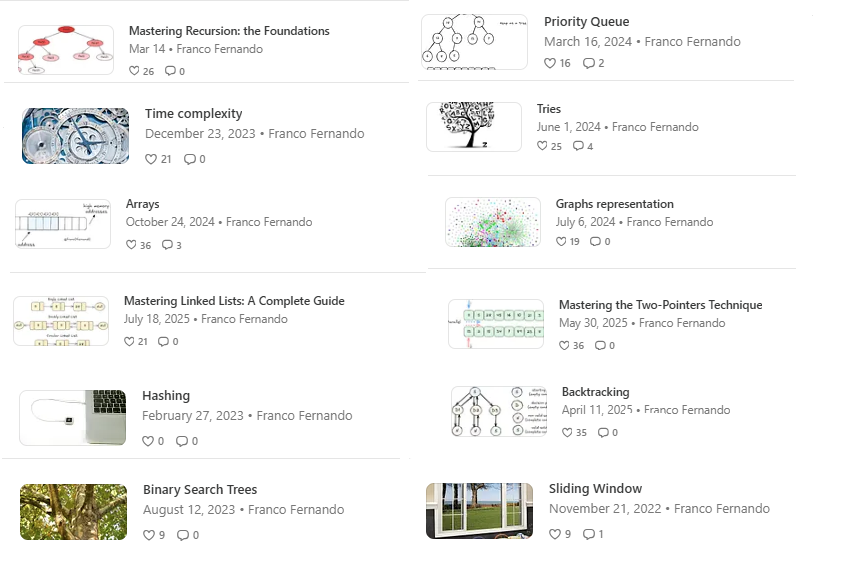
Most engineers struggle with DSA because they jump straight into LeetCode without the fundamentals.
Here are the 12 topics I always tell people to master first (Bookmark this and work through one a week): ↓
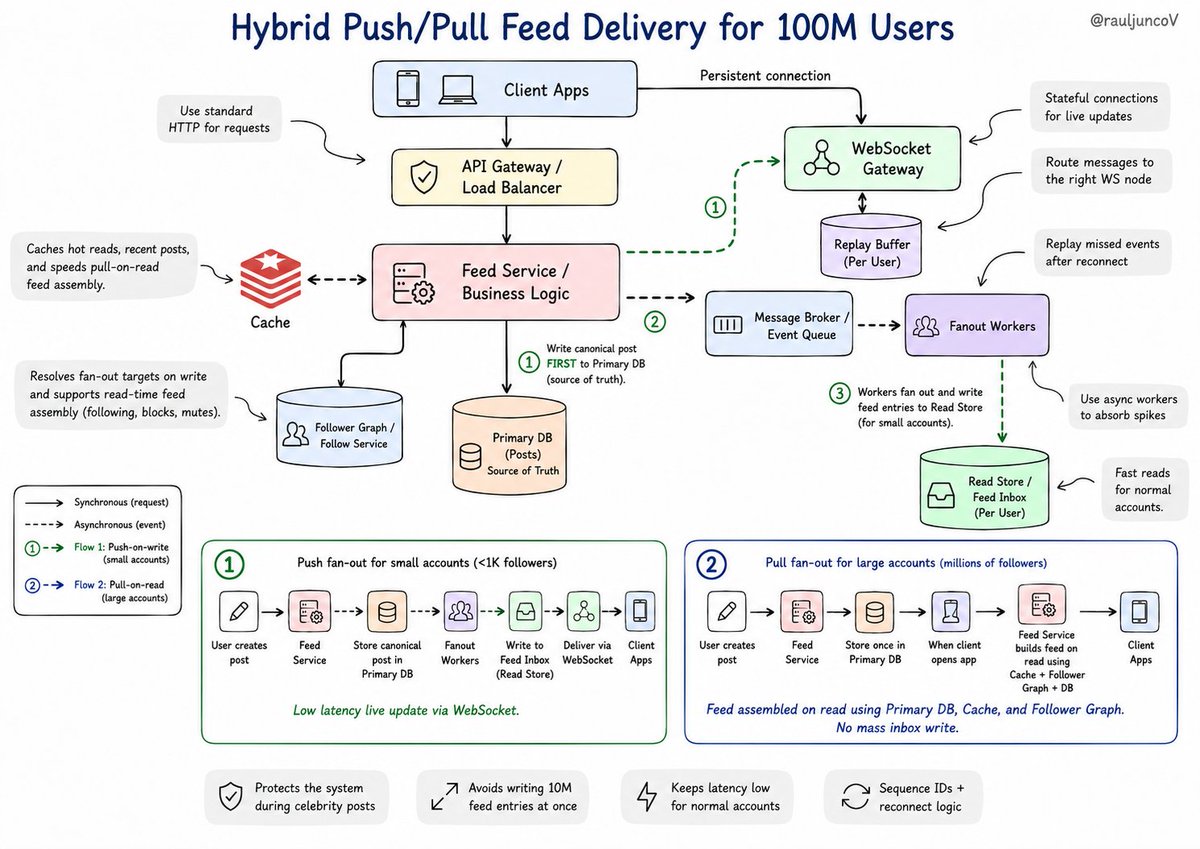
Push-based systems come up in 90% of system design interviews.
Here's the exercise you should be able to solve:
Design a notification system for 100M users. Some have 50 followers. Some have 10M.
The instinct is to hold a WebSocket connection open to every active user and push updates as they arrive. Clean mental model. It collapses the moment a celebrity posts.
When someone with 10M followers posts, you push to 10M open connections simultaneously. Your message broker saturates. Your WebSocket servers fall over. The system fails at the exact moment it needs to work.
That's the fan-out problem. And it kills more interview answers than any other mistake.
The production answer: push and pull aren't binary. You pick based on follower count. Users with fewer than 1,000 followers get push fan-out. Each follower gets notified immediately.
Users with millions of followers get pull fan-out. Their feed assembles on read. Nobody gets a push. Followers see the post when they open the app.
Twitter built exactly this: push-on-write for small accounts, pull-on-read for large ones.
But fan-out is only half the problem.
Push means stateful connections. Your servers now need to know which connection lives on which machine. You can't route blindly. Most teams reach for Redis pub/sub here; the WebSocket server subscribes, the backend publishes, the message finds the right node.
Add a 3-second network drop and you have another layer: what did the client miss? Now you need sequence IDs, a message buffer, and reconnect logic that replays missed events.
"Push-based" became push with a pull fallback, a message broker, sticky routing, and a replay buffer.
Most engineers stop at the first diagram.
The ones who get the offer keep pulling the thread until the system breaks.
We just launched something we've been building for a long time.
🧵
1/ Orion Terrametrics has spent 5+ years mapping Africa. 5,00+ projects. Kenya, Somalia, Zimbabwe, and beyond. Today we open-source that infrastructure to the continent.
https://t.co/vQRMVyUz8P is live.
Karpathy didn't make a course.
He made THE course.
3 hours. Free.
Tokenization. Attention. Hallucinations. Tool use. RLHF. DeepSeek. AlphaGo.
Every behavior you've ever wondered about in an LLM - where it comes from, why it exists, how it was engineered.
The gap between engineers who understand this and engineers who don't isn't technical depth.
It's the ability to conceive of entirely different things.
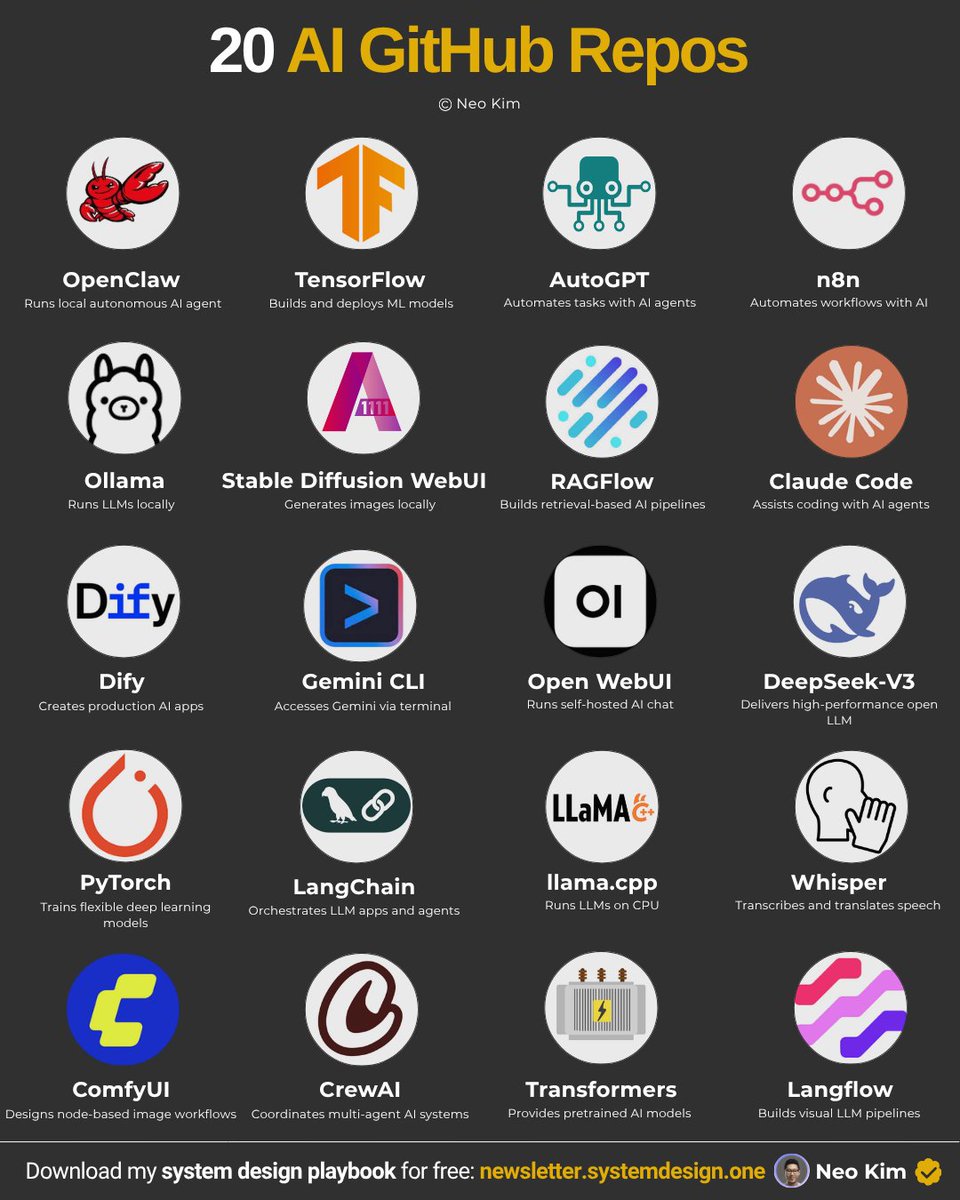
20 useful AI GitHub repos every software engineer should bookmark (you'll thank me later):
1 OpenClaw
↳ Runs a personal AI agent locally that can browse, plan & take actions on your device.
2 TensorFlow
↳ Provides a production-ready framework to build, train & deploy ML models at scale.
3 AutoGPT
↳ Automates multi-step tasks by chaining LLM reasoning into autonomous agents.
4 n8n
↳ Automates workflows with a visual builder that integrates APIs, data & AI tools.
5 Ollama
↳ Runs open LLMs locally with simple commands & optimized performance.
6 Stable Diffusion WebUI
↳ Generates images locally with a powerful UI for Stable Diffusion models.
7 Hugging Face Transformers
↳ Offers thousands of pretrained models for NLP, vision & multimodal AI tasks.
8 Dify
↳ Creates production-ready AI apps with built-in orchestration, prompts & APIs.
9 Langflow
↳ Builds & tests LLM pipelines visually using a drag & drop interface.
10 LangChain
↳ Orchestrates LLM workflows, tools, memory & agents in applications.
11 Open WebUI
↳ Delivers a self-hosted ChatGPT-style interface with local & API model support.
12 DeepSeek-V3
↳ Provides a high-performance open-weight LLM optimized for reasoning & coding.
13 PyTorch
↳ Builds & trains deep learning models with flexible, research-friendly APIs.
14 Gemini CLI
↳ Interacts with Google’s Gemini models directly from command line.
15 llama cpp
↳ Runs LLaMA-style models efficiently on CPUs & local hardware.
16 Whisper
↳ Transcribes & translates speech with high accuracy using deep learning.
17 ComfyUI
↳ Designs advanced image generation workflows using node-based pipelines.
18 CrewAI
↳ Coordinates multiple AI agents to collaborate on complex tasks.
19 RAGFlow
↳ Implements retrieval-augmented generation pipelines for enterprise search & QA.
20 Claude Code
↳ Assists coding with deep repository understanding & agent-style workflows.
What else should make this list?
===
1 Save & RT to help others learn AI engineering.
2 Follow @systemdesignone + turn on notifications.
This is the best way to learn how LLMs work.
Interactive. 3D. Step-by-step.
Covers:
→ Embedding
→ Layer Norm
→ Self-Attention
→ MLP
→ Transformer layers
→ Softmax
→ Output
Stop reading papers. Start seeing.
Link in comments.
Save this immediately.
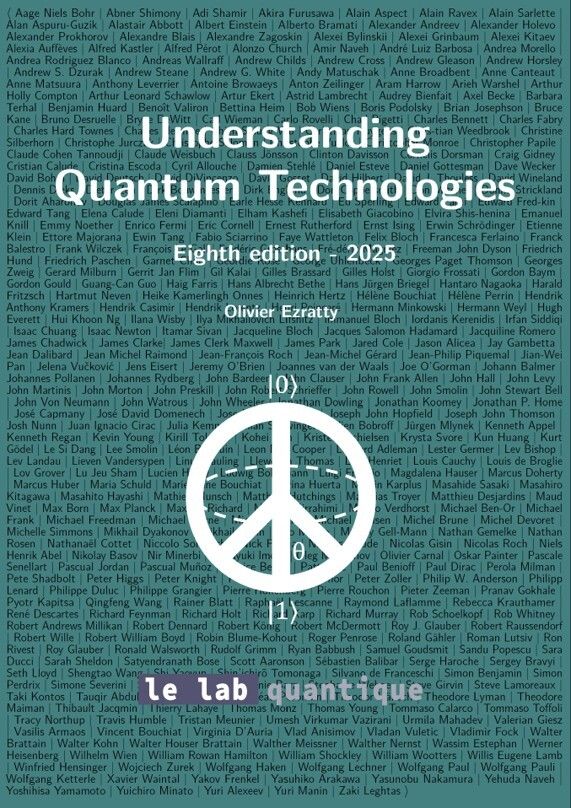
Ok I have a new update for which book to read if you want to really understand quantum technology. CON: it's 1,524 pages and updated like, daily?
PRO: it's free. No email required. No paywall. Just download the PDF.
Olivier Ezratty (@olivez) has been publishing Understanding Quantum Technologies every year since 2018. This is the 8th edition.
I sat down with him at Q2B this year and saw exactly how he updates and makes the book. He build agentic workflows for it before agents were a thing. And we had so much fun getting tacos after 🌮
It covers everything, quantum physics 101, every qubit modality with actual engineering details, enabling technologies like cryogenics and control electronics, quantum algorithms, software tools, use cases across 20 different markets, quantum communications, sensing, cryptography, geopolitics, the startup ecosystem by country, and a chapter on quantum fake sciences because yes that's necessary.
9,450 bibliographical references. 1,250+ annotated figures. A 500-term glossary. A timeline of key advances every year since 2018.
If you read 4-5 pages a day, you'll understand quantum in just one year 😃
As an AI Engineer, how many of the below concepts can you explain:
1. Agentic AI Orchestration
2. RAG Pipelines with Vector Databases
3. LLM Fine Tuning and PEFT
4. MLOps with Docker and Kubernetes
5. Prompt Engineering for Production
6. Context Management and Memory in Agents
7. Evaluation Frameworks for Generative AI
8. AI Safety and Guardrails
9. Distributed Training with PyTorch
10. Model Serving with vLLM or TensorRT
bro created an AI job search system for Claude Code that scored 700+ job applications and actually got him a job.
AND IT'S NOW OPEN-SOURCE.
It scans multiple company career pages, rewrites your CV per job, and even fills application forms. The repo has:
> 14 skill modes (evaluate, scan, PDF, ...)
> Go terminal dashboard
> ATS-optimized PDF generation via Playwright
> 45+ companies pre-configured (Anthropic, OpenAI, ElevenLabs, Stripe...)
GitHub: https://t.co/PwrYBOAphi




![systemdesignone's tweet photo. I created a handbook to help you learn AI agents.
It gives you:
• Must-know AI GitHub repos.
• Free courses to master AI agents.
• Papers to understand AI fundamentals.
• Curated videos to learn AI agent foundations.
• Books to get started with AI agent engineering.
• Condensed guides to broaden your AI agent knowledge.
(24 HOURS ONLY!!!)
To get it for free:
1 Follow @systemdesignone [MUST]
2 Like & Retweet to get DM
3 Reply "Handbook"
Then I'll DM you the details.](https://pbs.twimg.com/media/HOExcDrWYAAUTMM.jpg)