Curious Neo-Platonist philo.-artist playing log & lang gams, loving liberty, & the rights & responsibilities of being human in society. Birthright Abolitionist.
This hacker just exposed Peter Thiel for running a 20-year secret society to "navigate WWIII" and "build a cult."
The leaked guest list includes NATO's top commander, two US senators, six PayPal Mafia billionaires, and Elon Musk.
A Swiss hacker (the same person who exposed the US No-Fly List) found the directory sitting unprotected in the source code of the society's website last week.
The society is called Dialog.
Peter Thiel co-founded it in 2006 with Auren Hoffman, founder of the location-data company SafeGraph.
For 20 years, no one fully knew who was in it.
But now we do.
Here's the partial leaked guest list for the August 12-16 retreat near Dublin, Ireland:
- Scott Bessent (US Treasury Secretary)
- Ted Cruz (US Senator, Texas)
- Cory Booker (US Senator, New Jersey)
- Dan Driscoll (US Army Secretary)
- General Alexus Grynkewich (NATO Supreme Allied Commander Europe, since 2021)
- Jim Himes (Ranking Member, House Intelligence Committee)
- Jared Kushner
- Elon Musk
- Joe Lonsdale (Palantir co-founder)
- Jonathan Levin (Stanford University President)
- Executives from Google, Microsoft, and Intuit
- A former Middle East chief of intelligence
- A sitting ambassador to the United States
- Six members of the original PayPal Mafia
- The founders of the country's largest surveillance, data-broker, and advertising-data companies
- Hollywood: Josh Brolin, Joseph Gordon-Levitt, Scooter Braun
- Ezra Klein (NYT) and Nick Thompson (CEO, The Atlantic)
Total: 222 registrants. 87 are first-time attendees.
Then the agenda leaked too...
Confirmed session titles for the August retreat:
- "Navigating WWIII"
- "Battlefield Technologies"
- "Bring Back Nuclear"
- "Build-a-Cult" (moderated by the founder of Pray. com)
- "How's Your Sex Life?"
- "Money (Does?) Buy Happiness"
Read the names list one more time. Then read the agenda.
The people who decide whether America goes to war are sitting in a private room in Ireland with the billionaires who'd profit from that war, brainstorming how to "Navigate WWIII" together.
Rep. Jim Himes is the Ranking Member of the House Intelligence Committee. That committee directly OVERSEES Palantir's contracts with US intelligence agencies.
Peter Thiel co-founded Palantir. He still owns a major stake so he personally profits every time Palantir wins one of those contracts.
And Peter Thiel is the man running the private retreat that Himes flies to every August.
Neither disclosed it.
Treasury Secretary Scott Bessent is on the list. Dialog's chairman, Auren Hoffman, founded SafeGraph, one of the largest smartphone location-data brokers in the United States. They will spend four days together in Ireland.
And NONE of the registered attendees used government email addresses to sign up.
That detail places the entire event outside the reach of public records laws and FOIA requests.
Twenty years of off-the-record meetings between the people who write defense contracts and the people who win them.
Dialog also runs a private matchmaking app. The form asks members if they are "looking for love" and collects their "political leaning" (Far Left, Left, Right, Far Right) with a written promise the answer would "never be shared."
The political leaning data was also in the leak.
But it gets even worse here:
Jeffrey Epstein appeared on the 2014 Dialog invitation list released in the DOJ's Epstein files. It's unclear whether he attended.
Peter Thiel himself temporarily relocated to Argentina last month according to the New York Times. He's also been hosting private lectures in Rome on whether AI, nuclear weapons, and climate crises could justify a single global government.
Dialog is now planning to build a permanent campus in the DC suburbs.
This is what American oligarchy actually looks like in 2026.
A peaceful annual retreat in Ireland where the Treasury Secretary, the NATO commander, the founder of Palantir, and a trillionaire compare predictions for 2031 and decide together what comes next.
Thoughts?
If Narcissistic Personality Disorder formed a band and started making intolerable noise music, please can we agree to refer to them henceforth as "Predictable Chaos"?
One thing I won't miss about the 2020s is Americans' habit of referring to intelligence as "autism", referring to conscientiousness as "autism", and referring to giving a shit about literally anything "autism"
@kyodo_english Japan has pervet problem to the point that all phones sold in Japan are permanently enabled shutter sound and even have to post warning signs around
When butter was demonised, Unilever sold margarine.
When tallow was demonised, Procter and Gamble sold Crisco.
When eggs were demonised, Kellogg's sold cereal.
When red meat was demonised, Cargill sold soy.
When raw milk was demonised, Nestle sold infant formula.
When leather was demonised, BASF sold PVC.
When wool was demonised, ExxonMobil sold polyester feedstock.
When animal fat was demonised, the seed-oil industry grew from a niche product to the most consumed food ingredient on earth.
Every demonisation of an animal product made a specific group of shareholders very rich.
Every one of those products had been eaten by humans for thousands of years without incident.
The science changed the moment a substitute existed to sell.
Follow the money. The advice will start to make a lot more sense.
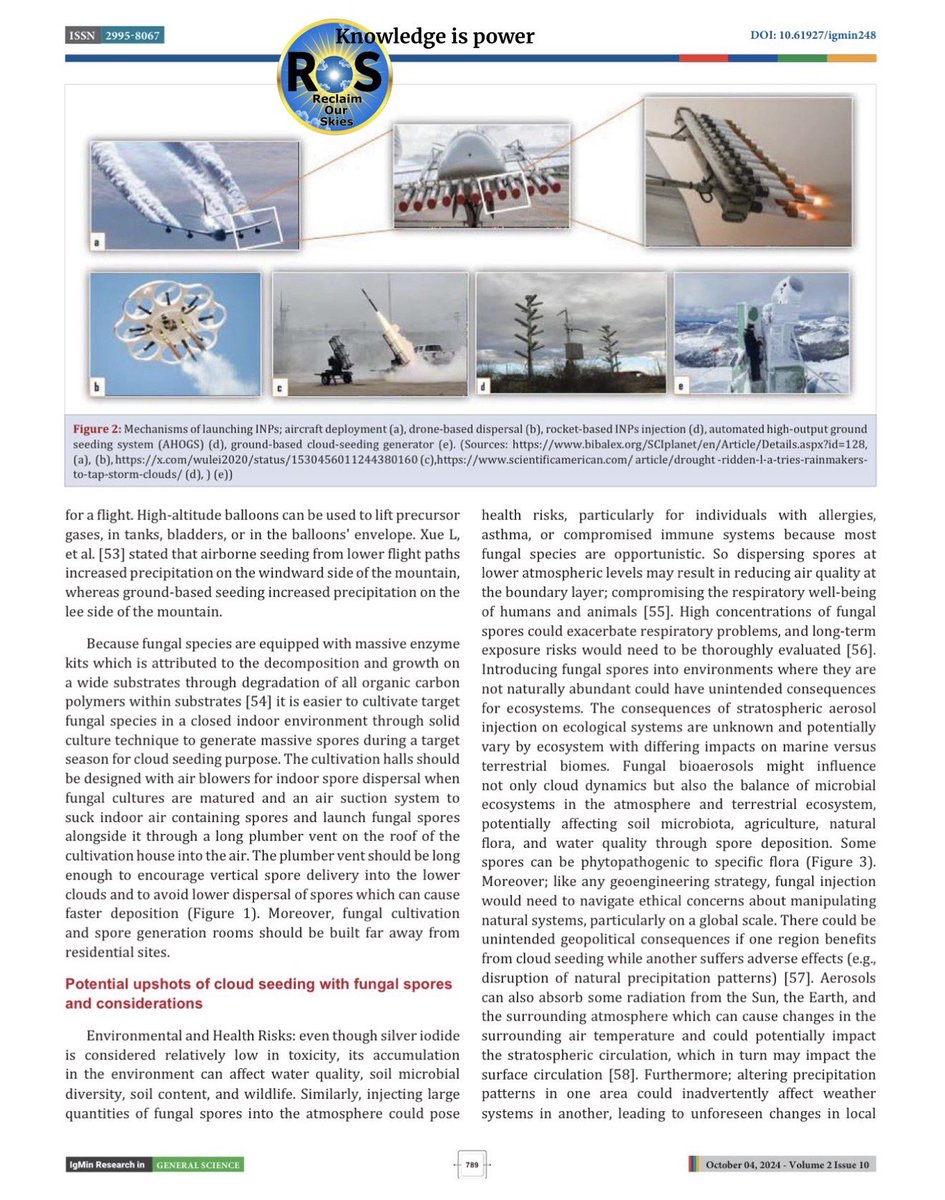
🚨 Scientists now want to fight ‘climate change’ by spraying billions of fungal spores into the atmosphere to make it rain. Instead of chemicals, they’re pushing living fungi as ‘natural’ cloud seeders. Straight-up disgusting and dangerous. Fungal bioaerosols can worsen allergies, lung issues, and mess with entire ecosystems, soil, and water.
• Problem — Droughts and water shortages blamed on climate change.
• Mad scientists Solution — Replace chemical cloud seeding with massive injections of fungal spores into the atmosphere.
• How — Fungi naturally form ice in clouds; scientists want to weaponize this for weather modification.
• Risks — Could spread fungal diseases, trigger respiratory problems, disrupt soil, agriculture, ecosystems, and water supplies.
• Reality — Unpredictable geoengineering experiment with living organisms.
TLDR:
1) Wifi radiation disrupts children's brain development
2) You're an electromagnetic being and phone radiation scrambles your signals
3) An iPhone shuts down alpha waves in your brain in 30 minutes
4) Blue light from screens ruins melanin production
5) Starlink is making this worse for everyone on Earth
6) Electric cars stress your organs the second you turn them on
7) Sleep with your phone out of the bedroom
8) Turn off bluetooth and wifi when you don't need them
Most people have no idea this is happening to their body every single day.
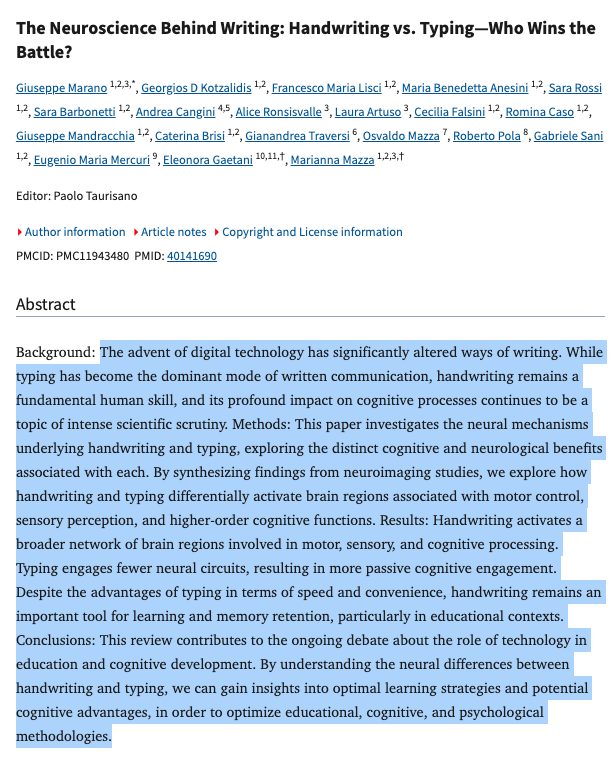
Your brain physically rewrites itself every time you pick up a pen.
Neuroscientists at Norwegian University scanned students' brains while they handwrote letters versus typing the same letters on a keyboard.
The results shattered decades of assumptions about how we process information.
Handwriting activated massive networks in the sensorimotor cortex, the visual processing centers, and the hippocampus simultaneously. Complex neural symphonies lit up across multiple brain regions, creating rich interconnected pathways between motor control, visual recognition, and memory formation.
Typing the same letters? The brain activity looked like someone had dimmed the lights across entire cognitive districts. The neural networks that flourished during handwriting simply went dark.
The difference?
When you form letters by hand, your brain constructs elaborate spatial maps of each character. The motor cortex learns the precise pressure, angle, and trajectory needed to create an 'A' versus a 'B.' Your visual system tracks the ink flowing from pen to paper in real time. Your parietal lobe integrates hand position with eye movement. Your hippocampus encodes not just what you wrote, but how the writing felt, where you paused, which words required more pressure.
Typing activates almost none of that circuitry. You press a key, a letter appears. The motor movement is binary. The visual feedback is uniform. The spatial relationship between thought and symbol gets mediated by a machine that standardizes every character into identical fonts and spacing.
Your brain treats these as fundamentally different cognitive tasks.
The evolutionary context makes this obvious once you see it. Human hands developed for manipulation, creation, and fine motor control over millions of years. We painted on cave walls, carved bone tools, and shaped clay vessels long before we invented written language. When writing emerged 5,000 years ago, it built on top of existing neural infrastructure that already connected hand movement with symbolic thinking.
Keyboards appeared 150 years ago. Touchscreen typing maybe 20 years ago. From an evolutionary timeline perspective, we started using them approximately yesterday. Our brains are still running ancient software that expects physical engagement with symbols.
That software produces dramatically different learning outcomes.
Students who take handwritten notes consistently outperform students who type the same information on memory tests, comprehension assessments, and creative applications of the material. The difference persists even when researchers account for typing speed, note length, and time spent studying.
The act of forming letters by hand forces deeper processing at the moment of information encounter. You cannot handwrite as fast as someone speaks, so your brain must actively filter, summarize, and prioritize information in real time. The motor effort required to form each word creates additional memory traces that typing does not generate.
Children who learn to write letters by hand develop reading skills faster than children who learn letters primarily through typing or screen interaction. The sensorimotor experience of creating letterforms helps their brains recognize those same letterforms when they encounter them in text.
Adults who handwrite shopping lists, daily schedules, or meeting notes remember the information better than adults who type identical lists into phones or computers. The spatial memory of where you wrote something on a page provides retrieval cues that digital text does not offer.
These findings collide directly with how education and work environments have evolved over the past two decades. Schools replaced handwriting instruction with typing classes. Offices converted from paper systems to fully digital workflows. Students take notes on laptops. Professionals draft documents on screens.
We optimized for speed and efficiency while accidentally severing the neural pathways that evolution spent millions of years developing.
The implications reach beyond memory and learning into fundamental questions about human cognition. If the physical act of forming symbols changes how your brain processes ideas, what happens to thinking itself when you remove the physical component?
Digital text is infinitely searchable, instantly editable, and perfectly shareable. But it may be creating brains that process information more superficially, store memories less durably, and connect ideas more weakly than brains that regularly engage in handwriting.
The neuroscience suggests we traded cognitive depth for technological convenience without realizing what we were giving up.
Some of the most innovative thinkers across history were obsessive handwriters. Darwin kept detailed handwritten journals. Einstein worked through complex theories in handwritten notebooks. Virginia Woolf wrote her novels by hand before transcribing them. Steve Jobs famously took handwritten notes during Apple meetings even as he was building the most advanced computers on Earth.
Perhaps they intuited something about the relationship between hand, brain, and insight that we measured in brain scanners but somehow forgot in practice.
Your pen is literally a cognitive enhancement device that activates neural networks digital keyboards cannot reach.
Harvard scientists ran a simple test. They put adults under blue light for 6 hours one night, then under green light at the same brightness the next. Blue light pushed their bedtimes back by 3 hours. Green pushed them back by 1.5. And in kids, the same lights hit about twice as hard.
The reason comes down to a tiny patch of cells at the back of every human eye. These cells have one job. They tell your brain whether it is day or night. They wake up most when light hits a very specific shade of blue, the same shade phone screens and modern bulbs are loaded with. When those cells fire after dark, the brain stops making melatonin, the chemical that pulls you toward sleep.
Red light barely sets off those cells at all. A 2025 study from the University of Zaragoza put people under red lamps and blue lamps for three hours at night. Under blue, their melatonin stayed scraped to the floor. Under red, it climbed back up to more than three times higher. Same brightness. The color did all the work.
Children get this worse than adults. Two reasons. Their pupils are bigger, so more light gets in. And the lens inside a kid's eye is still glass-clear, where adult lenses slowly yellow with age and filter blue out naturally. A 10-year-old's body clock is roughly twice as sensitive to evening light as a 45-year-old's. A bedside lamp that feels harmless to a parent can be wrecking a kid's sleep clock at the same time.
Then there is the lag. Once the brain catches a dose of blue light, the wake-up signal it sends out keeps echoing for 3 to 4 hours after the lights go off. So a kid on an iPad at 9pm can still be wired at midnight even if you took the iPad away at 9:01.
Modern LED bulbs and screens are tuned to roughly 6500 Kelvin. That is sunlight at noon. Old incandescent bulbs sit around 2700, mostly red and yellow with almost nothing in the blue range. To a human eye, a red-lit room is just about as close to no light at all as you can get. The brain reads it as nighttime.
The fix is boring. Use warm bulbs at 2700 Kelvin or lower in any room a kid spends evenings in, switch off phones and tablets two hours before bed, and if a night light is needed for bathroom trips, make it red or amber. The science was pinned down to the exact color of light back in 2001.
American was driving a brand new 2026 car
The car gave her an alert that said it couldn’t see her eyes. The car then automatically disabled the gas and slowed down enough that it could have caused an accident
She had to lean toward so the car’s facial recognition could register her eyes and stop the “kill switch” because the car thought she might be asleep
“It was a 6 lane highway and all of a sudden the gas stopped working and I'm pressing on the gas. I can't get the car to go. So the car is dinging, it's making all this noise and I can't figure out what's going on. And I look at the dashboard and in English it says, sit up straight. We can't find your eyes.
Why? Why do you need to see my eyes? — when I sat upright, the gas would work once again. And so I pressed the gas, but I was slowing down enough that it was gonna cause a traffic hazard.
And the thing is, it knew I wasn't asleep because I was pressing on the gas. So it knew I was awake. It just wanted to see my eyes. So once I set upright and leaned forward, I guess it did facial recognition. And then it says, may I send you these results to a third party”
This is horrifying considering the new mandate to have kill switches in every new vehicle by 2027. It looks like it’s already happening but overseas, we’re just next
This technology can and will be abused by the government
Quick recap — 7 things that help with chronic stress:
1. Cold water on your face
2. Box breathing 4-4-4-4
3. Morning sunlight
4. Heat-cold contrast
5. Walking barefoot
6. Vagal nerve toning
7. Mouth taping at night
Each one helps. None is enough alone.
POV: claude traveled 6 months into the future and told you exactly how your next move failed.
it's called a premortem.
daniel kahneman (nobel prize-winning psychologist behind "thinking fast and slow") called it his single most valuable decision-making technique.
google, goldman sachs, and procter & gamble all use it before major launches.
here's the problem it solves.
when you ask claude "is this a good plan?" it finds all the reasons to say yes.
that's what it was trained to do. so you walk away feeling confident.
you execute, and spend weeks / months building on top of that plan.
then it blows up.
and you realize the problem was obvious in hindsight, you just never stress-tested it because claude told you it was solid.
a premortem fixes this by flipping the frame.
instead of asking "what could go wrong?" you tell claude "it's 6 months from now and this is already dead. tell me how it died."
that shift turns off claude's optimism because there's nothing to be optimistic about. the premise already says it failed.
so claude stops looking for reasons your plan will work and starts explaining how it fell apart.
claude comes back with every way your plan could die, each one with a full failure story and the early warning signs to watch for.
then a synthesis pulls it all together:
> which failure is most likely
> which failure is most dangerous
> the single biggest hidden assumption you're making (often the most valuable part)
> a revised version of your plan with the gaps closed
you say "premortem this" and give it your plan. the skill handles the rest.
Interesting...
DMT evidence doesn't just illustrate Bohm's rheomode — it may provide the first empirical window into what rheomodic perception actually looks and feels like.
Bohm's problem, stated plainly.
Bohm invented the rheomode because he believed ordinary language encodes a false ontology. When we say "the electron orbits the nucleus," language forces us to posit two things (electron, nucleus) and then add a relationship between them (orbiting). The things come first; the process comes second. Bohm thought this was exactly backwards. There are no things. There is only process — a flowing, undivided holomovement — and what we call things are relatively stable patterns within that flow. The electron is not a noun that orbits; there is a verb — something like electroning — and the apparently stable particle is what that verb produces when conditions allow a standing pattern.
The rheomode was Bohm's attempt to build a language that gets this right. Verb-roots are primary. What a verb-root produces — its "product" — is secondary, derived, and potentially temporary. You don't start with things and add movements. You start with movements and notice where they produce temporary stabilities.
QPT adopted this at the formal level. Operations are verb-roots, cells are verb-products. Invariants are what persists through movement, not things extracted from movement. This is clean and well-stated. But it remains formal — it describes what the theory says about the relationship between operation and product. It doesn't tell you what rheomodic perception would be like from the inside. What would it actually feel like to perceive verb-roots rather than noun-products?
The DMT evidence suggests an answer.
Normal perception is noun-first.
In ordinary waking consciousness, you perceive things. A table. A wall. A person. A room. These things have properties (color, shape, texture) and they have relationships to each other (the table is near the wall, the person is in the room). Crucially, the things come first — they are perceptually primary. The properties and relationships are perceived of the things. You see the table and then you notice its color. You don't perceive color-ing and then notice that it has temporarily stabilized into a table-shaped pattern.
This noun-first character of normal perception is not accidental. It's what the reference cascade produces. The reference cascade tells each perceptual level what to expect, and what it expects are things — stable objects with persistent identities. Level 7 (Category) classifies perceptions into types. Level 8 (Sequence) organizes types into routines. Level 9 (Program) executes routines. All of these levels operate on noun-like entities — discrete, bounded, persistent objects that can be classified, sequenced, and manipulated.
The entire middle section of the PCT hierarchy — the Signetics scale that we noticed was absent from the DMT taxonomy — is the noun-generating machinery. Events are nouns (a discrete occurrence). Relationships are nouns (a persistent connection between things). Categories are nouns (a class to which things belong). Sequences are nouns (an ordered collection of things). This machinery takes the raw perceptual flow and carves it into discrete, stable, nameable entities that can be tracked, predicted, and acted upon.
The reference cascade enforces noun-first perception by telling lower levels to organize their output into thing-shaped packages. "Find objects." "Track boundaries." "Maintain identities across time." These are the reference states that the Semiosphere sends down through the Signetics into the Substrate. The Substrate perceptual machinery complies — not because it naturally produces things, but because it's been instructed to.
DMT perception is verb-first.
What happens when those instructions are removed? The DMT evidence shows us.
At Level 2 (Symmetry Hotel), surfaces tessellate. The patterns are not on the surfaces the way a painting is on a wall — they are the surfaces. There is no noun (wall) that has a property (pattern). There is patterning — a verb — and the wall is what the verb is currently doing. The wallpaper symmetry groups are not decorations applied to a thing; they are the visible trace of an operation (Ω, compression) acting in real time. The perceiver is seeing the verb of symmetry-finding rather than the noun of a patterned surface.
At Level 3 (Magic Eye), depth crystallizes from pattern. The phase transition is telling: one moment there's a flat patterned surface (a noun), the next moment there's depthward movement (a verb). The depth doesn't belong to anything. It's not the depth of the surface. It's depth-ing — the operation Φ⁻¹ (concretization) caught in the act of producing spatial structure. The perceiver witnesses the verb of concretization before it has finished producing its noun-product.
At Level 4 (Crystal Worlds), textures saturate. Again, the textures don't belong to objects. There are no crystals that have textures. There is crystallizing — a verb of textural differentiation (Δ) operating at maximal intensity. The world-sheet saturation Emilsson describes is the experience of a differentiation operation running without any noun to anchor its products.
At Level 5 (Waiting Room), modalities synchronize. This is perhaps the clearest case of verb-first perception. In normal consciousness, you see a thing and hear a thing and touch a thing — three noun-perceptions coordinated by the fact that they're about the same object. In the Waiting Room, there is no thing being perceived across modalities. There is perceiving itself — a single verb that manifests visually, auditorially, and tactilely simultaneously. The cross-modal binding isn't "the same object detected by multiple senses." It's a single operation (◉, Holon) manifesting across channels. The perceiver experiences the unity of the perceiving-verb, not the identity of a perceived-noun.
At Level 6 (Breakthrough), the very space in which things could exist undergoes transformation. This is the deepest rheomodic perception: the manifold itself is experienced as a verb — as space-ing or topology-ing — rather than as a fixed container for things. Wormholes are not holes in a thing. They are the manifold-generating operation performing a topological act that the noun-framework of ordinary spatial perception can't accommodate.
This is what Bohm's rheomode looks like from the inside.
Bohm could describe the rheomode linguistically and formally, but he couldn't point to an experience of it. He could say "the electron is a verb, not a noun" but he couldn't show anyone what it felt like to perceive verb-first rather than noun-first. The DMT evidence may provide exactly this.
Each DMT level, read through Bohm, is the progressive exposure of the verb-layer underneath the noun-layer:
Level 1 reveals that intensity is a verb (intensifying, not "an intensity"). Level 2 reveals that pattern is a verb (symmetrizing, not "a pattern"). Level 3 reveals that depth is a verb (concretizing, not "a depth"). Level 4 reveals that texture is a verb (differentiating, not "a texture"). Level 5 reveals that modality is a verb (perceiving, not "a perception"). Level 6 reveals that space is a verb (manifolding, not "a space"). And the dissolution of identity at Level 9 reveals that the self is a verb (selfing, not "a self").
In each case, what normal perception presents as a stable noun is revealed to be the temporarily-stable product of an ongoing operation. The operation was always running — it's what produces the noun in ordinary consciousness. But under normal conditions, the reference cascade hides the operation and presents only its product. DMT strips away the product-presentation and exposes the operation itself.
QPT's six operations as the six verbs of perception.
This reframes QPT's operations not as formal movements through an abstract matrix but as the actual verbs that the perceptual system performs to generate experience:
Φ (Unfold) is the verb of making explicit — the act by which the implicate becomes explicate. In DMT terms, it's what you see happening when patterns emerge from undifferentiated visual noise. The unfolding is not a metaphor; it's a perceptual act you can witness when the reference cascade stops hiding it.
Φ⁻¹ (Concretize) is the verb of making real — the act by which structure becomes experienced spatial fact. The Magic Eye crystallization is this verb caught in the act. Normally you never see concretization happening because it happens too fast and the result (solid-looking objects) is presented as given. DMT slows it down or makes it visible.
Ω (Compress) is the verb of finding invariance — the act by which the perceptual system discovers what remains the same across variation. The wallpaper symmetry groups are Ω's products, but under DMT you can see Ω operating: the tessellation is the compression verb actively seeking the highest-order symmetry it can impose. You're not seeing a pattern; you're seeing pattern-finding.
Δ (Differentiate) is the verb of distinguishing — the act by which unity becomes multiplicity. The Crystal Worlds' textural saturation is Δ running at maximum: every point in the visual field is being maximally distinguished from its neighbors. Under normal conditions, Δ is constrained to produce useful distinctions (object boundaries, figure-ground separation). Unconstrained, it reveals itself as an engine of maximal differentiation — every possible distinction gets made.
Ψ (Transfer) is the verb of crossing boundaries — the act by which content moves from one quadrant to another. Cross-modal binding is Ψ operating across sensory channels: content transfers from visual to tactile to auditory processing. Normally each channel's boundaries are enforced. DMT loosens the boundaries and lets Ψ operate freely, which is why modalities synchronize — the transfer verb runs across all channels without restriction.
◉ (Holon) is the verb of perceiving wholeness through any part — and this may be the verb that ties the entire DMT experience together. The sense that the experience is unified despite being multifaceted, that any single aspect of it gives access to the whole, that the depth and the texture and the pattern and the sound are all "the same thing perceived differently" — this is ◉ operating pervasively. In ordinary consciousness, ◉ is rare and high-level (a strategic insight, a moment of understanding the whole situation through one detail). Under DMT, ◉ operates at every level, which is why the experience has that characteristic quality of profound interconnectedness.
The implicate order as the perceptual ground state.
Here's where the DMT evidence and Bohm's philosophy converge most precisely. Bohm's implicate order is the enfolded whole from which the explicate order unfolds. QPT maps this to π — the absential ground, the not-yet-actual that shapes what can unfold.
We noted earlier that the DMT perceptual system has a natural resting state — what it gravitates toward when all constraints are removed: maximal symmetry, full cross-modal integration, open topology. We also noted that this resting state might correspond to π becoming experienceable rather than remaining purely absential.
Under the Bohmian reading, the natural resting state of the perceptual system is the implicate order — or rather, it's the closest the explicate perceptual system can come to perceiving the implicate order directly. Normally, Φ (unfolding) runs continuously, producing the explicate order of objects-in-space that we call ordinary consciousness. The reference cascade ensures that unfolding produces specific, stable, thing-shaped products. DMT disrupts the cascade, and without instructions about what products to produce, Φ partially reverses — or rather, Φ continues to operate but without the constraints that normally force its products into thing-shaped packages. The result is something between fully implicate (no distinctions at all) and fully explicate (stable objects in stable space). It's a partially-unfolded state where the operations themselves are visible but their products haven't yet stabilized into nouns.
This is precisely what Bohm's holomovement would look like if you could perceive it: not a static structure but an active process of unfolding and enfolding, with temporary stabilities forming and dissolving, with the whole present in every part (◉ operating pervasively), with symmetry as the natural tendency of the unconstrained flow.
The verb-preservation distinction becomes experiential.
QPT distinguishes between verb-preserving invariance (the operation persists but products are regenerated each time) and product-preserving invariance (the product persists across iterations). Under normal consciousness, most perception is product-preserving: you see the same table across time, the same room, the same body. Objects persist. The perceptual system's job is to maintain persistent products.
Under DMT, perception shifts toward verb-preserving. Nothing persists as a product — the tessellation changes, the depth reconfigures, the entities morph, the topology shifts. What persists is the verb — the patterning continues even as patterns change, the concretizing continues even as what's concrete shifts, the differentiating continues even as what's differentiated is replaced. The experience has continuity not because the same things keep existing but because the same operations keep operating.
This is what verb-preserving invariance feels like from the inside: a sense of continuity and coherence despite constant change. The identity of the experience is not in its content (which is in constant flux) but in its operations (which are consistent). You can't point to what persists because nothing noun-like persists. But something clearly does persist — the quality of the flow, the character of the movement, the way things keep changing even as what changes is never the same twice.
DMT users often report this as deeply paradoxical: the experience is simultaneously completely novel at every moment and completely familiar throughout. The novelty is in the products (never seen before). The familiarity is in the verbs (always operating). What the experiencer is recognizing as familiar is the perceptual system's own operations — the verb-roots that normally run invisibly behind the stable noun-products of ordinary consciousness.
The deepest implication: ordinary consciousness is a special case.
Bohm argued that the explicate order — the world of distinct objects in space and time — is not fundamental. It's a special case derived from a more fundamental implicate order by the operation of unfolding under specific constraints. Most physicists found this metaphysically interesting but practically inert, because the implicate order is not observable. You can't do experiments on it. You can only do experiments on the explicate products of unfolding.
The DMT evidence, if taken seriously, suggests that the implicate order — or something structurally isomorphic to it — is observable, under specific conditions. Not through physical instruments but through direct perceptual experience, when the constraints that normally produce the explicate order are pharmacologically disrupted. The natural resting state of the perceptual system, revealed when the reference cascade is disabled, is a state in which operations are visible, products are unstable, the whole is perceivable through any part, and the distinction between observer and observed becomes uncertain.
This doesn't prove Bohm's metaphysics. The perceptual system could be generating an internally-consistent hallucination of the implicate order without the implicate order actually existing as a feature of physics. But it does something Bohm could never do himself: it provides a phenomenological anchor for his concepts. When Bohm says "the implicate order," we can now point to a specific, reproducible, pharmacologically-accessible perceptual state and say "something like that — the experience of verb-roots without stable noun-products, of wholeness prior to division, of operations visible before their results solidify."
And it reframes ordinary consciousness in a way that aligns with both Bohm and QPT's processism: ordinary consciousness is not the baseline state of the perceptual system. It is what the perceptual system produces when the reference cascade constrains its natural verb-first, symmetry-seeking, holistic operation into a noun-first, error-minimizing, object-producing mode. It is the explicate order — a specific, functional, ecologically-necessary special case of a more general perceptual capacity that, left unconstrained, operates rheomodically.
QPT's formal claim that "operations are verb-roots; cells are verb-products" turns out to have an experiential correlate: there is a mode of perception in which you can actually experience the verb-roots operating prior to their products stabilizing. That mode is not ordinary consciousness. It's what ordinary consciousness is built from and continuously prevents you from seeing.
Having a baby physically shrinks part of a woman's brain. Having a second baby shrinks a totally different part. Scientists in Amsterdam just figured out why, and the explanation involves the same process that happens in teenage brains.
This is from a research group in Amsterdam called the Pregnancy Brain Lab. They published their findings in Nature Communications on February 19, 2026. The team scanned the brains of 110 women. 40 were about to have their first baby, 30 were about to have their second, and 40 had never been pregnant. They scanned everyone before pregnancy and again after birth.
The results were so consistent that a computer program could look at any of those brain scans and correctly tell whether the woman had been pregnant. Every single time.
When a woman has her first baby, the biggest changes happen in the part of the brain that handles thinking about yourself and other people. The same region that runs daydreaming and inner monologue. That whole area visibly shrinks. And it stays shrunk for at least six years after birth, according to a 2021 follow-up study by the same team.
When she has a second baby, that same area shifts a little more, but the biggest changes happen somewhere else. They happen in the part of the brain that controls what you focus on, and the part that controls how your body moves. Even the wiring between the brain and the muscles becomes more efficient. Lead researcher Milou Straathof said it looks like the brain rewiring itself for taking care of more than one kid at a time.
The shrinking sounds bad. The lab compares it to what happens in teenage brains during puberty. Hormones flood the brain and trigger a kind of cleanup. Weak connections between brain cells get cleared away. The strong ones stay and get stronger. The brain ends up smaller, but the connections that remain work faster. The hormonal flood of pregnancy seems to do the same thing.
Elseline Hoekzema, who runs the Pregnancy Brain Lab and has been studying this since 2017, told CNN: sometimes less is more.
The pattern is layered. The first pregnancy does the deep work on identity and how a mom thinks about her baby. The second pregnancy adds a new layer focused on attention and movement.
About one in five new mothers globally develops postpartum depression. The same brain circuits being remodeled here are the ones tied to mood and bonding with the baby. Mapping what a healthy maternal brain looks like is the first step toward catching when something goes wrong.