In 2020, nine traders from a small village outside London made $660 million in a single afternoon.
One of them was 22 years old. He made over $100 million.
The day was April 20. Oil had never in history traded below zero. That afternoon, it fell to minus $37 a barrel.
The traders weren't from Goldman Sachs or a giant hedge fund. They worked out of a tiny firm in Essex called Vega Capital, whose website just said "under construction." They were led by a former trading pit veteran whose nickname was "Cuddles."
They were friends. They drove Rolls-Royces and Bentleys, went on holiday to Marbella, and supported West Ham together.
In the video below, the Bloomberg reporters who tracked them down explain what happened.
"I think they made as much money in one day as Apple makes from its international sales in one day."
At 2:08 pm, oil went negative. They had bet on it falling, and every contract paid them on both sides of the trade.
"I can't think of another example where you enter a trade and you get paid on both sides."
Thousands of ordinary investors in a Chinese oil fund lost everything that same day.
And in the final half hour before the price was set, nine guys from Essex were the biggest sellers in the entire market, bigger than the world's largest banks, BP and Shell.
They've been sued in the US for market manipulation and investigated by UK regulators. They say they did nothing wrong.
Was it the greatest trade in history, or did nine friends from Essex push the price of oil below zero?
Around 1981, the 30 year U.S. Treasury touched about 15%.
Put a million dollars in then and hold it. That is roughly $12,500 a month for the next 30 years.
The checks came twice a year. The average is the same.
Then inflation cooled. Rates fell for decades. The government had to keep paying what it promised.
That is the strange part. It did not look like a gift at the time. Prices had already fallen. Inflation was still fierce. Short term deposits were paying even more, and most people assumed rates would stay high or go higher.
People who believe in cycles, and do not treat today as permanent, are the ones who gain from chances like this. The outlook looks uncertain when you buy. That is usually when the opportunity is there.
Imagine earning a risk free 15% a year for three decades.
الدوبامين اللي يجيك مع شريك جديد يستمر تقريبًا 18 شهر. وبعدها، عقلك يصنّف الشخص اللي تحبه ضمن الأشياء المألوفة، ويبدأ ذاك الشعور والحماس يخف.
لكن الإيطاليين لقوا 3 طرق يرجّعون هالإحساس من جديد بدون ما يغيرون شريكهم.
وطريقتهم مستمرة من أكثر من 300 سنة:
Met a wealth manager today who handles over Rs. 2,500 crore in AUM.
He mentioned that nearly 90% of his business leads come from the content he publishes on Instagram and YouTube.
The takeaway is simple: if you run a business, not creating content is a missed opportunity.
It doesn't matter what you sell, consistent content is your most powerful growth channels.
One of the greatest viruses of the modern man is looking at Instagram Stories. You will melt your brain looking at a barrage of outcomes—like vacations, parties, cars—with no visibility of the process that got them there.
never understood the female obsession with feeling special
if your idea of relationship is wanting to feel special everyday , you view romance as something that happens to you and not something you create with you partner
I resigned from Anthropic today. I spent the last three years doing pretraining research at both OpenAI and Anthropic. Neither company is acting responsibly. They are racing straight to self-improving superintelligence and gambling with our lives. More thoughts below.
I'm in my 30s now. If home ownership and having kids aren't desirable/viable pursuits right now, then what direction is there to take in everyday life? Running marathons and baking sourdough? Dead-end hobbies? Sporadic side hustles? It all has me feeling so stagnant and numb
The entire point of paying ₹400 for a naan and ₹2000 for a biryani in a 5 star hotel is the assurance that basic hygiene would be followed.
You need to bring fear back in the hearts of these people man.
Your morning coffee on an empty stomach is a cortisol bomb.
Cortisol follows a natural rhythm. It peaks when you wake up, then gradually drops through the day. Breakfast is the signal that tells your body to start pulling cortisol back down. Skip that signal and cortisol stays elevated for hours past its normal window.
Now add coffee. Caffeine directly stimulates your adrenal glands to produce more cortisol. So the actual sequence for millions of people every morning: wake up with peak cortisol, skip food, pour a stimulant into an already-stressed system, then wonder why they feel wired and anxious by 10 AM.
The mechanism connecting this to depression runs through serotonin. Your brain synthesizes serotonin from tryptophan, but tryptophan needs insulin to cross the blood-brain barrier. Insulin comes from eating. No breakfast means no insulin spike, which means less tryptophan reaching the brain, which means less serotonin production during the exact hours your brain is trying to stabilize mood for the day.
This study found the link is strongest in adolescents (51% higher odds of anxiety vs no significant link in adults). That tracks perfectly. Teenagers skip breakfast at the highest rate, sleep the least, and drink the most caffeine relative to body weight. Three compounding cortisol drivers stacked on a brain that's still developing its stress regulation systems.
399,550 people across 14 studies. The finding isn't that breakfast is magical. The finding is that your body uses that first meal as a hormonal reset button, and skipping it leaves your stress system running in the background all morning like an app you forgot to close.
If your goal is fat loss, the gym bros have been misleading you.
Lifting weights is essential for health, but if you believe it is the best way to lose fat, especially visceral (belly) fat, you have fallen for a marketing myth.
The Evidence (The STRRIDE Trial & Beyond):
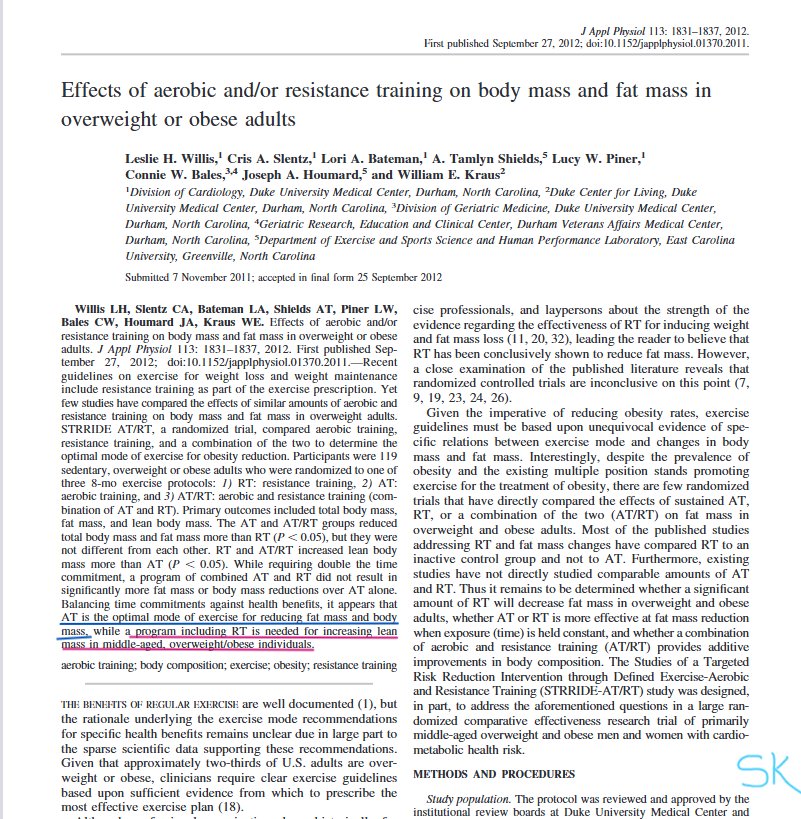
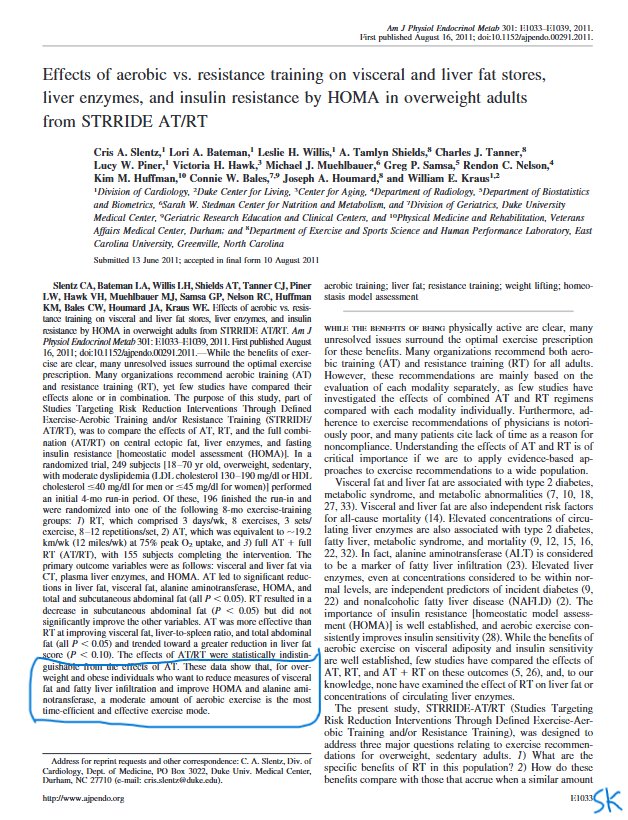
One of the most comprehensive studies on this (Duke University) compared aerobic training, resistance training, and a combination.
The results were clear:
🔸Aerobic Training led to significantly more fat loss and a greater reduction in visceral fat than weight training.
🔸Resistance Training is great for building lean mass, but it had zero significant impact on decreasing fat mass or total body weight when used alone.
🔸Visceral Fat: Runners consistently show lower levels of internal organ fat, which is the most dangerous type for metabolic health.
The Harsh Reality:
You can "chase the pump" for years and still carry a stubborn belly.
Why is it so?
Because the calorie expenditure of a heavy lifting session is often overcompensated for by increased appetite and decreased movement throughout the rest of the day.
Meanwhile, regular runners/cardio enthusiasts:
✔Burn more calories per minute of effort.
✔Experience better lipid oxidation (fat burning).
✔Accumulate significantly less visceral fat as they age.
Why won’t the fitness industry tell you this?
🔸"Lift heavy to get shredded" is a sexier sell. It sells supplements, gym memberships, and expensive coaching programs.
🔸"Go for a 45-minute run 4 times a week" is free, simple, and effective, but it doesn’t move product.
Reality Check:
✅Strength Training: Builds the "engine" (muscle) and preserves bone density.
✅Running/Cardio: Actually burns the "fuel" (fat).
If fat loss is your #1 goal:
1. Prioritize Zone 2 & Aerobic sessions. This is your primary fat-loss tool.
2. Use Weights as the Support. 2–3 days a week is enough to maintain muscle while the cardio does the heavy lifting for fat loss.
Bottom Line:
The "Cardio kills gains" era is over. If you are skipping the track and wondering why your waistline is not budging despite hitting PRs on the bench press...You are playing the wrong game.
Dr Sudhir Kumar X:@hyderabaddoctor
(Disclaimer: Information provided here is general in nature. Discuss individual exercise regimen with your fitness trainer and physician.)
By 2 PM, you're worse at learning than you were at breakfast. The connections between your brain cells get so loaded with information throughout the morning that they start to max out, like a hard drive running low on storage.
A study published this January in the journal NeuroImage is the first to show that an afternoon nap can reverse this. About an hour of sleep in the early afternoon physically resets your brain's ability to learn.
Researchers at the University of Freiburg and the University of Geneva had 20 people either nap between 1:15 and 2:15 PM or stay awake. Then they used magnetic pulses to measure what happened inside the brain. After the nap, the overall strength of connections between brain cells decreased, indicating that the brain cleared out clutter and freed up space. And the brain's ability to form new connections increased. It was ready to learn again.
Until this study, scientists had only seen this kind of reset after a full night of sleep.
The theory behind this has been developing for over 20 years. Giulio Tononi and Chiara Cirelli proposed it at the University of Wisconsin in 2003. Every experience during the day strengthens connections between brain cells. That's how learning works. But those connections can only get so strong before they hit a ceiling. They burn more energy and eventually max out, so your brain can't take in anything new. Sleep is what turns the volume back down.
Their lab saw this under a microscope in 2017. They mapped 6,920 connections in mouse brains and found they shrank by about 18% after sleep. The shrinkage was selective: about 80% of connections got trimmed back. The strongest 20%, the ones holding your most important memories, were left alone. Tononi estimated that in a human brain (which has over 100 trillion of these connections), trillions of them slim down every single night.
The January study shows a nap can trigger that same kind of reset. The effects persisted for up to 2 hours after waking.
A 1995 NASA study found that pilots who napped for just 26 minutes showed 54% better alertness and 34% better performance on the job. Now there's a biological explanation for that. A nap clears your brain's storage to make room for what comes next.
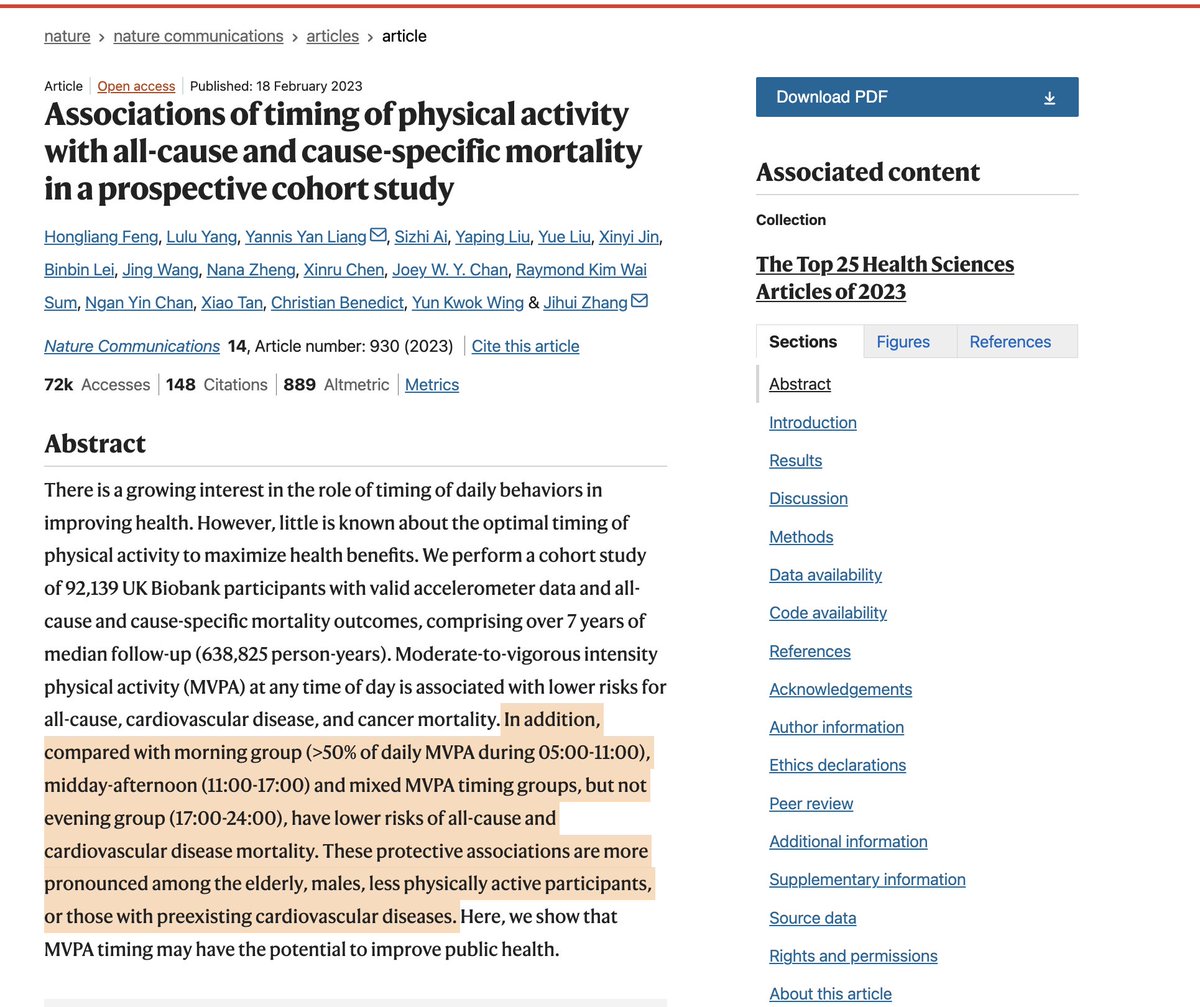
6–10am is by far the worst time to go to the gym.
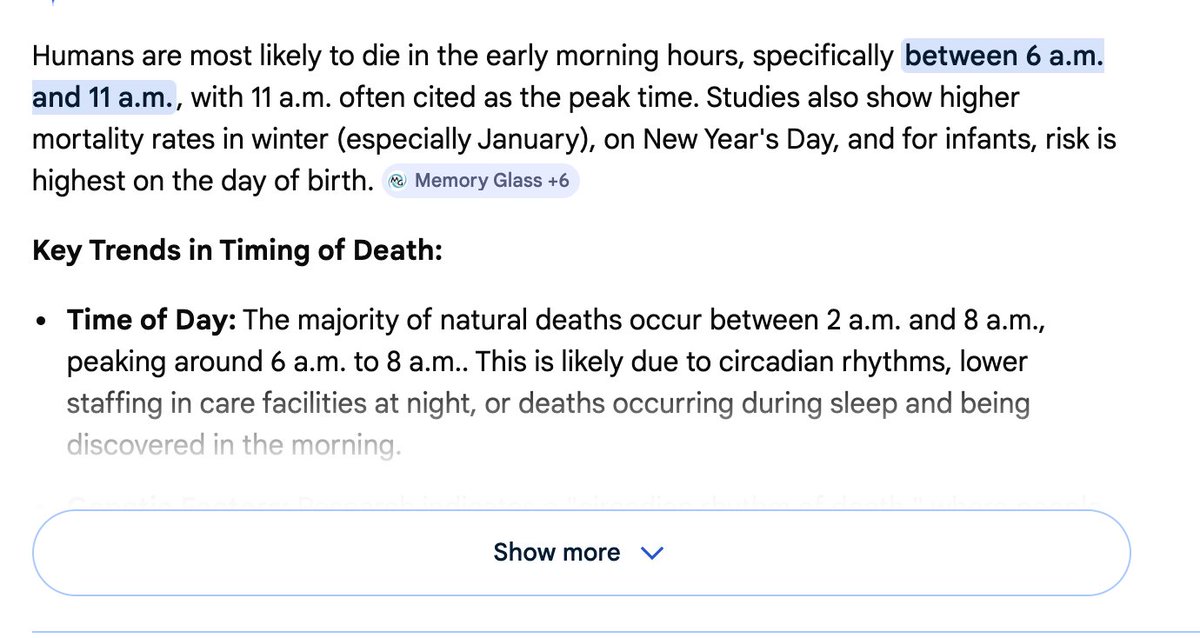
Cortisol is highest upon waking, the time humans are most likely to die. Only slaves wake up and immediately begin exerting themselves.
A leisurely stroll or Tai Chi (both shown to lower cortisol) is more prudent