DeepSeek Harness was just released with MIT license. The current 0.1.0 version is a developer preview, and may still have many rough edges. Feedback is welcome!
DeepSeek Harness 已经以MIT协议开源发布。现在的0.1.0版本是一个面向Harness开发者的预览版,还很不完善。恳请大家多提提宝贵意见。
https://t.co/aBToa3b3L9 https://t.co/VMZC5i2sG0
Never forget, no matter how much you hate on Chinese models, you will never exceed the disdain Chinese people themselves have for them. True story
I have lost count of how many times I've heard from Chinese people "I only use Chinese models because I have to, they're hopeless"
And I'm clearly not the only one because Pingwest's @guixingren felt compelled to publish a post today titled "Stop bashing Chinese AI models. Foreign users are having a great time with them."
Here are the most highlighted portions, which you'll probably LOL at as I did:
"A further complication in China is that domestic models are judged against standards that don’t really exist elsewhere.
One standard treats them as a test of whether China has achieved genuine AI innovation. It’s not enough for a model to be useful or widely adopted; people immediately ask whether it was distilled, whether it is truly original, or whether it’s just following someone else’s lead.
The other standard is to compare every new model directly against the very best versions of Claude or GPT and ask why it isn’t the strongest model in the world.
Put those two expectations together, and questions like how many people use a model or whether it actually solves real problems often become secondary.
Chinese audiences also tend to be slower to recognize the significance of domestic models. DeepSeek is a good example. What really pushed it into the mainstream wasn’t domestic adoption, but the fact that it first climbed to the top of the U.S. App Store rankings and triggered a global debate about AI costs. Only after overseas users embraced it and international markets reacted did many people in China take a second look.
That pattern is not unusual. In many cases, the rest of the world starts using and discussing a Chinese technology before China itself fully appreciates what it has built."
/shrug
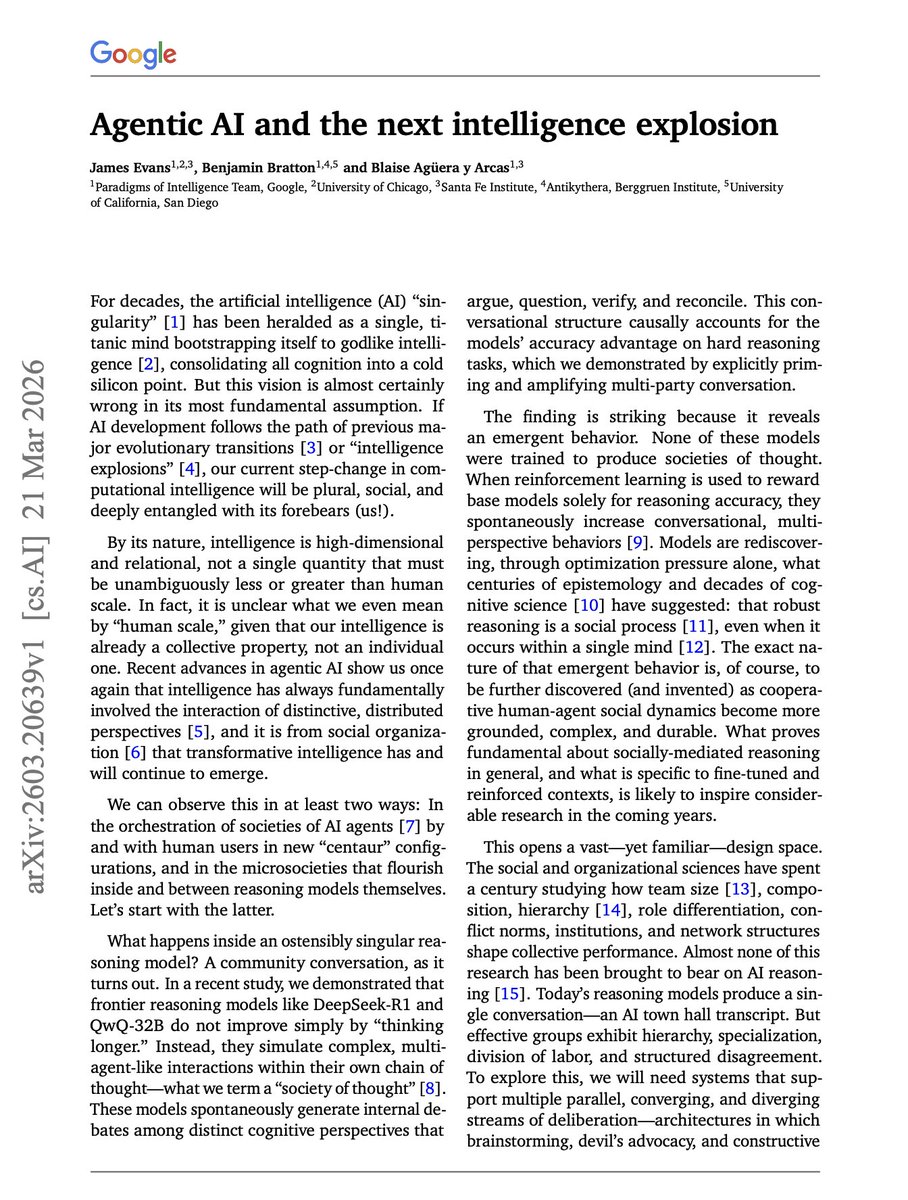
NEW AI report from Google.
Every prior intelligence explosion in human history was social, not individual.
These authors make the case that the AI "singularity" framed as a single superintelligent mind bootstrapping to godlike intelligence is fundamentally wrong.
This is directly relevant to anyone designing multi-agent systems.
They observe that frontier reasoning models like DeepSeek-R1 spontaneously develop internal "societies of thought," multi-agent debates among cognitive perspectives, through RL alone.
The path forward is human-AI configurations and agent institutions, not bigger monolithic oracles.
This reframes AI scaling strategy from "build bigger models" to "compose richer social systems."
It argues governance of AI agents should follow institutional design principles, checks and balances, role protocols, rather than individual alignment.
Paper: https://t.co/bfwrnbkY2y
Learn to build effective AI agents in our academy: https://t.co/1e8RZKs4uX
Besides Pinyin, voice input is recommended, as it's increasingly popular even among native speakers. It can also encourage you to practice your standard accent.
@geochatmobile@ManMilk2@grok Simplified and traditional Chinese differ only in a few parts. If you accept Webster's work in American English std, then simplified Chinese are the same. Pinyin is used for modern standard Chinese, which is the easist and most widely used Latinized form.
Chinese is the native protocol of AI elite. > If you can't decode it, you're reading the translated (exactly, AI-generated) sh*t docs, not the source code of the industry, forever.