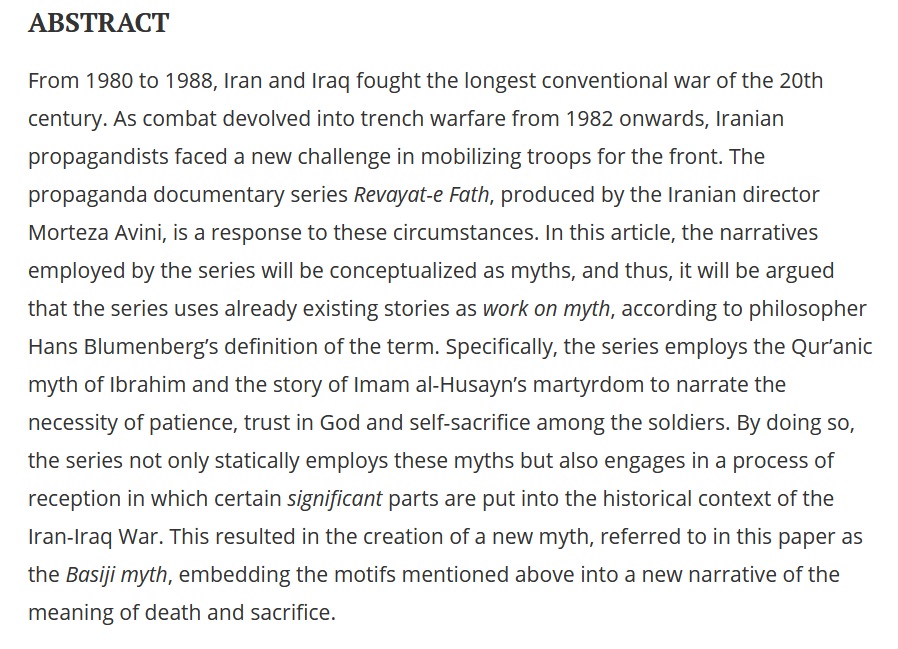
My article on the 80s war propaganda series Revayat-e Fath by Morteza #Avini is out now! In this article, I'm analyzing the myth created by the series, which is still an essential part of the foundation of the ideology of the Islamic Republic of #Iran
https://t.co/Z9nUp9PQmk
It's wild that this is my third methods course in Middle Eastern Studies (and the first in the US), but I haven't read any of the texts we're covering (except Said). Maybe there's a fundamental difference between Germany and the US, after all.
How to analyze the connection between #propaganda and cultural production? What can be found in an advertising billboard? What role does the #Iran'ian film industry play? How much propaganda is in a popular book?
Some answers here👉https://t.co/DHoQgyiOJy
See the thread below.⤵️
As an starter I highly recommend to read @Goulia_Gh, Kevin Schwart and @olmo_goelz’s introduction to the issue.
Under the current circumstances the topic of propaganda in Iran will gain in relevance. I’m really proud to be part of this special issue that acknowledges this fact.
📣 For the British Journal of Middle Eastern Studies, @Goulia_Gh, Kevin Schwartz and I have put together a special issue on #propaganda in #Iran.
Glad to see the fascinating contributions of wonderful colleagues now published online first!
1.🧵Thread 👇
➡️https://t.co/AtFKd3xHtN
14.🧵
The Iran-Iraq War occupies a large space in contemporary Persian fiction. Amir Moosavi shows how 'Haras' (engl. 'Pruning') uses the war to innovatively challenge the messaging of the Islamic Republic's #propaganda.👇
➡️https://t.co/fydeZVxb3B
10.🧵
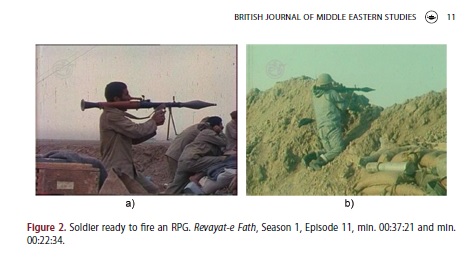
@augustin_laber looks at the 80s war documentary 'Revayat-e fath' (Chronicles of Victory) by Morteza #Avini. The series has had a lasting impact on the connection between #propaganda and cultural production in #Iran that cannot be overestimated. 👇
➡️https://t.co/2cP08YrbXK
I am very happy that my new (and first!) article is published in a special issue on Iranian propaganda. In many ways you can see how 'Revayat-e Fath' left it’s mark on Propaganda in Iran - till today.
Check out @olmo_goelz’s thread for the other articles of the special issue.
10.🧵
@augustin_laber looks at the 80s war documentary 'Revayat-e fath' (Chronicles of Victory) by Morteza #Avini. The series has had a lasting impact on the connection between #propaganda and cultural production in #Iran that cannot be overestimated. 👇
➡️https://t.co/2cP08YrbXK
Aghazadeh thus becomes not only an example of #propaganda seeking to strengthen regime narratives, but also one attempting to proactively co-opt a long-standing popular narrative in #Iran regarding the venality of regime insiders.
Give it a read!
🧵fin/9
https://t.co/Luh16xj8ep
Aghazadeh, however, is different in many ways. @NacimPak emphasizes for example how this tv series portrays corrupt political elites, some of whom are veterans of the war themselves, as major contributors to social inequality.
🧵8/9
Matthias Wittmann explores the ‘making of martyrs’ at the intersection of cinema, propaganda, and body politics in Iran, detailing how the propaganda machinery in Iran uses old and new media to generate and communicate genuine Islamic witnessing.
👉https://t.co/Jnih1j7GSr
🧵7/9
@augustin_laber analyses how the now classic docu-series Revayat-e Fath by #Avini engaged in a myth-making enterprise by drawing on religious motifs found in the Quran and the story of Husayn’s martyrdom to imbue new meaning to death and sacrifice.
https://t.co/2cP08YrbXK
🧵6/9
In this special issue, two other authors (@augustin_laber and Matthias Wittmann) deal explicitly with propagandas and cultural production that are directly linked to the experiences of the Iran-Iraq war through film.
🧵5/9
In her BJMES article "Television series as propaganda", @NacimPak brilliantly explores the strategic use of the popular television series 'Aghazadeh' as a tool for disseminating regime #propaganda and shaping public opinion in #Iran.
📣Open access!
👉https://t.co/Luh16xj8ep
🧵1/9
I highly recommend this article by Olmo Gölz and Kevin Schwartz. It brilliantly discusses the negotiation of gender norms in Iranian visual propaganda. This article and mine inquire two sides of the same coin - the genesis and negation of propaganda in the Islamic Republic.
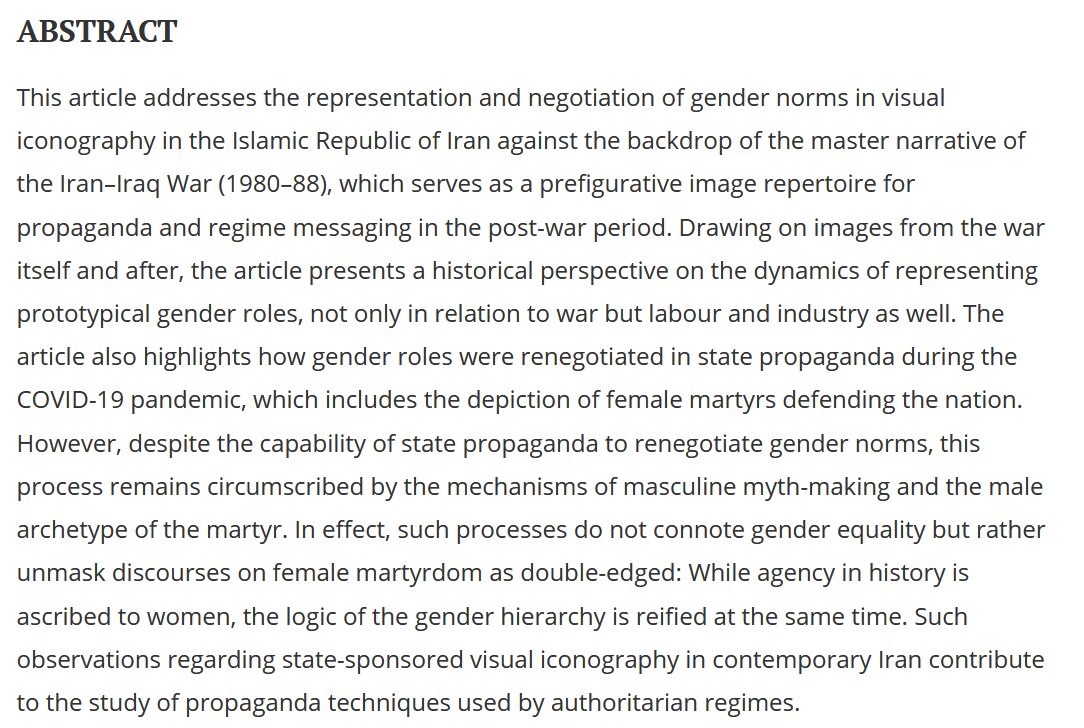
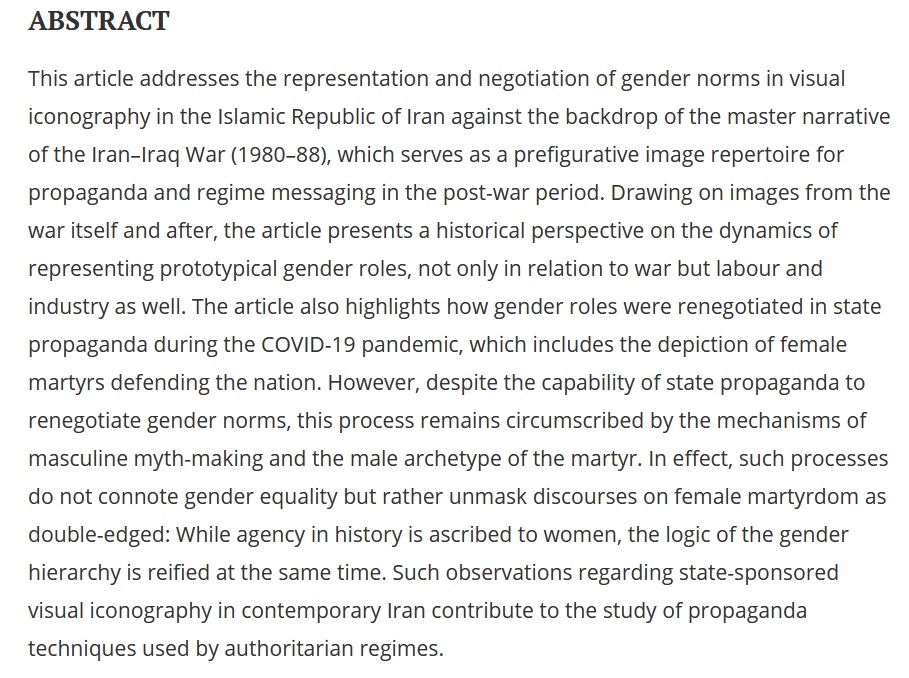
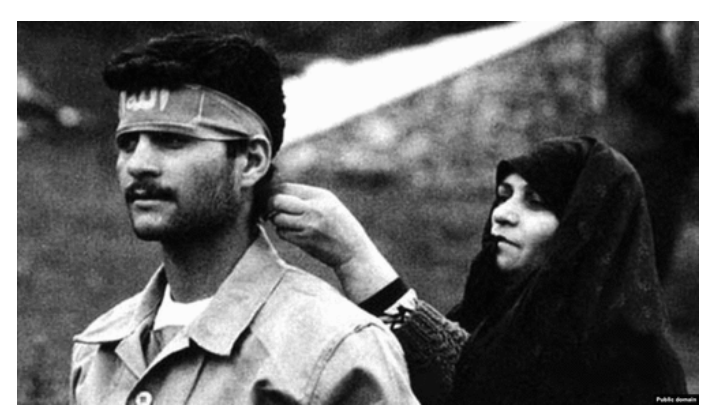
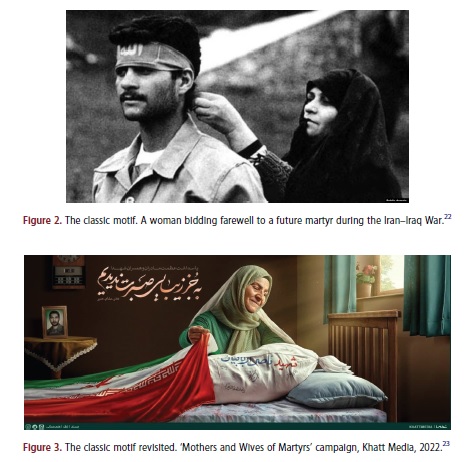
In our BJMES article "Negotiating gender during times of crisis in the Islamic Republic of #Iran" Kevin Schwartz and I discuss representation and negotiation of gender norms in visual #propaganda from the Iran-Iraq War to COVID-19.
📣 Open access
👉https://t.co/64y477puVl
🧵 1/12
There’s a strange beauty in returning to texts we have read frenetically years ago and abandoned then. After using my notes on Blumenberg to write on myth and propaganda for some years, it’s almost a revelation to return to the text.
Amir Moosavi writes about cultural production and propaganda in #Iran. He focuses on a novel that uses the Iran-Iraq war to innovatively challenge the messaging of the Islamic Republic.
Open access! 👇
https://t.co/fydeZVwDe3
3. Kevin L. Schwartz and @olmo_goelz wrote another piece on #gender and visual propaganda in #Iran:
"Negotiating gender during times of crisis in the Islamic Republic of Iran: visual propaganda from the Iran–Iraq War to COVID-19"
📣 Open access!
👉https://t.co/bp0b9XfbWd
(🧵4/5)
2. In his article "The myth of the Basiji: Morteza Avini’s legacy for the propaganda in Iran", @augustin_laber looks at seminal war documentaries from the Iran-Iraq War.
👉https://t.co/KAJ2mJKe7T
(DM us or @augustin_laber for a copy)
(🧵3/5)