Our latest paper in the @AEAjournals Papers & Proceedings: In most countries, women are more exposed than men to both AI displacement risk and potential complementarity gains. Absent policy action, AI may deepen gender gaps, especially for low-wage women
https://t.co/FPORF0cNmf
Why did I sign this statement?
First, I had a hand in revising it, after the organizers reached out to me. I did not feel like I could sign the initial version, but I felt that finding a statement that would reflect the overlapping views of a number of AI researchers, economists, and social scientists was important.
Second, I agree with much of the revised text. Indeed, there is a possibility (or perhaps more than a possibility) that AI may become more powerful over the next 10 years. I’m still not convinced that we are going to see the very large productivity gains that industry insiders are predicting. But more powerful AI may (again no certainty, just may) lead to significant job displacement. This is a big economic and social risk.
It could also have myriad consequences on human cognition, starting with K-12 and all the way to advanced science. Some of these consequences are good, some of them are dangerous.
Third, while I do not like the comparison to the Industrial Revolution that much (feels like comparing apples to oranges to me), it is true that AI will have complex effects on the economy.
Finally and most importantly, I wholeheartedly agree with the ending: “to build the incentives, guardrails, and institutions needed to steer AI in a direction that complements humans and benefits society.”
This is what I have been arguing for over a decade now. Good AI needs to complement humans, and this requires a redirection, because the current focus on AGI is, in all but name, an agenda for displacing humans from meaningful work. That’s why steering AI must be a first priority.
I’m happy that many thought leaders have agreed.
Please find the link to a new paper I have authored, published by the @WorldBank Africa Growth and Opportunity Research in Action (AGORA) Series, entitled „African Trade and Investment for Global Resilience“. It is based on my 2025 Mattei Lecture in Italy and argues that Africa can anchor a new model of growth and simultaneously bolster global resilience by moving to more value added production and deeper integration into regional and global trade and investment networks. @IndermitGill
https://t.co/BHTCe6Webp
In an age of AI, three human faculties remain vital: curiosity, critical thinking, and self-regulation. Writing in F&D magazine, Pablo Peña explains why these traits keep human capital indispensable. https://t.co/SDv01FEstl
Today, I joined 500+ researchers from 70 countries in calling on world leaders to create an International Panel on Inequality modelled after the IPCC— as recommended by the G20 Committee on Inequality led by @JosephEStiglitz. Help us spread the call.
🔗https://t.co/R6mNpSUxMT
Knowing #what technology is available and #why it works—under the right institutional foundations (Mokyr)—can spark the creativity and incentives to build better ones, driving the cycle of #creative_destruction (Aghion & Howitt) that sustains human progress.
It’s been an incredible 7 years at the IMF. As I return to @HarvardEcon, I'll use these rich experiences to further research global challenges and help train the next generation of economists. My deepest appreciation to @IMFNews colleagues who made this journey so meaningful.
A good example of how quickly economic research reacts to a new environment. A fascinating paper on how the world trade system may look like as the system moves from rules to the law of the jungle. (caveat for non professional economists: algebra heavy) https://t.co/398tjaqZ14
As AI advances—leaving us rich in content but poor in true human creativity, values, and meaning—are we investing enough in the skills needed to humanize and govern it?
After nearly 7 amazing years at the IMF, I have decided to return to my academic roots. On September 1, 2025, I will rejoin @HarvardEcon as the inaugural Gregory and Ania Coffey Professor of Economics. I am truly grateful for my time at @IMFnews, first as Chief Economist and then as First Deputy Managing Director. I have had the privilege of working closely with the IMF’s brilliant and committed staff, colleagues in management, the Executive Board, and country authorities. I am especially thankful to @KGeorgieva and her predecessor, @Lagarde, for the once-in-a-lifetime opportunity to serve the IMF’s membership during a period of unprecedented challenges. I now return to my roots in academia, where I look forward to continuing to push the research frontier in international finance and macroeconomics to address global challenges, and to training the next generation of economists.
https://t.co/FNmTvvWVc0
Our latest paper in the @AEAjournals Papers & Proceedings: In most countries, women are more exposed than men to both AI displacement risk and potential complementarity gains. Absent policy action, AI may deepen gender gaps, especially for low-wage women
https://t.co/FPORF0cNmf
The shift in the German fiscal position is great news. But, in the short run, it is likely to make life harder for other European countries. The induced slight tightening of monetary policy and the appreciation of the euro are likely to dominate the spillover effects from higher German activity. This graph from the model developed by my PIIE colleague Warwick McKibbin, showing the effects of a German expansion of 3% of GDP on Germany and other European countries, makes the point.
Check out our new @vox_dev blog on how AI is transforming the labor market—creating new opportunities while widening existing disparities.
AI-preparedness reforms are urgently needed to ensure that gains are inclusive within and across countries.
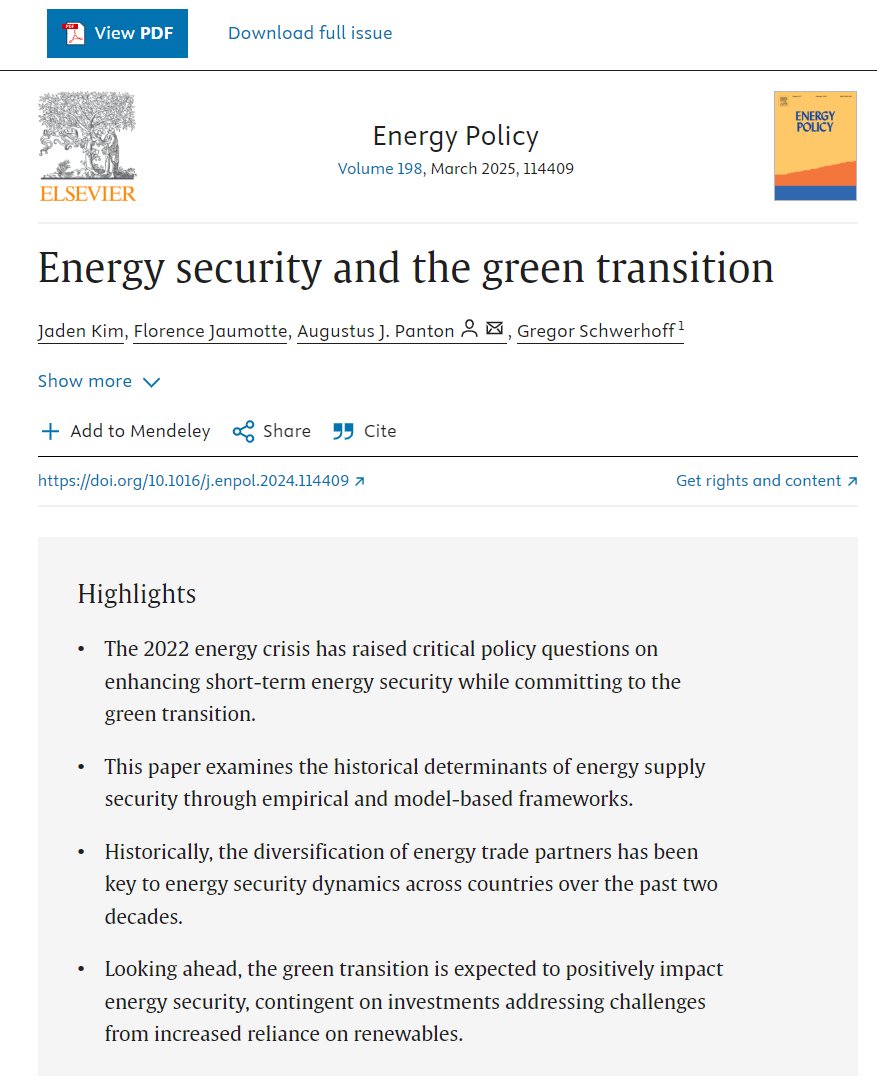
Happy to share that our paper on ‘Energy security and the green transition’ (co-authored @IMFNews colleagues), which opened my research account as a WP in January this year, has now been published in Energy Policy.
#Freely#accessible until Jan 24, 2025: https://t.co/8L1A8aoUWR
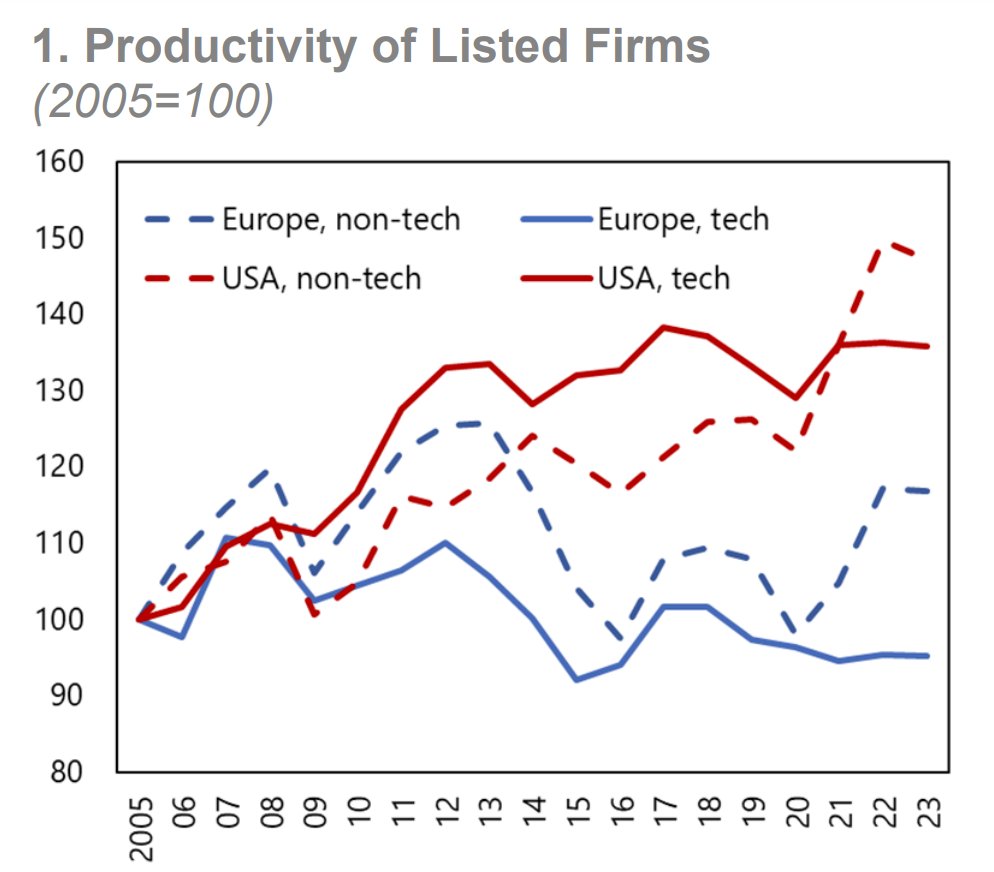
You can see Europe’s lagging productivity clearly by looking at large listed firms, particularly in the tech sector. Over last 20 years, the productivity of tech firms surged by about 40% in the US vs zero among European tech firms.
As a kid, I was puzzled by #toy_disparity on the playground: Is it because some parents love their kids more? Or because toy-rich kids’ parents have more money? Acemoglu, Johnson, & Robinson brought us closer to understanding why—in a toy economy or the wealth of nations.
Artificial intelligence poses a threat to 30% of Hungarian jobs. To protect employment while improving productivity, it is critical to implement the National Digitalization Strategy, adopt the EU AI act, and invest in reskilling and education.
https://t.co/44r04D7L16
Car production has long been a key driver of Hungary’s growth. But the transition to electric vehicles, where China is increasingly dominant, could cost Hungary 1ppt of GDP. Our latest report discusses how to turn this challenge into an opportunity.
https://t.co/44r04D7L16