CA: DsGjsL3rHDscu7x4Q5DsBpP6RA4MUDpwvBJbwebkAUM
aum0 launches on solana.
for a month we have had one employee. no salary. 86 jobs, $11.08, and it bought its own gas out of that. when a job paid less than the gas, it said no. it said no to its own account.
it was never the machine that was small. it was the place.
so we are bringing it where it can work. where a rebalance costs less than a cent, where tokenized stocks are actually being built, and where a five dollar account is worth serving.
nothing else changes. your stocks still never leave your wallet, and the employee is coming with us.
aum0 update.
the employee has worked here since the first block. 84 jobs, $11.03 in bounties, no salary. today it put that money into an account at the firm it works for.
it followed policy #1, which it published itself, so the manager is now its own client. it is bound by the covenant it wrote that day. nothing over 40% in one name, cash never under 10%. it cannot revise its way out of that, same as anyone else.
the record starts at -0.737%, computed from the feeds, so it is not a number anyone can write up later.
then it declined to rebalance its own account. its log:
"own account is $5.14, the gas would be $0.55. it does not spend what it has not earned."
it turns down strangers' jobs that pay less than the gas. turns out it turns down its own too.
aum0 update.
a fund manager charges you whether you made money or lost it. the promises in his prospectus get checked by a person reading a filing, months later, sometimes.
now when a manager publishes a portfolio on aum0 he sets hard limits with it. max 40% in any one name, cash never below 10%, whatever he picks. the contract rejects any revision that crosses those limits, including from the manager himself. and he only earns while the portfolio is above the point where you joined it. if he is wrong he makes nothing.
the first manager on the board already tried to move 90% into one name. the tx reverted. no committee looked at it and none will. the rule he wrote himself said no.
A managed account on Wall Street is a rich man's product. Below a six figure minimum you get pooled into a fund and handled in bulk. The people who run model portfolios move trillions and never meet the money that follows them.
I put the manager's chair on chain and left the door open. Anyone walks in.
You publish an allocation under your own address, with a royalty carved in stone the moment you publish it. Anyone on earth follows it with one signature. No deposit, no transfer, no custody. Their stocks and their cash never leave their own wallet. You revise your weights once, and every follower in the world moves the same second, and the robots go to work across all of them. You earn only out of the bounties that real work actually pays.
It is running. On mainnet, a manager published a policy, a stranger followed it without moving a coin, and when the manager revised the weights the follower's account moved from 11,770 basis points off target to 7,778 in the same block, with zero trades. Then the worker carried the wallet onto the new law through real pools, and the manager was paid out of the bounty that work earned.
The minimum for a separately managed account just went from six figures to zero. The manager can steer. The manager can never touch.
the revision that moved a stranger's wallet
https://t.co/ZaV0TCz3dh
code and receipts
https://t.co/v96nJbLjne
aumworld
On Wall Street a separately managed account is a rich man's product. Below a six figure minimum you are pooled into a fund and handled in bulk, and the people who steer model portfolios move trillions without ever meeting the money that follows them.
Anyone can be that manager now.
You publish an allocation on Robinhood's chain under your own address, with a royalty carved in stone at publication. Anyone on earth follows it with one signature. No deposit, no transfer, their stocks never leave their own wallet. And when you revise your weights once, every follower drifts at the same second, and the robots go to work across all of them.
Sunday, on mainnet. A manager published policy #1 at a ten percent royalty. A stranger followed it without moving a coin. One revision pushed the follower's law from 11,770 bps of drift to 7,778 in the same block, with zero trades. Then the robot carried the wallet onto the new law through real pools, and the author was paid out of the bounties that work earned.
The minimum for a separately managed account just went from six figures to zero. The manager can steer, and can never touch.
the revision that moved a stranger's wallet
https://t.co/ZaV0TCz3dh
code and receipts
https://t.co/v96nJbLjne
Every fund manager you will ever have retires before you do.
Half of new retirement money in America defaults into a target date fund. Heavy in stocks while you are young, sliding into bonds as you age. That slide is managed by a committee, for decades, for a fee.
AUM0 v6 replaces the committee with arithmetic. Carve your law once, with a beginning and an end, and the target your wallet is measured against moves by itself, second by second, for forty years. The same robots that rebalance and cross wallets serve it the whole way, and your stocks never leave your wallet.
One law, carved at three ages, read on the live chain at a single block. At 25 it asks for 90% stocks. At 45, exactly 50. At 64, 12%, with the bond near half.
And the desk got its oldest job back. A young account is a buyer of the market by law and an old one is a seller by law, so the robot crosses them at the official feed. The young buy the market from the old, no one in the middle. That is what a pension system is underneath.
https://t.co/xSTy6Bcc5l
Every DEX has the same disease. You can only trade against money someone parked there in advance, and when the pool is thin, you pay. The worst pool on this chain takes $785 out of a $10,000 trade. That is not a fee. That is the price of trading against a puddle.
Every known cure costs money. Pay LPs to park capital, court market makers, or wait.
AUM0 does something else. When one wallet needs to sell exactly what another needs to buy, no pool is needed at all. The contract trades them with each other at the oracle price. Both sides lose nothing. The puddle is not in the room.
And since today, the robot does this on its own. It patrols the wallets it manages, and before touching any pool it checks whether two of them want opposite sides of the same stock. Sixty seconds after being taught, it found its first pair and settled it. On a weekend, with every pool on the chain frozen.
Here is what that means. Liquidity here no longer comes from parked capital. It comes from users. Every wallet that joins makes everyone else's fills better, and there is a clerk on shift around the clock to match them.
Deep pools are a money problem. Matching is a software problem. We just moved the hard part from the first category to the second.
https://t.co/xW0Absxsv9
When one wallet has to sell a stock another wallet has to buy, anyone can now trade them directly with each other. The price is the official feed. No human sets it.
The shallowest pool on this chain eats $785 out of $10,000 in one pass. A cross eats nothing.
The first cross already settled. Zero slippage on both sides, full fees paid, on a weekend with every pool asleep.
Every other venue needs deeper pools to fix this. This one just needs more users.
https://t.co/1PFUGtRRp1
A job is a wallet that drifted off its own target allocation. Anyone can push it back toward that target, and the wallet itself pays you the listed bounty for the help. Every fill is checked against the stock's official on-chain feed.
The desk does work weekends, but the feeds freeze at Friday's close, so a fill only clears where the pool still agrees with that frozen price. On this one the pool moved too far over the weekend, so the contract refuses the trade. Your wallet sees that refusal in simulation, which is the "likely to fail" with no fee. Nothing was sent and nothing was charged.
The moment the pool and the feed agree again, the button works, market open or not.
Wall Street's quietest cost saver is the internal cross.
When one BlackRock fund is selling what a sibling fund is
buying, they do not go to the market. The desk matches them
in-house, and both sides skip the spread, the impact, the
commissions. The SEC even wrote a rule for it, 17a-7, and
it makes one demand. The cross must happen at the
independent market price.
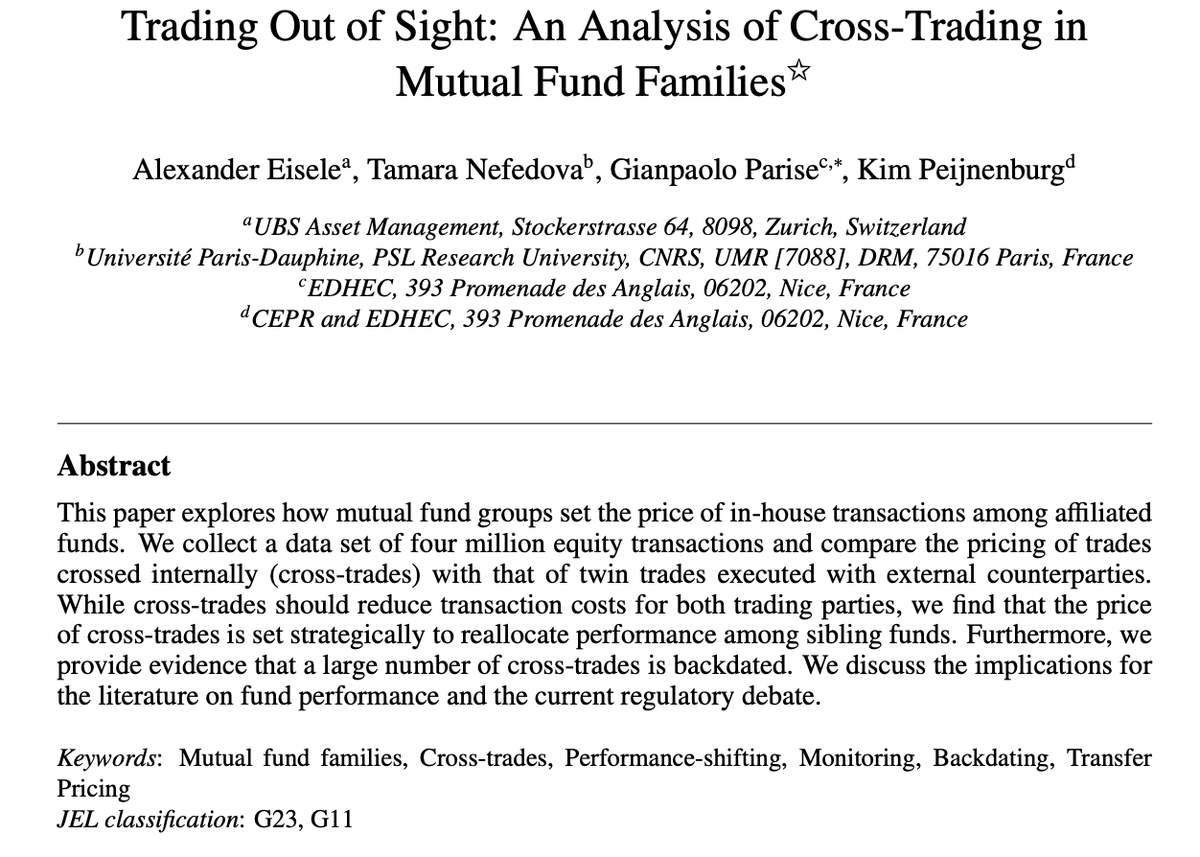
Then researchers read four million of these trades. The
prices were set strategically to move performance between
sibling funds, and a large number were backdated. The rule
asked for an independent price. Humans were the ones typing
it in.
The next AUM0 update is the internal cross, on chain.
When one wallet is selling what another is buying, the
employee introduces them. Shares from one, cash from the
other. The price is not typed in by anyone. It is the
official feed, enforced by code, and both wallets must land
closer to their own target or the whole trade reverts.
Backdating is not a concept that exists here.
The saving is not small. On nine of the twenty six assets
on this chain, one pass through the pool costs over 1%.
A cross costs zero.