"Abisi onu iyileştirecek." Bu cümleyi spoi kabul ediyorum bunun aksi bir senaryo görmek istemiyorum. Bi kere de aşk iyileştirir klişesine girmesin bi dizi
подслушала разговор мамы с маленькой дочкой
— я обещала простить если он извинится передо мной и другом
— извинился?
— да но у него были серьезные причины
— скоро ты вырастешь и поймешь что у человека который тебя оскорбляет и унижает всегда будут причины и прощать его не нужно
I know this is pointless right now because this only matters if ADOR can actually prove that Danielle breached her exclusive contract.
That said, this is about ADOR filing a lawsuit against Danielle seeking ₩33.1 billion in penalties and damages. So let’s be clear about what those terms mean.
First, liquidated damages must be reasonable. They can’t operate as punishment, and they have to reflect actual, provable losses.
Penalty clauses, on the other hand, especially in K-pop contracts, are typically designed to deter exit. In plain terms, that’s why they contain absurdly large numbers: not to compensate losses, but to scare artists into staying.
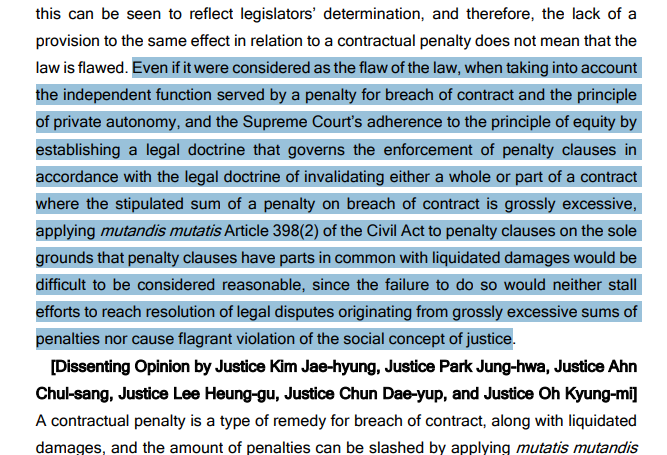
Under Supreme Court precedent (see: https://t.co/eUfNLKfs4r), courts cannot simply “adjust” or reduce the amount of a contractual penalty. However, if a penalty clause violates principles of fairness or public order, the court can invalidate the clause entirely under a mutatis mutandis application of Article 398(2) of the Civil Act.
The Supreme Court was explicit on this point:
“If a penalty clause is grossly unfair, coercive, or contrary to public order, the court should invalidate it, not enforce it.”
Applying that standard here, a 30 billion KRW contractual penalty against Danielle is nowhere near fair or proportional. It functions as coercion, not compensation, and that is exactly the kind of clause the Court said should not survive judicial scrutiny.
[1] Examination of HYBE RSU Cost Transfer to ADOR and Internal Transactions with HYBE IM
An analysis of ADOR’s 2024 financial data reveals that internal transactions with HYBE IM and RSU (Restricted Stock Unit) compensation from HYBE HQ were accounted for as expenses by ADOR. This resulted in a systematic reduction of the artist settlement payments due to internal cost structures.
[2] ADOR 2024 Performance
- Revenue increased by 0.8% (KRW 110.28B → KRW 111.18B)
- Operating profit decreased by KRW 2.66B (KRW 33.51B → KRW 30.85B)
- NewJeans’ settlement payment dropped from KRW 26.1B → KRW 20.3B (a decrease of KRW 5.8B)
Both operating profit and artist settlements decreased.
→ Why?
➡️ Primary Cause: SG&A (Selling, General & Administrative) expenses increased by KRW 3.2B
• 2023: ~KRW 12.8B
• 2024: ~KRW 16.0B
[3] Breakdown of SG&A Surge
📊 Changes from 2023 → 2024:
- Commission fees: ↑ KRW 660M
- RSU (stock compensation): ↑ KRW 1.68B (total: KRW 2.89B)
- Entertainment expenses, taxes, and salaries also increased
※ Only R&D expenses decreased
→ Signals a shift in company spending from artists → to internal executives
[4] The Core of the RSU Cost Surge
- Although compensation was made in HYBE stock, ADOR bore the cost
- Only ~3,000 shares were realized:
• Kim Joo-young: 2,141 shares
• Lee Kyung-joon: 432 shares (approx. 7,500 stock options remaining and may be converted)
• Lee Do-kyung: 573, Kim Hak-ja: 91, etc.
- Despite being mostly HYBE HQ personnel, ADOR carried these costs
① HYBE staff transferred to ADOR and passed on their RSUs
② Upon condition changes, RSUs were shifted to ADOR
③ Though it appears HYBE paid, ADOR recognized the full cost
→ “Executives are rewarded, company profits decline, and artist settlements vanish.”
(Disclosure Note)
The stock options granted while employed at HYBE HQ were recognized as expenses by ADOR upon their transfer. The stated batch refers to the original HYBE grant cycle.
[5] ADOR’s “Other Capital” Surges 2.9x
- Other Capital: KRW 1.74B → KRW 4.63B
- RSU Cost: KRW 1.2B → KRW 2.89B
※ No actual cash outflow, but part of ADOR’s assets converted into executive-held shares
→ Creates an illusion of financial soundness
→ RSUs with voting rights become tools to consolidate control
[6] ➡️ Secondary Cause: KRW 5.54B Internal Transaction with HYBE IM
In 2024, ADOR → HYBE IM:
- Cash paid: KRW 2.87B
- Outstanding payable: KRW 2.67B
→ Total: KRW 5.54B
- HYBE IM took 40% of the revenue
- No trace of these in SG&A
→ Likely processed as COGS (Cost of Goods Sold)
→ Impossible to verify externally
[7] Are These Practices Properly Disclosed and Justifiable Under Accounting Standards?
Disclosures and footnotes fail to adequately explain reclassification reasons or internal transaction structures.
[8] Conclusion
In 2024, ADOR cut artist settlement payments while transferring tens of billions of won to HYBE IM and HYBE HQ executives.
📉 Profits and artist pay decreased
📈 Executive compensation increased
This structure undermines ADOR’s independence and its artist-centric philosophy, representing a clear breakdown in trust.
Read:
HYBE IM’s 4 Billion Won Internal Transaction Dispute with ADOR
https://t.co/E17oX6Rrw1
“The pattern across 15 years of K-pop contract litigation reveals consistent judicial outcomes: courts enforce exclusive contracts unless agencies demonstrably breach material obligations. Artists who challenge contracts face significant legal barriers, financial exposure, and career disruption regardless of public sympathy.
The cases span multiple jurisdictions and legal frameworks, from Korean courts applying Fair Trade Commission regulations to California courts adjudicating child labor laws, but similar patterns emerge. Settlements frequently result in continued contractual obligations with modified terms rather than complete separation.
When artists lose preliminary injunctions, agencies often terminate contracts on their own terms rather than artists achieving voluntary departure, as demonstrated in the FIFTY FIFTY, NewJeans and VCHA cases.
Financial disputes over accounting transparency and production costs, seen in both the Daisy/MOMOLAND and VCHA cases, highlight ongoing industry practices regarding trainee debt and cost allocation. While Daisy won her wage dispute in Korean courts, the victory came after years of litigation and effective career suspension.
Danielle’s situation follows this established pattern. Whether her case proceeds to trial or settles, the outcome will likely reinforce existing precedent: Exclusive contracts in Korea’s entertainment industry remain legally enforceable even when the relationship between artist and agency has seemingly deteriorated beyond repair.”
- Forbes
🇬🇧 UK BUNNIES: Want a legal way to help Danielle that buries HYBE’s legal team in mountains of paperwork?
If you use Weverse, send them with GDPR requests. It forces them to waste manpower responding to us instead of fighting Dani, or they face massive fines.
Plus, we can force them to go on record about TAG PR.
Here is the template ⬇️ 🧵
An Open Letter to the International Media, Human Rights Organizations, and All Who Can Help
To journalists, editors, human rights advocates, cultural institutions, and members of the global public,
We write to you out of urgency and alarm regarding the ongoing situation facing the K-pop group NewJeans, and the conditions under which these young artists are being pressured, silenced, and legally cornered by HYBE and its subsidiary ADOR.
This is not a fan dispute. This is not entertainment gossip. This is a case that raises serious questions about human rights, freedom of expression, retaliation, abuse of power, and structural injustice within one of the world’s most influential cultural industries.
A Dangerous Power Imbalance
HYBE is not merely an entertainment company. It is a conglomerate with immense economic, cultural, and institutional power. It controls multiple labels, dominates distribution channels, owns or influences major fan platforms, and maintains deep relationships with advertisers, broadcasters, and media outlets. This concentration of power enables narrative control, discourages critical coverage, and blurs the line between reporting and corporate messaging.
NewJeans, by contrast, are five young women, some of whom entered contracts as minors, with no comparable access to capital, media platforms, or legal insulation.
When conflict arises between a global conglomerate and individual artists, the imbalance is not theoretical... it is decisive.
An Industry Built on Gray Zones of Human Rights
The situation surrounding NewJeans cannot be understood in isolation. It exists within a K-pop industry whose entrenched practices operate in the gray zones of human rights, allowing abuse of power to persist while remaining technically legal.
For decades, the industry has normalized:
- Long-term exclusive contracts signed by minors, often without meaningful bargaining power
- Severe restrictions on autonomy, speech, movement, and personal relationships
- Retaliation against dissent, framed as “discipline” or “contractual enforcement”
- Psychological pressure, including public shaming, isolation, and financial intimidation
- Lack of meaningful protection mechanisms for young artists, creatives, trainees, and aspirants
Because these practices are institutionalized and culturally tolerated, companies are able to claim legality while evading accountability. What should raise human rights alarms is routinely dismissed as “industry custom.”
This environment has allowed powerful agencies to get away with mistreatment, coercion, and exploitation, while artists, especially young women, are expected to endure harm silently in exchange for opportunity.
NewJeans’ case exposes what happens when artists refuse to conform to this silence.
Legal Victory Followed by Retaliation
One of the most disturbing aspects of this case is what occurred after HYBE and ADOR obtained a favorable ruling in court.
ADOR pleaded with the court to uphold the validity of the exclusive contracts, insisting that the members must return and continue activities under the agency. The court ruled in ADOR’s favor. The artists complied.
Yet shortly thereafter, ADOR unilaterally terminated Danielle’s contract and proceeded to file a damages lawsuit seeking approximately 43 billion KRW against Danielle and her mother.
This sequence cannot be understood as normal contract enforcement.
It constitutes retaliation.
Winning in court did not lead to reconciliation, protection, or stability. Instead, it was followed by punishment... financially catastrophic, emotionally destabilizing, and directed not only at an artist, but at her family.
The message to all artists is chilling:
Even compliance does not guarantee safety.
Media Capture and Narrative Control
Since the dispute began, Korean media coverage has followed a troubling pattern:
- Selective amplification of corporate claims
- Speculative reporting sourced from controversial figures and recycled as “analysis”
- Infantilization of the artists, portraying them as naïve or manipulated
- Silence or minimization regarding retaliation, coercion, and psychological harm
This is not coincidental. It reflects a media ecosystem structurally dependent on entertainment conglomerates for access, advertising, and survival. When corporate power and media incentives align, critical scrutiny collapses.
The Law as a Tool of Intimidation
Rather than functioning as a safeguard for vulnerable individuals, legal mechanisms in this case have operated as instruments of pressure.
Despite established legal principles recognizing that exclusive entertainment contracts rely on mutual trust and that forced continuation after trust collapses violates personal dignity, massive damages claims and retaliatory lawsuits have been deployed to suppress resistance.
When family members are sued, when financial ruin is threatened, and when speaking out invites escalation, the law ceases to be neutral. It becomes a warning.
Why This Matters Beyond NewJeans
This case is not an exception... it is a mirror.
It reveals how a powerful industry sustains itself by exploiting gray areas, cultural deference, and legal asymmetry. It shows how young artists are treated as replaceable assets rather than rights-bearing individuals, and how resistance is met not with dialogue, but with force.
If this can happen to one of the most visible groups in the world, it is happening, unchecked, to countless others without international attention.
A Call to the International Community
We call on the international media to investigate independently, without reliance on corporate-aligned narratives.
We urge human rights organizations, cultural labor advocates, and UN Special Rapporteurs to recognize this case as implicating:
- Freedom of artistic expression
- Protection from coercive and retaliatory labor practices
- The rights of young workers in industries defined by extreme power imbalance
And we ask the global public to move beyond fandom tribalism and ask the fundamental question:
What does justice look like when an entire industry is structured to protect power rather than people?
This letter is not a request for special treatment.
It is a demand for scrutiny, accountability, and protection.
When domestic systems fail those without power, international attention is not interference... it is responsibility.
NewJeans deserve to be seen not as assets, leverage, or cautionary examples, but as people.
And all people deserve rights.
it’s fascinating how much hate danielle has received because of armys. there’s a reason they shared a screenshot instead of the full video. y’all made people believe that danielle was blindly following mhj, when in fact, if you watch the entire video, she did the exact opposite
[English translation - Part 2]
https://t.co/bFzeXddtYI
Some people might ask whether it really makes sense
to damage an IP as valuable as NewJeans
just to split the group apart.
But if you think from HYBE’s perspective,
their actions do follow their own internal logic.
You might also wonder,
“Why do you see this situation in a hopeful way?”
Yesterday, I came across an article that said
a contract termination is only possible
when there has been conduct that fundamentally destroys
the relationship of trust.
The key point here is that
Danielle has already clearly expressed
her intention to return to the agency.
In group activities,
each member’s individuality is recognized,
but the core of the contract is the group itself.
Because of that,
if ADOR were to unilaterally exclude just one member,
it could constitute a breach of contract
with respect to the remaining members as well.
Moreover, if the remaining members demand
full-group activities,
ADOR could face a counterattack,
as they may be legally obligated
to comply with that demand.
For these reasons,
I believe there is a very high possibility
that Danielle does not fall under
any contract-violation scenario.
According to the December 31 broadcast of Kim Sung-soo TV, as explained by Sung-soo Kim,
a certified letter Danielle received from ADOR
listed one of the grounds for contract termination as follows:
Danielle’s parent had lost their phone,
and the question was raised as to
why that phone was replaced.
When you think about it,
it makes no sense that changing a phone
could be grounds for terminating a contract with an agency.
Why should an agency have control over,
or even access to,
a phone that contains the private lives
of an artist and their family?
And even before that,
if the phone hadn’t been changed,
what exactly were they planning to do with it?
After attending CEO Min Hee-jin’s trial in person,
what stood out to me was that
nearly all of the evidence presented by the plaintiff
consisted of her KakaoTalk messages.
A significant portion of those messages
were conversations that took place
even before ADOR was established in 2021.
As for the messages exchanged after that,
they were used by selectively cutting out context
and piecing together fragments
that were completely unrelated to the actual issues.
Of course, the final judgment is up to the judge,
and this is simply my personal impression
based on what I observed.
Because it is highly likely that
Danielle does not meet the criteria for contract violation,
I believe the other side is using this as a stalling tactic—
a strategic misstep meant to drag things out.
In the end,
I believe this fight will move in a direction
where NewJeans comes out on top.
What we can do is simple:
stream NewJeans’ albums
and support them loudly as fans.
I mentioned earlier that
I compiled 27 pages of court records
from attending the trial.
Going forward,
I plan to gradually share
the most important parts of those records.
If you follow me,
you’ll be able to hear stories
that are much closer to the truth.


![juantokki's tweet photo. [1] Examination of HYBE RSU Cost Transfer to ADOR and Internal Transactions with HYBE IM
An analysis of ADOR’s 2024 financial data reveals that internal transactions with HYBE IM and RSU (Restricted Stock Unit) compensation from HYBE HQ were accounted for as expenses by ADOR. This resulted in a systematic reduction of the artist settlement payments due to internal cost structures.
[2] ADOR 2024 Performance
- Revenue increased by 0.8% (KRW 110.28B → KRW 111.18B)
- Operating profit decreased by KRW 2.66B (KRW 33.51B → KRW 30.85B)
- NewJeans’ settlement payment dropped from KRW 26.1B → KRW 20.3B (a decrease of KRW 5.8B)
Both operating profit and artist settlements decreased.
→ Why?
➡️ Primary Cause: SG&A (Selling, General & Administrative) expenses increased by KRW 3.2B
• 2023: ~KRW 12.8B
• 2024: ~KRW 16.0B
[3] Breakdown of SG&A Surge
📊 Changes from 2023 → 2024:
- Commission fees: ↑ KRW 660M
- RSU (stock compensation): ↑ KRW 1.68B (total: KRW 2.89B)
- Entertainment expenses, taxes, and salaries also increased
※ Only R&D expenses decreased
→ Signals a shift in company spending from artists → to internal executives
[4] The Core of the RSU Cost Surge
- Although compensation was made in HYBE stock, ADOR bore the cost
- Only ~3,000 shares were realized:
• Kim Joo-young: 2,141 shares
• Lee Kyung-joon: 432 shares (approx. 7,500 stock options remaining and may be converted)
• Lee Do-kyung: 573, Kim Hak-ja: 91, etc.
- Despite being mostly HYBE HQ personnel, ADOR carried these costs
① HYBE staff transferred to ADOR and passed on their RSUs
② Upon condition changes, RSUs were shifted to ADOR
③ Though it appears HYBE paid, ADOR recognized the full cost
→ “Executives are rewarded, company profits decline, and artist settlements vanish.”
(Disclosure Note)
The stock options granted while employed at HYBE HQ were recognized as expenses by ADOR upon their transfer. The stated batch refers to the original HYBE grant cycle.
[5] ADOR’s “Other Capital” Surges 2.9x
- Other Capital: KRW 1.74B → KRW 4.63B
- RSU Cost: KRW 1.2B → KRW 2.89B
※ No actual cash outflow, but part of ADOR’s assets converted into executive-held shares
→ Creates an illusion of financial soundness
→ RSUs with voting rights become tools to consolidate control
[6] ➡️ Secondary Cause: KRW 5.54B Internal Transaction with HYBE IM
In 2024, ADOR → HYBE IM:
- Cash paid: KRW 2.87B
- Outstanding payable: KRW 2.67B
→ Total: KRW 5.54B
- HYBE IM took 40% of the revenue
- No trace of these in SG&A
→ Likely processed as COGS (Cost of Goods Sold)
→ Impossible to verify externally
[7] Are These Practices Properly Disclosed and Justifiable Under Accounting Standards?
Disclosures and footnotes fail to adequately explain reclassification reasons or internal transaction structures.
[8] Conclusion
In 2024, ADOR cut artist settlement payments while transferring tens of billions of won to HYBE IM and HYBE HQ executives.
📉 Profits and artist pay decreased
📈 Executive compensation increased
This structure undermines ADOR’s independence and its artist-centric philosophy, representing a clear breakdown in trust.
Read:
HYBE IM’s 4 Billion Won Internal Transaction Dispute with ADOR
https://t.co/E17oX6Rrw1](https://pbs.twimg.com/media/G9kwsKDbIAAGTW7.jpg)
![juantokki's tweet photo. [1] Examination of HYBE RSU Cost Transfer to ADOR and Internal Transactions with HYBE IM
An analysis of ADOR’s 2024 financial data reveals that internal transactions with HYBE IM and RSU (Restricted Stock Unit) compensation from HYBE HQ were accounted for as expenses by ADOR. This resulted in a systematic reduction of the artist settlement payments due to internal cost structures.
[2] ADOR 2024 Performance
- Revenue increased by 0.8% (KRW 110.28B → KRW 111.18B)
- Operating profit decreased by KRW 2.66B (KRW 33.51B → KRW 30.85B)
- NewJeans’ settlement payment dropped from KRW 26.1B → KRW 20.3B (a decrease of KRW 5.8B)
Both operating profit and artist settlements decreased.
→ Why?
➡️ Primary Cause: SG&A (Selling, General & Administrative) expenses increased by KRW 3.2B
• 2023: ~KRW 12.8B
• 2024: ~KRW 16.0B
[3] Breakdown of SG&A Surge
📊 Changes from 2023 → 2024:
- Commission fees: ↑ KRW 660M
- RSU (stock compensation): ↑ KRW 1.68B (total: KRW 2.89B)
- Entertainment expenses, taxes, and salaries also increased
※ Only R&D expenses decreased
→ Signals a shift in company spending from artists → to internal executives
[4] The Core of the RSU Cost Surge
- Although compensation was made in HYBE stock, ADOR bore the cost
- Only ~3,000 shares were realized:
• Kim Joo-young: 2,141 shares
• Lee Kyung-joon: 432 shares (approx. 7,500 stock options remaining and may be converted)
• Lee Do-kyung: 573, Kim Hak-ja: 91, etc.
- Despite being mostly HYBE HQ personnel, ADOR carried these costs
① HYBE staff transferred to ADOR and passed on their RSUs
② Upon condition changes, RSUs were shifted to ADOR
③ Though it appears HYBE paid, ADOR recognized the full cost
→ “Executives are rewarded, company profits decline, and artist settlements vanish.”
(Disclosure Note)
The stock options granted while employed at HYBE HQ were recognized as expenses by ADOR upon their transfer. The stated batch refers to the original HYBE grant cycle.
[5] ADOR’s “Other Capital” Surges 2.9x
- Other Capital: KRW 1.74B → KRW 4.63B
- RSU Cost: KRW 1.2B → KRW 2.89B
※ No actual cash outflow, but part of ADOR’s assets converted into executive-held shares
→ Creates an illusion of financial soundness
→ RSUs with voting rights become tools to consolidate control
[6] ➡️ Secondary Cause: KRW 5.54B Internal Transaction with HYBE IM
In 2024, ADOR → HYBE IM:
- Cash paid: KRW 2.87B
- Outstanding payable: KRW 2.67B
→ Total: KRW 5.54B
- HYBE IM took 40% of the revenue
- No trace of these in SG&A
→ Likely processed as COGS (Cost of Goods Sold)
→ Impossible to verify externally
[7] Are These Practices Properly Disclosed and Justifiable Under Accounting Standards?
Disclosures and footnotes fail to adequately explain reclassification reasons or internal transaction structures.
[8] Conclusion
In 2024, ADOR cut artist settlement payments while transferring tens of billions of won to HYBE IM and HYBE HQ executives.
📉 Profits and artist pay decreased
📈 Executive compensation increased
This structure undermines ADOR’s independence and its artist-centric philosophy, representing a clear breakdown in trust.
Read:
HYBE IM’s 4 Billion Won Internal Transaction Dispute with ADOR
https://t.co/E17oX6Rrw1](https://pbs.twimg.com/media/G9kwsJ9aoAATH2P.jpg)
![juantokki's tweet photo. [1] Examination of HYBE RSU Cost Transfer to ADOR and Internal Transactions with HYBE IM
An analysis of ADOR’s 2024 financial data reveals that internal transactions with HYBE IM and RSU (Restricted Stock Unit) compensation from HYBE HQ were accounted for as expenses by ADOR. This resulted in a systematic reduction of the artist settlement payments due to internal cost structures.
[2] ADOR 2024 Performance
- Revenue increased by 0.8% (KRW 110.28B → KRW 111.18B)
- Operating profit decreased by KRW 2.66B (KRW 33.51B → KRW 30.85B)
- NewJeans’ settlement payment dropped from KRW 26.1B → KRW 20.3B (a decrease of KRW 5.8B)
Both operating profit and artist settlements decreased.
→ Why?
➡️ Primary Cause: SG&A (Selling, General & Administrative) expenses increased by KRW 3.2B
• 2023: ~KRW 12.8B
• 2024: ~KRW 16.0B
[3] Breakdown of SG&A Surge
📊 Changes from 2023 → 2024:
- Commission fees: ↑ KRW 660M
- RSU (stock compensation): ↑ KRW 1.68B (total: KRW 2.89B)
- Entertainment expenses, taxes, and salaries also increased
※ Only R&D expenses decreased
→ Signals a shift in company spending from artists → to internal executives
[4] The Core of the RSU Cost Surge
- Although compensation was made in HYBE stock, ADOR bore the cost
- Only ~3,000 shares were realized:
• Kim Joo-young: 2,141 shares
• Lee Kyung-joon: 432 shares (approx. 7,500 stock options remaining and may be converted)
• Lee Do-kyung: 573, Kim Hak-ja: 91, etc.
- Despite being mostly HYBE HQ personnel, ADOR carried these costs
① HYBE staff transferred to ADOR and passed on their RSUs
② Upon condition changes, RSUs were shifted to ADOR
③ Though it appears HYBE paid, ADOR recognized the full cost
→ “Executives are rewarded, company profits decline, and artist settlements vanish.”
(Disclosure Note)
The stock options granted while employed at HYBE HQ were recognized as expenses by ADOR upon their transfer. The stated batch refers to the original HYBE grant cycle.
[5] ADOR’s “Other Capital” Surges 2.9x
- Other Capital: KRW 1.74B → KRW 4.63B
- RSU Cost: KRW 1.2B → KRW 2.89B
※ No actual cash outflow, but part of ADOR’s assets converted into executive-held shares
→ Creates an illusion of financial soundness
→ RSUs with voting rights become tools to consolidate control
[6] ➡️ Secondary Cause: KRW 5.54B Internal Transaction with HYBE IM
In 2024, ADOR → HYBE IM:
- Cash paid: KRW 2.87B
- Outstanding payable: KRW 2.67B
→ Total: KRW 5.54B
- HYBE IM took 40% of the revenue
- No trace of these in SG&A
→ Likely processed as COGS (Cost of Goods Sold)
→ Impossible to verify externally
[7] Are These Practices Properly Disclosed and Justifiable Under Accounting Standards?
Disclosures and footnotes fail to adequately explain reclassification reasons or internal transaction structures.
[8] Conclusion
In 2024, ADOR cut artist settlement payments while transferring tens of billions of won to HYBE IM and HYBE HQ executives.
📉 Profits and artist pay decreased
📈 Executive compensation increased
This structure undermines ADOR’s independence and its artist-centric philosophy, representing a clear breakdown in trust.
Read:
HYBE IM’s 4 Billion Won Internal Transaction Dispute with ADOR
https://t.co/E17oX6Rrw1](https://pbs.twimg.com/media/G9kwsJ6awAASgk2.jpg)




![juantokki's tweet photo. [1] Examination of HYBE RSU Cost Transfer to ADOR and Internal Transactions with HYBE IM
An analysis of ADOR’s 2024 financial data reveals that internal transactions with HYBE IM and RSU (Restricted Stock Unit) compensation from HYBE HQ were accounted for as expenses by ADOR. This resulted in a systematic reduction of the artist settlement payments due to internal cost structures.
[2] ADOR 2024 Performance
- Revenue increased by 0.8% (KRW 110.28B → KRW 111.18B)
- Operating profit decreased by KRW 2.66B (KRW 33.51B → KRW 30.85B)
- NewJeans’ settlement payment dropped from KRW 26.1B → KRW 20.3B (a decrease of KRW 5.8B)
Both operating profit and artist settlements decreased.
→ Why?
➡️ Primary Cause: SG&A (Selling, General & Administrative) expenses increased by KRW 3.2B
• 2023: ~KRW 12.8B
• 2024: ~KRW 16.0B
[3] Breakdown of SG&A Surge
📊 Changes from 2023 → 2024:
- Commission fees: ↑ KRW 660M
- RSU (stock compensation): ↑ KRW 1.68B (total: KRW 2.89B)
- Entertainment expenses, taxes, and salaries also increased
※ Only R&D expenses decreased
→ Signals a shift in company spending from artists → to internal executives
[4] The Core of the RSU Cost Surge
- Although compensation was made in HYBE stock, ADOR bore the cost
- Only ~3,000 shares were realized:
• Kim Joo-young: 2,141 shares
• Lee Kyung-joon: 432 shares (approx. 7,500 stock options remaining and may be converted)
• Lee Do-kyung: 573, Kim Hak-ja: 91, etc.
- Despite being mostly HYBE HQ personnel, ADOR carried these costs
① HYBE staff transferred to ADOR and passed on their RSUs
② Upon condition changes, RSUs were shifted to ADOR
③ Though it appears HYBE paid, ADOR recognized the full cost
→ “Executives are rewarded, company profits decline, and artist settlements vanish.”
(Disclosure Note)
The stock options granted while employed at HYBE HQ were recognized as expenses by ADOR upon their transfer. The stated batch refers to the original HYBE grant cycle.
[5] ADOR’s “Other Capital” Surges 2.9x
- Other Capital: KRW 1.74B → KRW 4.63B
- RSU Cost: KRW 1.2B → KRW 2.89B
※ No actual cash outflow, but part of ADOR’s assets converted into executive-held shares
→ Creates an illusion of financial soundness
→ RSUs with voting rights become tools to consolidate control
[6] ➡️ Secondary Cause: KRW 5.54B Internal Transaction with HYBE IM
In 2024, ADOR → HYBE IM:
- Cash paid: KRW 2.87B
- Outstanding payable: KRW 2.67B
→ Total: KRW 5.54B
- HYBE IM took 40% of the revenue
- No trace of these in SG&A
→ Likely processed as COGS (Cost of Goods Sold)
→ Impossible to verify externally
[7] Are These Practices Properly Disclosed and Justifiable Under Accounting Standards?
Disclosures and footnotes fail to adequately explain reclassification reasons or internal transaction structures.
[8] Conclusion
In 2024, ADOR cut artist settlement payments while transferring tens of billions of won to HYBE IM and HYBE HQ executives.
📉 Profits and artist pay decreased
📈 Executive compensation increased
This structure undermines ADOR’s independence and its artist-centric philosophy, representing a clear breakdown in trust.
Read:
HYBE IM’s 4 Billion Won Internal Transaction Dispute with ADOR
https://t.co/E17oX6Rrw1](https://pbs.twimg.com/media/G9kwsKEaMAAOA6m.jpg)





