I’ve spent 10 years teaching math to machine learning engineers.
80% of university math is irrelevant to your actual job.
Luckily, I've created a FREE roadmap to teach you the 20% you actually need.
Like, retweet, and comment "roadmap" and I'll DM you the link.
Some people today are discouraging others from learning programming on the grounds AI will automate it. This advice will be seen as some of the worst career advice ever given. I disagree with the Turing Award and Nobel prize winner who wrote, “It is far more likely that the programming occupation will become extinct [...] than that it will become all-powerful. More and more, computers will program themselves.” Statements discouraging people from learning to code are harmful!
In the 1960s, when programming moved from punchcards (where a programmer had to laboriously make holes in physical cards to write code character by character) to keyboards with terminals, programming became easier. And that made it a better time than before to begin programming. Yet it was in this era that Nobel laureate Herb Simon wrote the words quoted in the first paragraph. Today’s arguments not to learn to code continue to echo his comment.
As coding becomes easier, more people should code, not fewer!
Over the past few decades, as programming has moved from assembly language to higher-level languages like C, from desktop to cloud, from raw text editors to IDEs to AI assisted coding where sometimes one barely even looks at the generated code (which some coders recently started to call vibe coding), it is getting easier with each step.
I wrote previously that I see tech-savvy people coordinating AI tools to move toward being 10x professionals — individuals who have 10 times the impact of the average person in their field. I am increasingly convinced that the best way for many people to accomplish this is not to be just consumers of AI applications, but to learn enough coding to use AI-assisted coding tools effectively.
One question I’m asked most often is what someone should do who is worried about job displacement by AI. My answer is: Learn about AI and take control of it, because one of the most important skills in the future will be the ability to tell a computer exactly what you want, so it can do that for you. Coding (or getting AI to code for you) is a great way to do that.
When I was working on the course Generative AI for Everyone and needed to generate AI artwork for the background images, I worked with a collaborator who had studied art history and knew the language of art. He prompted Midjourney with terminology based on the historical style, palette, artist inspiration and so on — using the language of art — to get the result he wanted. I didn’t know this language, and my paltry attempts at prompting could not deliver as effective a result.
Similarly, scientists, analysts, marketers, recruiters, and people of a wide range of professions who understand the language of software through their knowledge of coding can tell an LLM or an AI-enabled IDE what they want much more precisely, and get much better results. As these tools are continuing to make coding easier, this is the best time yet to learn to code, to learn the language of software, and learn to make computers do exactly what you want them to do.
[Original text: https://t.co/HdI3Jb9HmF ]
I quit my job to become a full-time writer on Twitter.
Today, I make 350% more money than I ever did as a Machine Learning Engineer.
Think about that for a second!
I spent 20+ years working as an engineer and left everything behind to write and teach online.
Building an audience changed my life, and I want to share some of the principles that helped me get here.
I'm not successful because of my ideas but because my process helps me stay consistent and get the most out of them.
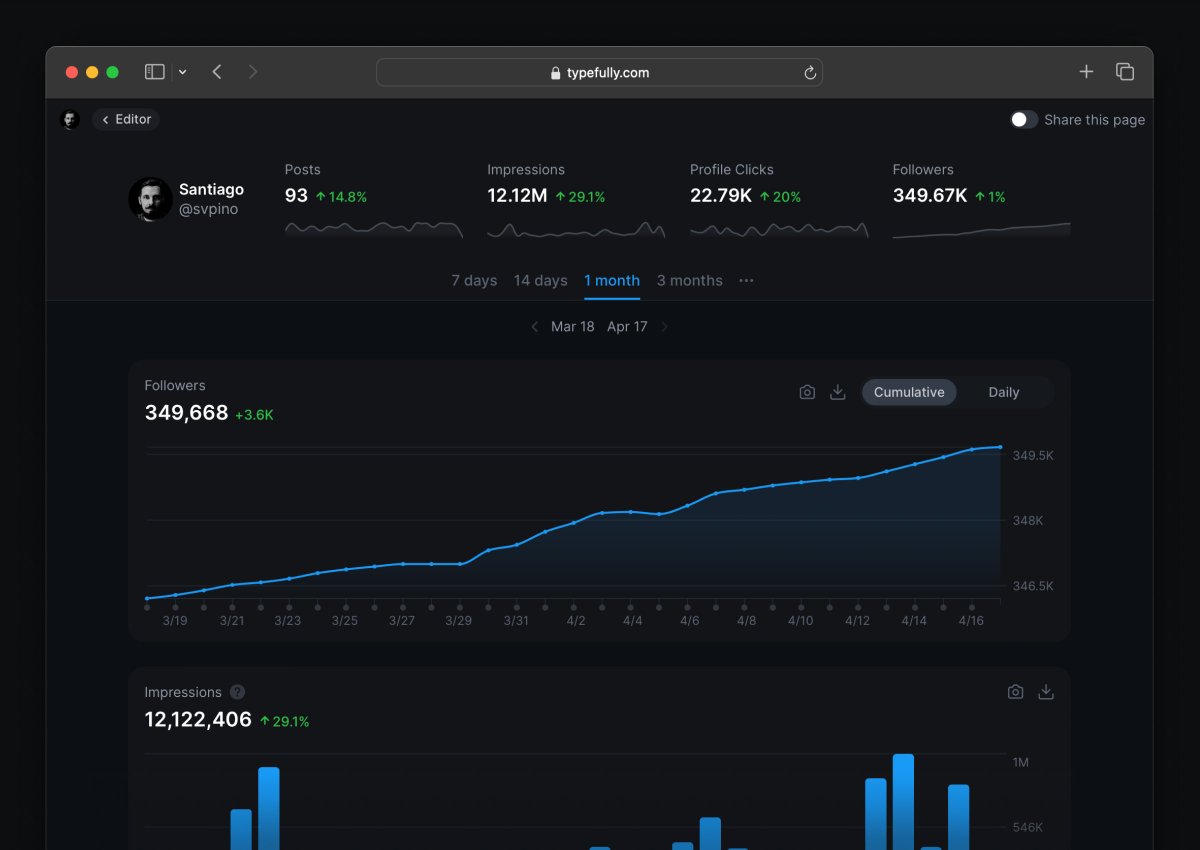
I use @typefully to write and schedule most of my content, as well as to cross-post on X and LinkedIn. I tried many scheduling tools but stopped looking when I found @typefully. Nothing else comes close.
(Read until the end. There's a massive opportunity for you.)
I write in short bursts. Whenever I'm inspired, I write as much as I can. You may think I always have something to say, but that's false.
I attribute most of my success to how much time I spend on my writing.
Here are the three most important secrets I have to share:
First, I spend 90% of my time writing the first two sentences of my posts. Nothing else matters if I can't hook you in half a second. The more I invest in how my story starts, the better it does.
Second, I never give you everything you want right up front. I withhold critical information you can only uncover by reading more. There will be an unexpected turn or a "something else" waiting for you.
Third, if removing a word doesn't break my sentence, I remove it. The simpler I write, the more my content spreads. Complex writing goes nowhere.
And, of course, AI helps!
@typefully built Vesper AI, their own specialized model focused on helping users write better content. I use it to solve the biggest challenge I always have:
How can I make my content punchier and shorter? That’s what AI is for!
I appreciate the folks at @typefully reaching out and suggesting I speak about this topic. While I have a material relationship with them and their product, I'd promote them any day, any time. They have built one of the best products I use every day.
The @typefully team will give my audience a 25% discount on their creator plan for a full year. Here is how you get it:
1. Reply to this post with the word "Typefully"
2. Retweet the post.
We'll DM you the offer code.
This is a great opportunity to start using the gold standard for writing content for X and LinkedIn: https://t.co/b2WOv97nd1.